The Totems of the Cowichan

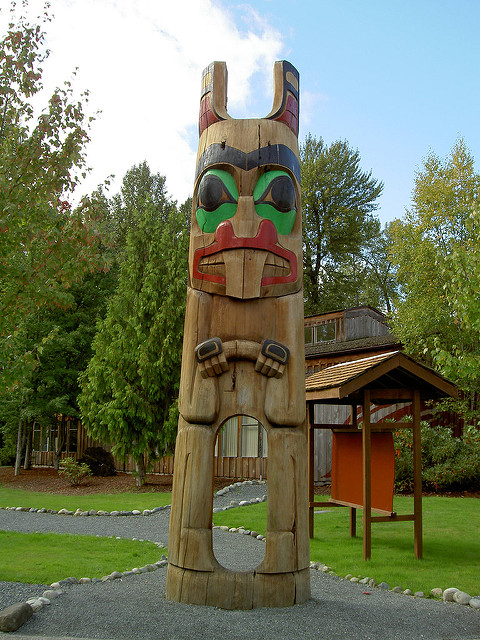
Totem Pole at Cowichan Center, Duncan B.C.

The first vacation I took with a digital camera was to Seattle, Victoria and Tofino (both on Vancouver Island), and the city of Vancouver. One of the highlights of that trip was a visit to Duncan on Victoria Island, roughly midway between Victoria and Nanaimo. The city bills itself as “The City of Totems,” mostly because of the large number of totem poles created by the Cowichan First Nation. At he time (2004), there was a very active visitor center with a restaurant containing Cowichan delicacies and even a program of native dancing.

On that particular vacation, I was traveling alone. Five years later, I repeated my itinerary from 2004. One of the biggest disappointments was the Cowichan visitor center in Duncan. Over a period of five years, neglect had set in. Many of the buildings, including the restaurant, were closed. It seems as if the center were re-positioning itself as a conference site for hire. I guess the economics of using the center as a tourist destination in 2009 were a bit prohibitive. I can only hope they make a comeback: On my first visit, I really liked the place.

Another Cowichan Totem Pole at Duncan

The German-American anthropologist Franz Boas was an expert on the early art of the tribes of the Northwest. His book Primitive Art (1927) attempts to explain how the totem poles functioned in the cultures of the various tribes. It’s a difficult read, but like many difficult reads, eminent worthwhile.
 

On the MV Lady Rose

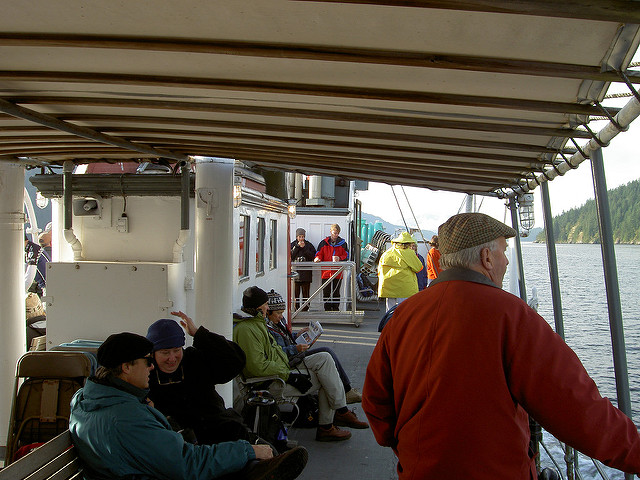
A Cruise on the MV Lady Rose in 2004

I am thinking back to a daylong cruise I took in 2004 between Port Alberni on Vancouver Island and Bamfield and back again. The little packet freighter we were on, the MV Lady Rose, is no longer in service, built was a fun ride. The Alberni inlet is a wild place, with dense forests, a few logging camps, lots of wildlife, and very few roads, if any. We saw bears along the edge of the inlet.

Vancouver Island in British Columbia is one of my favorite travel destinations, from Victoria to Nanaimo, Port Alberni, Ucluelet, and especially Tofino. There is one place in Tofino I always wanted to stay. During the month of January, powerful lightning storms assault the Pacific Coast of the island; and the Wickaninnish Inn just south of Tofino is an ideal place to watch all the action. It costs a bundle of money, but it would be worth it.

Failing that, the Tofino area is rich in things to do and places to see, including temperate rainforest hikes, whale cruises, and boat rides to watch bears feeding along the numerous islets surrounding the town.

In the past, I stayed at the Whalers on the Point Guesthouse, a better than average youth hostel within easy walking distance of restaurants and the Tofino Bus stop. (I do not like to rent cars when I am traveling alone.)

Butchart Gardens on a Rainy Day

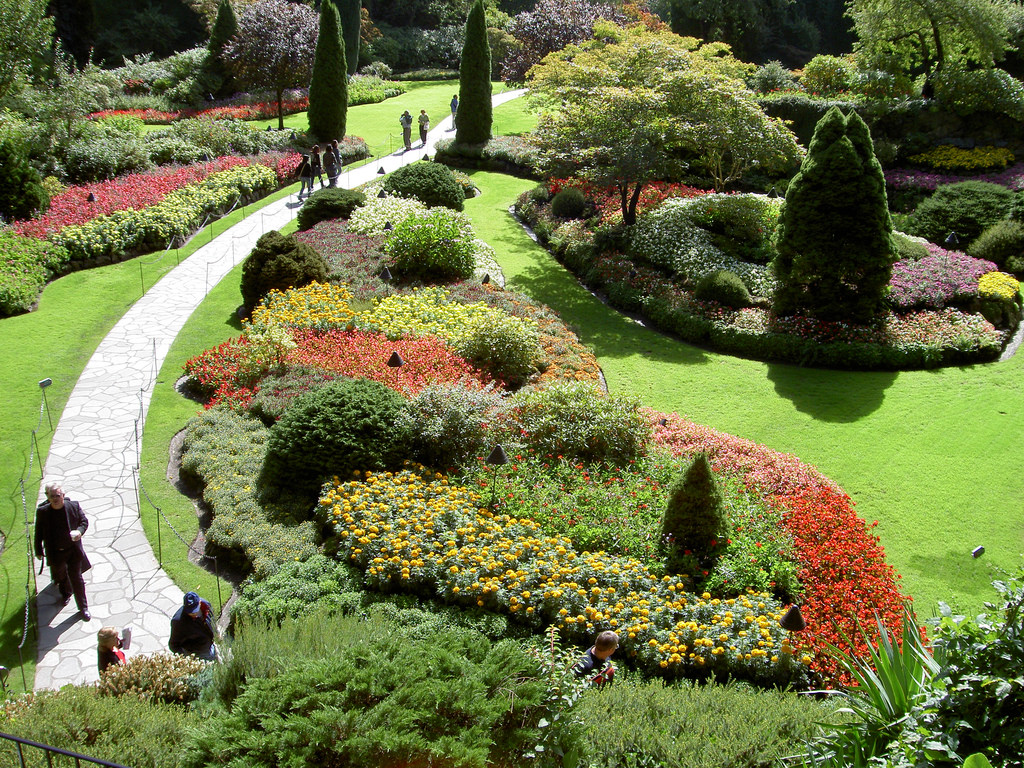
This Used To Be a Quarry

Everyone knows that gardens always look their best under bright sunlight. There is, however, one garden that looks great even on a rainy day. I am referring to Butchart Gardens, near Victoria, British Columbia. There is something about the plants there that shine in all weathers. When in Los Angeles, I love to hang out at Descanso Gardens, Huntington Gardens, the Los Angeles Arboretum, and the South Coast Botanical Gardens—but none of them hold a candle to Butchart Gardens.

The only garden in North America that I could conceive of as competing with Butchart is in Nova Scotia at Annapolis Royal: The Annapolis Royal Historic Gardens. Perhaps it has something to do with both gardens being more in the temperate climatic zone. In Los Angeles, at certain times of the year, even the most beautiful plants can look a little dusty and bedraggled.

Sign at the Garden Entrance

I have visited both gardens twice, and I love both of them. But then, I wouldn’t be at all surprised that there are other great botanical gardens of whose existence I am not aware. As much as I have traveled, I have seen only little bits here and there. Martine and I went to Annapolis Royal to see the citadel, not even knowing of the garden’s existence. The citadel is nice, but the gardens are spectacular.


Favorite Cities: Québec

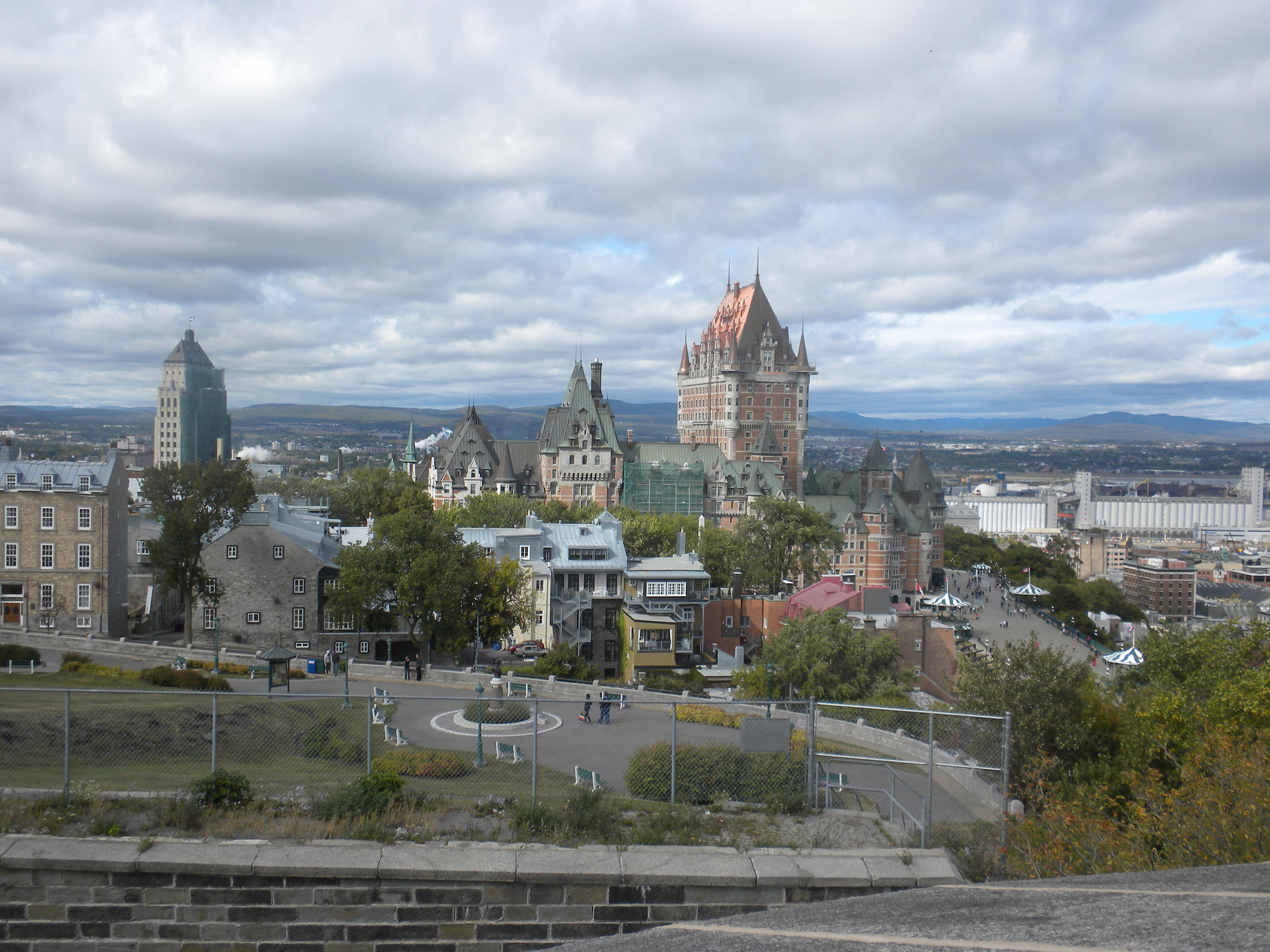
View of Quebec Skyline from La Citadelle

One of my favorite cities in North America is French-speaking Québec. Martine and I have visited it twice, once staying in the city itself and once at Lévis, a short ferry ride across the St. Lawrence. It is a wonderfully walkable place, with spectacular views, fascinating little museums such as the old Ursulines’ Convent, and delicious French Canadian food. It is surrounded by 17th century ramparts which can be walked in several hours.

Many of the buildings along the St. Lawrence waterfront are built to resemble 17th century buildings, though they were built much later. There is even a funicular to take one from the waterfront up to the level of the city.

My Favorite Restaurant in Canada

To enjoy Québec to the fullest, it helps to be able to speak some French. Like the Parisians, the Québecoises appreciate it when visitors try to meet them at least halfway. Even when they speak perfect English, some of the residents will pretend not to, especially if they have reason to think that tourists are being ugly Americans.

One of my favorite restaurants in Canada is Aux Anciens Canadiens in the Old Town. Check out the menu, which comes in French and English. And enjoy your caribou and Canadian maple syrup tartine with cream. If you don’t mind having dinner late in the afternoon, lunch prices prevail until 5 pm.

In the weeks to come, I will name some of my other favorite cities around the world.

Do You Ever Want to Live There?

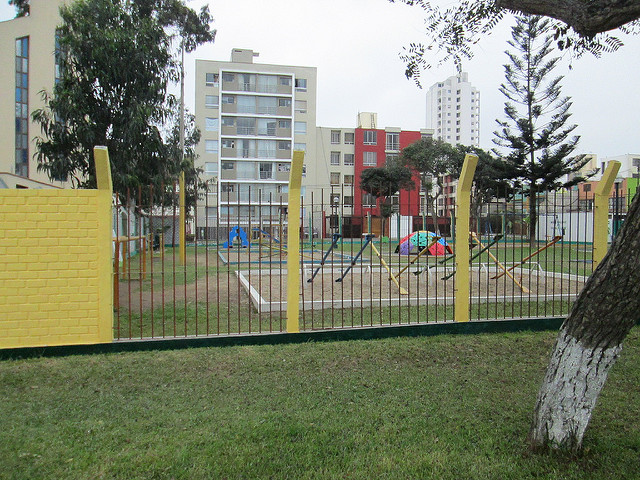
Parque El Carmen in Lima’s Pueblo Libre Municipalidad

Parque El Carmen in Lima’s Pueblo Libre Municipalidad

If you’ve read my blog for any length of time, you know that I love to travel. The question that many people have asked me is, “Yes, but wouldn’t you like to live there?”

The answer is very simply no. It’s not because I have any great hopes for the United States, but because I know that many of the places I love to visit have or have had insurmountable difficulties which make me think twice.

For instance, I love Iceland; but I dread the idea of six dark months out of every year in which the weak sun comes up for only a few minutes in the middle of the afternoon. And even though virtually everyone speaks English, I would probably have difficulties getting my kennitala (registration number), because officialdom likes to do its business in Icelandic.

Of all the countries I have visited, I would probably like Argentina the best. Even though my Spanish is adequate for travel, however, it would not fare too well dealing with the authorities in matters relating to housing and taxation. Also, all the South American countries I like (including Peru, Uruguay, and Chile) have had problems in the not too distant past with rightist dictators and left wing insurgencies.

We’re not quite there in the U.S.—yet!

As for Hungary, Slovakia, France, England, Scotland, Belgium, and the Netherlands—they’re nice, but I have a feeling they are just at the point of entering a bad time, what with the hoards invading from the Middle East and Africa. I just don’t see a good path around the problems they are just beginning to face.

There’s always Canada, I suppose, and I really like the Canadian people, even the Québecois, but I think I’ll stick it out in the U. S. of A. for the time being.


Watering the Forests of the Northeast

Forest in Maine

To return for a moment to my recent vacation, one thing I forgot to tell you was that I had forgotten to pack one of my diabetes medications, namely the Metformin HCL. One result was that, even taking insulin, my glucose reading was running rather high (in the 300s). Apparently, when that happens, I have to urinate frequently, about every thirty to forty-five minutes.

While Martine was driving toward the end of our vacation, I felt as if I had to stop by every other tree in the forests of New Brunswick and Maine to water it. That got particularly difficult when there was a chain-link fence separating me from the trees, making it difficult to disguise my actions from other motorists.

That last day from Bar Harbor, Maine, to Manchester, New Hampshire, was definitely the worst. Not only did I have to have Martine stop the car ten to twenty times, but there was a driving rainstorm once we passed Augusta.

Somehow I survived. As soon as we returned to Los Angeles, I started on the Metformin at once. Within a few days, the readings had declined to an acceptable level; and I no longer had to evaluate the cover possibilities of nearby trees.

I can tell you, I left a part of myself in the Northeast,

Tories or Loyalists?

Loyalist Reenactors at Kings Landing, New Brunswick

Back in the days before the Cretaceous Extinction, when I was in high school learning the history of the American Revolution, we heard a lot of nasty things about the so-called Tories. These were American colonists who would have no part of the Revolution and who wanted to remain loyal to King George III.

We did not treat these Americans particularly well. We destroyed their property, threatened their lives, and keyed their carriages. The result was that many, if not most, of them fled to Canada or back to Britain.

When one is in Canada, there is an entirely different point of view. The Tories here are called Loyalists. And the United States is seen, particularly from the point of view of the 18th and 19th centuries, as the enemy. After all, we sent Benedict Arnold to invade Canada during the Revolution; but he failed, as he himself was conflicted over his loyalties. Then, during the War of 1812, we invaded twice and were beaten back twice.

In New Brunswick, one of Canada’s Maritime Provinces, there is an open-air park near Fredericton called Kings Landing Historical Settlement, which honors the Loyalist settlers. When the Saint John River was dammed near Fredericton, many old 19th century buildings were moved to Kings Landing and re-assembled as an outstanding museum, complete with costumed reenactors in the houses and shops who were able to explain the details of farming, cooking, printing, milling grains, sawmills, furniture manufacture, and other typical activities of the time.

Martine and I spent a whole day here, from opening time to closing. We even had an excellent lunch at the King’s Head Inn. I don’t suppose we were disloyal Americans for sympathizing with these Tories who, after all, were for the most part decent people who contributed greatly to Canada’s growth in the early days after the English occupied the country after the French and Indian War (1754-1763).

In general, it was interesting during our vacation to see so many of the populations that make up Eastern Canada, from the Loyalists to the French Canadians of Quebec to the Acadians of the Maritime Provinces (who are very distinct from the Quebecers) to the so-called First Nations tribes.

We Americans joke about the Canadians lacking a national identity. We did not find that to be so. It’s just that most Americans don’t bother to see for themselves, or else they just won’t open their eyes.


Time and Tide

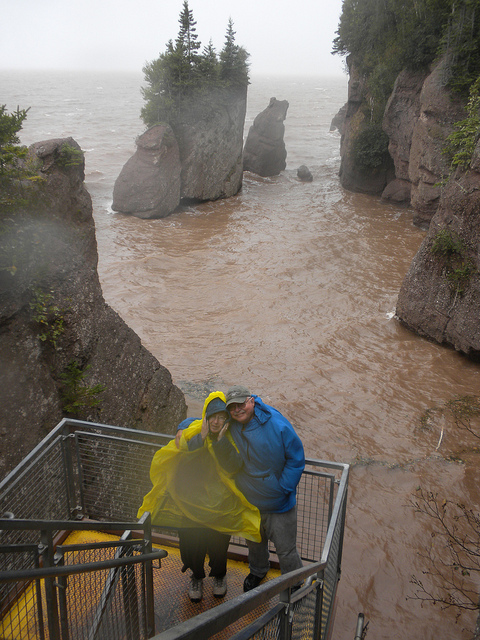
Hopewell Rocks at High Tide, September 19, 2:45 pm

I had always wanted to see the famous high and low tides in Canada’s Bay of Fundy, though I doubted I could do this without some guidance. So Martine and I took the Hopewell Rocks and Bay of Fundy Coastal Tour offered by Roads to Sea of Moncton, New Brunswick. About ten of us crowded into a minibus with Anna-Marie Weir, our capable guide.

We started by going to Hopewell Rocks at low tide, around 8:45 am. We learned that we had by accident picked a day when the difference between high and low tide would be 45.3 feet (13.8 meters). Afterwards, we saw several other sites affected by the tides, including the Harvey Shipyard, the Alma Lookout, the boats in the harbor at Alma, and Cape Enrage. The first three of the above, we saw twice, at intervals that graphically illustrated the striking difference made by the tides.

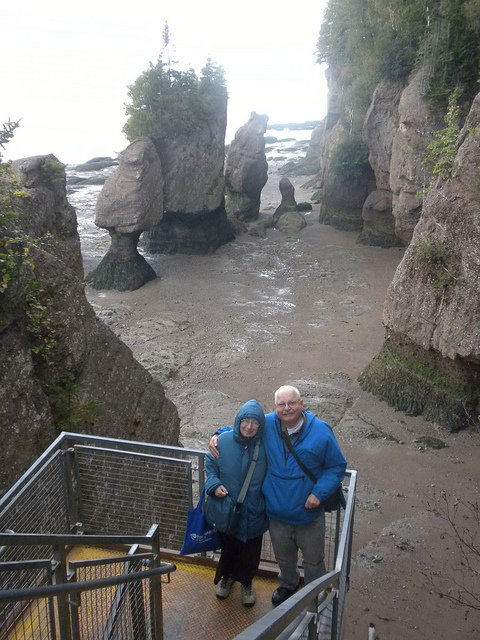
Below is the same location as the above photo in the early morning at low tide:

Hopewell Rocks at Low Tide Earlier the Same Day

We were able to walk among the rocks and take pictures . One can see by the markings along the bottom of the rocks how high the tide normally comes.

That Wednesday we took the tour started with the threat of rain, which, by early afternoon, became a reality—as you can see in the first photo above. Irrespective of the weather, we enjoyed the tour to such an extent that it was one of the highlights of our recent vacation.

Below is a photo of the personable Anna-Maria Weir and the minibus we rode on the tour:

Anna-Marie Weir of Roads to Sea

Martine and I had been in other areas with substantial tidal variation, especially when we visited Normandie in France about fourteen years ago. The high tide at Mont St-Michel reputedly would come in so fast that author Victor Hugo compared it to the speed of a galloping horse. Alas, we never were able to time our visit to see the variation with our own eyes.

Later in the trip, we even crossed the Bay of Fundy in a roll-on roll-off ferry that runs between Digby, Nova Scotia, and St. John, New Brunswick. It was interesting that the ferry docked at both coasts by a steel bridge that moved up and down with the tide. Ours was a surprisingly smooth crossing over its three-hour length. We were even able to eat a delicious supper with the famous Digby scallops, which are particularly huge and succulent.


FDR’s Canadian “Cottage”

FDR’s Summer Home on Campobello Island

During his youth, Franklin Delano Roosevelt spent many of his summers on Campobello Island in the Province of New Brunswick, just a few hundred feet from the Easternmost Point in the United States at Lubec, Maine. Since the 1960s, there is a bridge that connects Lubec with Campobello. But back when FDR stayed here, it was approachable with difficulty, by a combination of trains and ferries.

In 1921, FDR discovered during a visit to the island that he had a paralytic illness, which was later diagnosed as polio. That was a watershed in the ambitious young man’s life: From being an active outdoorsman who loved sailing the waters of Passamaquoddy Bay and the Bay of Fundy, he found himself increasingly a cripple. From that point on, he didn’t have it in him to spend much time time at Campobello.

That was not the case for his wife, Eleanor, who continued to visit the island—especially after her husband died in 1945. One of the highlights of a trip to the massive “cottage” at Campobello is a daily event known as “Tea with Eleanor.” For twenty lucky guests, tea and cookies are served in an adjoining cottage; and the knowledgeable waitstaff tell stories about Eleanor, who is much loved by the local people.

Campobello Island is a strange little island. To buy gasoline or perform many other services, the residents must cross the border into Lubec. There are two restaurants on the island and, I believe, only a couple of places where tourists can spend the night. The cottage is surrounded by a large park and criss-crossing hiking trails, where once there were other resorts for wealthy tourists around the turn of the century.

Lubec and Campobello are about two hours east of Acadia National Park and the resort at Bar Harbor.


Bougainville on the Indians of the East

Louis Antoine de Bougainville

I see no difference in the dress, ornaments, dances, and songs of the various western nations. They go naked, excepting a strip of cloth passed through a belt, and paint themselves black, red, blue, and other colors. Their heads are shaved and adorned with bunches of feathers, and they wear rings of brass wire in their ears. They wear beaver-skin blankets, and carry lances, bows and arrows, and quivers made of the skins of beasts. For the rest they are straight, well made, and generally very tall. Their religion is brute paganism. I will say it once for all, one must be the slave of these savages, listen to them day and night, in council and in private, whenever the fancy takes them, or whenever a dream, a fit of the vapors, or their perpetual craving for brandy, gets possession of them; besides which they are always wanting something for their equipment, arms or toilet, and the general of the army must give written orders for the smallest trifle,—an eternal, wearisome detail, of which one has no idea in Europe.—Louis Antoine de Bougainville as quoted in Francis Parkman’s Montcalm and Wolfe