Serendipity: The Broken Prism

The Blessed Virgin Mary

You could be a million miles away when, quite suddenly, you can be confronted with what you believe—and what you don’t believe. Today, I was sitting in the Santa Monica Library reading Tim Cahill’s Hold the Enlightenment: More Travel, Less Bliss, ostensibly a book of adventure travel essays, when the following paragraph hit me smack between the eyes:

My own background is Catholic. I suppose my current status in that Church can best be described as long-lapsed. Even so, no one who has suffered a Catholic education is ever entirely free of the belief, or at least the discipline. Quaint notions, punitive and medieval, color my perception of the physical world. I tend to see the wilderness through the broken prism of my faith.

That holds true for me as much as it does for Tim Cahill, one of the founders of Outside magazine. The only change I would make is that I never “suffered” a Catholic education: I merely “experienced” it, and not unwillingly. My grade school, Saint Henry in Cleveland, Ohio, was staffed by Dominican sisters; and my high school, St. Peter Chanel in Bedford, Ohio, was taught by Marist priests. At Dartmouth College, I was an active participant in Catholic services at the Newman Club under Monsignor William Nolan.

When asked whether I believe in God, my answer is always, Yes. I quickly add that I have no idea what God is like or what He/She/It wants. I only know that the Godhead manifests itself in some very curious ways to the peoples of this planet. I cannot pretend to be an atheist with any degree of certitude, nor do I wish to. There is enough left of the shards of my faith to see me through the day.

What will I believe a year from now? I don’t know. It’s all subject to change.

Latin American Churches

Altar of Quito’s La Compañía de Jesús Church

Altar of Quito’s La Compañía de Jesús Church

In my posting the other day on Why Did I Go to Ecuador?, I seem to have left out one of the main reasons. This applies equally to Peru and probably Colombia, but not so much to Argentina, Chile, and Uruguay.

I am referring to the Catholic cathedrals, basilicas, and other old churches of the Andes. Until age 17, I received a Catholic education at St. Henry School in Cleveland and Chanel High School in Bedford, Ohio. Then, while I was at Dartmouth, although a nominally Congregationalist school, I was very active with the Catholic Students’ Newman Club.

Coming to California has been disastrous to my faith—but yet something remains. It comes out when I visit the Andean churches, the most beautiful of which is La Compañía de Jesús church (shown above) near Quito’s Plaza de la Independencia.

In both Peru and Ecuador, I frequently stopped in at the local churches; and, not infrequently, I stayed for the services. In the Andes, I felt like a Catholic again. Even the smaller churches in places like Otávalo, Alausi, and Mindo drew me in.

The Small Church in the Village of Mindo

The Small Church in the Village of Mindo

In my life’s journey, I can see my returning to the Catholic Church. I continue to take exceptions to many points of dogma, such as the prohibitions on married priests, women in the priesthood, abortion, and divorce and some doctrines such as the relatively recent ones of the Immaculate Conception and what I call Papal Inflammability. On he other hand, there is much to admire. At this point, I am not sure which route I will take.

“Tears of the Lord”

Paul Pletka’s Paintings “Tears of the Lord” at the Autry National Center

Paul Pletka’s Paintings “Tears of the Lord” at the Autry National Center

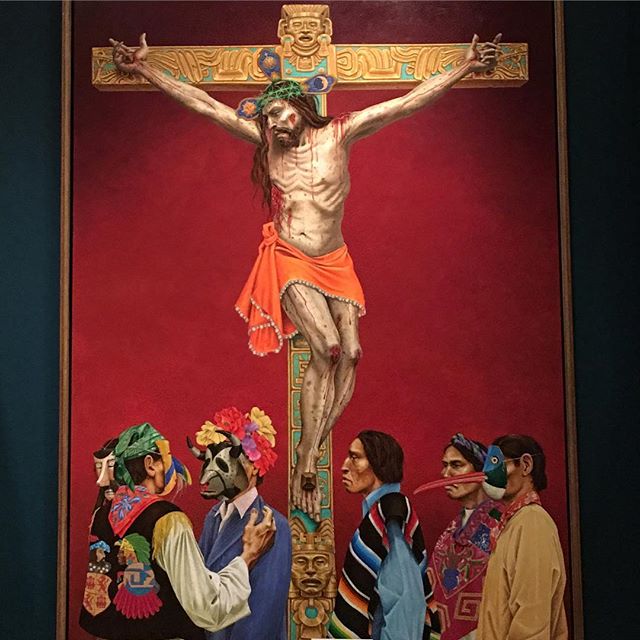
One of the paintings I saw on Saturday’s visit to the Autry National Center is Paul Pletka’s “Tears of the Lord,” which depicts a bloody crucifixion on an Aztec cross, with native Americans in ceremonial garb walking by the foot of the cross.

It reminds me of the strange mix of Christianity with Andean religions that I saw in Peru in 2014. As one who has had a Catholic education through age 17, I was amazed by the beauty and ornateness of the churches in Lima, Arequipa, Puno, and Cusco. The farther I got from the larger cities, however, the more I saw signs of local religious practices alongside the Catholic images.

In the 1980s, when my brother and I visited the State of Chiapas in southern Mexico, we saw something even more extreme—so extreme, in fact, that we were made to sign statements in advance that we would not photograph inside the church or any of the religious ceremonies. The penalty for violation? Tourists had been killed for disrespect of the local customs. In the church of San Juan Chamula, the Christian statuary was decked out with corncobs and flowers. All pews had been removed, and the Mayans prayed by lying on their stomachs with their arms outstretched. The altar was de-emphasized altogether. Instead, there were various worship stations scattered around the nave.

And where was the local priest? The Catholic clergy had been kicked out more than a hundred years previously as part of a revolt. The churches they left behind were adapted to highland Mayan religion.

As I look at Pletka’s painting, I see the native peoples of the Americas incorporating all or part of Christianity, but insisting on their own brand of religious syncretism as well. At the tiny church in Corporaque, Peru, near Colca Canyon, I felt very far indeed from the Cathedral at Cusco. The only modern touch was that I was being filmed. Apparently, a nearby church was ransacked by thieves; and many of the small churches took measures to protect their ecclesiastical treasures.

Catholic Peru

Statue of Saint in Lima’s Cathedral

Statue of Saint in Lima’s Cathedral

Peru was without a doubt the most Catholic country I have ever visited. Whenever I wanted to rest, especially when I was at high altitude, I frequently stopped at a church, looked around, and took a pew. Never before had I seen so much ornateness and wealth lavished on any religion. Although I have not been a practicing Catholic for almost fifty years, I did not feel out of place in this whole pre-Vatican II religious environment: The altars may have been turned around to face the congregation, but otherwise I was in the 16th and 17th centuries, where the Churrigueresque ruled. And I spent the first seventeen years of my life in a Catholic environment.

When I was in Puno fighting for my breath at an altitude of 12,500 feet, I sometimes attended Mass twice in one day, once at the Cathedral and once at the parish church of San Juan Bautista at Parque Pino. I could not follow the service as my Spanish is highly rudimentary.

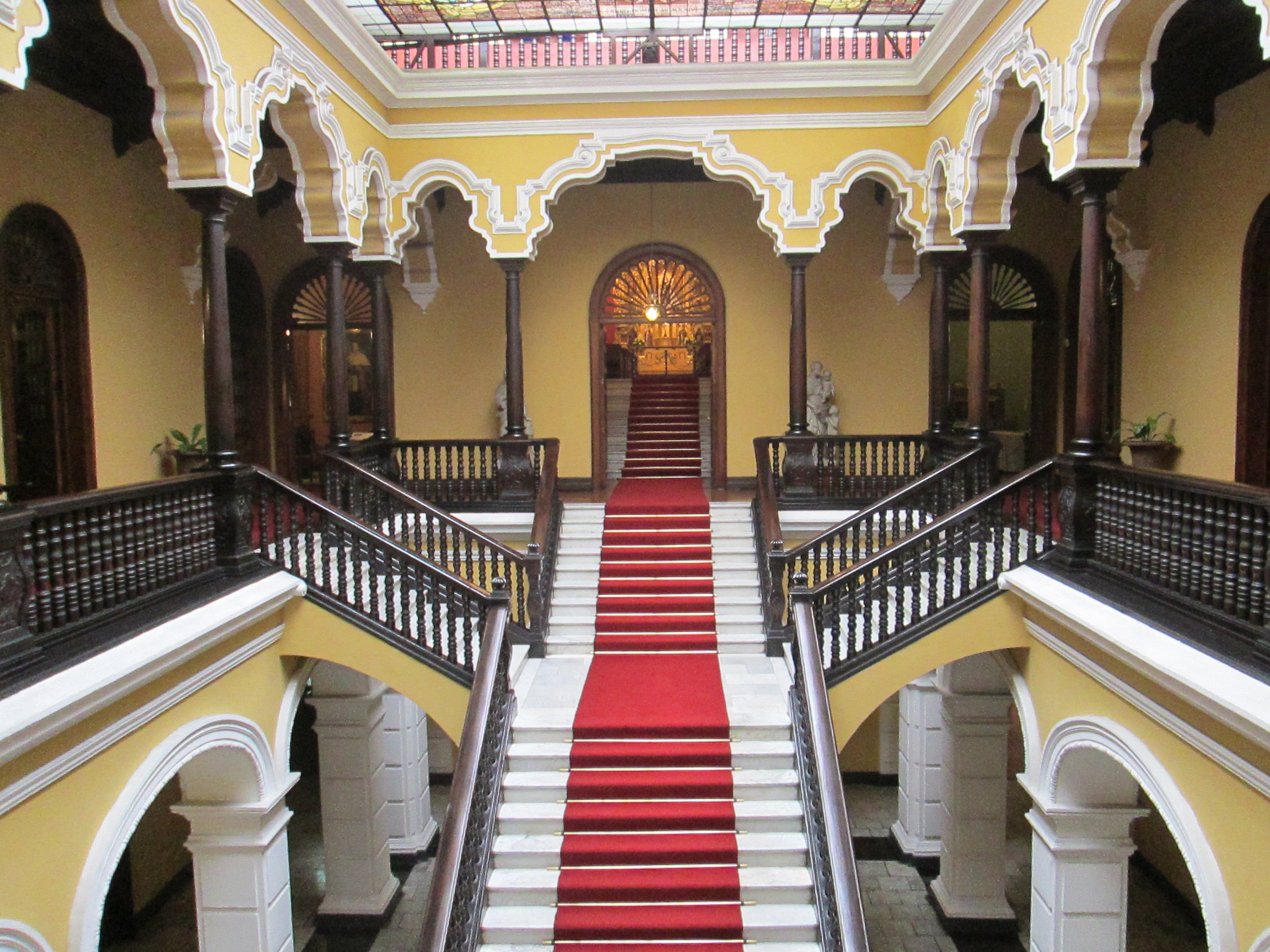
The Main Staircase of the Archbishop’s Palace in Lima

The Main Staircase of the Archbishop’s Palace in Lima

I had no inkling that this would happen to me, but I probably spent more time visiting churches and related religious museums in Peru than I did Inca-related archaeological sites. The Inca locations were what I had been led to expect, but the power and majesty of the Catholic Church in Peru came as a surprise to me.

It was from the Audiencia of Peru that the Spanish ruled South America. The gold and silver from the mines of Peru and Bolivia were transshipped from Lima to Panama, where they were carried overland to the Caribbean ports of  Nombre de Dios and Porto Bello and put on treasure galleons to Spain. Even though some 20% of all treasure was for the Spanish Crown, I suspect twice as much or more eventually found its way into the hands of the Church.

In future postings, I hope to show you some of the churches I saw.


How I Survived 7 Years with the Penguins

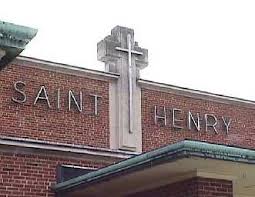
The Former Saint Henry Church and Elementary School

The Former Saint Henry Church and Elementary School

To begin with, I have a terrible admission to make: I never finished First Grade. As my birthday is in January, I started kindergarten at Cleveland’s Harvey Rice Elementary School on East 116th Street in January 1950. I was not a huge success, as I did not speak a word of English. Mrs. Idell sent me home with a note pinned to my shirt that said, “What language is this child speaking?” Duh! She was teaching kids in a Hungarian neighborhood, so she should have guessed. But in 1950, people didn’t think that way.

Halfway through First Grade, my parents moved to the suburbs in what was then called the Lee-Harvard area. After half a year of First Grade at Harvey Rice, I started in immediately with Second Grade at the newly opened Saint Henry School on Harvard Avenue. Please don’t tell the authorities at the Cleveland School District that I didn’t complete First Grade, or they might come looking for me and make me sit for six months at one of those tiny school desks in which my adult posture would become stunted.

Dominican Sisters

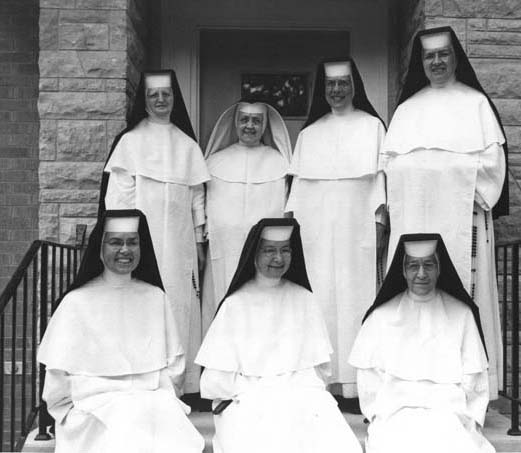
Dominican Sisters (a.k.a. Penguins)

For the next seven years, I was a prisoner of a mixture of Dominican nuns (whom we referred to as penguins because of the color of their habits) and lay teachers. They included:

  1. Sister Francis Martin (Second Grade). She pulled my ears and called me Cabbagehead.
  2. Sister Marjorie (Third Grade). She was not a full sister yet, just a postulant; but she was rather cute as I recall.
  3. Mrs. McCaffery (Fourth Grade). A nice, warm-hearted Irish woman.
  4. Miss Cunningham (Fifth Grade). Something of a cold fish, looked vaguely like Tippi Hedren.
  5. Mrs. Joyce (Sixth Grade). Friendly and knowledgeable.
  6. Sister Beatrice (Seventh Grade). In her eighties, but with no diminution of her abilities.
  7. Sister Rose Thomas (Eighth Grade). A short martinet, but very capable.

I started Saint Henry with a rudimentary knowledge of English and ended up something of a whiz kid—with a specialty in English. In my younger years, I took a lot of guff because of my foreignness, so I deliberately set about becoming something of a specialist in the language. I could still diagram a sentence. (Do they do that any more?)


Pope on the Ropes

Adieu Benedict XVI!

Adieu Benedict XVI!

In a way, I liked Benedict XVI (whom Martine persists in calling Ratzo after his last name, Ratzinger); but I think the job was beyond the abilities of a conservative theologian. What with the Catholic Church being against gays in theory and, in effect, for same-sex molestation of the under-aged, there is too much of a disconnect. The world does not want theology at this juncture. In fact, many Catholics are fleeing the church because they feel it is either devious or too unemotional. Their destination? The various evangelical sects, which can be even more devious and certainly insincere in their emotionalism.

I shouldn’t be surprised if Benedict’s departure will open the doors to new revelations about perfidy by members of the clergy. What is that thing about the Pope’s butler? Shades of Godfather III! And now Britain’s only Cardinal has resigned for molesting priests!? (What I want to know is, why don’t the poor nuns ever get molested? Even Martin Luther did it.)

Catholicism is a religion which its adherents must cherry-pick if they wish to remain sane. You can like the great traditions, the Latin Mass, the saints, the miracles—while, at the same time, abhorring the stance on contraception, abortion, and the punishment of wayward pederast priests. For me, the things I love about the Church are the works of Thomas Merton and G. K. Chesterton (both converts) and the great saints, stretching back to Augustine and Thomas Aquinas.

I hope that Benedict is not too torn up by the Augean Stables that the Church has become. He was basically a good man in an impossible position.

The Endless Attributes of the BVM

The Immaculate Conception of the BVM

The Immaculate Conception of the BVM

Today is the feast of the Immaculate Conception of the Blessed Virgin Mary. Along with the Assumption of Mary, it is one of the more recently created holy days of obligation thanks to the inflammability of the Pope, itself a relatively recent attribute..

As one who has been through the Catholic school system (grades 2-12), I have been exposed to the rapidly expanding role of the Mother of God in Catholicism. There is a word for this: Mariolatry (Mary + Idolatry). It didn’t help that the priests who taught me at Chanel High School in Bedford, Ohio, belonged to a religious order called the Society of Mary. Just to make things more confusing, there were two Societies of Mary (both denoted with an S.M. after the priest’s name), the Marianists and the Marists. Our order were the Marists.

In addition to all the attributes of Mary, and the special devotions to her held by the Legion of Mary, to which I did not belong, there were a whole host of saints. Our school was named after St. Peter Chanel, a French Marist missionary who was martyred for his faith in Polynesia (on the island of Futuna) and eaten by cannibals—the only saint known to have suffered such a fate.

New saints are being created all the time. Just this year, Benedict XVI elevated Kateri Tekakwitha, an Indian maiden, to sainthood. Here she is:

St. Kateri Tekakwitha

St. Kateri Tekakwitha

Just so she doesn’t feel jealous, some new attributes for the Blessed Virgin Mary are even now being dreamed up by the Sacred Consistory of Adventitious Marian Attributes (SCOAMA) in the Vatican, including the ability to solve Rubik’s Cube puzzles in less than two minutes, miraculously finding parking places directly in front of whatever her destination may be, and being able to keep her girlish figure for over two millennia.

That reminds me of my friend Alain Silver, who was once offered a relic in Europe, nothing other than a piece of wood from the Blessed Virgin’s boat. Now I do not recall any tales from the Bible about Mary’s boating proclivities, but it could be true! 

Catholicism sometimes seems as cluttered as the Hindu or Graeco-Roman Pantheon, but I do not object to it. There are many aspects of Catholicism about which I feel nostalgic, though the statutory rape of altar boys and attempts to dictate what is and what is not sinful regarding human sexuality are not among them. But when I get troubled and confused, I simply return to my special devotion to the Sacred Multiplicity of the BVM.