
At the Tomb of the Inflatable Pig

Definitely on my travel bucket list is one of South America’s two landlocked countries (the other one is Bolivia, which had a seaport on the Pacific until they lost it in an 1870s war with Chile). I am speaking, of course, of Paraguay, which is surrounded by Argentina, Brazil, and Bolivia. I personally know no one who has been to Paraguay, yet I am yearning to visit it.

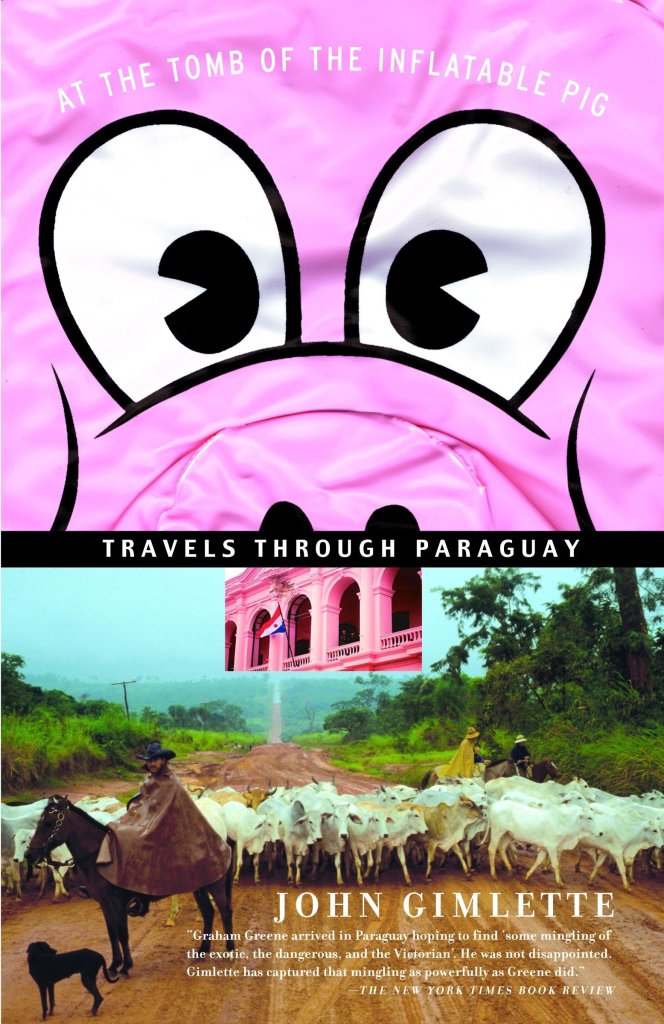
What piqued my interest was John Gimlette’s At the Tomb of the Inflatable Pig, which captures the insane history of this little known country, which is known for:

  • The Paraguayan War (1864-1870) against, simultaneously, Argentina, Brazil, and Uruguay, in which 50% of the population lost their lives.
  • The Chaco War (1930s) against Bolivia, in which two armies confronted each other in a waterless desert and which, surprisingly, Paraguay won despite horrendous casualty rates.
  • The dictatorship of Alfredo Stroessner (1954-1989) in which the country welcomes fleeing Nazis.
While it is theoretically possible to fly into the capital, Asunción, I would rather enter by bus from Argentina. When I visited Iguazu Falls in 2015, I was only a few miles from Ciudad del Este, which is a known hangout of smugglers and Hezbollah terrorists—but I chose not to visit it at that time. (Actually, probably never would suit me.)

If I went to Paraguay, I would be interested in visiting the old Jesuit missions that were destroyed by the Brazilians. At one time, in the 18th century, Paraguay was controlled by the Jesuits and was considered a paradise on earth. To corroborate, read Voltaire’s Candide and see Roland Joffe’s 1986 film The Mission with Robert De Niro and Jeremy Irons. But after the missions were destroyed, things went bad.

And I would like to stay in Asunción sipping Tereré, a cold preparation made with Yerba Mate. If I had time, I would like to see a little bit (a very little bit) of the Chaco region in the northwest.

La Guerra de la Sed

Translation: “The War of Thirst”

Paraguay has given the world two horrendous wars over the last two centuries. Yesterday, I posted about the War of the Triple Alliance. Today, we will see one of the most horrendous wars of the Twentieth Century: The Chaco War of 1932-1935 between Paraguay and Bolivia. The Grand Chaco is a desert area comprising most of Paraguay’s territory (in an area the size of Poland) but with only 3% of the population. In its earlier war, Paraguay lost big. The Chaco War was actually fought to a draw, with heavy casualties on both sides.

The Bolivians were hampered by the fact that their supply line was so much longer, and most of their troops were from the altiplano and were not used to lowland deserts, especially truly horrible ones like the Chaco. Here there were few water holes, cockroaches that ate human hair, poisonous snakes, jaguars, giant lizards, vampire bats, and a wilderness of thorns and sharp spines. Also, Paraguayans could intercept messages in Spanish meant for the Bolivians, while the Paraguayans communicated over radio lines in Guaraní, the other official language of the country.

In his book At the Tomb of the Inflatable Pig: Travels Through Paraguay, John Gimlette wrote:

A pattern emerged. The Bolivians would be separated from their water and then the Guaranís would cut round the back to offer them dehydration or surrender. Behind these moves was a man with chilly blue eyes who played the war like chess, not theatre. General Estigarribia is often credit with genius, and later he would stand for [the] presidency. Had his propeller not come off over Altos, he might have spared Paraguay the Stronato [the nickname for the long presidency of dictator General Alfredo Stroessner] and the uncomfortable years ahead….

Bolivian morale slithered. The myth of Paraguayan invincibility took shape: the Guaranís lived on palm hearts and thin air, fought like wilcats and were everywhere.

PARAGUAY: a Stamp Printed in Paraguay shows Heroes of the Chaco War


When the war was over, the general thinking was that the war was fought for oil instead of a useless chunk of desert. In fact, there was no oil in the Chaco. The war was fought over a desolate area of no major import to either of the war’s participants.