The Man Who Invented Christmas

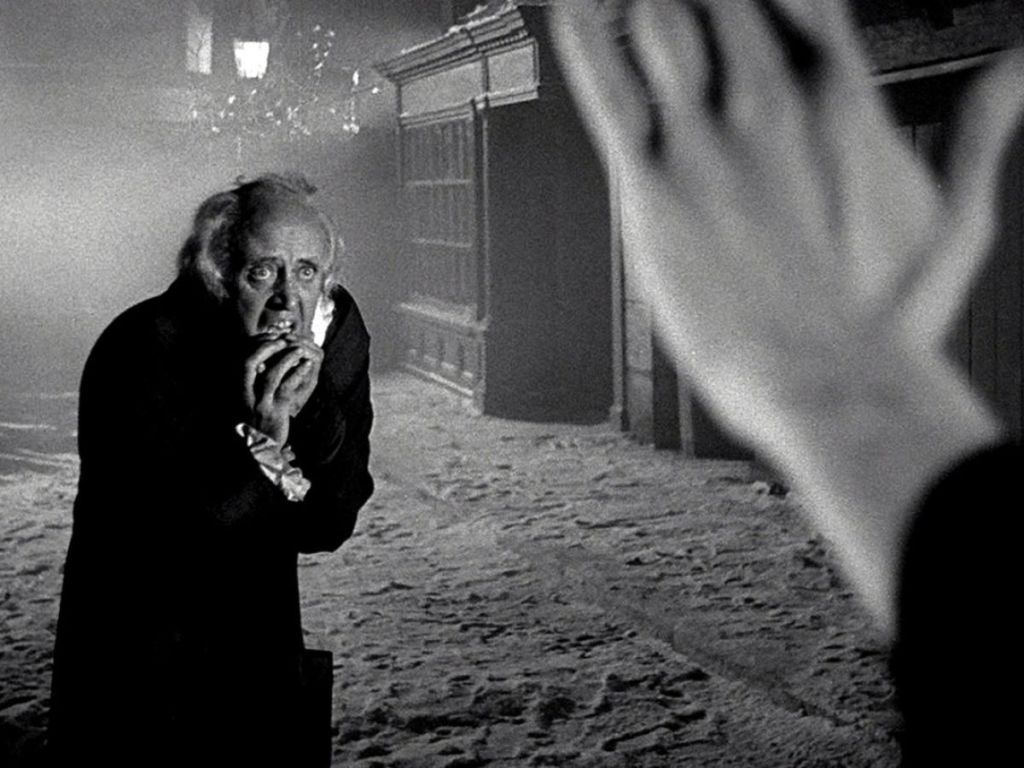
Scrooge and the Ghost of Marley

It is actually hard to imagine what Christmas would be like today in England and the United States if Charles Dickens had never written A Christmas Carol. There have been countless film versions of the story; and, today, virtually everyone over the age of twelve knows the story.

In this age of Trump, there have even been stories justifying Ebenezer Scrooge’s meanness as being somehow praiseworthy. Go figure!

The message of benevolence toward the poor and general loving kindness is something new in literature. While being guided by the Ghost of Christmas Present, Scrooge sees two gaunt children clinging to him:

From the foldings of its robe, it brought two children; wretched, abject, frightful, hideous, miserable. They knelt down at its feet, and clung upon the outside of its garment.

“Oh, Man! look here. Look, look, down here!” exclaimed the Ghost.

They were a boy and girl. Yellow, meagre, ragged, scowling, wolfish; but prostrate, too, in their humility. Where graceful youth should have filled their features out, and touched them with its freshest tints, a stale and shrivelled hand, like that of age, had pinched, and twisted them, and pulled them into shreds. Where angels might have sat enthroned, devils lurked, and glared out menacing. No change, no degradation, no perversion of humanity, in any grade, through all the mysteries of wonderful creation, has monsters half so horrible and dread.

Scrooge started back, appalled. Having them shown to him in this way, he tried to say they were fine children, but the words choked themselves, rather than be parties to a lie of such enormous magnitude.

“Spirit! are they yours?” Scrooge could say no more.

“They are Man’s,” said the Spirit, looking down upon them. “And they cling to me, appealing from their fathers. This boy is Ignorance. This girl is Want. Beware them both, and all of their degree, but most of all beware this boy, for on his brow I see that written which is Doom, unless the writing be erased. Deny it!” cried the Spirit, stretching out its hand towards the city. “Slander those who tell it ye!
Admit it for your factious purposes, and make it worse. And bide the end!”

“Have they no refuge or resource?” cried Scrooge.

“Are there no prisons?” said the Spirit, turning on him for the last time with his own words. “Are there no workhouses?”

This little scene casts a long shadow into our own time.

I have read Dickens’s novella perhaps a dozen times, always around Christmas time. The last reading was completed not an hour ago.

“A Great Earthquake”

In his novel Dombey and Son (1848), Charles Dickens had a striking passage about the effect that railroad construction was having on parts of London. I remember this passage vividly from when I first read the book decades ago.

The first shock of a great earthquake had, just at that period, rent the whole neighbourhood to its centre. Traces of its course were visible on every side. Houses were knocked down; streets broken through and stopped; deep pits and trenches dug in the ground; enormous heaps of earth and clay thrown up; buildings that were undermined and shaking, propped by great beams of wood. Here, a chaos of carts, overthrown and jumbled together, lay topsy-turvy at the bottom of a steep unnatural hill; there, confused treasures of iron soaked and rusted in something that had accidentally become a pond. Everywhere were bridges that led nowhere; thoroughfares that were wholly impassable; Babel towers of chimneys, wanting half their height; temporary wooden houses and enclosures, in the most unlikely situations; carcases of ragged tenements, and fragments of unfinished walls and arches, and piles of scaffolding, and wildernesses of bricks, and giant forms of cranes, and tripods straddling above nothing. There were a hundred thousand shapes and substances of incompleteness, wildly mingled out of their places, upside down, burrowing in the earth, aspiring in the air, mouldering in the water, and unintelligible as any dream. Hot springs and fiery eruptions, the usual attendants upon earthquakes, lent their contributions of confusion to the scene. Boiling water hissed and heaved within dilapidated walls; whence, also, the glare and roar of flames came issuing forth; and mounds of ashes blocked up rights of way, and wholly changed the law and custom of the neighbourhood.

In short, the yet unfinished and unopened Railroad was in progress; and, from the very core of all this dire disorder, trailed smoothly away, upon its mighty course of civilisation and improvement.

But as yet, the neighbourhood was shy to own the Railroad. One or two bold speculators had projected streets; and one had built a little, but had stopped among the mud and ashes to consider farther of it. A bran-new Tavern, redolent of fresh mortar and size, and fronting nothing at all, had taken for its sign The Railway Arms; but that might be rash enterprise—and then it hoped to sell drink to the workmen. So, the Excavators’ House of Call had sprung up from a beer-shop; and the old-established Ham and Beef Shop had become the Railway Eating House, with a roast leg of pork daily, through interested motives of a similar immediate and popular description. Lodging-house keepers were favourable in like manner; and for the like reasons were not to be trusted. The general belief was very slow. There were frowzy fields, and cow-houses, and dunghills, and dustheaps, and ditches, and gardens, and summer-houses, and carpet-beating grounds, at the very door of the Railway. Little tumuli of oyster shells in the oyster season, and of lobster shells in the lobster season, and of broken crockery and faded cabbage leaves in all seasons, encroached upon its high places. Posts, and rails, and old cautions to trespassers, and backs of mean houses, and patches of wretched vegetation, stared it out of countenance. Nothing was the better for it, or thought of being so. If the miserable waste ground lying near it could have laughed, it would have laughed it to scorn, like many of the miserable neighbours.

The Ghost of New Years Past

Lucky New Year’s Postcard

I’ve said on many occasions, usually around this time of year, that only a fool celebrates the passing of time. Every January 1, take a picture of yourself in your bathroom mirror and note the thinning and graying of your hair, the mottling of your skin, and the network of spidery lines demarcating the zones of your face. Oh, well, it’s all a natural process.

On a more positive note, let’s see what the youthful Charles Dickens wrote about New Years Day in his first book, Sketches by Boz:

Next to Christmas-day, the most pleasant annual epoch in existence is the advent of the New Year. There are a lachrymose set of people who usher in the New Year with watching and fasting, as if they were bound to attend as chief mourners at the obsequies of the old one. Now, we cannot but think it a great deal more complimentary, both to the old year that has rolled away, and to the New Year that is just beginning to dawn upon us, to see the old fellow out, and the new one in, with gaiety and glee.

There must have been some few occurrences in the past year to which we can look back, with a smile of cheerful recollection, if not with a feeling of heartfelt thankfulness. And we are bound by every rule of justice and equity to give the New Year credit for being a good one, until he proves himself unworthy the confidence we repose in him.

This is our view of the matter; and entertaining it, notwithstanding our respect for the old year, one of the few remaining moments of whose existence passes away with every word we write, here we are, seated by our fireside on this last night of the old year, one thousand eight hundred and thirty-six, penning this article with as jovial a face as if nothing extraordinary had happened, or was about to happen, to
disturb our good humour.

Hackney-coaches and carriages keep rattling up the street and down the street in rapid succession, conveying, doubtless, smartly-dressed coachfuls to crowded parties; loud and repeated double knocks at the house with green blinds, opposite, announce to the whole neighbourhood that there’s one large party in the street at all events; and we saw through the window, and through the fog too, till it grew so thick that we rung for candles, and drew our curtains, pastry-cooks’ men with green boxes on their heads, and rout-furniture-warehouse-carts, with cane seats and French lamps, hurrying to the numerous houses where an annual festival is held in honour of the occasion.

We can fancy one of these parties, we think, as well as if we were duly dress-coated and pumped, and had just been announced at the drawing-room door.

An Enduring Masterpiece

Sam Weller and His Father Tony

Although I first read Charles Dickens’s The Pickwick Papers in the late 1960s, a number of its characters have remained fresh in my memory. Aside from Mr Pickwick himself, there was Sam Weller and his father Tony, Job Trotter, Sergeant Buzfuz, and Angelo Cyrus Bantam. I have always regarded this book as one of Dickens’s best, though I had the feeling in the back of my mind that I would not think so upon re-reading it.

Fortunately, I was wrong. I loved the book—again. It is one of those long picaresque shaggy-dog stories that sags in some places, but rises to incredible heights during such set pieces as the parliamentary election at Eatanswill, the trial of Mr Pickwick for breach of promise, the time spent in the Fleet debtors’ prison, and the Christmas festivities at Dingley Dell.

The book starts slowly with Pickwick and his three associates (Nathaniel Winkle, Augustus Snodgrass, and Tracy Tupman) as the main characters. Before long, however, we find that the real character of interest is Sam Weller, Pickwick’s manservant. Despite coming from the lower classes, his native wit is considerable, and before long he leaves everyone else in the shade. And he is 100% pure English: He almost defines Englishness.

As the book grinds to a halt, Dickens gives us a delirious ending:

Let us leave our old friend in one of those moments of unmixed happiness, of which, if we seek them, there are ever some, to cheer our transitory existence here. There are dark shadows on the earth, but its lights are stronger in the contrast. Some men, like bats or owls, have better eyes for the darkness than for the light. We, who have no such optical powers, are better pleased to take our last parting look at the visionary companions of many solitary hours, when the brief sunshine of the world is blazing full upon them.

In the end, we have been mightily entertained. There has been much humor and—a rarity in Dickens—very little extreme pathos.

Yes, indeed, this is still one of the great books!

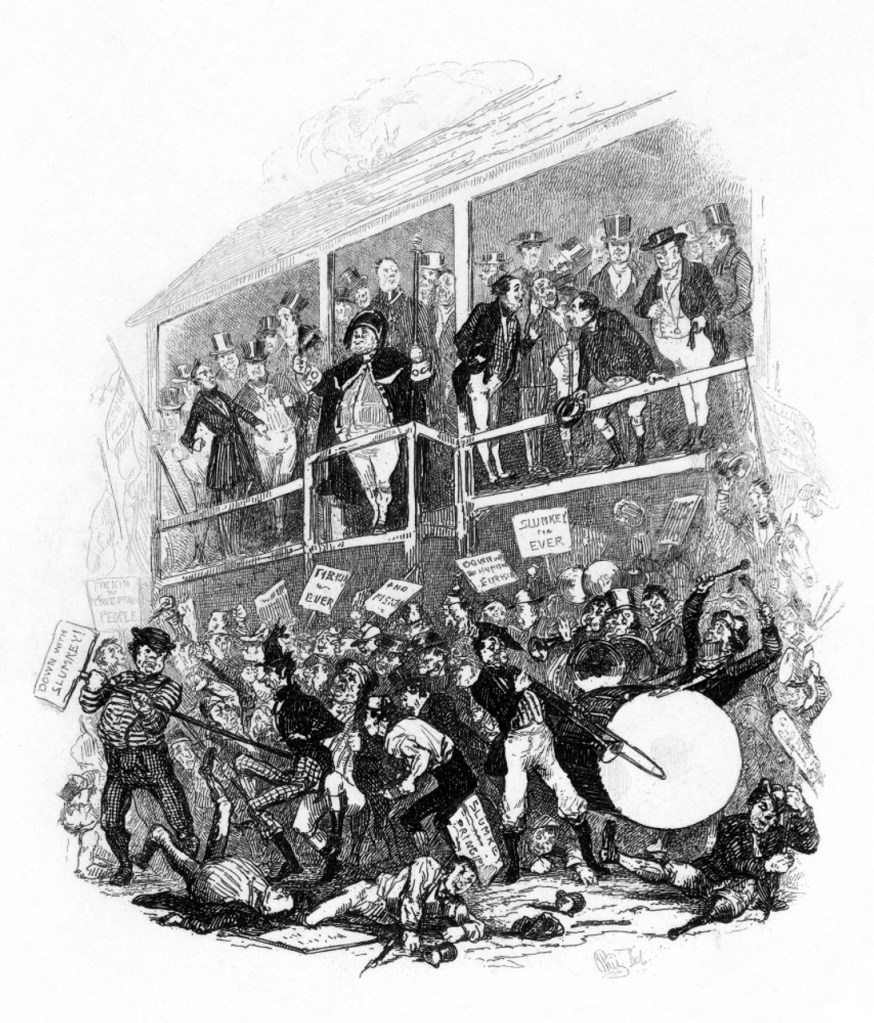
The Parliamentary Election at Eatanswill

Illustration by “Phiz” for The Pickwick Papers by Charles Dickens

If you think the political division between the Democrats and Republicans is a new think, you should read Charles Dickens’s The Posthumous Papers of the Pickwick Club (1837), particularly in the scenes describing the parliamentary election at Eatanswill (“Eat and Swill”), one of the most savage satires by the British writer. Here is his masterful description of the state of things at Eatanswill:

It appears, then, that the Eatanswill people, like the people of many other small towns, considered themselves of the utmost and most mighty importance, and that every man in Eatanswill, conscious of the weight that attached to his example, felt himself bound to unite, heart and soul, with one of the two great parties that divided the town—the Blues and the Buffs. Now the Blues lost no opportunity of opposing the Buffs, and the Buffs lost no opportunity of opposing the Blues; and the consequence was, that whenever the Buffs and Blues met together at public meeting, town-hall, fair, or market, disputes and high words arose between them. With these dissensions it is almost superfluous to say that everything in Eatanswill was made a party question. If the Buffs proposed to new skylight the market-place, the Blues got up public meetings, and denounced the proceeding; if the Blues proposed the erection of an additional pump in the High Street, the Buffs rose as one man and stood aghast at the enormity. There were Blue shops and Buff shops, Blue inns and Buff inns—there was a Blue aisle and a Buff aisle in the very church itself.

Of course it was essentially and indispensably necessary that each of these powerful parties should have its chosen organ and representative: and, accordingly, there were two newspapers in the town—the Eatanswill Gazette and the Eatanswill Independent; the former advocating Blue principles, and the latter conducted on grounds decidedly Buff. Fine newspapers they were. Such leading articles, and such spirited attacks!—‘Our worthless contemporary, the Gazette’—‘That disgraceful and dastardly journal, the Independent’—‘That false and scurrilous print, the Independent’—‘That vile and slanderous calumniator, the Gazette;’ these, and other spirit-stirring denunciations, were strewn plentifully over the columns of each, in every number, and excited feelings of the most intense delight and indignation in the bosoms of the townspeople.

At the Peggotty’s

The Peggotty Boat House in Yarmouth

Some months ago, I made a stab at re-reading Charles Dickens’s David Copperfield but gave up. Somehow, I was just not in the mood. (That happens, but fairly rarely.) Today, I made another attempt, with vastly improved results.

What got to me before was the character of Edward Murdstone and his sister Jane. Murdstone marries David’s mother, Clara, but begins raising David in an abusive even sadistic manner. But before the grim scenes of marriage, with Clara being forced to suppress her love for Davy, there intervenes the magical Chapter III, “I Have a Change.”

Magic is rare in fiction, but not with Dickens at his best. Davy goes with his mother’s maid Clara Peggotty to visit her family in Yarmouth on the Isle of Wight. There, he stays in an odd beach house built from an old boat, with Peggotty’s brother Daniel as head of household. In the boat house live Ham Peggotty, an orphaned nephew; Little Em’ly, an orphaned niece; and the morose Mrs Gummidge, widow of a fishing partner of Daniel’s. It is an odd mixed-up family that somehow seems to work.

It all starts with the first view of the boat house on the sands:

Ham carrying me on his back and a small box of ours under his arm, and Peggotty carrying another small box of ours, we turned down lanes bestrewn with bits of chips and little hillocks of sand and went past gas-works, rope-walks, boat-builders’ yards, shipwrights’ yards, caulkers’ yards, riggers’ lofts, smiths’ forges, and a great litter of such places, until we came out upon the dull waste I had already seen at a distance; when Ham said,

‘Yon’s our house, Mas’r Davy!’

I looked in all directions, as far as I could stare over the wilderness, and away at the sea, and away at the river, but no house could I make out. There was a black barge, or some other kind of superannuated boat, not far off, high and dry on the ground, with an iron funnel sticking out of it for a chimney and smoking very cosily; but nothing else in the way of a habitation that was visible to me.

‘That’s not it?’ said I. ‘That ship-looking thing?’

‘That’s it, Mas’r Davy,’ returned Ham.

If it had been Aladdin’s palace, roc’s egg and all, I suppose I could not have been more charmed with the romantic idea of living in it. There was a delightful door cut in the side, and it was roofed in, and there were little windows in it; but the wonderful charm of it was, that it was a real boat which had no doubt been upon the water hundreds of times, and which had never been intended to be lived in, on dry land. That was the captivation of it to me. If it had ever been meant to be lived in, I might have thought it small, or inconvenient, or lonely; but never having been designed for any such use, it became a perfect abode.

Davy stays in the boat house for a couple of weeks, allowing his mother to be married to the grim Murdstone and provide an unhappy surprise when Davy returns to The Rookery at Blunderstone, only to find Murdstone in charge as paterfamilias.

Until then, there are a couple of weeks of grace, during which little Davy falls in love with Little Em’ly, and is showered with kindnesses he was no longer able to receive at home.

I remember the chapter vividly from my own childhood, when I read an abridged edition of David Copperfield. Even in its mutilated form, it was magical then; and now, it’s still magical.

A Merry Xmas to All

During my entire adult life, I have been of two minds about Christmas. On the plus side, it is a pious celebration of God becoming Man in order to save the human race from the shame of Adam and Eve. Though I can’t help wondering that God, being God, could have accomplished the same result any number of ways.

On the negative side, Christmas time has become a two-months-long stress fest in which families immolate their finances and valuable time buying gifts that the recipients do not necessarily want or need. I am happy that the holiday is now over, because I will be able to drive without encountering quite so many highway kamikazes out on endless errands.

It was nice to see the two classical movie versions of Charles Dickens’s A Christmas Carol (1938 with Reginald Owen and 1951 with Alastair Sim, pictured above). In his story, Dickens doesn’t even mention the Deity, but he makes a case for generosity and good will toward men.

I also saw Bob Clark’s marvelous recreation of a 1950 Christmas in his 1983 A Christmas Story. In a way, the quest of Ralphie (Peter Billingley) for a BB gun is not nearly as acceptable a journey as Scrooge’s, but it was a reminder of my own Christmases in Cleveland. The picture showed such old Cleveland landmarks as the Terminal Tower, the Soldiers’ and Sailors’ Monument, and Higbee’s Department Store. I never got much in the way of presents except clothing that I didn’t like—except that my uncle gave me a $20 bill every Christmas, which was like a rare treasure for me, even though I couldn’t spend it on what I wanted.

At least I didn’t have an Aunt Clara who would make me a pink rabbit suit that made me look like a deranged Easter Bunny.

Serendipity: Marley’s Ghost

Tiny Tim with Scrooge in Dickens’s A Christmas Carol

In honor of Christmas, I will excerpt a brief scene from Charles Dickens’s A Christmas Carol, representing the first moment when Ebenezer Scrooge realizes that something is not quite right. He sees, instead of the usual door knocker, the face of his dead partner Jacob Marley. (I know I was a little hard on Dickens in a post I wrote last week, but I think that this particular story is not only one of his best: It has influenced the way that Christmas is celebrated across the West.)

Now, it is a fact, that there was nothing at all particular about the knocker on the door, except that it was very large. It is also a fact, that Scrooge had seen it, night and morning, during his whole residence in that place; also that Scrooge had as little of what is called fancy about him as any man in the city of London, even including—which is a bold word—the corporation, aldermen, and livery. Let it also be borne in mind that Scrooge had not bestowed one thought on Marley, since his last mention of his seven years’ dead partner that afternoon. And then let any man explain to me, if he can, how it happened that Scrooge, having his key in the lock of the door, saw in the knocker, without its undergoing any intermediate process of change—not a knocker, but Marley’s face.

The Door Knocker Transposed into Marley’s Face

Marley’s face. It was not in impenetrable shadow as the other objects in the yard were, but had a dismal light about it, like a bad lobster in a dark cellar. It was not angry or ferocious, but looked at Scrooge as Marley used to look: with ghostly spectacles turned up on its ghostly forehead. The hair was curiously stirred, as if by breath or hot air; and, though the eyes were wide open, they were perfectly motionless. That, and its livid colour, made it horrible; but its horror seemed to be in spite of the face and beyond its control, rather than a part of its own expression.

As Scrooge looked fixedly at this phenomenon, it was a knocker again.

To say that he was not startled, or that his blood was not conscious of a terrible sensation to which it had been a stranger from infancy, would be untrue. But he put his hand upon the key he had relinquished, turned it sturdily, walked in, and lighted his candle.

He did pause, with a moment’s irresolution, before he shut the door; and he did look cautiously behind it first, as if he half expected to be terrified with the sight of Marley’s pigtail sticking out into the hall. But there was nothing on the back of the door, except the screws and nuts that held the knocker on, so he said “Pooh, pooh!” and closed it with a bang.

What the Dickens?!

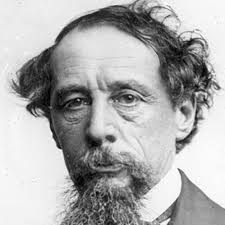
Charles Dickens (1812-1870)

It was bound to happen sooner or later. After many decades regarding him as a great writer, I seem to have suddenly fallen out of love with Charles Dickens. It happened while re-reading David Copperfield, one of my hitherto favorites of his. All of a sudden, early in the book, I just didn’t feel like continuing after Mrs Copperfield married the cruel Edward Murdstone.

Shortly thereafter, I started reading Wilkie Collins’s No Name, which I found enthralling. Where Dickens puts together a series of humorous or tragic character sketches, Collins has a rogue hero named Captain Horatio Wragge who is a mixed scoundrel, but one who seems to have a good heart. And his tall, slightly retarded wife Matilda is a compassionate portrait of a disabled woman of the 19th century.

I will try reading Dickens again—probably either The Pickwick Papers or Bleak House; but I feel that somehow I have thrown in my lot with his competition. Wilkie Collins and Anthony Trollope are, to my mind, better writers of fiction. Though perhaps not quite so deft with memorable character sketches.

Wilkie Collins (1824-1889)

Interestingly, Wilkie Collins and Charles Dickens were not only close friends, but partners who co-wrote some works and who had a marked influence on each other. It was Dickens who won all the fame, but Collins who singlehandedly invented the detective novel (The Moonstone) and who retained in his work much of the edginess which has become more popular today.

In his major novels, Collins seems to distrust marriage, seeing it almost as an existential stepping off into the void. He himself was never married, though he had a lifelong relationship with Caroline Graves and her daughter from a previous marriage.

If you are interested in learning more about Collins, there is an excellent website dedicated to his life and work.