
Chiloe: A Near Miss

Palafitos on the Shore of Castro on Chiloé

In 2014, I was within a mile of the ferry from Puerto Montt, Chile, to Ancud on the island of Chiloé. Chiloé is one of two places in South America that lay claim to the first cultivation of potatoes, the other being Peru. Why didn’t I go? Because of a 1963 documentary by Joris Ivens entitled À Valparaíso, I was dead set on spending several days in the port of Valparaíso before returning to Los Angeles via Santiago. You can see this documentary by clicking here. Even though it has a French soundtrack with Spanish subtitles, you can see why I wanted to see the city.

And so, Chiloé is one of those places I almost but not quite visited. The island is famous for its palafitos, brightly colored buildings clinging to the shore on wooden stilts, and also for its wooden churches, built without benefit of nails and frequently covered with wooden shingles. The climate is a humid, cool temperate climate; and the island is covered with rare temperate rain forests.

Church of San Francisco in Castro

Back in 2000, the wooden churches of Chiloé were collectively named as a UNESCO World Heritage Site.

Chilotes have a unique stew called curanto, which includes seafood, meat, potatoes, and vegetables. The dish is buried in a deep hole filled with hot coals and covered with stones.

I would love to spend a week in Chiloé sometime, “Had we but world enough and time.”
Places: Puerto Montt, Chile 2015

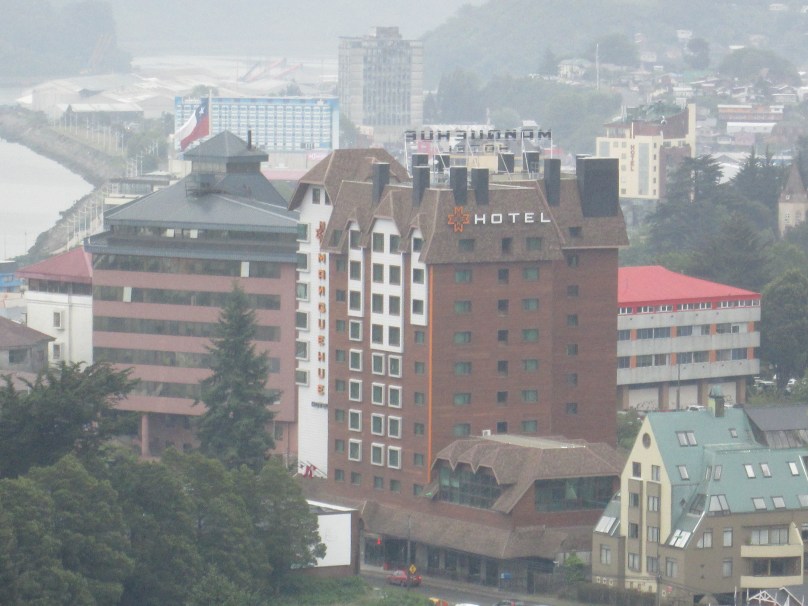
Puerto Montt in the Fog

This is the beginning of a new series based on places I have visited since 2001 and always illustrated by my own photographs. In common with all the places I decide to feature is my desire to go back and spend more time in the vicinity. I visited Puerto Montt briefly in 2015 on a trip I started in Buenos Aires, going on to Iguazu Falls (on the Argentina side), San Carlos de Bariloche, Puerto Varas, Valparaíso, and Santiago.

In her book Among the Cities, Jan Morris describes Puerto Montt as the southern terminus of the Pan American Highway. Actually, it continues on the Island of Chiloé across Reloncavi Sound as far as the town of Quellón, from which one could travel by ferry to Chaitén. The port was named after Manuel Montt, who was President of Chile from 1851 to 1861.

The Cathedral of Puerto Montt, Built Entirely of Native Alerce Wood

The Sea Creatures of Puerto Montt

The highlight of my visit to Puerto Montt was the incredible fish market, which Jan Morris described very picturesquely back in 1961:

And wettest, strangest, most southern, most remote, more alien than any melon-flower are the sea creatures of Puerto Montt, dredged through the rain out of the Pacific. There are heavy eels with muscular flanks, big flat fish like slabs of fat, giant clams, crinkled oysters by the million, mountains of spiky urchins, glistening and globular.

If I weren’t on a bus tour, I would have loved to stay for a giant seafood dinner, but I was scheduled to take an all-night TurBus sleeper to Valparaíso.

Unfinished Business

I would dearly love to go back to Puerto Montt for that seafood dinner, and then head across the sound to the Island of Chiloé, which is famous for its UNESCO-recognized wooden churches and wet forests. The Chilotes dispute with the Peruvians the development of the potato, which grows extensively on the island, and which is served with seafood in a local stew known as curanto.