
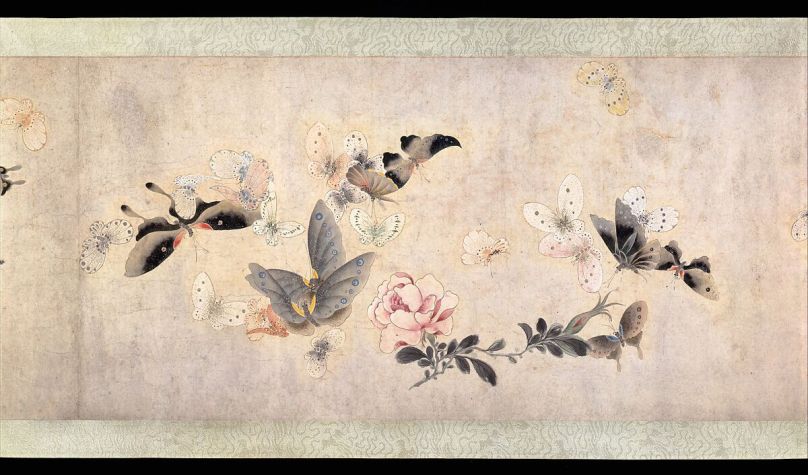
Chuang Tzu and the Butterfly

The two greatest poets of T’ang China were Tu Fu (712-770 CE) and Li Po (701-762 CE). The following poem by Li Po is one of the most profound he ever wrote. The Chuang Tzu (4th century BCE) referred to was the Taoist philosopher and follower of Lao Tzu. Forget all this detail: The following poem speaks for itself.

Chuang Tzu and the Butterfly

Chuang Tzu in dream became a butterfly,
And the butterfly became Chuang Tzu at waking.
Which was the real—the butterfly or the man ?
Who can tell the end of the endless changes of things?
The water that flows into the depth of the distant sea
Returns anon to the shallows of a transparent stream.
The man, raising melons outside the green gate of the city,
Was once the Prince of the East Hill.
So must rank and riches vanish.
You know it, still you toil and toil,—what for?

Signs

Bronze Chinese Bells

Here is a poem by Jorge Luis Borges of Argentina that mentions the butterfly dream by Zhuangzi that I wrote about in yesterday’s post.

Signs

for Susana Bombal

Around 1915, in Geneva, I saw on the terrace
of a museum a tall bell with Chinese characters.
In 1976 I write these lines:

Undeciphered and alone, I know
in the vague night I can be a bronze
prayer or a saying in which is encoded
the flavor of a life or of an evening
or Chuang Tzu’s dream, which you know already,
or an insignificant date or a parable
or a great emperor, now a few syllables,
or the universe or your secret name
or that enigma you investigated in vain
for so long a time through all your days.
I can be anything. Leave me in the dark.

About that last line: Remember that for the last thirty or forty years of his life, Borges was blind.

The Butterfly Dream

Zhuangzi, also known as Chuang Tzu, was a Chinese sage who lived around the 4th Century BC. There is a famous parable of his in which he talks about dreaming he was a butterfly. It is a simple parable that requires no explanation:

Zhuangzi’s Butterfly Dream Parable

Once upon a time, I, Zhuangzi, dreamt I was a butterfly,
fluttering hither and thither,
to all intents and purposes a butterfly.

I was conscious only of my happiness as a butterfly,
unaware that I was Zhuangzi.

Soon I awakened,
and there I was,
veritably myself again.

Now I do not know whether I was then a man dreaming I was a butterfly,
or whether I am now a butterfly,
dreaming I am a man.

Between a man and a butterfly,
there is necessarily a distinction.

The transition is called the transformation of material things.

Probably the only line that requires an explanation is the last one. I rather like the translation of the last line shown on this website: “This is called ‘Things Change.´”