Stormy Petrel

Lieutenant General Nathan Bedford Forrest

Lieutenant General Nathan Bedford Forrest

Probably the ultimate bad ass of the Civil War was Lieutenant General Nathan Bedford Forrest, commander of Confederate cavalry forces operating primarily in Mississippi and his native state of Tennessee. Just to give you an idea of how divisive a figure he has come to be, the above image was hijacked from the website of the Ku Klux Klan, of which Forrest was first Grand Wizard.

I have just finished reading Jack Hurst’s Nathan Bedford Forrest: A Biography. What is it that interests me about this man? First of all, the late Civil War historian and novelist Shelby Foote referred to him as being one of the two authentic geniuses produced by the conflict. The other was Abraham Lincoln. As William Tecumseh Sherman wrote, he was “the most remarkable man [the war produced, with] a genius for strategy which was original and … to me incomprehensible… He seemed always to know what I was doing or intended to do, while I … could never … form any satisfactory idea of what he was trying to accomplish.”

Forrest used cavalry in a manner that dumfounded his enemy. Instead of attacking on horseback, he used the horses to move his men to battle, whereupon he had them fight on foot as if they were infantry. Once, when attacked on two sides by Union forces, he divided his forces in two and had them attack in both directions. At the Battle of Brice’s Crossroads, which he won against insuperable odds, he made one maneuver which I simply cannot wrap my head around: He attacked with artillery.

One result of his unconventional methods was that he didn’t get along with higher ranking generals with whom he was supposed to cooperate. At one point, he threatened Braxton Bragg to his face. There were numerous other Confederate generals with whom he refused to fight, with the result that, most of the time, he was on his own in territory that he knew well from his childhood.

In the north, he is most famous for the massacre of Fort Pillow in Tennessee, which was mostly manned by black Union forces. When he felt that the negotiations for a truce were being conducted with bad faith (as, indeed, he had some reason to believe), he ordered his men to “kill every God damned one of them.” When he saw the results of his orders, he relented; but not before hundreds of black and white Union soldiers were killed rather than captured. The taint of this action was to haunt him for the rest of his life.

Although he did not found the Ku Klux Klan, Forrest was its first Grand Wizard. After a couple of years, however, he saw where the organization was headed and decided to repudiate it. Instead, he went in for building a railroad between Memphis and Selma, Alabama. The reputation as the perpetrator of the Fort Pillow massacre and his association with the KKK continued to follow him. As he began to suffer bad health, Forrest tried to become a force for good in the South and even became supportive of the African-Americans with whom he dealt, to the extent that hundreds honored him at his funeral when he died of advanced diabetes in 1877.

When it became clear to him that the Southern cause in the Civil War was lost, he addressed his troops:

Civil war, such as you have just passed through, naturally engenders feelings of animosity, hatred, and revenge. It is our duty to divest ourselves of all such feelings, and, as far as in our power to do so, to cultivate friendly feelings toward those with whom we have so long contended…. Neighborhood feuds, personal animosities, and private differences should be blotted out; and, when you return home, a manly, straightforward course of conduct will secure the respect even of your enemies. Whatever your responsibilities may be to the government, to society, or to individuals, meet them like men.

… I have never, on the field of battle, sent you where I was unwilling to go myself; nor would I now advise you to a course which I felt myself unwilling to pursue. You have been good soldiers, you can be good citizens. Obey the laws, preserve your honor, and the government to which you have surrendered can afford to be, and will be, magnanimous.

Today, when the stormy petrel figure of Nathan Bedford Forrest is still being used to divide Americans, it is interesting to see in him a person who changed during his lifetime from a slave dealer in Memphis to a powerful guerrilla fighter to a Klansman and finally to the much-loved warden of a prison farm on an island in the Mississippi where most of his charges were black.

Living in the Past?

Not Altogether a Bad Thing

Not Altogether a Bad Thing

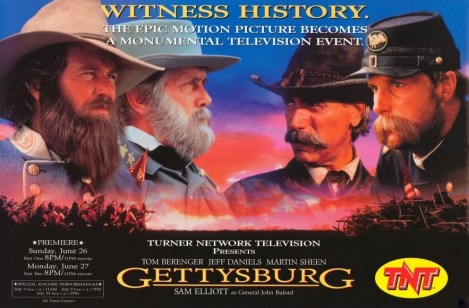
My brother and I usually talk on the phone on Sunday mornings, usually while I’m on my weekend hike. (That wasn’t the case today, however, because of the heat.) I hadn’t called him first because I was watching the DVD version of Ken Burns’s multi-part documentary The Civil War (1990), specifically the episode relating to Gettysburg, Vicksburg, and Chickamauga. Dan was curious to know why I was watching it. I replied that, frequently, during the hottest part of the summer, I would read a lot about the Civil War and watch DVDs on the subject. For instance, last month I watched Ted Turner’s production of Gettysburg (1993) with Tom Berenger, Martin Sheen, and Jeff Daniels.

“Boy, you really like living in the past, don’t you?” was Dan’s response.

“Absolutely,” I replied. “There’s little to like about what’s happening right now. After all, we’re getting ready to go to war again in the Middle East.”

Strictly speaking, I don’t live in the past. Although my tastes in music might be mostly 18th and 19th century, I am very partial to Jazz, the Blues, and folk music. I am more aware of what’s happening than people who rely on television news. Perhaps I do read the papers, getting the Los Angeles Times home-delivered seven days a week; but I get most of my news updates from the Internet, from the websites of CNN, MSNBC, and the BBC. Occasionally, I also check out Al Jazeera.

I am quite aware that many people who live in the past do so out of fear of the present. I have no particular fear of the present. If I like the history and literature of the past, it is partly to understand the present. Take a look at the illustration above, for instance: We are still fighting the American Civil War a hundred and fifty years later. The  Confederate States of America have found a way to bollix up the Senate by requiring that all measures pass with at least a 60-40 vote in order to avoid a filibuster. Do we have majority rule in the Senate? Not really. We’re sill hung up on States’ Rights, and talk of Secession is still in the air. We may no longer have literal slavery; but racism is rife and the villains have shifted from the rich plantation owners to the rich CEOs, the so-called One Percent.

No, if I spend time in the past, it is with an eye to the present. I urge all of you to read Herodotus, Thucydides, Livy, Tacitus, Philippe de Commynes, Gibbon, Parkman, Prescott—and, yes, the Civil War historians—for a unique perspective on the present.

Another War Nobody Wants

Just What We Needed!

Just What We Needed!

I guess things have been going too well for us lately. It must be time for another war. Let’s dust off those “Support Our Troops” signs and wave that raggedy flag. We are about to step once again into that Tar Baby par excellence, the Middle East, which is full of people who hate us and want to get even with us for … for … I forget what. We don’t understand them, though they understand us somewhat from being exposed to our entertainment media for so long.

There is no possible good outcome from our involvement in Syria. Innocent Syrians will be killed by our weaponry, and thousands of people will thereupon discover they have a blood feud with the United States. I thought Obama was smarter than that.

Let’s say we have a super bomb in our arsenal that will seek out Bashar al-Assad and blow him to kingdom come. Then what? Even such a surgical strike will lead to a civil war among Islamists, al-Qaida, Baathists, Druzes, Shi’ites, Alawites, and others. Are we going to send in referees with striped shirts to declare who will be the winner and who is fighting fair. No one will be fighting fair, and of one thing I am certain: Before long, all weapons will be aimed at us. So much for gratitude, huh?


Act Like It’s a Victory

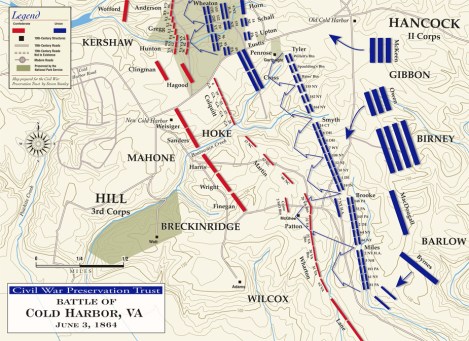
Schematic of the Battle of Cold Harbor

Schematic of the Battle of Cold Harbor

I think I am coming to the end of my Civil War enthusiasm. But then, it can suddenly be revived at a moment’s notice—so don’t count too much on it.

My chief interest has been Ulysses S. Grant, who finally figured out how to win the Civil War for Lincoln. There had been so many failures in the leadership of the Army of the Potomac. A noxious pattern was established, which consisted of rampant braggadocio followed by condign defeat followed by a retreat to lick their wounds.

Look at that schematic of the Battle of Cold Harbor. Like all the victories of Grant’s 1864 Overland Campaign, it was by no means a rout. It could even be viewed as a defeat. The Army of the Potomac suffered more casualties than the Army of Northern Virginia—except for one key difference. Grant stayed put and prepared for the next battle, and Lee inexorably backed toward the Confederate capital at Richmond. (This is exactly the opposite of Lee vs. previous commanders of the Army of the Potomac, who always backed toward Washington in case they had to defend it.)

Between the Battle of the Wilderness and the Siege of Petersburg, Grant kept applying the pressure, and Lee kept responding. Casualties almost didn’t matter. If Lee lost a man, he had great difficulty replacing him. For Grant, there was a pool of two and a half million men of military age who had not yet served (though it was difficult at times getting them to enlist).

By acting as if the battle were a victory and getting ready for the next one, Grant guaranteed a Northern victory.


Favorite Films: Gettysburg (1993)

Probably the Greatest Ever Movie Made for Television

Probably the Greatest Ever Movie Made for Television

Since reading the second volume of Shelby Foote’s magnificent The Civil War: A Narrative, I have decided to read some more histories during the heat of the summer. But first, I thought it was a good time to see the Turner movie of Gettysburg directed by Ronald F. Maxwell.

The film is a real labor of love, with excellent performances by Martin Sheen as Robert E. Lee (he was too short for the role, but was most convincing), Tom Berenger as General James Longstreet, Sam Elliott as General John Buford, and Jeff Daniels as Colonel Joshua Chamberlain. What is so remarkable is that so many of the minor roles were acted with so much passion that they stick in the mind even after twenty years. I am thinking particularly of Richard Jordan as General “Lo” Armistead; Patrick Gorman as General John Bell Hood; and Brian Mallon as General Winfield Scott Hancock.

The use of Civil War re-enactors on both sides made a big difference. This was literally a cast of thousands—thousands of enthusiastic volunteers who had their own uniforms and were accoutered with all the authentic accessories. The only disadvantage to using re-enactors is that so many of them are stout and in late middle age, but one can overlook that.

Also significant was that the script was based on Michael Shaara’s novel The Killer Angels, which focussed on several key parts of the battle, namely the charge on Little Round Top and Pickett’s suicidal charge on the center of the Union line on Cemetery Ridge. There were other actions that never quite make it to the forefront in histories, not to speak of this movie: I am thinking of Ewell’s assaults on Cemetery Hill (not to be confused with the Ridge) and Culp’s Hill. Without that focus, the battle, like many Civil War battles, tends to be too diffuse. (The classic example of a diffuse battle was Chickamauga fought near Chattanooga later that year.)

As good as Gettysburg the movie is, the same director tried to make a prequel ten years later: Gods and Generals (2003) was a rather flaccid failure. Jeff Daniels plays the same role, but he had gained quite a few pounds while he was at Chancellorsville a scant few months earlier.


From the Confederate Point of View

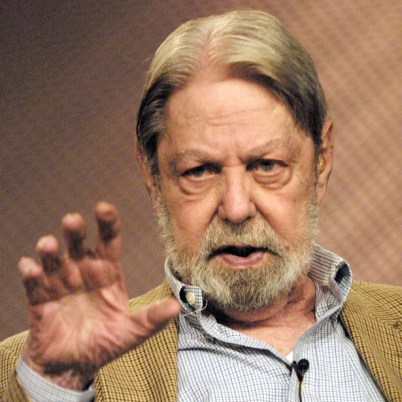
Historian Shelby Foote (1916-2005)

Historian Shelby Foote (1916-2005)

If you have ever seen the multipart Ken Burns documentary on the Civil War first broadcast by PBS in September 1990, you will undoubtedly remember Shelby Foote (above), who is famous for his trilogy The Civil War: A Narrative. For today, I decided to post my review of the second volume of his trilogy, covering the pivotal year of 1863.

Ever since I first came across the works of Bruce Catton in my teens, I have been an aficionado of the American Civil War. So much concentrated slaughter among peoples who resembled one another so much! Also, so many lessons to be learned about the arts of leadership, and what happens when they are lacking—as in all but the last generals in charge of the Army of the Potomac!

This is the second volume of three of historian Shelby Foote’s The Civil War: A Narrative. Nestled away in the “Bibliographical Note” section at the end is this revealing quote:

As for method, it may explain much for me to state that my favorite historian is Tacitus, who dealt mainly with high-placed scoundrels, but that the finest compliment I ever heard paid a historian was rendered by Thomas Hobbes in the forward to his translation of The Peloponnesian War, in which he referred to Thucydides as “one who, though he never digress to read a Lecture, Moral or Political, upon his own Text, nor enter into men’s hearts, further than the Actions themselves evidently guide him … filleth his Narrations with that choice of matter, and ordereth them with that Judgement, and with such perspicuity and efficacy expresseth himself that (as Plutarch saith) he maketh his Auditor a Spectator. For he setteth his Reader in the Assemblies of the People, and in their Senates, at their debating; in the Streets, at their Seditions; and in the Field, at their Battels.” There indeed is something worth aiming at, however far short of attainment we fall.

I don’t think Foote falls far short at all. In Periclean Athens, there was not much first-hand information upon which the historian could rely, whereas the Civil War is one of the most written-about episodes in all of world history. In addition to making his information vivid, Foote has to wade through terabytes of minutiae to find interesting episodes. One example: Southern General Nathan Bedford Forrest, encountering one of his men in headlong retreat, stopping him in his tracks, pulling down his trousers, and administering a savage spanking with a brush in front of his peers to motivate him to reconsider, which he did.

The period covered by the volume is calendar year 1863, in which two of the most decisive Union victories took place: Gettysburg and Vicksburg — right around the 4th of July. The other major battle discussed was Chickamauga, a Southern victory which ruined the careers of both generals, Rosecrans and Bragg, and which could have gone either way if a third of the Union line had not panicked and run. There is also a brief look-ahead to the spring of 1864, when U.S. Grant was named a Lieutenant General and appointed to the Army of the Potomac.

This 966-page book seems shorter than its weight would imply. That is due to Foote. In fact, this volume is so good that two extracts have been separately published as books: The Stars in Their Courses about Gettysburg and The Beleaguered City about Vicksburg, both of which are excellent reads in their own right.

Boo-Birds and Soreheads

Alexander Stephens, Vice President of the Confederate States of America

Alexander Stephens, Vice President of the Confederate States of America

In the past, I have been critical of what I sneeringly referred to as the Confederate States of America. Now, as I am slowly working my way through the second volume of Shelby Foote’s magnificent The Civil War: A Narrative, I realize that further distinctions need to be made.

On the Southern side were such admirable and talented men as Jefferson Davis and Robert E. Lee, and such great generals as Thomas “Stonewall” Jackson and Nathan Bedford Forrest (though the latter, as founder of the Ku Klux Klan, was not terribly admirable).

Where I was mistaken is that certain political partisans, such as the Tea Partiers, have more in common with the people who were like a saddle sore to Davis and Lee. The diminutive Alexander Stephens, Davis’s Vice President, got so disgruntled by the politics of Richmond that he just moved back to his home state of Georgia and stayed there. The Confederate paper dollar plummeted in value, eventually sinking to one-twelfth the value of a gold dollar. As Foote writes:

[T]here were many behind the southern lines who disagreed with [Davis]; who were also for peace, but only on Union terms. Some had lost heart as a result of the recent reverses [at Gettysburg and Vicksburg], while other had had no heart for the war in the first place. The latter formed a hard core of resistance around which the former gathered in numbers that increased with every Federal success. It was these men Davis had in mind when, after referring to “threats of alienation” and “preparation for organized opposition.”

I cannot help but think that the Limbaughs and Hannities of our time would also have fought against their government at Richmond. There is a certain strain of sorehead or boo-bird that is incompatible with any leader who is actually trying to accomplish something even halfway laudable—even if we were to assume that States’ Rights was a laudable goal (which I myself do not).

After Gettysburg, Lee asked Davis to be relievbed of his command.  Davis responded with a heartfelt letter that made the Army of Northern Virginia take back his resignation:

RICHMOND, VA., August 11, 1863.

GENERAL R. E. LEE,

Commanding Army of Northern Virginia.

GENERAL : Yours of the 8th instant has been received. I am glad that you concur so entirely with me as to the wants of our country in this trying hour, and am happy to add that, after the first depression consequent upon our disasters in the West, indications have appeared that our people will exhibit that fortitude which we agree in believing is alone needful to secure ultimate success.

It well became Sidney Johnston, when overwhelmed by a senseless clamor, to admit the rule that success is the test of merit, and yet there is nothing which I have found to require a greater effort of patience than to bear the criticisms of the ignorant, who pronounce everything a failure which does not equal their expectations or desires, and can see no good result which is not in the line of their own imaginings. I admit the propriety of your conclusions, that an officer who loses the confidence of his troops should have his position changed, whatever may be his ability; but when I read the sentence, I was not at all prepared for the application you were about to make. Expressions of discontent in the public journals furnish but little evidence of the sentiment of an army. I wish it were otherwise, even though all the abuse of my self should be accepted as the results of honest observation.

Were you capable of stooping to it, you could easily surround yourself with those who would fill the press with your laudations and seek to exalt you for what you have not done, rather than detract from the achievements which will make you and your army the subject of history, and object of the world’s admiration for generations to come.

I am truly sorry to know that you still feel the effects of the illness you suffered last spring, and can readily understand the embarrassments you experience in using the eyes of others, having been so much accustomed to make your own reconnoissances. Practice will, however, do much to relieve that embarrassment, and the minute knowledge of the country which you have acquired will render you less dependent for topographical information.

But suppose, my dear friend, that I were to admit, with all their implications, the points which you present, where am I to find that new commander who is to possess the greater ability which you believe to be required ? I do not doubt the readiness with which you would give way to one who could accomplish all that you have wished, and you will do me the justice to believe that, if Providence should kindly offer such a person for our use, I would not hesitate to avail of his services.

My sight is not sufficiently penetrating to discover such hidden merit, if it exists, and I have but used to you the language of sober earnestness, when I have impressed upon you the propriety of avoiding all unnecessary exposure to danger, because I felt your country could not bear to lose you. To ask me to substitute you by someone in my judgment more fit to command, or who would possess more of the confidence of the army, or of reflecting men in the country, is to demand an impossibility.

It only remains for me to hope that you will take all possible care of yourself, that your health and strength may be entirely restored, and that the Lord will preserve you for the important duties devolved upon you in the struggle of our suffering country for the independence of which we have engaged in war to maintain.

As ever, very respectfully and truly,

(Signed) JEFFERSON DAVIS.

I take back my words about the Confederates States of America. Even in the South, there were Archangels, and there were also malignant spirits.

A Grim Secret

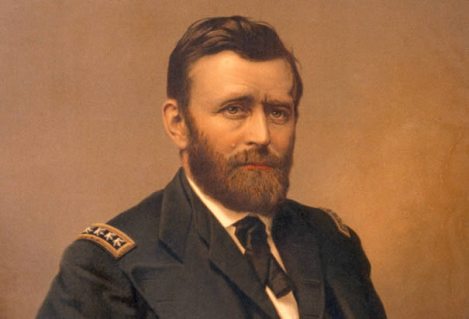
Union General Ulysses S. Grant

Union General Ulysses S. Grant

Ulysses S. Grant was an altogether unprepossessing man. He didn’t have the swagger or gravitas of such Union generals as McDowell, Pope, McClellan, Burnside, Hooker, or Meade; but on the other hand, he was not a coward, a poltroon, or pathologically cautious either. His successes were due not only to his pertinacity, but to a grim secret that he knew and made use of as head of the Army of the Potomac.

Yes, the South had the more dashing generals, but they were on the wrong side when it came to the numbers. You see, the North had a larger population of eligible males to sacrifice to death, disability, and capture than the South. The South had, for all practical purposes, 100% conscription. At the end of the war, there were still at least 2 million eligible men who hadn’t worn the blue uniform. Take a look at this website by the Civil War Trust or charts and tables on Civil War casualties.

This Chart Says It All

This Chart Says It All

The other factor was that Grant never ran. At the end of the battle, he was still there and still game for more bloodshed—not for the sake of shedding blood, but for the sake of ultimate victory.

I have been reading the second volume of Shelby Foote’s The Civil War: A Narrative. Even with his Confederate sympathies, Foote could appreciate Grant’s grand strategy at Vicksburg. If the North won Vicksburg, the whole Trans-Mississippi South would be lost. The problem was: How to get at it. The most obvious way was to invade Mississippi and take it from the rear. Unfortunately, that failed; and in any case the area was controlled by the South’s most ingenious and fierce commander of cavalry, Nathan Bedford Forrest. (After the war, Forrest was one of the founders of the Ku Klux Klan.)

Grant was not afraid to fail, and he failed a total of seven or eight times before he found a way of marshaling his army and navy forces to effect a landing on the eastern side of the Father of Waters, well out of the way of Forrest’s cavalry. He made straight for Jackson, Mississippi, where he wrecked the railroad lines that supplied the Confederates at Vicksburg. Along the way back toward Vicksburg, he fought two battles at Champion Hill and the Big Black River. Then and only then did he directly besiege Vicksburg. From then on, it was pretty much a matter of starving the rebels until they surrendered early in July.

It was right around then that the North won its decisive victory at Gettysburg.

It wasn’t long before Lincoln concluded that, in Grant, he had a general who could outfight Lee’s Army of Northern Virginia. That is exactly what he proceeded to do in what has come to be known as his Overland Campaign. It didn’t matter how many men he lost jat battles such as the Wilderness, the North Anna, Spotsylvania Court House, and Cold Harbor just so long as he didn’t fall back after each battle, as the Army of the Potomac was wont to do. He not only did not fall back: He pushed Lee’s forces step by step closer to the final showdown in front of Richmond. And by then, it was all over.

Too bad that Grant made such a terrible President. He was a smart man, and a great military leader, but none of us are perfect.


Sheer Funk

“Fighting Joe” Hooker

“Fighting Joe” Hooker

It is no secret that, until he decided on Ulysses S. Grant, President Lincoln had nothing but trouble with his generals in charge of the Army of the Potomac. They were specialists in losing battles, such as Ambrose Burnside at Fredericksburg, who would have attacked again into the teeth of Robert E. Lee’s guns had Lincoln not removed him. When he did, he replaced him with “Fighting Joe” Hooker, one of the more promising of his subordinates.

At the outset, Hooker looked good. Not only was he dashing and debonair, but he seemed to have put together a good plan for attacking—and encircling—Lee’s Army of Northern Virginia.

But then, something happened. Lee and Stonewall Jackson worked out a highly successful attack on Hooker’s right flank at Chancellorsville. That flank folded, spectacularly. And then, surprisingly, Hooker folded. It was a case of sheer funk. He started issuing contradictory orders while Lee picked him apart. Even when one of Hooker’s generals (Sedgewick)  re-took Fredericksburg, it still made Chancellorsville one of the North’s most spectacular losses.

It reminds me of the time I was backing up my car in a parking lot, not thinking someone was right behind me. It was a woman driver who just panicked as she saw my car coming at her at the frightening speed of 5 mph.

There had been no sign in previous battles that Hooker would lose his marbles once he was put in charge. But he did nonetheless.

Incidentally, the term hooker to refer to a prostitute comes from Joe Hooker’s surname. Before he took charge, he was quite a drinker and parter. Perhaps he should have had a few drinks at Chancellorsville, together with some loose women. The result couldn’t have been worse.

Unfortunately for Lee, he lost his favorite subordinate, Stonewall Jackson, to a case of friendly fire. What was at first a wounded arm wound up being an amputated arm followed by a fatal case of pneumonia.