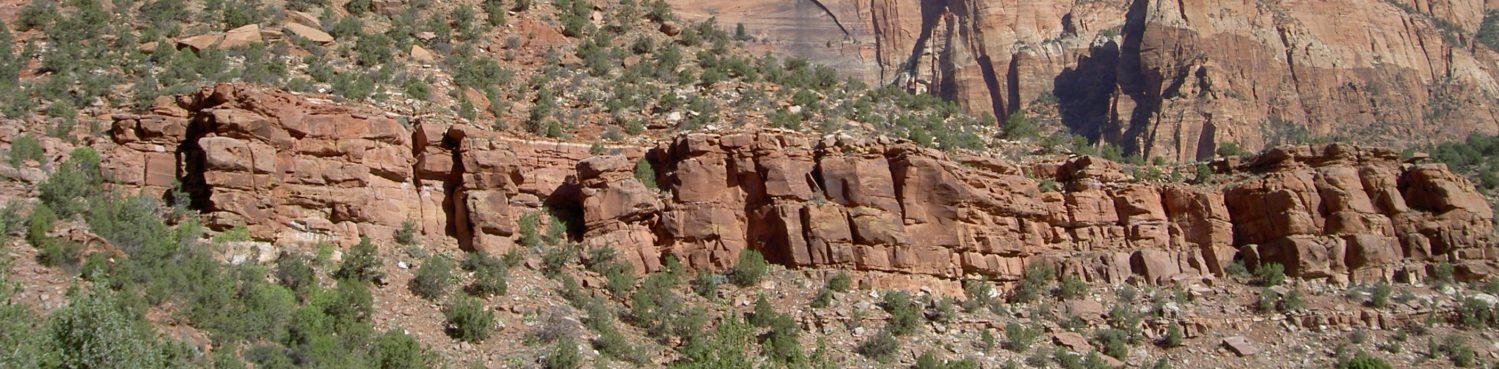

A Different Order of Beauty

Orchids at Honolulu’s Foster Botanical Garden

At first, I saw nature from the point of view of a Midwesterner. Cleveland had some few beauty spots in its extensive park system, but they tended to be muted. And then there was the matter of Cleveland’s horrible weather.

Then, when I came out to Southern California, I saw that the desert had an entirely different beauty. I am still exploring it slowly. After all, the desert is not an inviting place during the summer months.

In our recent visits to Honolulu, Martine and I visited a couple of botanical gardens, most notably the Foster which abuts Chinatown on the north. We didn’t see any of the other islands, though I am sure there were eye-opening botanical gardens elsewhere, too.

I am eager to visit Alaska. There is yet another order of beauty: Majestic and huge, dwarfing the human scale.

In 1965, John Ford directed a film about Sean O’Casey entitled Young Cassidy. In one scene, William Butler Yeats offers the O’Casey character some advice which has kept rattling around inside my head:

You’re young Cassidy, and that makes your passion effortless and artless. Think towards the day when you are old and the passion is painful and remorseless. What you have now has given you pity. What you must one day find will give you compassion. Age, the winter days, make the chill of the frost as compelling as the heat of the sun. Lovers look towards the time of day when the sun goes down. But give a thought to the time, when as an old man, you’ll be surprised to see the sun come up. The warmth of your girl’s body inspires you now, Cassidy. There will be a time when you must be inspired by the Arctic waste. Prepare for that.

Yes, I can see myself being inspired by the Arctic waste, or the Mojave desert, or the tropical islands of the Pacific. It’s all part of really and truly being where you are, and allowing yourself to be acted upon by all the flavors and colors and tonalities of life.

Saxophone Lessons

Downtown Cleveland When I Was Young

At the time I agreed to take saxophone lessons, not only did I not know what a saxophone was, but I had no idea I would have to spend hours each week “practicing.” I wanted to play a trombone, but the music store salesman saw the look in my parents’ eyes and said something to the effect that I had the wrong kind of teeth for blowing into a trombone. It worked: He made the sale.

My music teacher was Jack Upson, who had a studio on East 4th Street, almost in the dead center of the postcard image above. (The tall building was the Terminal Tower, at that time the tallest building in the U.S. outside of New York City.)

Every week, I took the 56A bus downtown. It let me off at Prospect and Ontario. From there, I walked two blocks or so to Jack Upson’s studio.

Truth to tell, I never liked the saxophone as a musical instrument. The moisture from my mouth formed a gooey discharge that made the reed of the sax very mucky after a while. What I did enjoy was being downtown on my own. I would eat lunch at Woolworth’s lunch counter, walk around a bit, and hang out at Schroeder’s book store on Public Square.

I started playing the sax at age nine and quit at age eighteen, when I went out of town to college. Seeing that my parents weren’t there to force me to practice, I just quit playing altogether. I was no good at it anyway; and it was no fun playing an instrument only because my mother and father liked it. More importantly, I didn’t like it.

My Libraries

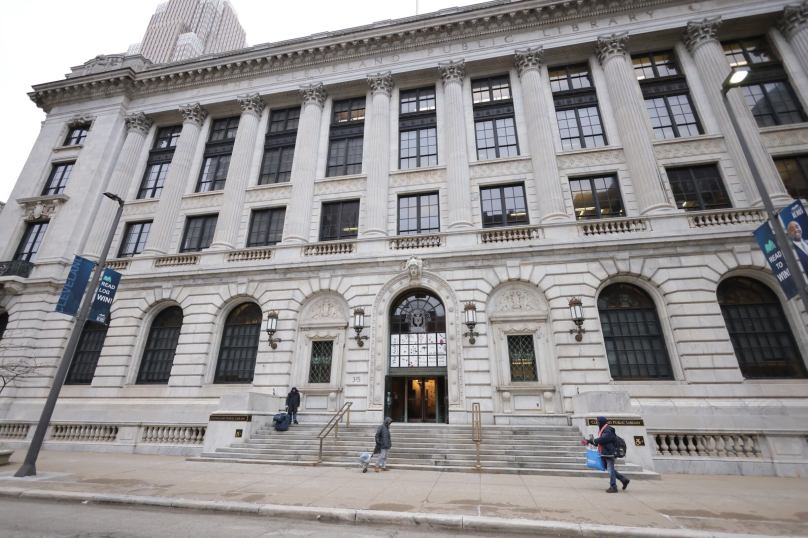
The Main Branch of the Cleveland Public Library Downtown

Books and libraries have always played an important part in my life.

When I was a toddler, my mother took me to the branch of the Cleveland Public Library on East 109th Street (now Martin Luther King Drive). Not that I could read, but I could indicate based on the illustrations the books I would be most interested in. She would check them out and read them to me in Hungarian, probably embroidering a bit. The one book I remember from that period was Dr. Seuss’s The King’s Stilts, which I now have in my collection.

In 1951, after my brother Dan was born, we moved to the Lee-Harvard Area on the East Side of Cleveland. For many years, I went to the Lee-Harvard branch which was located on Lee Road, first north of Harvard, and then south of it. The head librarian was a fellow Hungarian, Mr. Matyi, who played the oboe in the Cleveland Philharmonic Orchestra.

During my college years at Dartmouth, I spent many hours at Baker Library, which was modeled after Independence Hall in Philadelphia. What I loved most about it were the frescoes in the reserve room that were painted in the 1930s by José Clemente Orozco.

Jose Clemente Orozco, Murals at Baker Library Reading room, Dartmouth College, Hanover NH; The Machine

Once I moved to Los Angeles, I spent some time at the UCLA University Library, but I liked going to the main branch of the Santa Monica Public Library—which satisfied me until an opportunity opened up with the construction of the E (for Expo) Line of the Metro Rail. Driving and parking downtown was always a major pain. But now I was able to whiz downtown for 35 cents in three quarters of an hour.

I am now hooked on the Central Branch of the Los Angeles Public Library. Not only because of the library’s holdings, but various events sponsored by the library, especially the guided Thursday mindful meditation sessions.

The one library I forgot to mention is my own personal library of some 6,000 volumes, which I am slowly trying to thin by donations.

East Side, West Side

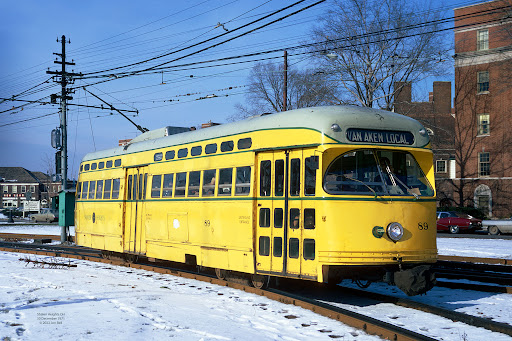
Cleveland’s Shaker Rapid—Way Back When

This was a particularly vivid dream that I had last night. I was visiting in Cleveland, and my mother was still alive. I was wandering the streets of downtown looking for the bus stop of the #71 CTS (Cleveland Transit System) line that went down Pearl Road to York Road, letting me out in Parma Heights where my mother lived.

The stop used to be near the corner of Prospect and Ontario, but in my dream the streets were different; and I didn’t see any bus stops. So I walked to Public Square and around Euclid and Superior Avenues, noting where Schroeder’s Bookstore used to be when I was young.

I gave up and decided to take the Shaker Rapid instead and headed for the concourse under the Terminal Tower.

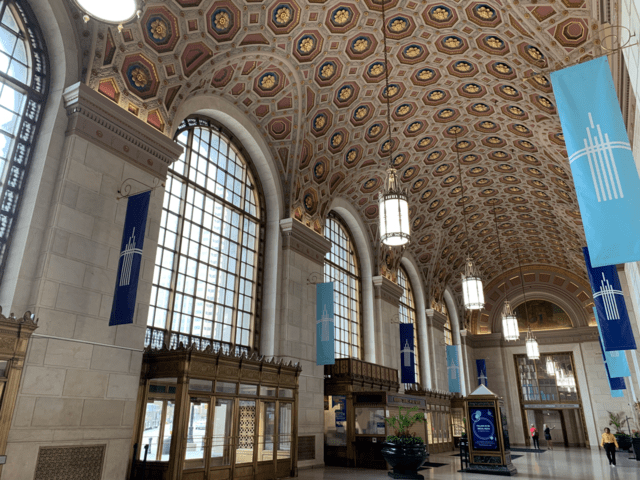
Entrance to the Terminal Tower Concourse

But wait! Mom lived in Parma Heights on the West Side of Cleveland, while the Shaker Rapid served the East Side, where we used to live in the Lee-Harvard area.

My dream ended inconclusively, as I got stuck in a busy store and then had to deal with a Shaker Rapid ticket seller who pointedly ignored me.

It wasn’t a nightmare: I almost never have nightmares. It was just a curious amalgam of my many trips from home to downtown and back again. It was at a point after my childhood after 1985, when my father died. My widowed mother lived alone in Cleveland until she decided to move to Hollywood, Florida, a number of years later.

From Ghoulardi to Rollergirl

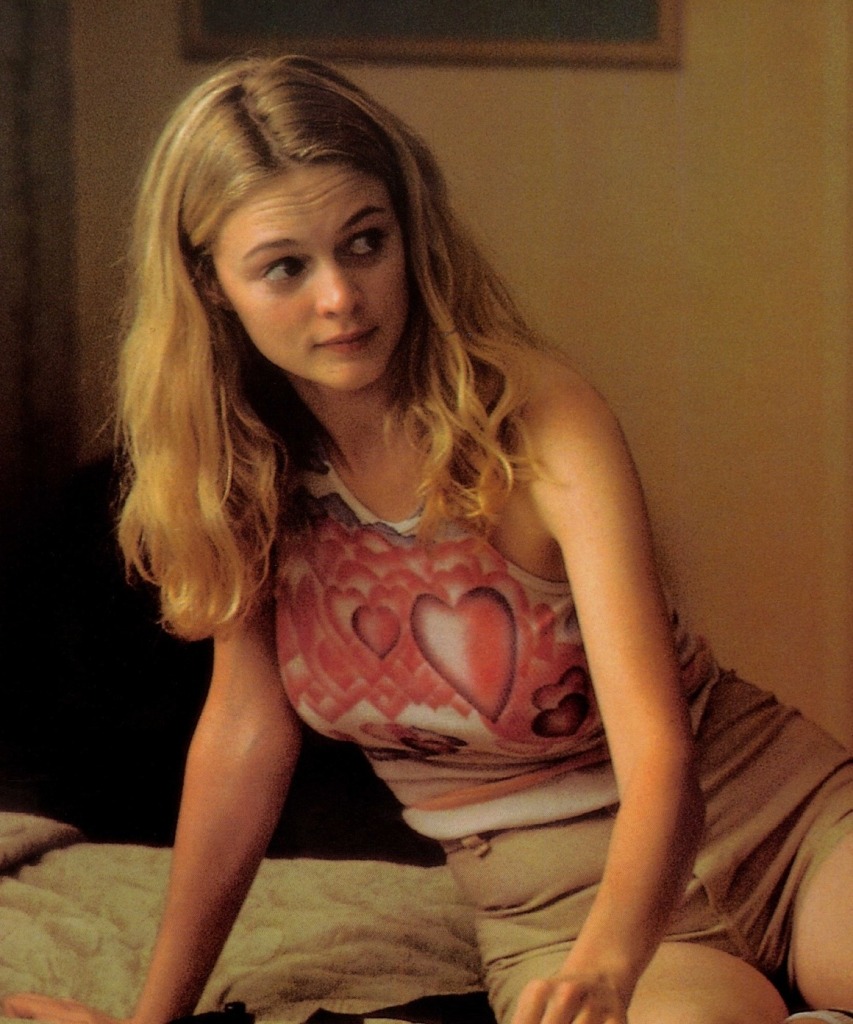
Heather Graham as Rollergirl in Boogie Nights

She’s an attractive young star in the stable of go-to actresses around Burt Reynold’s porn studio in the 1970s and 1980s. Called Rollergirl because she never takes off her inline skates, even during sex, she helps to recruit Mark Wahlberg by seducing him in the nightclub where he works as a bus boy. She is an intriguing presence in Paul Thomas Anderson’s film Boogie Nights (1997).

Decades before the film was made, the director’s father, Ernie Anderson, was a big star on WJW-TV, Channel 8 in Cleveland. He played a character named Ghoulardi who hosted horror films between 1963 and 1966. In between scenes of the films he showed, he made fun of Cleveland¹s Polish population with their polkas and white socks and flamingo lawn ornaments, and particularly when they lived in the southwestern suburb of “PAHR-ma?” His catch phrases were “turn blue” and “stay sick.”

If you were a teenager in Cleveland during the 1860s, you watched Ghoulardi and adopted his mannerisms the next Monday in the school cafeteria.

One final note: If you watched reruns of the Carol Burnett Show, you may recall that in the opening scene, when Carol comes out on stage to answer questions from the audience, she occasionally gave a call-our to Ernie Anderson, who was a frequent member of the studio audience. Ernie typically smiled and gave a little wave to acknowledge. That was Ghoulardi, who had come to Los Angeles and served a number of years as announcer for the show after Lyle Waggoner had left.

It’s a long way from horror films in Cleveland in the 1960s to his son’s explicit study of the emerging L.A. porn scene filmed in 1997.

My Cities: Cleveland

This is the first in a series of posts on cities where I have lived or traveled to or even just yearned to visit. It is natural that I begin with the city in which I was born, namely, Cleveland, Ohio. Once I left to go to college in 1962, my visits have all involved school vacations, family visits, or family funerals. In the 1960s, Cleveland was a city that was going nowhere. Jobs were vanishing, particularly from what had once been a healthy industrial base.

And, to make matters worse, my parents’ marriage seemed to be coming apart, after almost twenty years. (Fortunately, it never did.) Nonetheless, I didn’t want to stick around for the escalating nastiness.

So when, during a family truce, my folks drove me to the wilds of New Hampshire, I was already not planning ever to return to Cleveland unless I had to. It was only when I wound up in Los Angeles to attend grad school that Mom and Dad realized that I would never again live in the family home on Lawndale Drive.

Yet after almost half a century on the West Coast, I no longer have any negative feelings about Cleveland and the monster that, according to Seymour Krebs of “Dobie Gillis” fame, devoured it. On the other hand, there is no longer any reason for me to go there. My mother and father have both passed on (in 1998 and 1985 respectively), and my brother now lives in the Coachella Valley of California. My uncle and aunt are no more, and my cousin Emil is also gone. The only remaining members of my family are my cousin Peggy and her three daughters—but I was never particularly close to them as I was to Emil.

Cleveland has some wonderful museums, a world-class symphony orchestra, and some top-notch colleges and universities. But lost forever is the Hungarian neighborhood that helped nurture me—all moved to the distant suburbs and become deracinated.

A Vanished Legacy

My Old Grade School—Since Renamed

Between September 1951 and June 1958, I attended Saint Henry Catholic School in Cleveland, Ohio. It was taught mostly by Dominican sisters who had a two-story convent on the premises. I started in second grade after having finished only half of first grade at Harvey Rice Elementary School in the old Buckeye Road neighborhood. My persistent nightmare is that someone will find out that a illegally skipped half a grade and force me to go back to Cleveland and sit at one of those tiny desks and spend my days trying to puzzle out phonics.

I suspect that we moved to the Harvard-Lee neighborhood primarily because, when I lived in the old Hungarian neighborhood, I didn’t speak English, which didn’t help my academic standing.

The good sisters at Saint Henry forced me to become more of an American (and less of a Hungarian). With my poor second grade marks, Sister Frances Martin O.P. (short for Ordinis Praedicatorum, or Order of Preachers) would sneak up behind me when I misbehaved, pull my ears and call me “cabbagehead.”

My grades improved, until in fifth grade I was considered less of a wiseacre and more of an “A” student. My seventh grade teacher, Sister Beatrice, was in her eighties when she taught my class. In eighth grade, I had Sister Rose Thomas.

Back at Saint Henry, we typically had an average of 55 students per class. At some point, the Harvard-Lee neighborhood became majority African American and (probably) Baptist. The church (whose entry is the door on the right in the above photo) was closed down; and in 1993 the school was renamed Archbishop Lyke School Saint Henry Campus, with an average of 17 students per class.

While I was in college, my parents joined the “White Flight” to the all-white community of Parma Heights on the West Side of Cleveland, where my brother attended Holy Family School.

When last I was in Cleveland—for my mother’s funeral in 1998—I couldn’t recognize the old Harvard-Lee neighborhood. The trees that were planted when the neighborhood was new right after the Second World War were now massive. We never had anything like that in the way of shade during the 1950s and 1960s.

Doctor K Is Out

It Was Decidedly My Worst Dental Visit

This happened at some point during my high school years, sometime between 1958 and 1962. I had a cavity that needed to be filled, so my parents took me to see Doctor K who had an office at the Southgate Shopping Center at the corner of Libby and Northfield Roads. My parents sat patiently in the waiting room while Dr. K drilled away at my tooth.

The time was late afternoon. Doctor K put the suction tube in my mouth and stepped out. For a very long time. In fact he left the office and went to dinner while all the moisture in my body was being sucked through the tube. He must have taken another exit, because my parents didn’t see him leave.

When he returned an hour later, there were sand dunes and cacti in my mouth. He calmly finished drilling and filled the cavity. When I stepped into the waiting room, my father and mother were annoyed at the time it took. When I told them Doctor K had left the office for an hour, my father told him he could whistle all the way to Warrensville if he wanted to be paid for his rudeness.

We never went back to Doctor K. I was all right with that.

Scarebabes

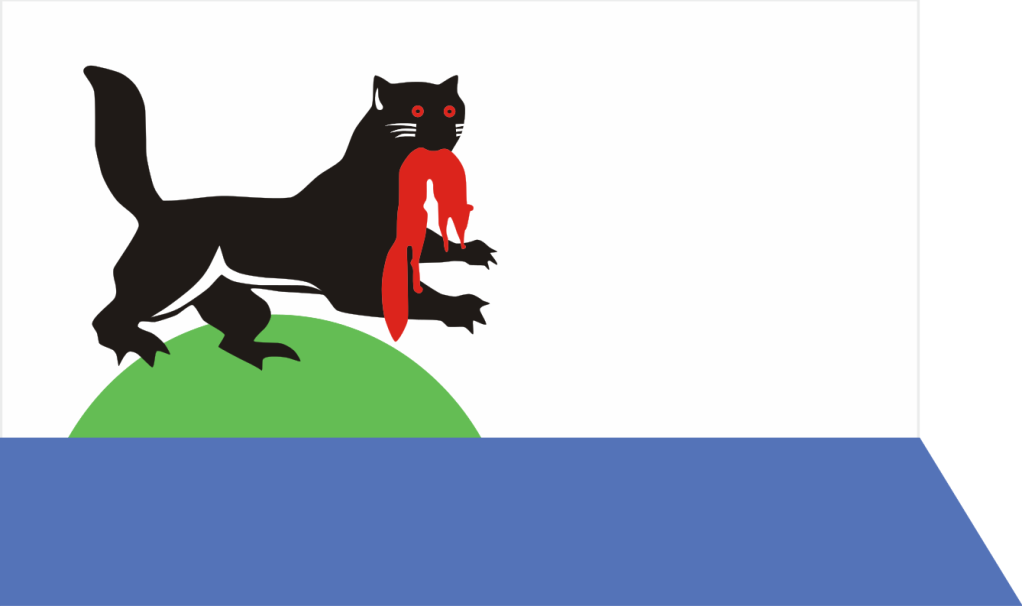
The Scary Flag of Irkutsk Oblast in Siberia

This post is about the things that scared me as a child. In it, I go back as far as I can in my memory banks, back to before I was two years old. There are three things that scared me around that age.

First and foremost was … would you believe … toilet training. We were living in the Hungarian Buckeye Road neighborhood of Cleveland, and my great grandmother was living with us. She was born in Felcsut (pronounced FEL-choot) in the province of Fehérmegye (don’t even TRY to pronounce that one) sometime around 1880. She was old school. Not only that, she didn’t particularly like me at that time because I was the son of that fuszóru Tóth (cock-nosed Slovak) who was my father. (She was later to love my brother me and me, but never my father.) Therefore, she was fairly brutal about my toilet training.

I remember my nightmares at the time. I was seated on the toilet and the walls of the bathroom would close in on me with the roaring sound of a steam locomotive. That occurred fairly regularly as I recall.

As an infant in the crib, I had a boogeyman which I couldn’t exactly describe, only that I knew him as the Lobogó (LOH-boh-goh), which is one of the Hungarian words for flag. It’s odd, because I wasn’t afraid of flags as such, just that word that sounded so sinister to me. My Mom would kid me that there was never any danger from the Lobogó.

Finally, I remember a series of nightmares I had in which I was being chased by a lion. My Mom and Dad must have taken me to the zoo, because how would I know about the existence of lions. This was at least two years before I ever saw a television set. It could have been in a fairy tale that my mother told me. She would make up wonderful stories about a fairy princess (tündérleány) in the dark forest (sötét erdő). A lion must have wandered into one of her tales.

The image above, which is the flag of Irkutsk Oblast in Siberia, combines the dread Lobogó (flag) with my lion nightmares. I particularly like the red eyes.

Sorry for all the Hungarian words, but at the time I didn’t know a word of English, or even that the English language existed.

Highland View

Above is an aerial view of Highland View Hospital in Warrensville Township, Ohio circa 1965. For a number of years, my mother worked there as an occupational therapy assistant; and I spent several summers in high school as a volunteer in the occupational and physical therapy departments.

At the time I volunteered there, I thought of Highland View as a hospital for the terminally ill, because most of the patients were seriously ill. The average length of stay per patient was 67 days. I don’t have any statistics about what percent of patients died there vs. were released.

As a volunteer for occupational therapy, I helped bring bed- and wheelchair-ridden patients from their rooms to an auditorium where a visiting volunteer named Harry Zasz screened movies from a 16mm projector onto a screen. After the show, I helped take the patients back to their rooms. The movies were standard Hollywood fare: I remember Pocketful of Miracles (1961) and Seventh Cavalry (1956) as two films that were shown several times over the years.

I remember one ambulatory patient who had a very visible dent one or two inches deep in his forehead.

Probably what impressed me was something that happened toward the end of my volunteer gig. I played chess with an elderly Puerto Rican patient named Manuel. I was proud to have defeated him, but chagrined to find he had passed away that night. So much for triumph!

Later, my mother moved on to Saint Vincent Charity Hospital near downtown Cleveland. I had a very short stint there as a volunteer in surgery. First they had been clean up a very bloody operating room after a surgery. Then they had me shave around the genitals of a man scheduled to have a hernia operation. I just didn’t have the stomach for surgery and didn’t go back.

Incidentally, Saint Vincent Charity was the hospital that appeared in Billy Wilder’s film The Fortune Cookie (1966) with Jack Lemmon and Walter Matthau. My Mom appeared in one shot, but the scene didn’t make it into the final cut.