
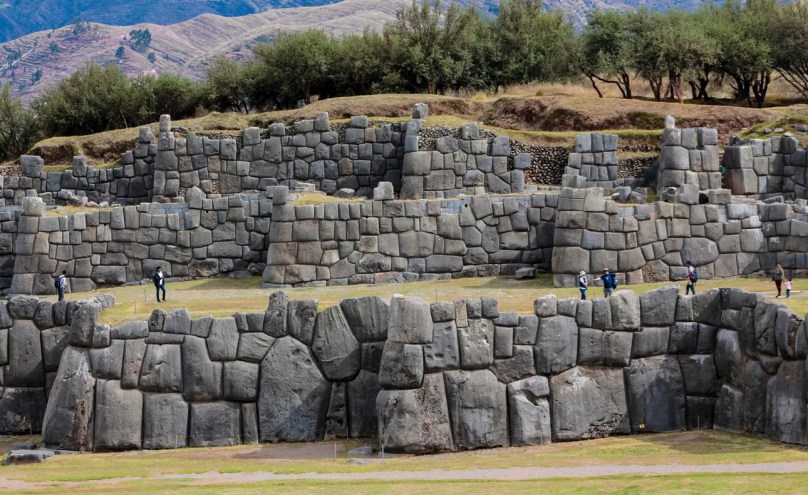
The Inca Ruins at Sacsayhuaman, Near Cuzco
To a generation of Gringo tourists visiting Peru, the impressive ruins at Sacsayhuaman near Cuzco were as often as not pronounced “Sexy Woman.” This will probably persist as long as Americans refuse to learn the intricacies of the Quechua language. When I visited Peru in 2014, I never made it to Sacsayhuaman. I wish I had. I have just finished reading George Woodcock’s Incas and Other Men: Travels in the Andes about a six week trip he took in the Summer of 1956. In it, he had some interesting things to say on page 199 about Sacsayhuaman:
But in fact nothing less than the elaborate centralized organization of the Inca realm at its peak of power could have embarked on such a project [as Sacsayhuaman], and modern scholars are now agreed that the fortress represents the master work of the great public engineers of the fifteenth century. Victor von Hagen, who examined the evidence critically, suggests in his Realm of the Incas that it was started around 1440, not long after Pachacuti began his campaigns of conquest, and that construction took seventy years and employed about 30,000 men, recruited by the mita system of forced labour. The stones seem to have been dragged to the site by teams of men using wooden rollers (presumably brought from the montaña since few trees grew around Cuzco until the eucalyptus was introduced a few decades ago), and to have been placed into position by a complex system of levers and earth ramps. The final shaping and fitting, other archaeologists have suggested, may have been done, after a rough cutting to size, by rubbing the stones against each other, with sand and water between their edges. Again it is largely conjecture, but whatever the methods used to assemble these gigantic walls, their patterns of vast polygonal surfaces have an extraordinary beauty which, combined with the massiveness of the fortress as a whole, make Sacsayhuaman by far the most dramatic building in Peru.


 Tarnmoor
You must be logged in to post a comment.