Still a Good Investment?

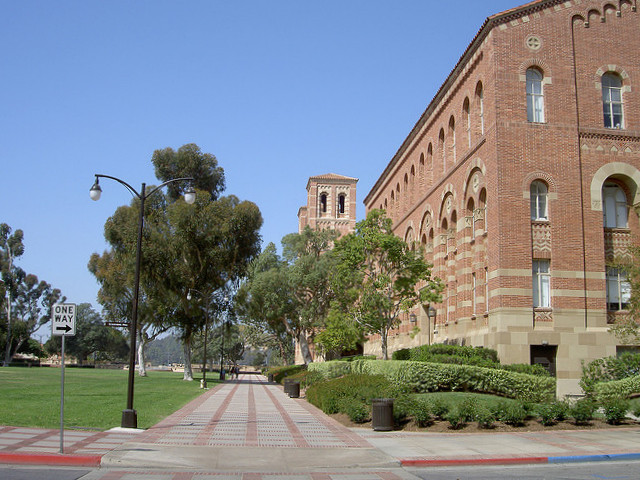
University Buildings at UCLA

University Buildings at UCLA

Over the years since I graduated from college, I’ve seen the cost of a university education climb to stratospheric levels. At the same time, I’ve seen massive unemployment among college graduates, sometimes even those with a postgraduate education. It forces me to think what I would do different if I had a couple of teenaged children to put through school (though in fact I have no children). Would I still at this date recommend that children go to college to improve their chances for the future?

Part of the problem is symbolized by that “One Way” sign in the above photo. It used to be that the object was to get everyone into college: It was a bargain back then. Even if the kids washed out within the first quarter or two, the thinking was that they were given the opportunity.

I went to an Ivy League college for four years—Dartmouth College in Hanover, New Hampshire—whose tuition back in the years 1962-66 was only $1,500 a year. With the dollar as it is today, that would be somewhere between $9,000 (using the CPI) to $27,200 (using the relative share of GDP) in 2012, the most recent year for which this calculation is available. For the academic year 2013-2014, Dartmouth’s tuition is now $45,445. The question I ask is this: Is a Dartmouth education worth twice as much as when I went to school? I think not. It’s still very good, but not at two to five times the cost.

Other related costs have also been skyrocketing. I am particularly incensed by textbooks that run to several hundreds of dollars each. I remember paying something under a hundred dollars for all the textbooks for an entire quarter. Admittedly, textbooks can be gorgeously produced with nice bindings and four-color illustrations, but is that always necessary? I can see where these expensive productions will eventually be replaced by software programs, but even then the temptation will be to charge more than they are worth, even after the production costs for multiple copies have plummeted.

So, what to do? There isn’t much chance that youth between the ages of eighteen and twenty-one will find jobs that at the same time do not require a college education, yet provide a reasonable opportunity for advancement. How does one advance after a job flipping hamburgers or selling tee shirts? A college degree will help, even though it has been devalued over the years. It costs twice as much in real dollars, yet probably isn’t as good as it was when my generation was on campus.

I still urge kids whose intellects are sharp to go to college whenever they can. It doesn’t have to be the best college, but it should be a decent one (and I don’t mean something like the University of Phoenix and its imitators). To get a good job after graduation, some thought has to be put into a good choice of a major. Perhaps it would help to have some kind of certification in certain subjects attesting to a student’s proficiency in, say, writing or mathematics. If instituted, it may even replace the whole notion of a major; and it may help grads with multiple certifications to have different options to choose from when looking for a job.

In 1966, I graduated with a major in English. Then I went on for two years at UCLA in motion picture history and criticism, stopping short of getting my M.A. for mostly political reasons. (The instructor I hated most got himself appointed to head up my thesis committee, upon which I switched over into computer software.) It was a good thing that I had taught myself how to become conversant with computers at Dartmouth, where every student was allowed free time on the Dartmouth Time-Sharing System, the nation’s first. That kind of flexibility to switch among career alternatives is becoming more important than ever.


Tarnmoor’s ABCs: Dartmouth College

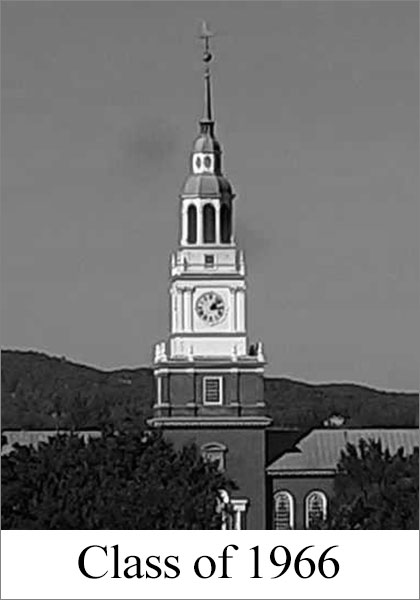
Dartmouth Hall

Dartmouth Hall

It was a beautiful place to spend four years, even if I had never really been more than a few miles away from home by myself before then. I went from being a valedictorian who had won all the non-sports-related honors at Chanel High School to one of hundreds of similar people from all around the country, including those famous prep schools that have sprouted up over all of New England.

At that time, Dartmouth College was isolated by the fact that the Interstate Highway system had not yet made its way into New Hampshire and Vermont. Today, Hanover, New Hampshire, is less than two hours from Boston via I-89. During the months of January and February, we were at times cut off from all supplies until the snow plows could cut a channel for cars and trucks. All four years, I stayed in Middle Wigwam Hall, which was later renamed to McLane Hall. My dorm stood a mile from the center of campus. To get to class, I had to trudge past the eerie old Hanover cemetery, with its tombs dating back to the Eighteenth Century, often on a sidewalk that had obligingly turned into a sheet of ice.

During those years, I suffered frequently from severe frontal headaches, which were the result of a pituitary tumor (chromophobe adenoma) pressing on my optic nerve. The attacks occurred on 50% of all days, with the “penumbra” of the headache beginning around 11 am and reaching a crescendo around midnight. That’s why I did most of my homework before midnight and 3 am. It was not until after I graduated that I was properly diagnosed: Until then, doctors did not know what to think—especially since MRIs and CT Scans had not yet been invented.

Pain and all, I loved Dartmouth. The quality of the instructors was, for the most part, incredibly high. Particularly in the English department, I had a succession of professors I will never forget: men like Chauncey Loomis, Peter Bien, and Thomas Vance.

At first, I hoped to become an English professor, until the movies turned by head. The Dartmouth Film Society screened great films, including a huge year-round Alfred Hitchcock festival. Plus I made the acquaintance of Arthur L. Mayer, the former “Merchant of Menace” from New York’s Rialto Theater and the author of Merely Colossal (1953). It was while at Dartmouth that I decided to go to graduate school in film history and criticism at UCLA—and that’s how I wound up in La La Land.

Dartmouth College had been founded as a missionary school for Indians in 1769 under the patronage of the Earl of Dartmouth. In 1819, the school made legal history when Daniel Webster argued before the Supreme Court in Trustees of Dartmouth College vs. Woodward, better known as the Dartmouth College Case. President Franklin “Handsome Frank” Pierce graduated from there and went on to become one of the most mediocre presidents in U.S. history.

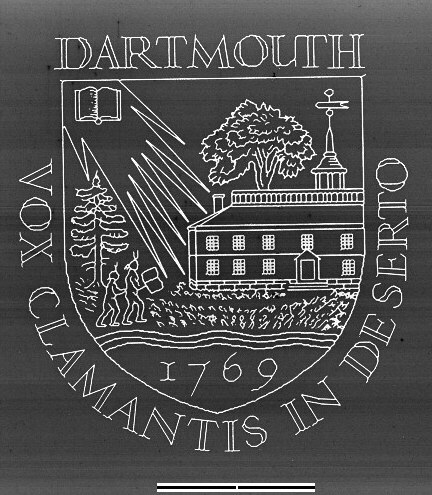
I will leave you with the official seal of Dartmouth:

“A Voice Crying in the Desert”

“A Voice Crying in the Desert”

The motto was most appropriate considering the school’s winter isolation.