It was September 1962. I was 13½ years old, and newly enrolled as a freshman at Chanel High School in Bedford, Ohio. The school was a Catholic school and taught by the Marist Fathers, who lived in a community on the top floor of the high school building.
Probably the strangest (to me) course in my first year was Latin 1, in which we studied Julius Caesar’s The Gallic Wars in the original Latin.
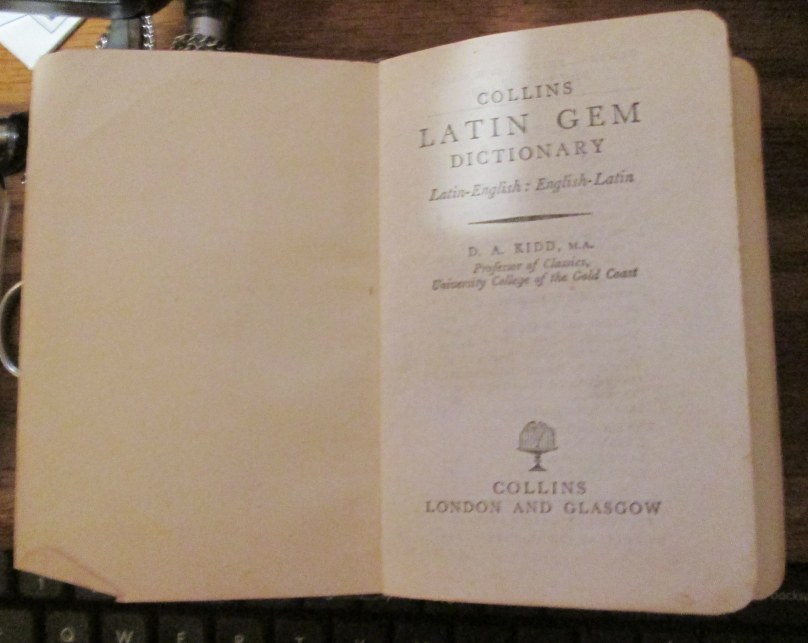
Most of the kids from wealthier families picked up a copy of Cassell’s Latin-English dictionary, but I chose instead to get the Collins Latin Gem Dictionary, which could fit in my shirt pocket. (Eventually, I also got the White’s Latin Dictionary, which looked to have been originally published in the 1800s.)
My Collins Latin Gem Dictionary is still in good condition and still eminently usable. The nice thing about Latin is that books in and about the Latin language never go out of date.
As I wrote yesterday’s blog post about proofreading computer transcriptions of two Merriam-Webster dictionaries, I remembered that one way I entertained myself in the process was collecting weird words. Three from the 7th Collegiate Dictionary were:
rotl. A unit of weight in the Middle East ranging from one to six pounds.
crwth. A Welsh stringed instrument.
cwm. Another Welsh vowelless wonder, meaning a steep-sided hollow at the head of a valley or on a mountain side.
Soon I started going farther afield:
medioxumous. Of or relating to an intermediate group of deities.
septemfluous. Flowing in seven streams. (Gosh, that’s a useful word.)
zax. A small axe used in roofing (or playing Scrabble).
triskaidekaphobia. Fear of the number thirteen.
gardyloo. In Scots, what people shouted outside their windows before emptying their bedpans in the street.
petrichor. The smell of rain.
That’s all I remember for now, but no doubt other examples will come to mind at a later point.
I came to Southern California to become a graduate student in film at UCLA. After my first year as a student, I needed an income, as my parents weren’t able to foot the bill for me much longer. In March 1968, I visited the job counseling center on campus and applied for a job at a Santa Monica tech company called System Development Corporation, or SDC.
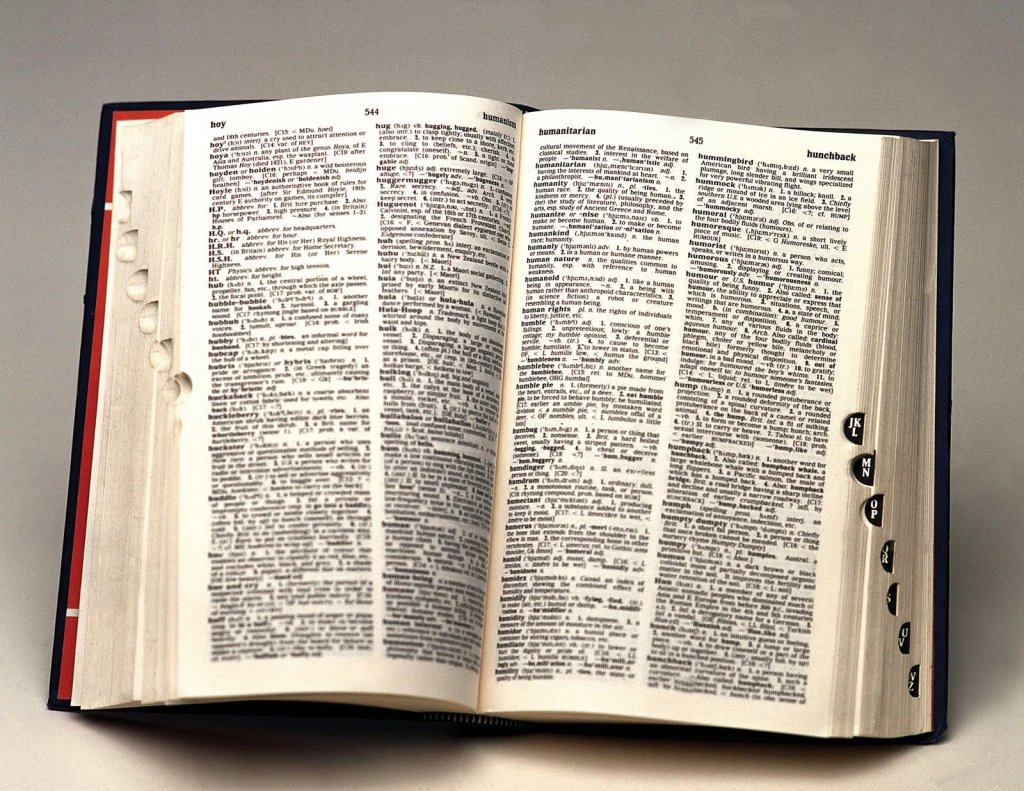
The job was for an interesting project. The Air Force’s Advanced Research Projects Agency (ARPA) had funded SDC’s Lexicography and Discourse project. The work done previously was to key in the complete contents of two dictionaries—the Merriam-Webster Seventh Collegiate Dictionary and the Merriam-Webster Pocket Dictionary—onto paper tape. Included were definitions, pronunciations, and etymologies. The paper tape had been converted to IBM punch cards, which were printed out. The printouts of the two dictionaries was in two piles that ran floor to ceiling of the office I was to use.
Interestingly, my predecessor in the position was murdered by a UCLA graduate student from the film department. I never was to find out who did it.
For the next couple of years, I proofread the transcriptions of both dictionaries and made corrections to the data files, which resided on a military AN/FSQ-32 computer whose parts were encased in epoxy so as to be able to survive a nuclear attack. Unfortunately, it had a single I/O channel, so that if a large number of users were logged in, as was the usual case, simple transactions took forever on the computer’s primitive time-sharing system.
If you are interested in finding out more about the project, you can see the document that described the project: Two Dictionary Transcripts and Programs for Parsing Them. Volume I. The Encoding Scheme, PARSENT and CONIX by Richard Reichert, John Olney, and James Paris (that’s me). It is still available from the Defense Technical Information Center (DTIC).
Incidentally, ARPA also created the Internet. It was originally designed to allow for uninterrupted communications between two points when certain key cities in between were destroyed by nuclear bombs.
My first real job in Los Angeles was for System Development Corporation (SDC) in Santa Monica. My predecessor in the job was a young woman who was murdered by a UCLA film student. How odd that she was succeeded by another UCLA film student—me!
The nature of the job was to proofread two transcriptions of Merriam-Webster dictionaries. Thy had been punched on paper tape and converted to character files that were sent to a line printer. The first was the Merriam-Webster Seventh Collegiate Dictionary and the other was the M-W Pocket Dictionary.
Everything had been entered—not only the definitions but the pronunciations and etymologies as well. This was a database to be used to assist in computer translation between languages. Was it, in fact, ever used for this purpose? I don’t really know, because my part of the project ended before the database was ever used for any practical purpose.



 Tarnmoor
You must be logged in to post a comment.