[Fashionable Term] A Nightclub

Say What?

Say What?

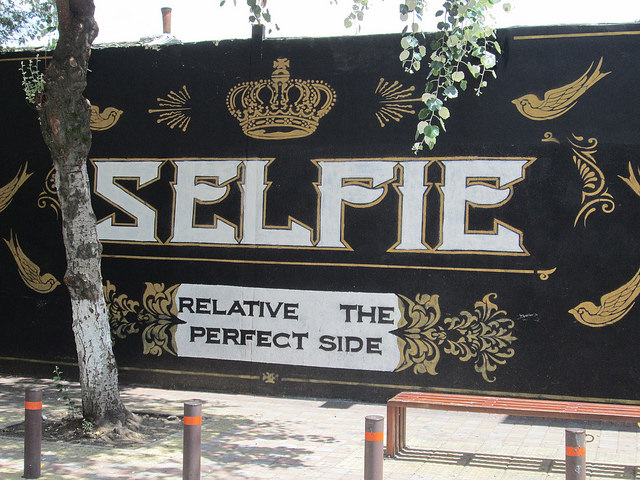
The Mariscal district of Quito is so full of nightclubs, including the oddly named (and described) one illustrated above. One could meditate for years on what “Relative the Perfect Side” really means. No matter: The term “Selfie” is hot right now, irrespective of any Perfect Side.

Apparently, people in Quito with money to invest think they can make a killing by opening a club. Walk down Diego Almagro or Reina Victoria, and you will, within a few blocks, pass several dozen clubs. My brother and I marveled at whether they were making any money at all. After all, probably most of the tourists are traveling on the cheap and staying at youth hostels.

Needless to say, neither of us wasted any time listening to loud music and drinking dubious concoctions.


Walking Straight Up a Hill

Indigenous Couple in Alausi

Elderly Indigenous Couple in Alausi

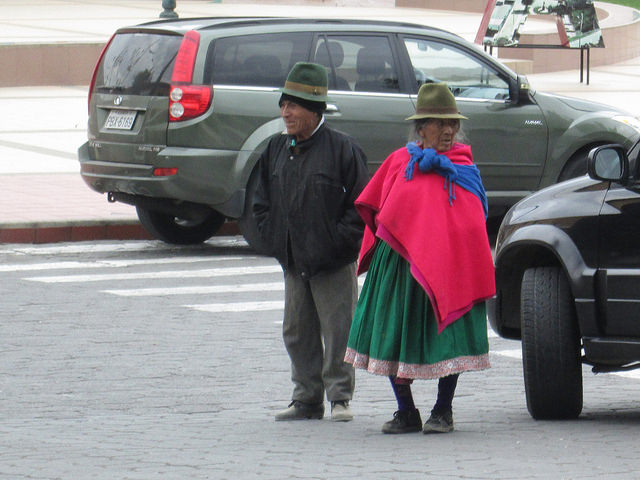
I’m not going to call them Indians because they feel insulted by the term: They are the indigenous peoples of the Andean highlands. I almost never saw them unless they were carrying babies or various other loads on their backs, sometimes obviously heavy.

The day I left Alausi, I waited at La Estación on the Pan-American Highway for two and a half hours for a bus to Cuenca. (See yesterday’s post.) At one point, a native woman who looked to be in her fifties or sixties greeted me, crossed the Pan-American Highway, and proceeded to walk straight up the hill on the other side. She was wearing cheap slipper-like shoes. There did not look to be much of a trail, and I saw her for upwards of thirty minutes while she ascended and began to harvest some tall grasses, which she put in her pack.

The Hill Across the Highway

The Hill Across the Highway

I waited for her to come back down, but by then, my bus to Cuenca had arrived. I think it was Thomas Hobbes who said that man’s life was “nasty, brutish, and short”—and this was a woman, and not a young one at that!

The native peoples of the Andes fill me with awe.

Dealing with Uncertainty

La Estación Near Alausi

La Estación Near Alausi

If you are unable to deal with uncertainty when traveling in other countries, it is possible that South America is not for you. One of my main destinations this trip was the Nariz Del Diablo railroad journey between Alausi and Sibambe. When I went to the bus terminal in Cuenca, I could not find a bus company that would sell me a ticket to Alausi; so I ponied up a few extra dollars for a ticket to Riobamba from the Patria bus company.

Alas, my Spanish is not good enough to understand what the ticket-sellers were trying to tell me. So I showed up the next morning and boarded my Patria bus, after telling the conductor I wanted to be let off on the Pan-American Highway near Alausi, which was a few kilometers away. I was met with another torrent of Spanish which I did not understand. (In this situation, it never helps to be flustered: I just played stupid and found my seat.)

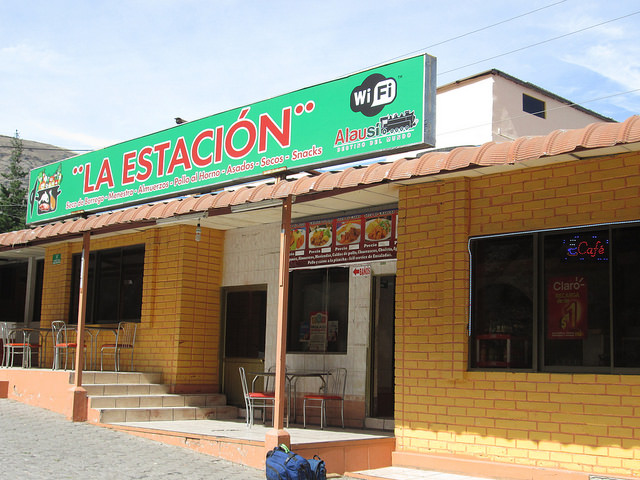
Five hours later, the bus pulled up for a lunch stop at La Estación (shown above), from which Alausi was visible in the valley below. Not only could I get off there, but the conductor called a cab for me, for which I thanked him. I suspect what everyone was trying to tell me was that the bus did not actually go into the town, but I knew that to begin with.

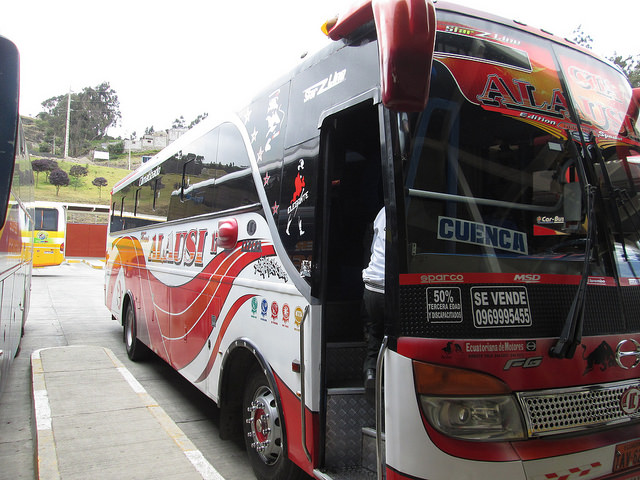
My Bus Back to Cuenca

My Bus Back to Cuenca

Getting back was even more complicated. I took a cab from my hostería back to La Estación, where I waited two and a half hours for a bus back to Cuenca. I was going under the mistaken assumption that all buses stopped there. Apparently, they didn’t. (You can see my two blue bags in the first photo above.)

Just when I gave up hope, I walked to the edge of the highway prepared to flag down any bus. No sooner did I do that than—from a side street a couple hundred feet ahead of me—a second class bus from Alausi’s own line pulled onto the highway and stopped for me. I saw the Cuenca sign in the window and boarded.

We drove like a bat out of hell and covered the distance to Cuenca’s Terminal Terrestre in an hour less than the Patria bus took. The driver hit speed bumps and rumble strips at high speed, and my head bounced off the ceiling a couple of times. But I made it to Cuenca in good time and was happy.


Quito’s English Bookshop

Mark Horton at the English Bookshop

Mark Halton at the English Bookshop

My brother had left a few days earlier, and I was due to fly back to Los Angeles the next day. Martine had given me strict instructions to bring back five Ecuador 2017 calendars that we could distribute as gifts, so I walked around the Mariscal district of Quito. A couple weeks earlier, Dan and I had stopped in at the English Bookshop at the corner of Calama and Diego de Almagro to ask if he had an Ecuador or Quito street atlas. The owner, Mark Halton, gave us a couple of good leads—though, alas, we could not find any such animal.

So, on this (dire) election day, I stopped back at the English Bookshop and got into an interesting discussion with Mark. He was kind enough to brew me an excellent cup of tea, and we had a wide-ranging conversation about books, politics, technology, and a variety of other subjects. He even told me where I could find the calendars. And they were exactly where he pointed me. There were just five left, and I bought all of them.

Mark has a large selection of hardbound and paperback books, mostly in English. It is a fun place for travelers to pick up some interesting titles and sit down and talk books.

If I ever find myself in Quito again—and I hope I do—I will make a point of stopping in at the English Bookshop and Mark’s excellent hospitality.

One of the Two Books I Bought There

One of the Two Books I Bought There

La Nariz Del Diablo, Part Dos

Train Conductors at Sibambe

Train Conductors at Sibambe

The destination for our day trip was the village of Sibambe, at the foot of the mountain we so laboriously came down. We were given an hour to buy snacks or handicrafts or watch the costumed dancers go through their paces. There were horses and llamas one could mount and be photographed wearing a campesino hat. There was even a mirador (viewpoint) and museum for those who felt like ascending about a hundred steps. (I myself did not.)

I just looked up at the mountain we had just descended and marveled at the ingenuity of those 19th century engineers who built the line:

The Mountain Where We Descended

The Mountain Where We Descended


Tomorrow, I will upload a video of the Nariz Del Diablo train departing from the sation at Alausi.

La Nariz del Diablo, Part Uno

Old Rolling Stock on the Nariz Del Diablo Train

Old Rolling Stock on the Nariz Del Diablo Train

The day my brother returned to the U.S., I took a Patria bus to Alausi for one of the most spectacular train rides in the Americas: The Nariz Del Diablo route from Alausi to Sibambe and back.

Originally, there was a single long train ride from Quito to Guayaquil. It still exists, as a luxury train called the Tren Crucero. If you take it, you will see a lot of rich Americans and Europeans—and damned few Ecuadorans. What the Ecuadorans did was to break the route into manageable day trips from Quito, Riobamba, and Alausi, while keeping the complete route as a four day trip including deluxe hotel accommodations.)

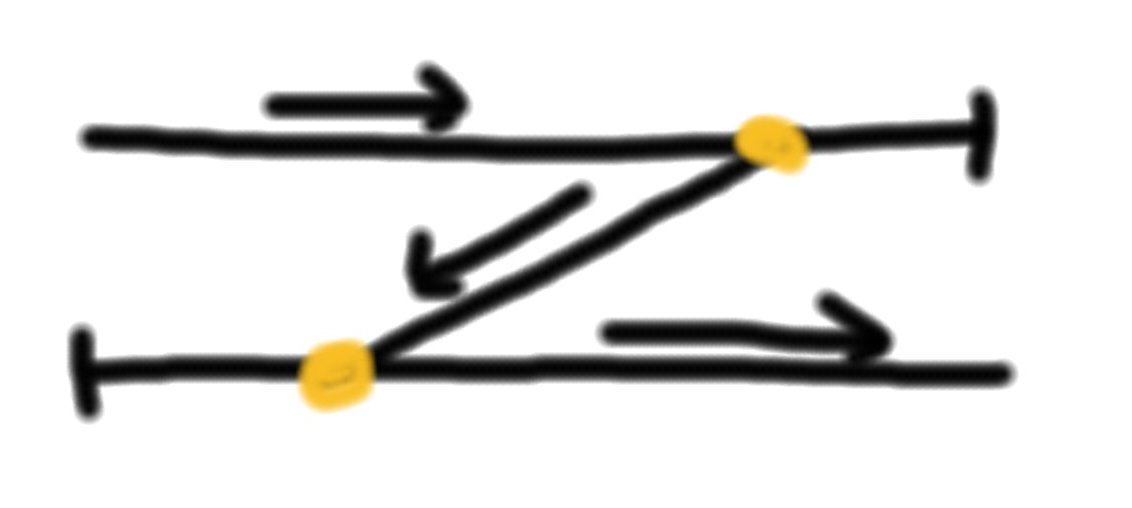
What is interesting about the Nariz Del Diablo (translated as “The Devil’s Nose”) is the rapid descent from the Andes where there is really no room to turn around. So the rail engineers designed a simple and elegant solution:

Excuse My Hand-Drawn Schematic

Excuse My Hand-Drawn Schematic

The train moves forward from the upper left to the end of track at the same level. Note the orange dots which represent switches. A rail employee throws the first switch, and the trains backs up past the second switch to the lower level end of track. Then the second switch is thrown, and the train moves forward at the lower level to its destination, the crafts village of Sibambe.

Here’s a view of the milieu:

Where There’s No Room to Turn Around ....

Where There’s No Room to Turn Around ….

Tomorrow, I will continue this post and also talk about our destination, Sibambe.

A Transcendent Moment

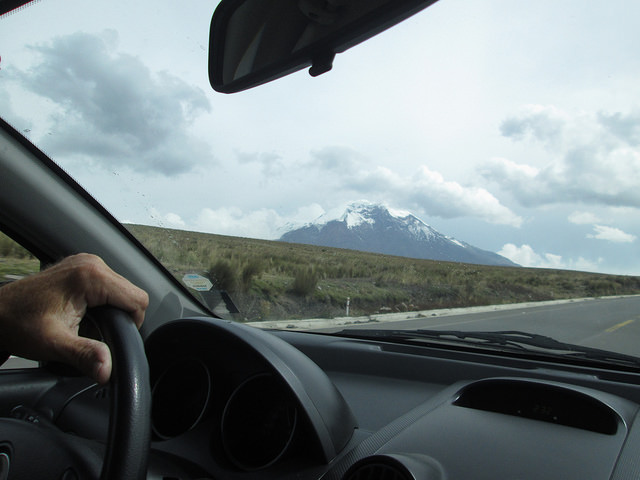
There It Was: Mount Chimborazo

There It Was: Mount Chimborazo

The text is from Matthew 18:22: “Jesus saith unto him, I say not unto thee, Until seven times: but, Until seventy times seven.” It refers to how many times one must forgive transgressors. That inspired the Swedish author, Lars Görling, wrote a novel entitled 491, which was made into a film by Vilgot Sjöman.

This is a very roundabout way of remembering the route Dan and I took as we emerged from the twisted warren of unmarked streets which is Ambato, one of Ecuador’s largest cities. We were looking for the E-35, which is the Pan-American Highway. Instead we were on E-491, which took us through a number of towns and villages which were not on my map of the country. Nor, for that matter, was E-491.

Then, as we rounded a hill, quite suddenly, we saw the volcano Chimborazo dead ahead of us. The clouds had moved aside, allowing us to see the glaciers on Ecuador’s tallest mountain. If you measure altitude from the center of the earth rather than sea level, it is the tallest mountain on earth, looming in splendid isolation from the rest of the Andes.
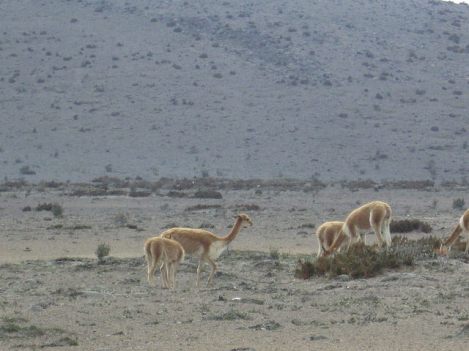
A Herd of Wild Vicuñas

A Herd of Wild Vicuñas

As we drew closer to the mountain, we espied a large herd of wild vicuñas on both sides of the road. Dan and I stopped to take pictures in the rarefied air, which must have been 15,000 feet altitude.

Throughout its length, E-491 was spectacular. Even the Indian villages along the route were more interesting. And then, as we approached the city of Riobamba, we crossed the Pan-American Highway. We spent the night in a spare, but scrupulously clean hotel near the railroad station. By then, we were on the “wrong” side of Chimborazo, which was now covered in clouds.

That was the end of our getting lost: The next day, we easily made our way to Cuenca in about five hours.

Where the Streets Have No Name

It’s Okay in the Center of Town, But ...

It’s Okay in the Center of Town, But …

When Dan and I started driving in Quito, we made a dismaying discovery. We spent a whole morning looking for a road atlas of Ecuador, and were greatly surprised that no one thought such a thing existed. And all city maps we had showed none of the outskirts, just the centro historico or tourist center of town.

Worse was to come: Once we left the center of town, there were almost no signs at street corners indicating where we were. Even if we had a good street atlas, it wouldn’t have helped, as most of the streets were strictly incognito. Missing were any directional indicators, most notably for E-35, the Pan-American Highway, the main trunk highway, which runs north/south through the center of the country. Where there were signs, they were more often than not for relatively minor streets.

The net result is that we got badly lost in the cities. All we could do is look out for intercity buses to see where they were going (if we were so lucky as to pass them) and follow them. Where there were no intercity buses in evidence, we tries to orient ourselves to the nearest known volcano and look for wider roads headed roughly in the right direction.

In Quito, we finally lucked out and found ourselves on the Pan-American Highway, but we didn’t know for about 40 miles that we were on the right track.

And then the E-35 lost itself in a warren of streets in the city of Ambato. In tomorrow’s post, I will explain how getting lost in Ambato led to the most transcendent moment in our whole vacation—just by sheer persistence and good luck!

For Ecuador With Love and Squalor

Cañar Indian Woman in Alausi

Cañar Indian Woman in Alausi

Late last night, I returned from Ecuador to another Los Angeles heat wave. It was yet another wonderful South American trip, with a number of highs and one very big low.

That low had nothing to do with Ecuador, and everything to do what happened to our country last Tuesday. Watching the election returns on CNN from my hotel in Quito, I spent a sleepless night twisting and turning, only to wake up early to leave for the airport.

But then, the Trumpster is our own American nightmare; and Ecuador for the most part cheered me and even amazed me. Even on the way to Mariscal Sucré Airport, my taxi driver pointed out the snow-covered Mount Cotopaxi looming to the south in a moment of extreme clarity. (It is not usually visible from Quito.)

Ecuador is a country with a number of viable indigenous cultures. In Otavalo, Alausi, Cuenca, and even Quito, I saw a number of what we incorrectly call Indians. I took a number of candid pictures, such as the one above.

One special feature of this trip was that I spent the first two weeks with my brother, and the last week alone, as Dan had to return to Palm Desert to fulfill some construction obligations. It was fun sharing my vacation with him, and it was a very different experience for me. I am not used to sharing the decision-making process during my trips; but here it worked out. We may be very different people, but there is considerable overlap in the matter of preferences.

It’s good to be back, even if it is to a Frankenstein-Dracula America. We’ll just have to see what happens.