It’s Greek To Me

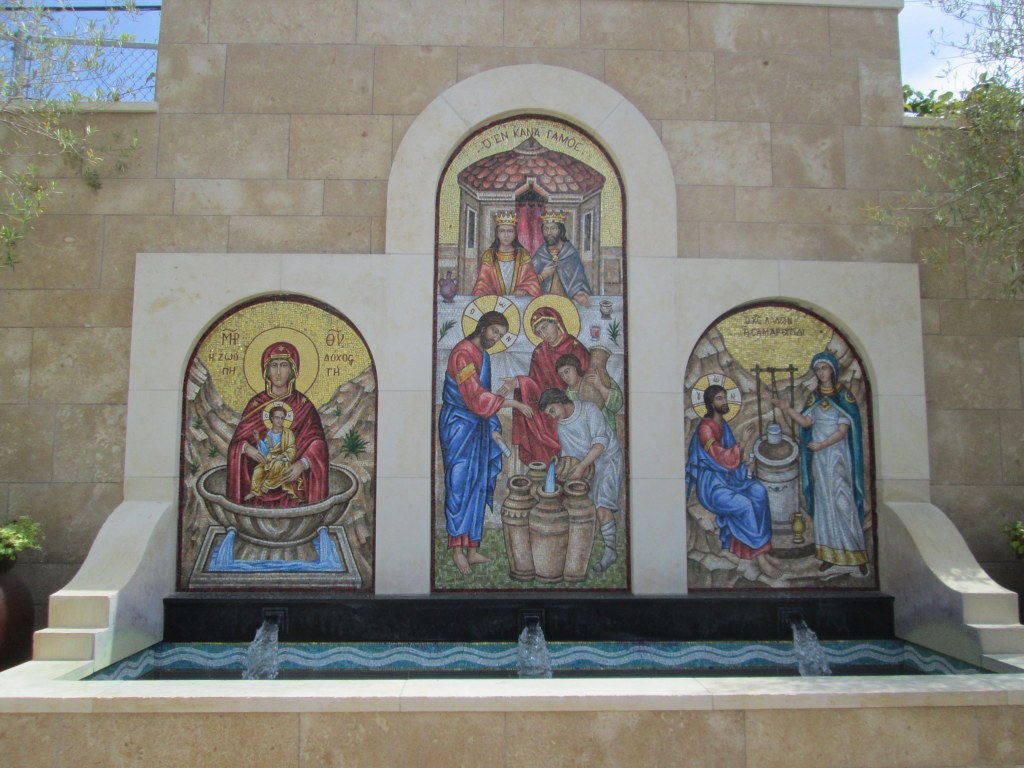
The Iconostasis at Assumption of the BVM in Long Beach

On Saturday, Martine and I attended the annual festival at Assumption of the Blessed Virgin Mary Greek Orthodox Church in Long Beach. It was our third Greek festival of the year, and probably not the last. We like the food, the music, and the churches. The Long Beach church was perhaps a bit on the gaudy side, but it was all reverently done.

There remain two more Greek festivals over the next six weeks: St Anthony Greek Orthodox Church on September 20-22 and the big event at Saint Sophia Greek Orthodox Church on October 5-6. I am pretty sure that we’ll be at Saint Sophia. We’ve never been to St Anthony, but we’ll go if I could talk Martine into it.

I love ethnic festivals, particularly if they’re Hungarian. But these are becoming fewer in number as time goes on, and the Magyar population of Southern California becomes more acculturated and dispersed. The Greek festivals seem to be more of a going thing. I hope that it continues to be.

Gradually Becoming Attenuated

Prayer garden at Saint Katherine’s Greek Orthodox Church

It was Greek Festival time in Redondo Beach this weekend at Saint Katherine’s Greek Orthodox Church. Martine and I love attending Greek festivals, even though we realize that they are becoming less and less ethnic each year, as the families of Greek-Americans drift farther and farther away from the authenticity of the older generation.

We enjoyed ourselves nonetheless. Martine particularly loves spanakopita (Greek spinach pie with feta cheese), while I had pastitsio (a lasagna-like dish of baked pasta with béchamel sauce) and fasolakia (Greek green beans). The food was good, but not up to the level of previous years.

Missing were Akrevoe Emmanouilides and Pitsa Captain, whose cooking classes at the festival were a tasty highlight. Alas, Akrevoe is no more; and there are no more cooking classes at the festival..

One thing which did not change were the tours of the church, with a discussion with the priest about some particulars of the Greek Orthodox faith, toward which I have long had some leanings. I was raised in the Roman Catholic faith, but have drifted away due to some disagreements with dogma.

Although the Greek Festivals are becoming less authentically Greek, there were hundreds of people in attendance. The heavy crowds made it difficult to move about the grounds, and led to Martine and I leaving soon after we ate lunch and visited the church.

The Long Retreat

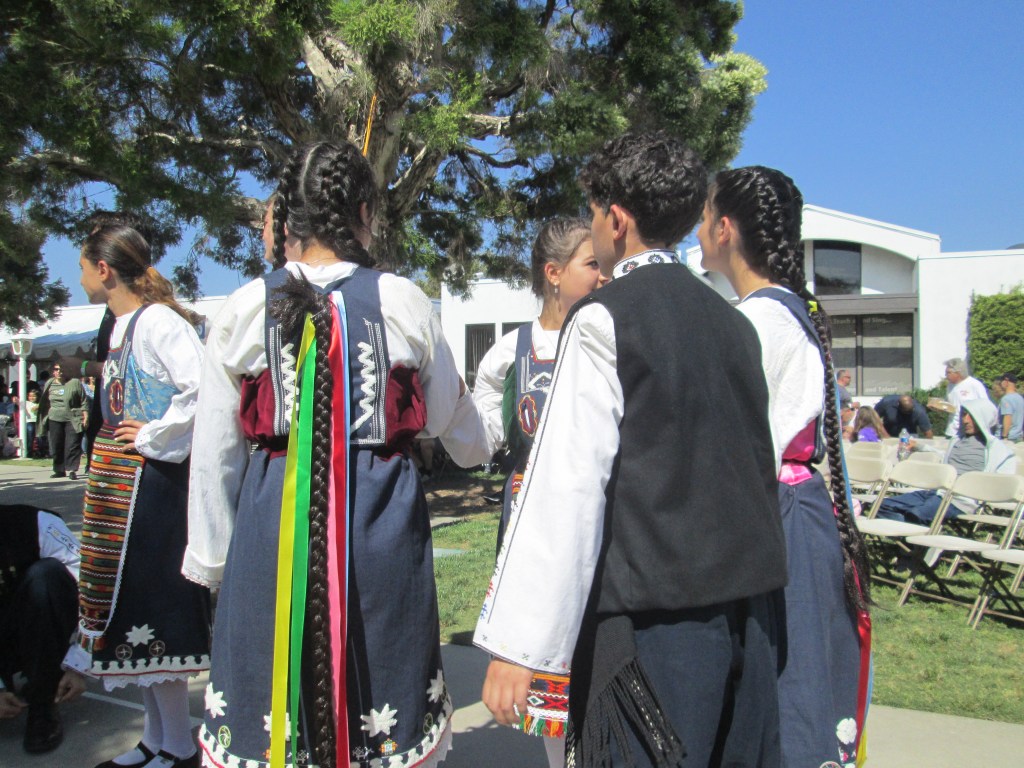
Middle School Greek Dancers at St Nicholas Greek Orthodox Church

I remember a time when most foreign-born Americans were of European ethnicity. My father, Elek Paris, was born in what is now the Republic of Slovakia; and my mother, who was actually born in Ohio, was taken to Hungary to be raised by her grandparents. For the first five or six years of my life, I thought that Hungarian was the language of the United States.

What inevitably happens has happened. The children of European-born immigrants see their parents’ culture, religion, and language as something quaint which they are being reluctantly marshaled into accepting. The three-year Covid-19 lockdown has brought this tendency into sharper focus.

Yesterday, Martine and I attended the annual Greek Festival at St Nicholas in Northridge for the first time since 2019. Sure enough, the tours of the church were more perfunctory; the calamari was more breading than squid; and there were fewer people able to do the traditional dance steps. I noticed much the same at the two Hungarian festivals we attended this month. Only the Grace Hungarian Reform Church in Reseda had anything like the same quality of food and entertainment as before the lockdown.

Our neighbors downstairs are refugees from Putin’s Ukrainian invasion. I notice that their two little daughters are addressing their mother in English instead of Ukrainian.

When I first came to Los Angeles, there were at least half a dozen Hungarian restaurants. Now there are none. If I want real Hungarian food, I’ll either have to cook it myself or visit my brother more often. (He’s a far better cook than I am.)

If Martine and I expect to find more authentic ethnic events, we will have to concentrate on the Asian and Latin American ethnic events, as they have arrived in this country more recently.

My Safe Spaces

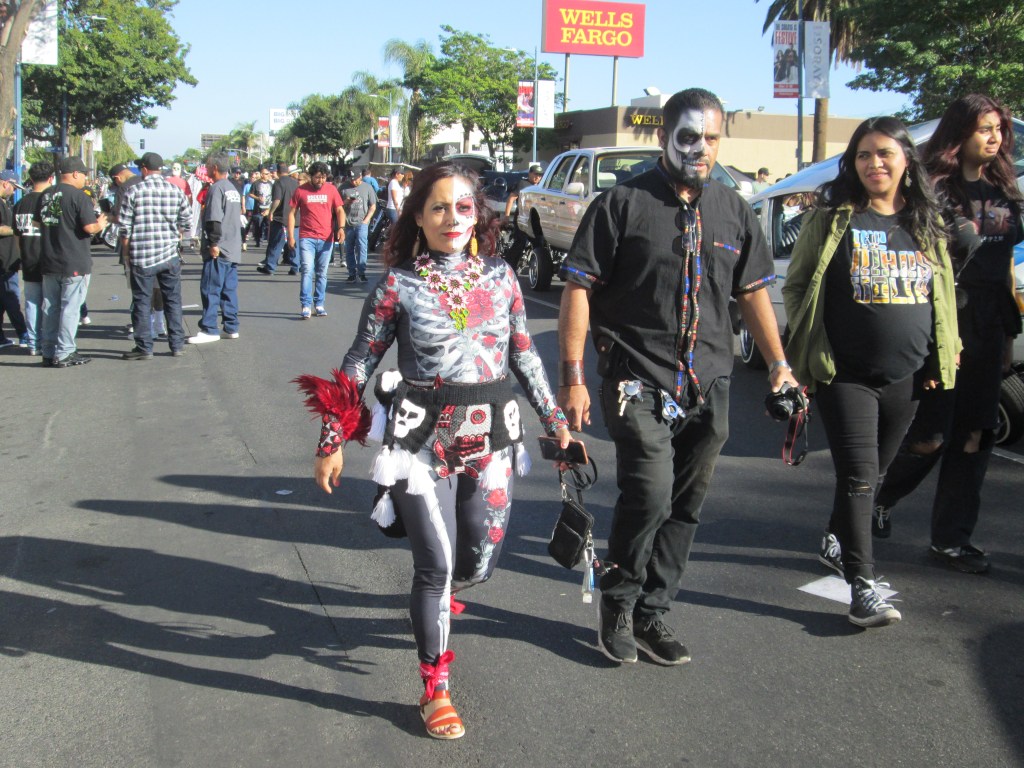
Day of the Dead Celebration in the San Fernando Valley

Ever since my first visit to Mexico in 1975, I no longer felt myself superior to Mexican-Americans. It didn’t take long before I felt that way about African-Americans and Asian-Americans. My safe space was becoming larger with each year. Now when I encounter prejudiced white people, I don’t even regard myself as being white. In fact, I’ve always felt particularly safe thinking of myself as a Hungarian.

That is a bit of a joke, really, as I am only 25% Hungarian. I am also 25% Slovak, 25% Czech, and 25% Bavarian German. The only difference is that Hungarian was my first language, and I can still think in Hungarian.

At the Los Angeles Times Book Festival this past weekend, I enjoyed the work of three black poets (Roger Reeves, Courtney Faye Taylor, and D. Manuel II) and one Hispanic poet (Brenda Cárdenas). Oh, and don’t forget Eloise Klein Healy, a white poet from El Paso, Texas, whose courage impressed me so much (see yesterday’s post).

I was presented with multiple templates of Los Angeles, all of which I accepted—if not exactly as my own, still as plausible worlds understandable to me. Probably the scariest Los Angeles was that of Eloise Klein Healy, because she fought successfully against the horrors of encephalitis and aphasia and recovered her verbal skills as a poet.

My reaction to the paranoia of white supremacists like Tucker Carlson is to regard them as broken people who are unable to join in the incredible richness of other ethnicities.

Attenuation of Ethnicity

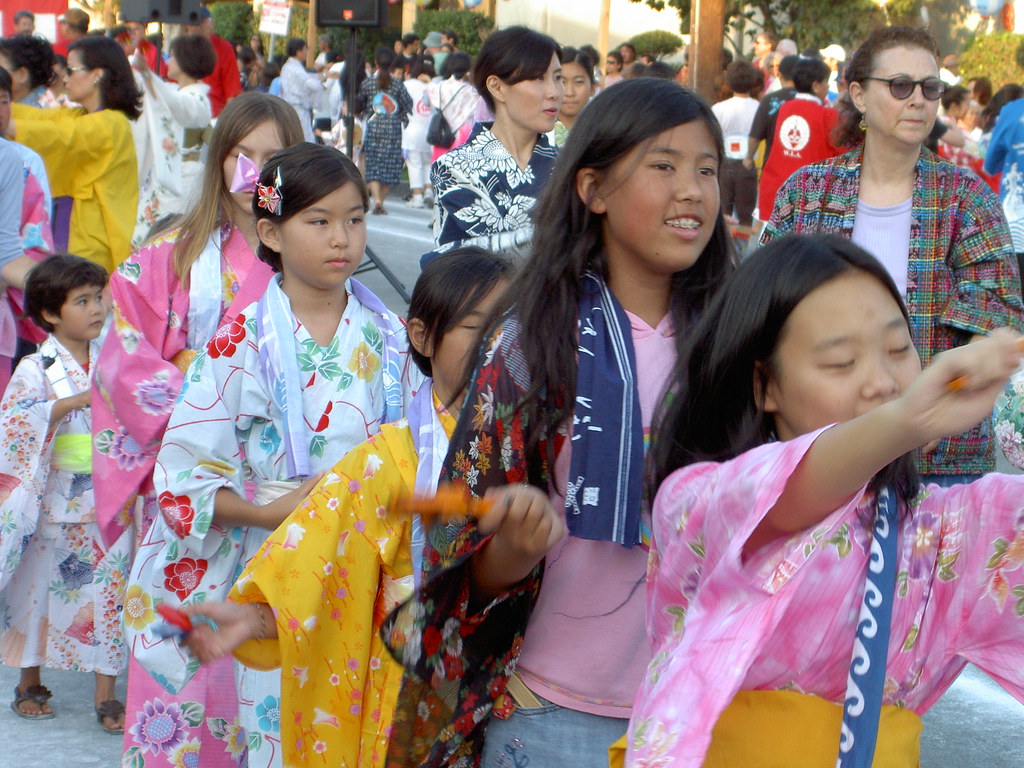
Picture from the West L.A. Buddhist Temple Obon Festival 2007

I have been attending the West Los Angeles Buddhist Temple’s Obon Festival for many years now, going back to the 1970s. Now Martine joins me and takes as much pleasure in the festivities as I do.

One thing that both of us noticed was that the festival was less Japanese. It was also not so well attended, and most of the dancers wore ordinary casual clothes. Only a few of the men and women wore kimonos, where in the past most of the participants were more traditionally dressed.

As a Hungarian-American who was born in a rich ethnic tradition in a Hungarian neighborhood in Cleveland, I am constantly aware that our ethnic traditions are being gradually attenuated over time. When I first came to L.A., there were a number of Hungarian restaurants. Now the count is down to zero. The same thing is happening to other ethnicities, such as the Japanese and even the Mexicans.

I suppose it is only natural that over time we are becoming more homogeneous. Even though the Obon Festival was a bit less Japanese, those of us who were present enjoyed it nonetheless. The Men’s Club udon noodle soup was delicious: This year it even had fish cakes with the barbecued pork.

In a way, one of the reasons I am no longer interested in belonging to a Hungarian group is that, in the long run, it will inevitably become a shadow of what it once was. If there are no Hungarian restaurants in town, I have some old Hungarian cookbooks and can make the dishes myself.


Fading Away

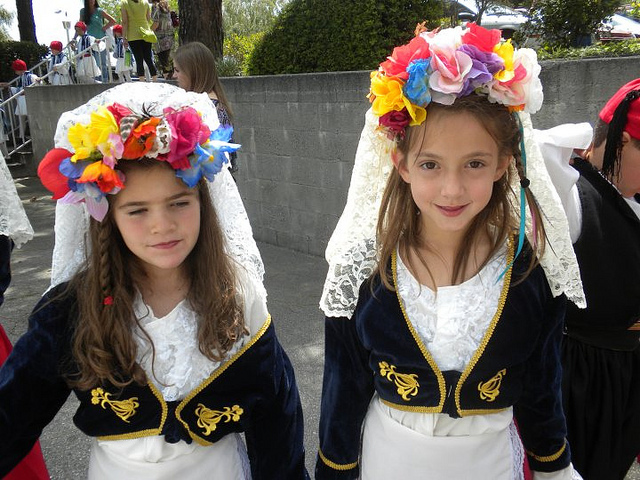
Little Girls in Greek Dance Costumes (2011)

In the time that Martine and I have been going to Greek church festivals in Los Angeles, we’ve noticed several trends:

  • The food is getting less authentic. Today, Martine ordered a spanakopita (spinach and cheese pie) that did not contain any cheese.
  • It seems that fewer of the parishioners speak Greek. Is it that the older generation is passing on?
  • The priests are less involved personally with the festivals, particularly in offering church tours to visitors.

This is less true of Saint Sophia Cathedral in downtown L.A. which draws crowds from a much larger area, and which is across the street from Papa Cristo’s, the most authentic Greek restaurant in town.

The same is true of the Hungarian festivals. At first, I felt abashed by my poor command of the Magyar language. Now my Hungarian seems to have gotten better, or again, are the old immigrants dying off and making my poor language skills look better by comparison?

I suppose this is a natural process. Many of the places we visit may not even be around in a few years. For instance, there do not seem to be any Hungarian restaurants left in our nation’s second largest city. Back when I first moved to L.A., there were a number of choices, especially the much lamented Hortobagy.

If you want a more authentic ethnic experience in Los Angeles, you have to look to Latin America and Asia. There is a bustling Thai and Korean scene; and numerous options involving Mexican, Central and South American culture. There are numerous places offering Oaxacan food. Culver City has an Indian restaurant offering the cuisine of Southern India’s State of Kerala.

As to the girls in the above photograph, I could have sworn that they were in a group of teenage girls who passed us on the way to our parked car. They were busy calling each other “chicken butt.”


Los Angeles de Meso-America

Mayan Dancers at El Pueblo de Los Angeles

I was looking at some old pictures I had taken near Olvera Street several years ago. There was a Meso-American dance troupe dancing by what passes in L.A. for the city’s zocalo. This was the center of Los Angeles when it was founded in 1781.  There are several 19th century museums, including the Chinese-American Museum and the old firehouse; there is an old Catholic church, Our Lady Queen of Angels; and, of course, there is Olvera Street with its restaurants and Mexican handicrafts.

What I like about the Pueblo is its seeming lack of self-consciousness. There are some scheduled events, such as the annual blessing of the animals by the Catholic Archbishop of Los Angeles that takes place in April. But there is also a lot of spontaneity.

Walk across Alameda Street from the Pueblo, and you find yourself at Union Station, L.A. art deco railroad station, which has since been turned into a rail and bus transit hub. That’s where I first arrived in Los Angeles on the El Capitan in December 1966.

A block or two north, and you’re in Chinatown. Not far south is Little Tokyo, and a mile or two east begins the East Los Angeles barrio.

I find myself in love with the city’s endless variety.


Another Day, Another Nationality

Costumed Children Waiting to Dance

Yesterday was Scottish, today was Greek. Every Memorial Day weekend, Saint Nicholas Greek Orthodox Church in North Hills puts on a three-day Greek festival with food, dancing, and vendors. It is one of three Southern California Greek festivals that Martine and I attend. For Martine, the main attraction is spanakopita, Greek spinach and cheese pie, the baked goods redolent of honey and nuts, and he beautifully decorated church.

My preference is to see the children dancing. As they go through their steps, members of their family step forward and shower the dancers with one-dollar bills, which are picked up after the performance. And, although I was raised as a Roman Catholic, I have always had a warm spot in my heart for the Greek Church.

I sometimes wonder what will happen in the years to come as the younger generation grows more detached from the values of their parents. Many of the older parishioners still speak to one another in demotic Greek, while the children are just American kids trying to make their own way in the world. When the girls in the above picture grow up, will the old ways matter to their own children? What about the Greek language? the cuisine? even the religion?

Are we seeing the last florescence of children trying to adhere to their parents’ folkways? Perhaps not. Trumpf to the contrary, America is still seeing waves of immigrants, mostly from Asia and Latin America. As a Hungarian, I am closer to the European ethnic ways; though the Central Americans and Koreans and Persians also have a lot to offer.

False Certitudes

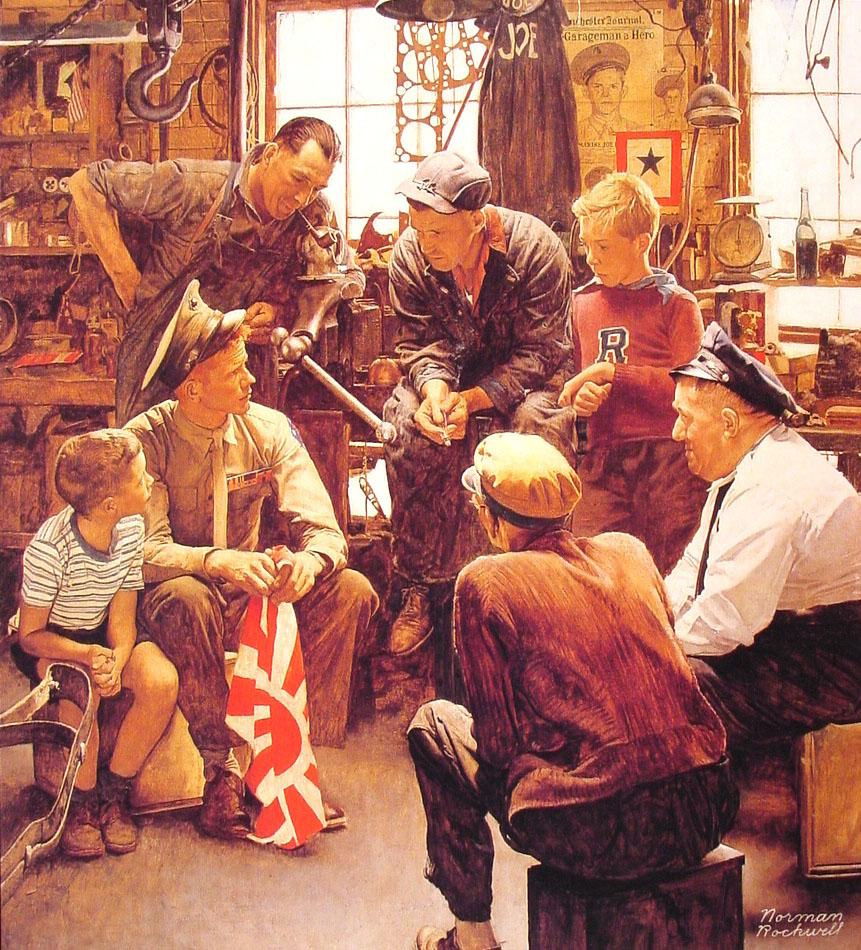
Norman Rockwell’s Homecoming of a U.S. Marine

Norman Rockwell’s Homecoming of a U.S. Marine

Let me begin by saying right off the bat that there is nothing wrong with the illustrations of Norman Rockwell. It’s just that he spoke for a different America, an America that was predominately small-town or even rural. His work belongs with the Judge Billy Priest stories of Irvin S. Cobb, silent films like King Vidor’s Tol’able David (1921), and the paintings of Thomas Hart Benton. Just about everybody you would be likely to meet on Main Street was White, Anglo-Saxon, and Protestant.

Then the Second World War happened, and people started to move around—a whole lot. African-Americans moved up to the industrial cities of the Northern U.S. Mexican farmers started streaming across the border to help bring in the crops.

And people like me started to pop up. When my kindergarten teacher, Mrs. Idell, first saw me in 1950 at Harvey Rice School in Cleveland, it was probably like a portent of the Apocalypse. My friend András and I didn’t speak a work of English. And although she taught at a public school in the heart of the largest Hungarian community outside the Peoples’ Republic of Hungary, she didn’t know a word of Magyar, nor did she feel she had to. When András and I started kicking her in the ankles, I am sure she felt like Joan of Arc among the Barbarian Hordes.

It was just the beginning. In addition to all the black and brown people who were showing up, including a large Puerto Rican neighborhood by Lorain, there were other strange people who came because we chose to fight wars all over the map in places where we had no more inkling of their culture than Mrs. Idell had of mine. I work in Tehrangeles, in a city that has a Thai Town, a Little Seoul, a Little Tokyo, and, of course, “East Los,” a.k.a. East Los Angeles. There are thousands of Armenians, Ethiopians, Hmong, Vietnamese, Arabs, and Chinese—to name just a few. Then, too, there was a whole new type of minority: gays, lesbians, trans-gender individuals.

For many Americans, the odd admixture of cultures leads to a terrible uncertainty. Many people who have been left behind in the “Heartland” feel that America doesn’t belong to them any more. Well it does, and it also belongs to the newcomers. They are or soon will be just as American as any of us. They may be slow to speak our lingo, but their kids’ll pick up on it quickly.

Of one thing I am sure: There is no point in trying to return to the America of Norman Rockwell.

There’s nothing wrong with uncertainty. There is, however, quite a bit wrong with false certitudes. Whatever happens, Norman Rockwell describes an America that is, for the most part, gone. Any attempt to force the Americans of today into a White, Anglo-Saxon, Protestant mold will fail, after causing a lot of hard feelings. Even I get pretty sick and tired of Evangelical posturing and the whole Anglo thing which is 0% of my own heritage. If I keep my mouth shut, I might be mistaken for a WASP; but I have no desire to parade around as one. I have no particular respect for WASPs. Their moment has come and gone. There are a whole lot of different people now.

I can live with that. In fact, I rather like it.