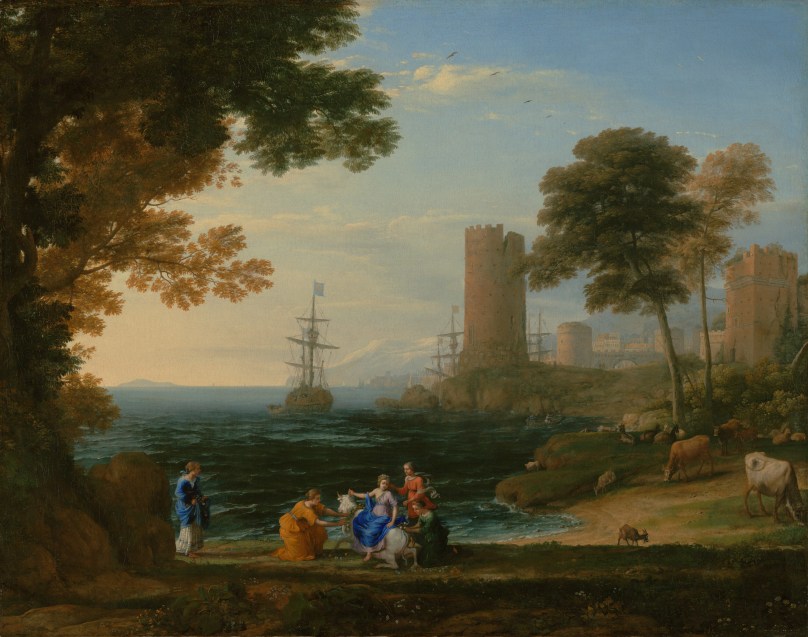
Claude Lorrain’s “Coast View with the Abduction of Europa”
Goethe perhaps said it best: “Claude Lorrain knew the real world by heart, down to the minute details. He used it as a means of expressing the harmonious universe of his soul.”
Both Lorrain (1604-1682) and Nicolas Poussin (1594-1665) made a career of creating peaceful canvases that draw the viewer’s eye in and leave him or her in a meditative state. That is the case even though the subject matter of the above painting is of a violent rape:
The Abduction of Europa is a classical myth from Ovid’s Metamorphoses, in which Zeus transforms himself into a white bull to abduct the Phoenician princess Europa. He lures her onto his back and carries her across the sea to the island of Crete, where they have children, including Minos, who become the first king of Crete and one of the divine judges of the underworld.
Rembrandt also painted the scene in a much more dramatic fashion, but in Lorrain’s painting, it is almost an afterthought—as if it could have been replaced by dancing Naiads or a shepherd with his flock with no loss in overall effect.
Every time I visit the Getty Center in the Santa Monica Mountains, I feel a frisson of excitement as I take a fresh look at the museum’s incredible collection.
Titian’s painting of “The Rape of Europa” tells of how Zeus turned himself into a bull, seduced the beautiful Europa, and impregnated her. Here is one version of the tale from Greeka.Com:
The name of Europa is mentioned in many contexts, most of which deal with the divine union between a young girl and Zeus. The most popular myth about Europa says that she was the daughter of Agenor, a Phoenician king, and later became a wife of Zeus, the King of Gods.
According to the legend, Europa was the epitome of feminine beauty on Earth. Zeus once saw her on the seashore of Phoenicia playing with her friends. He was so captivated by her beauty that he fell in love with her and developed a strong desire to possess her. Immediately, he took the form of a white bull and approached her. The bull looked wonderful with its snow-white body and gem-like horns. Europa looked at the extraordinary animal curiously and dared to touch and later hang him because he appeared so calm to her. Later, she was somehow motivated to climb on his back.
As soon as she did so, Zeus ran to the sea and carried her all the way from Phoenicia to the island of Crete. There he regained his human form and mated with her under an evergreen tree. This was the abduction of Europa, who later gave birth to three sons of Zeus, Minos, Rhadamanthys and Sarpedon. These men were known for their fairness and became the three judges of the Underworld, when they died. In fact, Minos founded the town of Knossos and gave his name to an entire civilization, the Minoan civilization.
Zeus loved Europa so much that he showered her with three priceless gifts. The first one was a bronze man, Talos, who served as a guard to her. He was the bronze giant that the Argonauts met and killed in their attempt to shore on Crete. The second was a dog, Laelaps, which could hunt anything she wanted. The last one was a javelin that had the power to hit the target, whatever it was. Europa was later married to one of the kings of Crete, Asterius, who adopted her sons and made her the first queen of Crete.
And here is the Roman poet Ovid’s telling of the legend from The Metamorphoses, as translated by Darrell Hine:
Majesty is incompatible truly with love; they cohabit
Nowhere together. The father and chief of the gods, whose right hand is
Armed with the triple-forked lightning, who shakes the whole world with a nod, laid
Dignity down with his sceptre, adopting the guise of a bull that
Mixed with the cattle and lowed as he ambled around the fresh fields, a
Beautiful animal, colored like snow that no footprint has trodden
And which no watery south wind has melted. His muscular neck bulged,
Dewlaps hung down from his chin; his curved horns you might think had been hand carved,
Perfect, more purely translucent than pearl. His unthreatening brow and
Far from formidable eyes made his face appear tranquil. Agenor's
Daughter was truly amazed that this beautiful bull did not seem to
Manifest any hostility. Though he was gentle she trembled at first to
Touch him, but soon she approached him, adorning his muzzle with flowers.
Then he rejoiced as a lover and, while he looked forward to hoped for
Pleasures, he slobbered all over her hands, and could hardly postpone the
Joys that remained. So he frolicked and bounded about on the green grass,
Laying his snowy-white flanks on the yellowish sands. As her fear was
Little by little diminished, he offered his chest for her virgin
Hand to caress and his horns to be decked with fresh flowers. The royal
Maiden, not knowing on whom she was sitting, was even so bold as
Also to climb on the back of the bull. As the god very slowly
Inched from the shore and the dry land he planted his spurious footprints
Deep in the shallows. Thus swimming out farther, he carried his prey off
Into the midst of the sea. Almost fainting with terror she glanced back,
As she was carried away, at the shore left behind. As she gripped one
Horn in her right hand while clutching the back of the beast with the other,
Meanwhile her fluttering draperies billowed behind on the sea breeze.


 Tarnmoor
You must be logged in to post a comment.