The Decline and Fall of the American Meal

Last night, Martine and I had dinner at a restaurant in Glendale that we have loved for twenty-five years. As soon as we walked in, we noticed some ominous signs. The waitstaff were all young, they were wearing bright new T-shirts imprinted with the name of the restaurant, and there was a brand new illuminated sign. Most seriously, the old owner was not there.

For the first time ever, both Martine and I left the restaurant feeling slightly ill. I almost didn’t make it back to my parked car. And it was lucky that there was a large Mobil gas station at the corner of Brand and Chevy Chase in Glendale, where I was able to dispose of some of the intestinal irritants.

Mind you, I can understand why restaurants are dropping like flies. It is no fun to own or work at a restaurant, especially after the Covid-19 lockdowns. And increasingly, there is more microwaving than cooking taking place in the kitchen—by people who don’t know much about food safety.

Not only in restaurants, but across the board the quality of the American meal has declined precipitously. Even supermarkets are moving away from serving customers who do their own cooking. Recently, I have had problems finding basic food items such as barley or peanut oil. What there is no lack of are frozen meals that taste like cardboard and various “helper” mixes for people afraid to make anything from scratch.

Increasingly, the foods that people eat at home or in restaurants are deficient in nutrition and flavor.

One thing that particularly bothers me is the disappearance of ethnic restaurants as the next generation takes charge. When I first came to Los Angeles, there were loads of great Italian, French, Hungarian, Greek, and other ethnic restaurants. And there were even good cheeseburgers that didn’t look like a 300-pound guy named Rufus sat on them.

Tiwanaku

Tiwanaku: Gate of the Sun

I must think I’m going to live forever.Trapped in my apartment during the quarantine, I am thinking more and more about returning to Peru and including the altiplano of Bolivia. Here I am at age 76, thinking of a strenuous trip at high altitude to one of the most fascinating (albeit difficult) places on Earth.

In 2014, I spent some time on the western shore of Lake Titicaca, on the Peru side. I even took a tour on a launch to Isla Taquile and one of the Uros Isles, but as the boat left the dock, I discovered that I was beginning to suffer the effects of food poisoning. The former afternoon at Sillustani, I ate something in a farmer’s house that violently disagreed with me. What is more, I was hours away from a toilet. Under the circumstances, I was not able to appreciate the beauties of Lake Titicaca, and in fact I took no pictures that day.

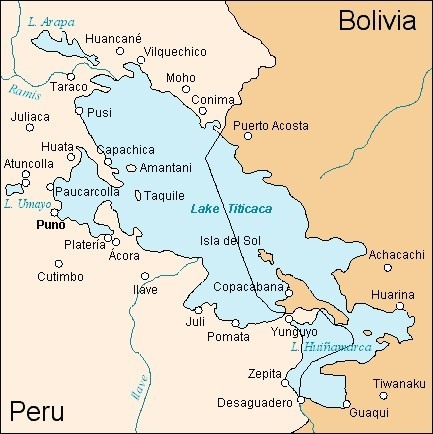
Map of Lake Titicaca, Showing the Location of Tiwanaku at Lower Right

Just as I returned to Tierra Del Fuego after breaking my shoulder there in 2006, I plan on returning to the Peruvian side of the lake, and adding some parts of Bolivia to the mix. I find myself suddenly interested in the Aymara-speaking peoples of the Andes.

A funny thing happened to me in Puno during my last visit. It was a bitterly cold morning, as it frequently is at that altitude (12,000 feet or 3,700 meters). I had neglected to bring a scarf with me, and I badly needed one. Enter a poor Aymara woman laden down with hand-knitted handicrafts. I walked up to her and brought a beautiful scarf at a reasonable price. Apparently, I made that woman’s day. She broke into a big smile and was almost prepared to welcome me into her family.

Over a thousand years ago, there was an Aymara empire centered at Tiwanaku in modern-day Bolivia. It lasted until AD 1100 when a massive and persistent drought led to a drop in the level of Lake Titicaca, leaving the Aymara fields high and dry. Hundreds of years later, the Inca took over; but their empire was short-lived once the Spanish conquistadores began to move in.

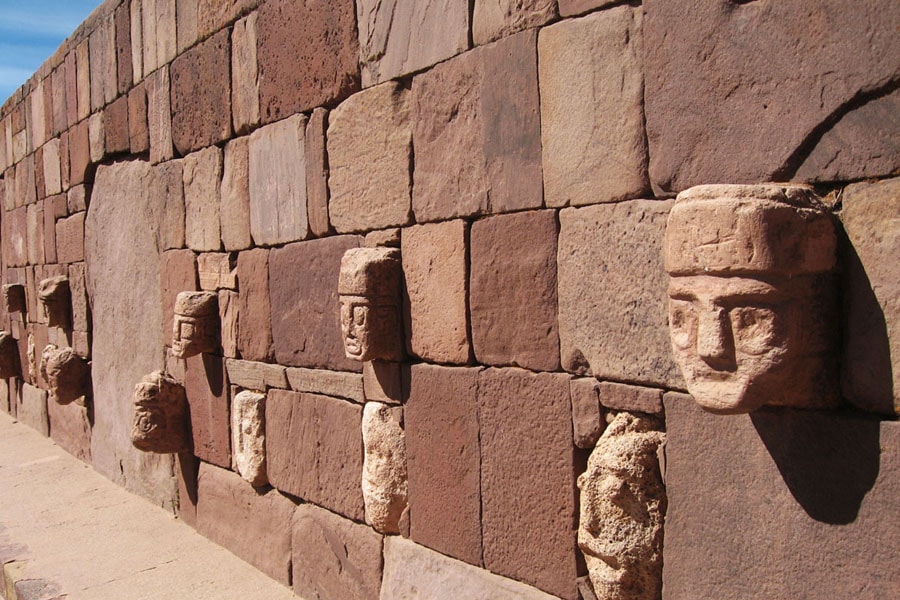
Walls of the Kalasaya Complex at Tiwanaku

Since the eco-catastrophe that destroyed the Aymara empire a thousand years ago, the Aymara have become a scattered people indulging in subsistence agriculture and the herding of llamas and alpacas.