Live Content

No, It Doesn’t Have To Be This Picturesque

The title of this post is deliberately misleading. I could mean the adjective “live” with a long “i” followed by the noun “CONtent,” with the accent on the first syllable; but what I really mean is the verb “live” with a short “i” followed by the adjective “conTENT,” with the accent on the second syllable. English is a very confusing language, but then life is confusing, too.

If you look at the images related to contentment in Google, you get a lot of nice scenery with people assuming various yoga-like pastures. If I were to sit like the woman in the above picture, I would be in considerable pain within two minutes. At my advanced age, I just don’t have the flexibility.

Besides, I’m not talking about contentment as seen by the chief gurus of our culture. I am thinking more of what G. K. Chesterton had in mind when he wrote his essay entitled “The Spice of Life”:

But it is much more important to remember that I have been intensely and imaginatively happy in the queerest because the quietest places. I have been filled with life from within a cold waiting room in a deserted railway junction. I have been completely alive sitting on an iron seat under an ugly lamppost at a third-rate watering place. In short, I have experienced the mere excitement of existence in places that would commonly be called as dull as ditch-water.

That I think, is the right idea. I rather like the idea of being content in a doctor’s office or at a bus stop or in a supermarket line. It actually doesn’t matter where, and it doesn’t have to be pretty. And it’s cheap: You don’t even need to buy a special wardrobe to practice it.

“Alas, Alas for England”

In this election year, I came across a short poem by G. K. Chesterton (1874-1936) that expressed exactly what I feel about politicians.

Elegy in a Country Churchyard

The men that worked for England
They have their graves at home:
And birds and bees of England
About the cross can roam.

But they that fought for England,
Following a falling star,
Alas, alas for England
They have their graves afar.

And they that rule in England,

In stately conclave met,

Alas, alas for England

They have no graves as yet.

Epiphanies: Chesterton’s Man Who Was Thursday

I first started listing the books I read in 1972 and continued, with a six month lacuna around 1992, to the present day. Of one thing I am sure: It was Jorge Luis Borges who pointed the way to G. K. Chesterton. Though what I discovered from reading him is slightly different from what Borges discovered.

First of all, there was in Chesterton’s fiction what I call moral landscape, in which the natural environment in the scene takes place is affected by the feeling conveyed by the narrator. Take, for instance, this paragraph from the first chapter of The Man Who Was Thursday:

This particular evening, if it is remembered for nothing else, will be remembered in that place for its strange sunset. It looked like the end of the world. All the heaven seemed covered with a quite vivid and palpable plumage; you could only say that the sky was full of feathers, and of feathers that almost brushed the face. Across the great part of the dome they were grey, with the strangest tints of violet and mauve and an unnatural pink or pale green; but towards the west the whole grew past description, transparent and passionate, and the last red-hot plumes of it covered up the sun like something too good to be seen. The whole was so close about the earth, as to express nothing but a violent secrecy. The very empyrean seemed to be a secret. It expressed that splendid smallness which is the soul of local patriotism. The very sky seemed small.

If I were designing a cover for a new edition of the book, the scene described in this paragraph is what I would attempt to depict.

Thursday was my first Chesterton. There were lines in the novel that affected me strongly. In the same opening chapter, the poet Gabriel Syme is made to say:

“All the same,” replied Syme patiently, “just at present you only see the tree by the light of the lamp. I wonder when you would ever see the lamp by the light of the tree.”

What went through my mind at this point was, “Wow!” That line is forever emblazoned in my memory as the absolute height of imagination. I went on to read all of Chesterton’s fiction, then moved over to his essays and even his religious works. Curiously, although Chesterton is perhaps most famous for his father Brown stories, I did not read those until relatively recently.

But I have read The Man Who Was Thursday four or five times. As a matter of fact, I should re-read it again soon.

Epiphanies: Borges’ Labyrinths

Jorge Luis Borges Story “Tlon, Uqbar, Orbis Tertius”

This is the first of a series of posts about literary works that got ,e started in becoming the person I am today. It all started with a New Yorker article around 1970 which introduced me to Latin American magical realism. I was enthralled, so I hunted up the two Jorge Luis Borges (1899-1986) books it mentioned: Labyrinths and Ficciones.

Borges really got me started on a quest that is still going strong more than half a century later. The first book I read was Labyrinths, and the first story in that collection was “Tlon, Uqbar, Orbis Tertius.” As soon as I read the following, I was on my way:

From the remote depths of the corridor, the mirror spied on us. We discovered (such a discovery is inevitable in the late hours of the night) that mirrors have something monstrous about them. Then [Argentinian writer Adolfo] Bioy Casares recalled that one of the heresiarchs of Uqbar had declared that mirrors and copulation are abominable, because they increase the numbers of men.

It turns out that Bioy Casares was quoting from a strange encyclopedia that the two of them decide to look up, but have difficulty finding, because different editions of the Anglo-American Cyclopedia have different articles.

I now own everything that Borges ever wrote that has been translated into English, and several in the original Spanish. Borges sent me in many directions. The next time, I will talk about how he turned me on to G. K. Chesterton.

The Death of a Bookstore

Sam Johnson’s Bookstore in Mar Vista in Happier Times

This is the story of a bookstore which I frequented for more than forty years before it went belly up two and a half years ago. I started spending time and money there back in the 1970s, when it was located on Santa Monica Boulevard between Colby and Federal. At that point, I was working at Santa Monica and Barry, and the bookstore was on my way to the post office, where I did a daily noontime mail pickup.

Later, the two partners, Bob and Larry, purchased a building on Venice Boulevard near Centinela (see above photo)—and I continued to patronize the store.

But there is something inherently problematical about partnerships. Sooner or later, one of the partners goes off the rails, and their business venture goes to the demnition bow-wows. That’s what happened to Sam Johnson’s. Larry Klein published three books, all of which were excellent, but as he aged, his life took a darker turn. He complained about his health; and he no longer went on strenuous weekend hikes in the San Gabriel Mountains. His worsening health also had an effect on his mind.

The upshot was that his partner Larry Myers somehow received the short end of the stick. And suddenly his milk also soured. When Bob suddenly died, it seems the bookstore was to be put up for sale, with Bob’s estate getting the store. The bookstore had good friends, chief among them David Benesty, who manned the desk when Bob was gone and Larry was beginning to fade away.

Well, Sam Johnson’s is no more, leaving me with nowhere to turn for top condition used books but the Internet. Don’t feel sorry for me: I have some 6,000 books. But the West Los Angeles area is now poorer. And the bookstore is shuttered, with no one taking over the premises. I saw it just the day before yesterday, when I went to Santouka at the Mitsuwa Marketplace for some Japanese ramen soup.

Sam Johnson’s had a formative part to play in my literary tastes. That’s where I became a die-hard fan of the works of G. K. Chesterton,

A Poem About Donkeys

“With Monstrous Head and Sickening Cry”

Having just finished re-reading G. K. Chesterton’s Autobiography, my mind is still reeling with his view of life. Here is one of his funniest poems, entitled, simply, “The Donkey”:

 When fishes flew and forests walked
And figs grew upon thorn,
Some moment when the moon was blood
Then surely I was born.

With monstrous head and sickening cry
And ears like errant wings,
The devil’s walking parody
On all four-footed things.

The tattered outlaw of the earth,
Of ancient crooked will;
Starve, scourge, deride me: I am dumb,
I keep my secret still.

Fools! For I also had my hour;
One far fierce hour and sweet:
There was a shout about my ears,
And palms before my feet.

The last quatrain refers to Christ’s entry into Jerusalem on the original Palm Sunday, mounted on a donkey.

“Something Buried Somewhere in the Book”

G. K. Chesterton Holding Book and Pen

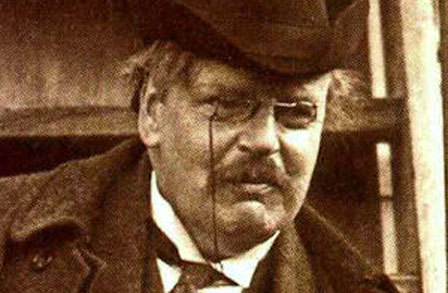
I can think of few authors who can be read and re-read with as much pleasure as G. K. Chesterton (1874-1936). I am currently re-reading his Autobiography, which is less an autobiography than a collection of essays on various themes suggested by his life. If there is any vestige remaining within me of the Catholicism with which I was raised and educated, it is owing largely to Chesterton and such writers as Trappist Monk Thomas Merton. What Chesterton says here about a soi-disant biography he wrote about Robert Browning applies equally to his own autobiography.

Finally, a crown of what I can only call respectability came to me from the firm of Macmillan; in the form of a very flattering invitation to write the study of Browning for the English Men of Letters Series. It had just arrived when I was lunching with Max Beerbohm, and he said to me in a pensive way: “A man ought to write on Browning while he is young.” No man knows he is young while he is young. I did not know what Max meant at the time; but I see now that he was right; as he generally is. Anyhow, I need not say that I accepted the invitation to write a book on Browning. I will not say that I wrote a book on Browning; but I wrote a book on love, liberty, poetry, my own views on God and religion (highly undeveloped), and various theories of my own about optimism and pessimism and the hope of the world; a book in which the name of Browning was introduced from time to time, I might almost say with considerable art, or at any rate with some decent appearance of regularity. There were very few biographical facts in the book, and those were nearly all wrong. But there is something buried somewhere in the book; though I think it is rather my boyhood than Browning’s biography.

The Things in My Pockets

I Accept G.K. Chesterton’s Challenge, Sort Of

It was in an essay entitled “A Piece of Chalk” that appeared in his collection Tremendous Trifles (1909):

Once I planned to write a book of poems entirely about the things in my pockets. But I found it would be too long; and the age of the great epics is past.

As I am not a poet, I will attempt to write an essay, or at least a blog post, about the contents of my pockets.

To begin with, I know it is a fashion among the svelte to wear shirts that have no pockets. (If you have ever seen any pictures of me, you know that “svelte” is not ba word that can be used to describe me.) One pulls one’s head through a hole at the top, and the result is a look that signals that one is in all probability dyspeptic. Fortunately, they haven’t attempted to do the same thing with pants. I suppose that if I had some native bearers, I could afford not to worry about he things I have to carry. But I have no native bearers.

Let’s start with the shirt. I prefer a shirt with two pockets. In the left one is an eyeglass case bearing my reading glasses. Shoved up against it is a Parker Executive ballpoint pen. The other usually contains a pill box for my Metformin HCL, Atorvastatin, Vitamin D3, and Oleuropein.

My pants have four pockets. Let’s start with the front left pocket, which contains my wallet. In my right front pocket are the sets of keys I need for the day’s activities: car keys, house keys, and—if I become employed again—my office keys.

In my back pockets are two handkerchiefs. The left back pocket contains a usually clean hanky used for cleaning the smudges off my eyeglasses. The right back pocket contains what Shakespeare would call my snotrag.

Now that usually is not enough for everything I need. If I step out of the house, I need room for a Ziplock® sandwich bag containing my two types of insulin and a supply of nano-needle nibs. Then, too, I go nowhere without books and/or one of my Kindles. Then, too, one must add bus schedules (on general principle, I do not pay exorbitant parking fees), a floor guide to the Los Angeles Central Library, my cellphone (when I allow myself to be so bothered), and a folded-up plastic bag for carrying books, if necessary. For the items in this paragraph, I use a Magellan travel bag which I see I will have to replace soon if I do not wish to be confused with the homeless.

And that is it. I don’t think it would have made for a good poem. Though, if anyone could do it, it would be G.K. Chesterton.


Serendipity: The Allegory of the Lamp Post

Lamp Post at Hotel Jardines de Nivaria in Tenerife

I am currently reading Simone Weil’s essay “On the Abolition of All Political Parties”—a subject to which I will return in a few days. In the introduction by Simon Leys, I found this splendid long quote from G. K. Chesterton’s Heretics:

Suppose that a great commotion arises in the street about something, let us say a lamp-post, which many influential persons desire to pull down. A grey-clad monk, who is the spirit of the Middle Ages, is approached upon the matter, and begins to say, in the arid manner of the Schoolmen, “Let us first of all consider, my brethren, the value of Light. If Light be in itself good—” At this point he is somewhat excusably knocked down. All the people make a rush for the lamp-post, the lamp-post is down in ten minutes, and they go about congratulating each other on their unmediaeval practicality. But as things go on they do not work out so easily. Some people have pulled the lamp-post down because they wanted the electric light; some because they wanted old iron; some because they wanted darkness, because their deeds were evil. Some thought it not enough of a lamp-post, some too much; some acted because they wanted to smash municipal machinery; some because they wanted to smash something. And there is war in the night, no man knowing whom he strikes. So, gradually and inevitably, to-day, to-morrow, or the next day, there comes back the conviction that the monk was right after all, and that all depends on what is the philosophy of Light. Only what we might have discussed under the gas-lamp, we now must discuss in the dark.

Terrible Harmony

Thoughts Inspired by Garry Wills’s Great Book on Chesterton

Thoughts Inspired by Garry Wills’s Great Book on Chesterton

I can identify the exact moment I fell in love with G.K. Chesterton. Many years ago, as I read The Man Who Was Thursday for the first time, I came across this line by Gilbert Syme, the narrator: “Just at present you only see the tree by the light of the lamp. I wonder when you would ever see the lamp by the light of the tree.” It hit me like a bolt of lightning that here was a man that knew that all was one, and that everything affected everything else. Indeed, why not by the light of the tree?

Decades later, I finally read Garry Wills’s first book, Chesterton. It is not only the best work about the author I have ever read, and perhaps one of the best works of literary criticism I have read for many a year, but it made me come to several realizations:

  1. Chesterton was not some sort of Jolly Green Giant: What peace he finally attained was hard won.
  2. As the First World War and the books he wrote at that time showed, he was a very indifferent political propagandist (see The Appetite of Tyranny and The Utopia of Usurers).
  3. When Chesterton finally converted to Catholicism in 1922, he became another type of propagandist—one for his faith—but considerably more effectively than in his political work.
  4. Perhaps Chesterton’s most interesting work came before the Great War.

The best thing about Chesterton is Wills’s detailed analysis of the early work, including the poems “The Wild Knight” and “The Ballad of the White Horse” and most particularly, my favorite GKC book, The Man Who Was Thursday.

In an essay on dreams in The Coloured Lands, Chesterton wrote one of the most cogent expressions of the complexity of his dance with joy and nightmare:

In this subconscious world, in short, existence betrays itself; it shows that it is full of spiritual forces which disguise themselves as lions and lamp-posts, which can as easily disguise themselves as butterflies and Babylonian temples…. Life dwells alone in our very heart of hearts, life is one and virgin and unconjured, and sometimes in the watches of the night speaks in its own terrible harmony.

I have only one minor quibble, and that is that Wills downplayed much of Chesterton’s fiction, which was almost always good, from his earliest Father Brown stories (which he covers) to such titles as The Club of Queer Trades, The Paradoxes of Mr. Pond, The Return of Don Quixote, and The Poet and the Lunatics. At the same time, what Wills does accomplish is to excellent that I cannot but see myself re-reading this excellent book, and maybe even searching for a hardbound copy for my burgeoning GKC collection.