Tarnmoor’s ABCs: G. K. Chesterton

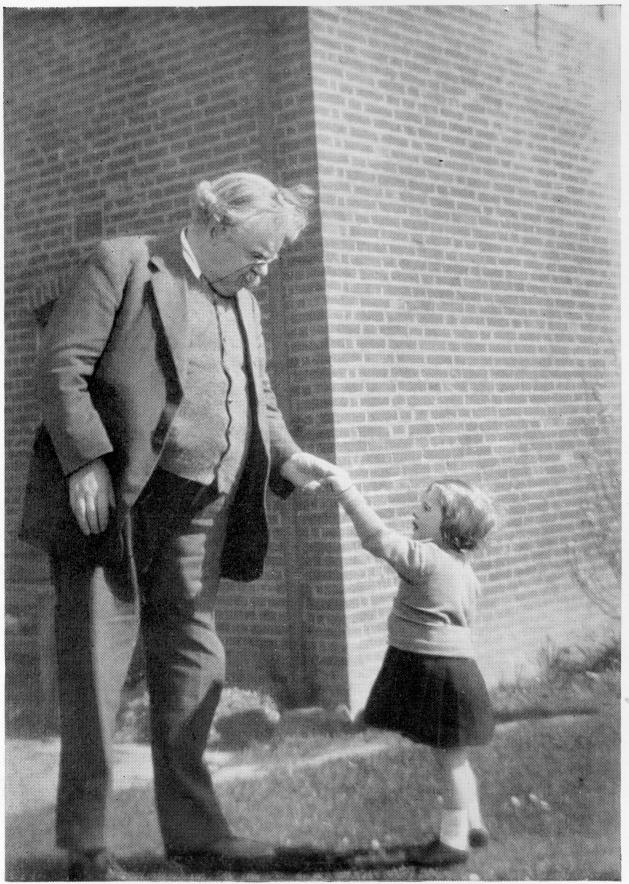
Chesterton with Admirer

Chesterton with Admirer

I was so very impressed by Czeslaw Milosz’s book Milosz’s ABC’s. There, in the form of a brief and alphabetically-ordered personal encyclopedia, was the story of the life of a Nobel Prize winning poet, of the people, places, and things that meant the most to him. Because his origins were so far away (Lithuania and Poland) and so long ago (1920s and 1930s), there were relatively few entries that resonated personally with me. Except it was sad to see so many fascinating people who, unknown today, died during the war under unknown circumstances.

This blog entry is my own humble attempt to imitate a writer whom I have read on and off for thirty years without having sated my curiosity. Consequently, over the next few months, you will see a number of postings under the heading “Tarnmoor’s ABCs” that will attempt to do for my life what Milosz accomplished for his. I don’t guarantee that I will use up all 26 letters of the alphabet, but I’ll do my best. Today, we’re at the letter “G”:

This is my first ABC entry about the writers who have most influenced me. Interestingly, I discovered all of them right around the same time, just after 1970. Gilbert Keith Chesterton (1874-1936) is the only one of them who might very well be declared a saint of the Catholic Church during my lifetime—or not. Roman Catholic Bishop Peter Doyle of Northampton, England, has ordered an examination into the life of the author, which is the usual first step on the road to beatification and, eventually, canonization. Feeling is strong both for and against his sainthood, some alleging that he was anti-Semitic, though I have never seen any evidence to that effect.

GKC was incredibly prolific, writing journalism, fiction, essays, poetry, plays, biography, and political and religious works. I started by reading his essays (mostly published as journalism), then moved on to his fiction, and in the end reading as much of everything as I could find. He is probably one of the most quotable writers of the Twentieth Century. The following is from my favorite of his novels, The Man Who Was Thursday:

He knew that each one of these men stood at the extreme end, so to speak, of some wild road of reasoning. He could only fancy, as in some old-world fable, that if a man went westward to the end of the world he would find something—say a tree—that was more or less than a tree, a tree possessed by a spirit; and that if he went east to the end of the world he would find something else that was not wholly itself—a tower, perhaps, of which the very shape was wicked. So these figures seemed to stand up, violent and unaccountable, against an ultimate horizon, visions from the verge.

And again:

Syme had for a flash the sensation that the cosmos had turned exactly upside down, that all trees were growing downwards and that all stars were under his feet. Then came slowly the opposite conviction. For the last twenty-four hours the cosmos had really been upside down, but now the capsized universe had come right side up again.

Following is a poem called “A Ballad of Abbreviations,” making fun of how Americans replace simple Anglo-Saxon terms with clumsier circumlocutions:

A Ballad of Abbreviations

The American’s a hustler, for he says so,
And surely the American must know.
He will prove to you with figures why it pays so
Beginning with his boyhood long ago.
When the slow-maturing anecdote is ripest,
He’ll dictate it like a Board of Trade Report,
And because he has no time to call a typist,
He calls her a Stenographer for short.

He is never known to loiter or malinger,
He rushes, for he knows he has ‘a date’ ;
He is always on the spot and full of ginger,
Which is why he is invariably late.
When he guesses that it’s getting even later,
His vocabulary’s vehement and swift,
And he yells for what he calls the Elevator,
A slang abbreviation for a lift.

Then nothing can be nattier or nicer
For those who like a light and rapid style.
Than to trifle with a work of Mr Dreiser
As it comes along in waggons by the mile.
He has taught us what a swift selective art meant
By description of his dinners and all that,
And his dwelling, which he says is an Apartment,
Because he cannot stop to say a flat.

We may whisper of his wild precipitation,
That it’s speed in rather longer than a span,
But there really is a definite occasion
When he does not use the longest word he can.
When he substitutes, I freely make admission,
One shorter and much easier to spell ;
If you ask him what he thinks of Prohibition,
He may tell you quite succinctly it is Hell.

You can find many of Chesterton’s best works available for free from Gutenberg.Com or for cheap from E-Book vendors.

Against Oligarchy

Can’t Be Bribed?

Can’t Be Bribed?

You will hear everlastingly, in all discussions about newspapers, companies, aristocracies, or party politics, this argument that the rich man cannot be bribed. The fact is, of course, that the rich man is bribed; he has been bribed already. That is why he is a rich man. The whole case for Christianity is that a man who is dependent upon the luxuries of this life is a corrupt man, spiritually corrupt, politically corrupt, financially corrupt. There is one thing that Christ and all the Christian saints have said with a sort of savage monotony. They have said simply that to be rich is to be in peculiar danger of moral wreck. It is not demonstrably un-Christian to kill the rich as violators of definable justice. It is not demonstrably un-Christian to crown the rich as convenient rulers of society. It is not certainly un-Christian to rebel against the rich or to submit to the rich. But it is quite certainly un-Christian to trust the rich, to regard the rich as more morally safe than the poor. A Christian may consistently say, “I respect that man’s rank, although he takes bribes.” But a Christian cannot say, as all modern men are saying at lunch and breakfast, “a man of that rank would not take bribes.” For it is a part of Christian dogma that any man in any rank may take bribes.—G. K. Chesterton, Orthodoxy

G. K. Chesterton vs Conservatism

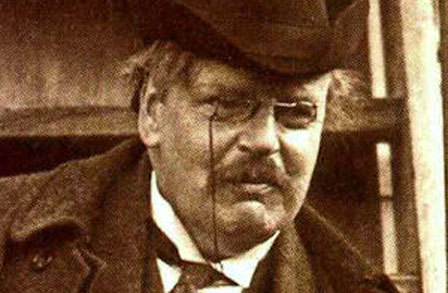
G. K. Chesterton

G. K. Chesterton

We have remarked that one reason offered for being a progressive is that things naturally tend to grow better. But the only real reason for being a progressive is that things naturally tend to grow worse. The corruption in things is not only the best argument for being progressive; it is also the only argument against being conservative. The conservative theory would really be quite sweeping and unanswerable if it were not for this one fact. But all conservatism is based upon the idea that if you leave things alone you leave them as they are. But you do not. If you leave a thing alone you leave it to a torrent of change. If you leave a white post alone it will soon be a black post. If you particularly want it to be white you must be always painting it again; that is, you must be always having a revolution. Briefly, if you want the old white post you must have a new white post. But this which is true even of inanimate things is in a quite special and terrible sense true of all human things. An almost unnatural vigilance is really required of the citizen because of the horrible rapidity with which human institutions grow old. It is the custom in passing romance and journalism to talk of men suffering under old tyrannies. But, as a fact, men have almost always suffered under new tyrannies; under tyrannies that had been public liberties hardly twenty years before. Thus England went mad with joy over the patriotic monarchy of Elizabeth; and then (almost immediately afterwards) went mad with rage in the trap of the tyranny of Charles the First. So, again, in France the monarchy became intolerable, not just after it had been tolerated, but just after it had been adored. The son of Louis the well-beloved was Louis the guillotined. So in the same way in England in the nineteenth century the Radical manufacturer was entirely trusted as a mere tribune of the people, until suddenly we heard the cry of the Socialist that he was a tyrant eating the people like bread. So again, we have almost up to the last instant trusted the newspapers as organs of public opinion. Just recently some of us have seen (not slowly, but with a start) that they are obviously nothing of the kind. They are, by the nature of the case, the hobbies of a few rich men. We have not any need to rebel against antiquity; we have to rebel against novelty. It is the new rulers, the capitalist or the editor, who really hold up the modern world. There is no fear that a modern king will attempt to override the constitution; it is more likely that he will ignore the constitution and work behind its back; he will take no advantage of his kingly power; it is more likely that he will take advantage of his kingly powerlessness, of the fact that he is free from criticism and publicity. For the king is the most private person of our time. It will not be necessary for any one to fight again against the proposal of a censorship of the press. We do not need a censorship of the press. We have a censorship by the press.—G. K. Chesterton, Orthodoxy

Some Things Get Better

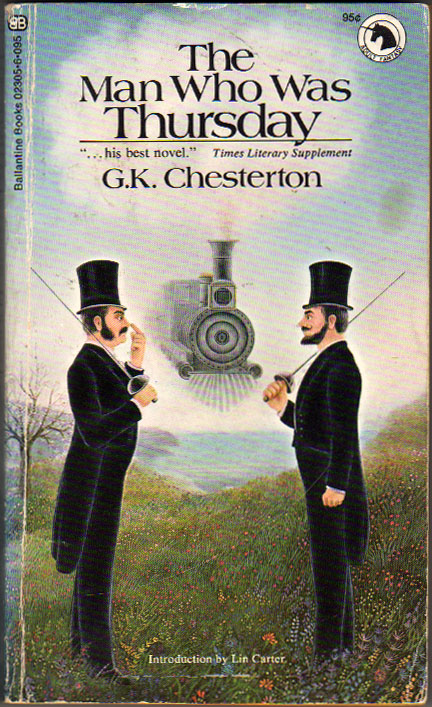
The Rare Ballantine Adult Fantasy Edition

The Rare Ballantine Adult Fantasy Edition

I am currently re-reading G. K. Chesterton’s The Man Who Was Thursday, perhaps his best work of fiction. I came to it first some forty years ago, and since then have read it two or three times. After going through all the Chesterton volumes at the Santa Monica Public Library—that took all of ten years—I decided to start collecting his work. At the outset, there weren’t many works in print. Fortunately, Ignatius Press of San Francisco started coming out with an edition of his Collected Works. To date, I have all the volumes that have been released so far: I say “so far” because they are still dribbling out at a rate of one or two a year.

Currently, all of Chesterton’s major works are in print, sometimes in multiple editions. It is only in some of the more abstruse titles such as GKC as MC, The Victorian Age in Literature, Sidelights of New London and Newer York, and William Cobbett that require some digging around. But Gutenberg.Com has full texts of more than forty of his works, including fiction, plays, essays, journalism, and poetry. (Click here and scroll about 40% of the way down.)

It isn’t easy to compile the complete works of someone who was so prolific as GKC. His short pieces appear in newspapers and magazines from all over the English-speaking world, many in publications which no longer exist. Fortunately, most of his books are still around. In fact, I would have been delighted (and bankrupted) if such were the case in 1986. I regularly scour the listings in eBay, but only once or twice a year can a find a title I don’t have on my shelves in some form.

In addition, Chesterton is also widely available cheap or free for readers of Kindles and other e-books.

Before I go any further, let me answer one question that might be hovering at the back of your mind if you’ve gotten this far: What is the point of reading Chesterton at all? I mean, didn’t he convert to Catholicism and write a whole lot of religious books?

Yes, he did—among scores of books not relating to religious subjects—despite the fact that the Catholic Church is considering canonizing him as a saint. Having read widely in both his religious and secular works, I think they are equally of value. His biographies of Saints Francis and Thomas Aquinas are well worth a read, as well as The Everlasting Man. He is probably most famous for the Father Brown stories, in which the hero/detective is a Catholic priest. Although his Catholicism certainly enters into the stories, it is not in an obtrusive way. (There is also an excellent 1954 British comedy called The Detective, starring Alec Guinness as Father Brown.)

What I like most about Chesterton is the way he exorcised his own demons, and he had a few. The early years of the Twentieth Century were an anxious time in Europe, with a nasty arms race between Britain and Germany, and the prospect of a war looming in the near horizon. At the same time, it was the high water mark of both anarchism and international socialism. And that was not to mention any personal demons lurking in the writer’s heart. GKC faced his demons with optimism, humor, and style. He did it so successfully that even today I will read an obscure Chesterton if I am feeling down in the dumps. In his own way, he is much like P. G. Wodehouse in that regard—but that is another story.


The Brotherhood of Silence

Saint G. K. Chesterton?

Saint G. K. Chesterton?

G. K. Chesterton has for many years been one of my favorite writers. And now I hear there is a movement to have him canonized as a saint. That would be all right with me. In the current issue of Gilbert, the publication of the American Chesterton Society (of which I am a member), there is even a jocular article entitled “Why G. K. Chesterton Ought to be Canonized,” in which eighteen reasons which some cite against his canonization are turned around by author Peter Kreeft into reasons espousing his sainthood.

At the bottom of the second and last page of his article was this slight poem, which is typical of the man:

Love’s Trappist

There is a place where lute and lyre are broken,
Where scrolls are torn and on a wild wind go,
Where tablets stand wiped naked for a token,
Where laurels wither and the daisies grow.

Lo: I too join the brotherhood of silence,
I am Love’s Trappist and you ask in vain,
For man through Love’s gate, even as through Death’s gate,
Goeth alone and comes not back again.

Yet here I pause, look back across the threshold,
Cry to my brethren, though the world be old,
Prophets and sages, questioners and doubters,
O world, old world, the best hath ne’er been told!

I will write more about Chesterton soon. When I first started reading him, only a few of his works were in print. Now, partly thanks to the Ignatius Press’s edition of his complete works (which is slowly coming out one or two volumes a year), and to a resurgence of interest in works in the public domain, virtually all of his published books are available. Because he was a prolific journalist as well as a poet, novelist, and essayist, much of his works in newspapers and more obscure magazines has not yet been collected.