The Archbishop’s Garden

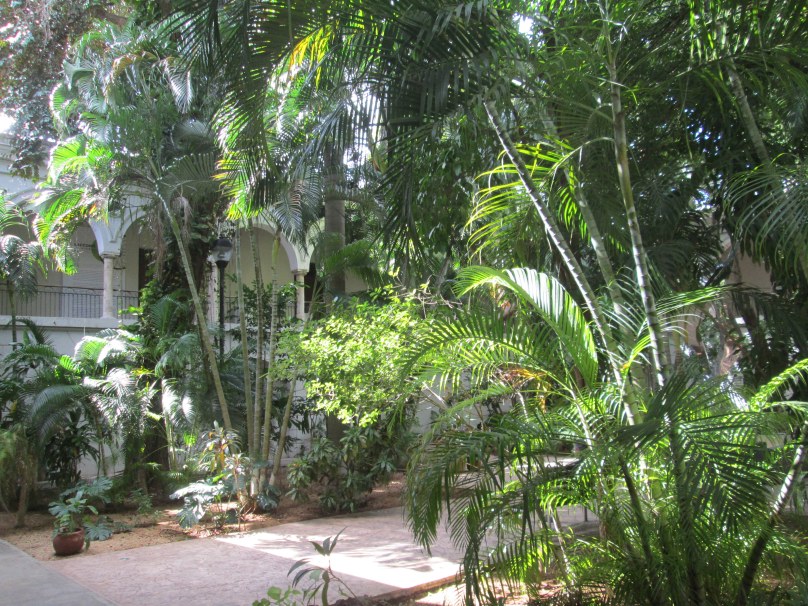
The Archbishop’s Enclosed Garden in Mérida, Yucatán

Do you ever really use your front lawn? There you are, in full view of wandering passersby and the occasional hobo. You feel self-conscious and even slightly stupid—unless you are doing yard work.

Take a look at the above courtyard, which is surrounded on all sides by the Mérida, Yucatán archbishop’s palace. It was a hot, humid day; yet the garden was cool with comfortable benches in the shade. I took advantage of the benches before seeing the rest of the art museum that the archbishop’s palace has been turned into.

I love the Mexican houses that have no setback from the street, instead enclosing a private courtyard that is in actuality the heart of the house. Of course, there are laws that prevent such a thing in the United States. Hence all those front lawns that are thirsty for water and fertilizer and are never used for the pleasure of the family within.

Granted, the archbishop had the means to have something special built for him; but I have seen scores of small gardens in more modest Mexican houses, including many of the small hotels at which I have stayed. In many cases, they are used as bars or simple restaurants.

Sometimes I think that the water shortages in California and other desert states could be alleviated simply by getting rid of those front lawns that attempt to imitate an English country house. California is not England, nor is it the Eastern U.S.
Traffic Island Paradise

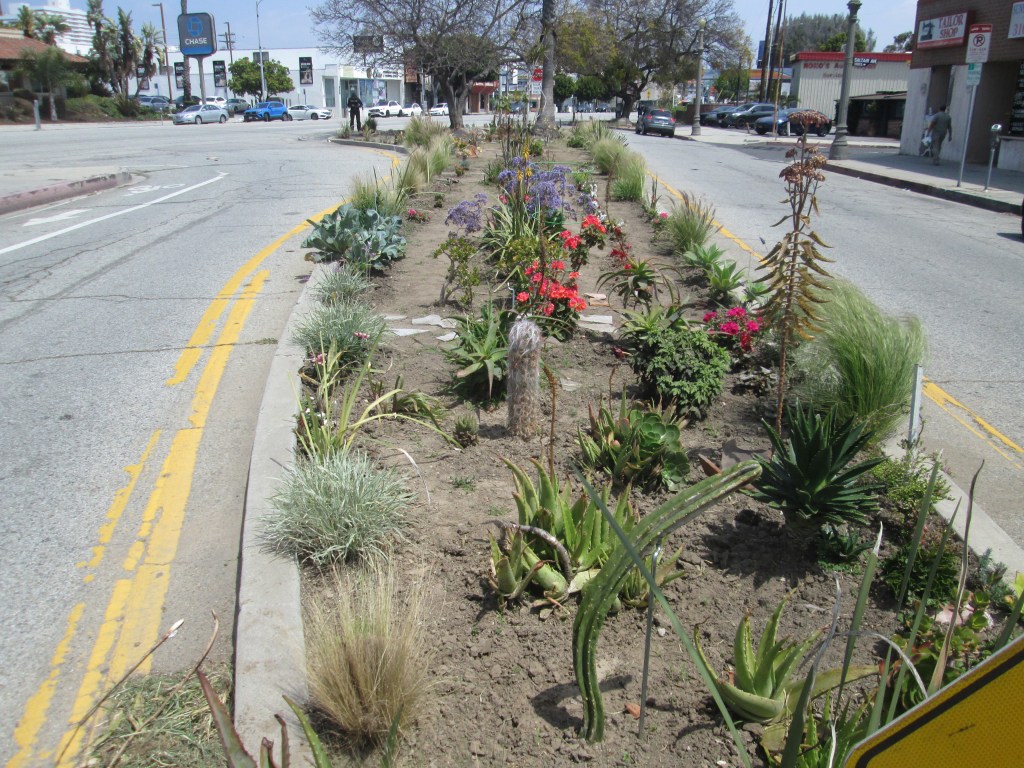
The Traffic Island at the Corner of Ohio Avenue and Santa Monica Blvd

You have not heard me say many good things about the legions of homeless that live in the streets of Los Angeles. Today, I will make an exception. Two blocks east of me is a little traffic island where Ohio Avenue intersects at an angle with Santa Monica Blvd.

The City of Los Angeles does not get the credit for digging up the earth of the island and planting it with succulents and other water-saving plants. The man responsible is a homeless man who lives in a tent to the left of the traffic island. Martine and I have seen him at work planting and weeding.

It is more often the case that the homeless who live in tents in West Los Angeles are known for accumulations of garbage, vandalism, panhandling, and getting into fights with other homeless in the wee hours of the morning.

I have not spoken to the man who created this little garden, but I wish him well. May he find a home where his talent at gardening will be more appreciated. I also hope that some idiotic city administrator does not decide to dig up the garden and replace it with something more boring.

A Botanical Garden Plus …

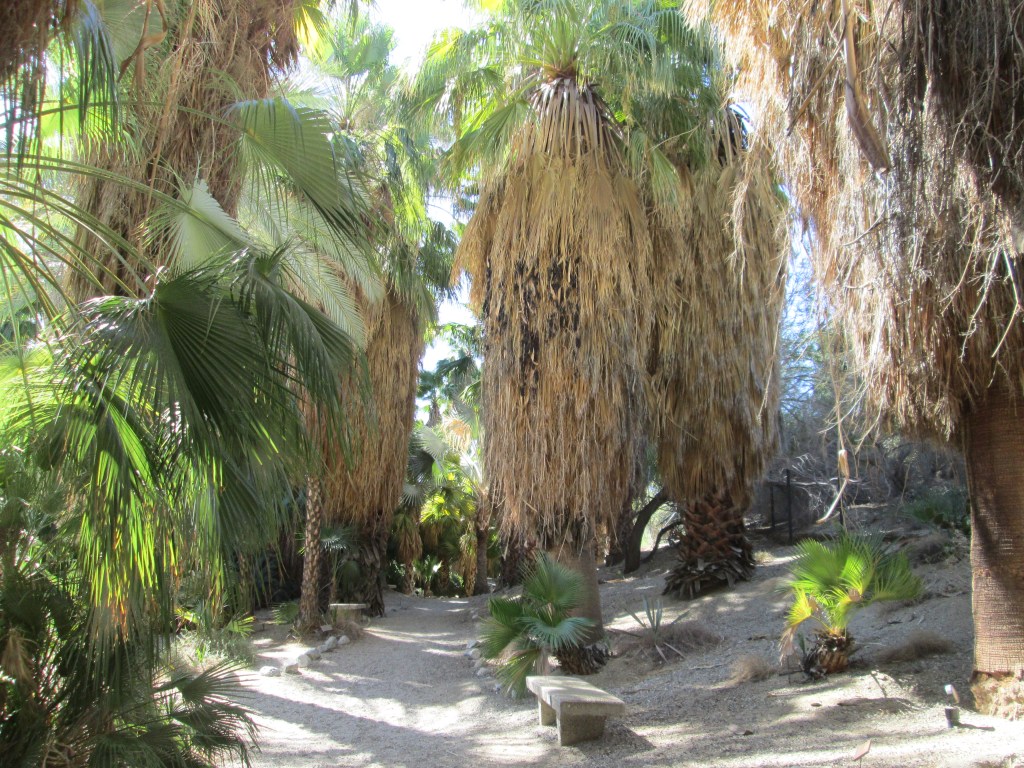
The big tourist attraction in the city of Palm Desert is the Living Desert Zoo and Gardens. On my last day in the desert, while the male members of my family hiked Andreas Canyon, I decided to re-visit the Living Desert. Instead of frantically trying to see all the animals—many of whom, typically, were in hiding—I concentrated on the gardens, which are restful and lovely.

So I spent some time in the shade of a palm tree reading Philip K. Dick’s The Zap Gun, with a bag of popcorn and a bottle of water at my side.

There have been changes since my last visit. For one thing, there is a whole Australian section; and, in future, there will be a major rhinoceros exhibit in the African section.

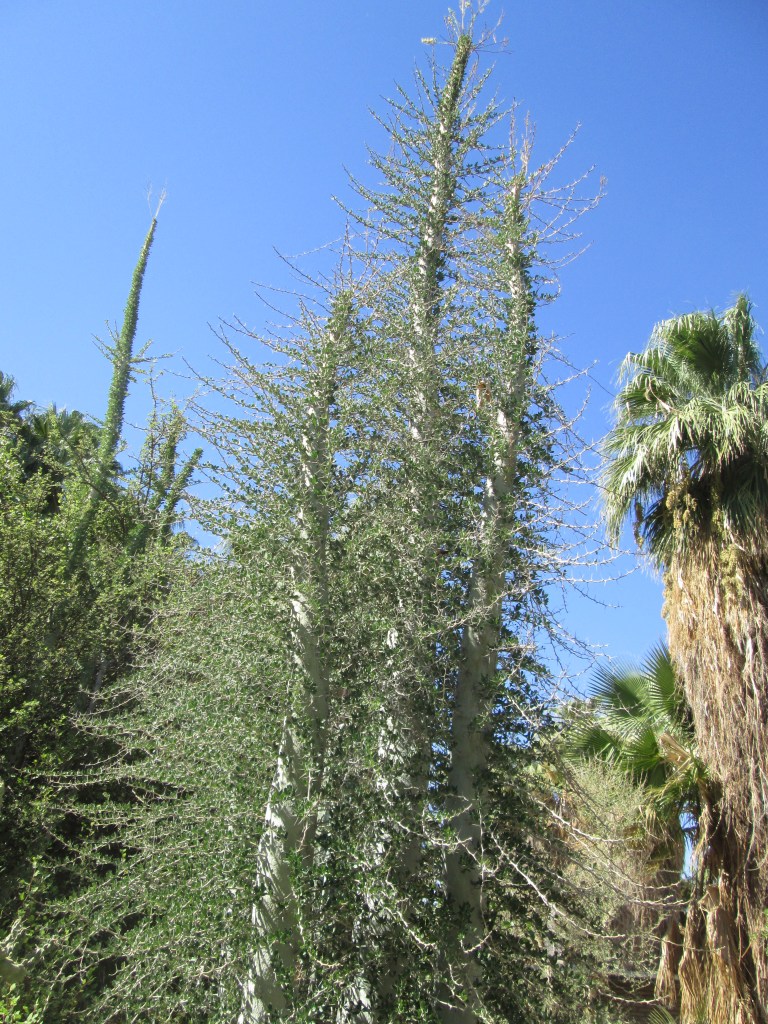
Shown above is a Boojum Tree or Cirio from Baja California’s central desert. The scientific name is Fouquieria columaris, but the English name is taken from Lewis Carroll’s poem “The Hunting of the Snark”:

“But if ever I meet with a Boojum, that day,
⁠In a moment (of this I am sure),
I shall softly and suddenly vanish away—
⁠And the notion I cannot endure!” 

Tomorrow, I will describe some of the animals I saw at the Living Desert.

Visiting L.A. History

The Ranch House at Rancho Los Alamitos

Over the last year or so, Martine and I have been visiting many of the old adobes that were associated with the Spanish and Mexican land grants into which the arable land of Los Angeles had been subdivided. These have included:

  • Centinela Adobe in Westchester
  • Dominguez Rancho Adobe Museum in Rancho Dominguez
  • Leonis Adobe Museum in Calabasas
  • Los Encinos State Historic Park in Encino
  • Pio Pico State Historic Park in Whittier
  • Rancho Los Alamitos Historic Ranch and Gardens in Long Beach
  • Rancho Los Cerritos Historic Site in Long Beach

Of these, the most spectacular have been the Leonis Adobe and Rancho Los Alamitos, both of which have substantially larger budgets and more well-developed exhibits than the others.

When one has visited a number of these adobes, a pictures emerges of an agrarian life of herding sheep and cattle and of a few widely-separated ranches, mostly far from the Pueblo of Nuestra Señora la Reina de los Angeles de Porciuncula (a.k.a. downtown Los Angeles), which was founded in 1781. In the years that followed, the map of Southern California was broken into large land grants:

Spanish Land Grants in the San Gabriel Valley

Small wonder that there are so many Spanish place names in L.A.! The land that was not part of a Spanish or Mexican land grant was either a town site, mountains, or desert.

Rancho Los Alamitos, which Martine and I visited today was surrounded by lush gardens of carefully chosen trees, flowers, and succulents.On the grounds is a deep artesian well that helped the land stay productive for agriculture for well over a century and a half.

Part of the Los Alamitos Gardens

It is also by far the most liveable of the adobes we have visited. For one thing, the original 19th century adobe structure was substantially added to. Unlike most adobes which are sparsely furnished with miscellaneous items that were never meant to coexist in the same room, at Los Alamitos we have the original furniture, library, kitchen appliances, including some pieces actually crafted by carpenter John Bixby, one of the original inhabitants.

Rancho Los Alamitos is a place of beauty which we will visit again.