“The Harmonious Universe of His Soul”

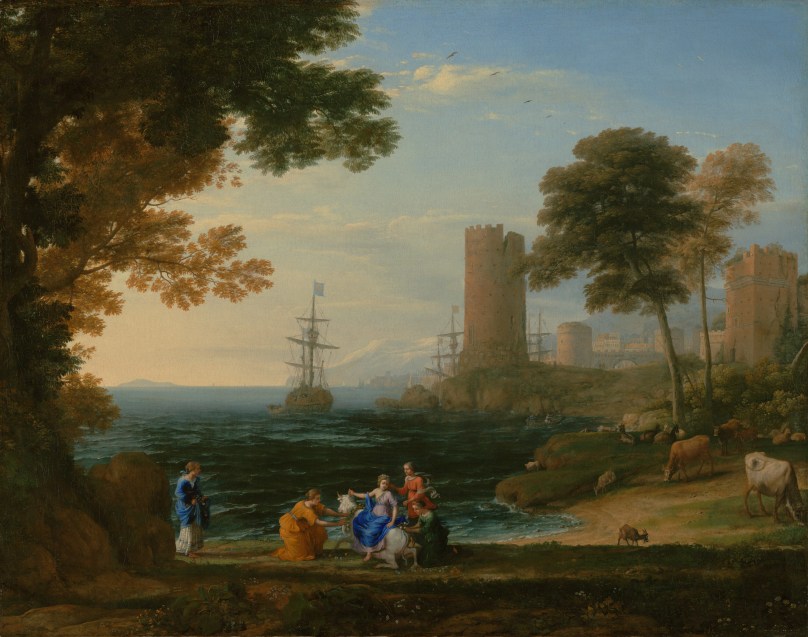
Claude Lorrain’s “Coast View with the Abduction of Europa”

Goethe perhaps said it best: “Claude Lorrain knew the real world by heart, down to the minute details. He used it as a means of expressing the harmonious universe of his soul.”

Both Lorrain (1604-1682) and Nicolas Poussin (1594-1665) made a career of creating peaceful canvases that draw the viewer’s eye in and leave him or her in a meditative state. That is the case even though the subject matter of the above painting is of a violent rape:

The Abduction of Europa is a classical myth from Ovid’s Metamorphoses, in which Zeus transforms himself into a white bull to abduct the Phoenician princess Europa. He lures her onto his back and carries her across the sea to the island of Crete, where they have children, including Minos, who become the first king of Crete and one of the divine judges of the underworld.

Rembrandt also painted the scene in a much more dramatic fashion, but in Lorrain’s painting, it is almost an afterthought—as if it could have been replaced by dancing Naiads or a shepherd with his flock with no loss in overall effect.

Every time I visit the Getty Center in the Santa Monica Mountains, I feel a frisson of excitement as I take a fresh look at the museum’s incredible collection.

The Musicians’ Brawl

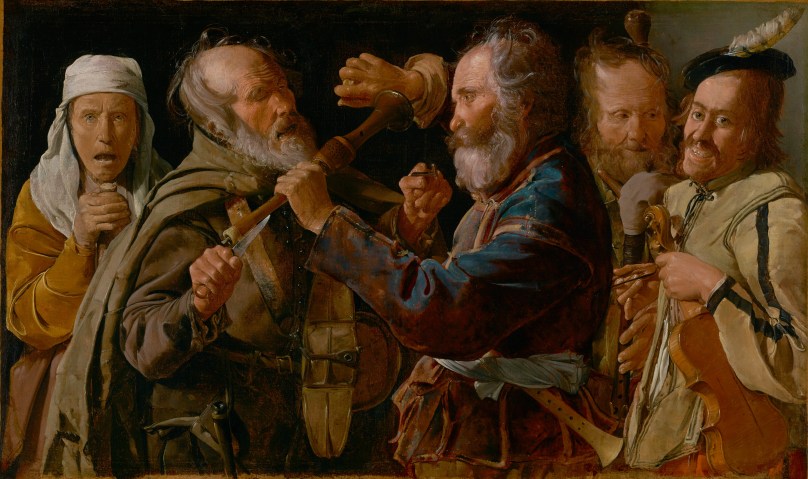
“The Musicians’ Brawl” by Georges de la Tour (1593-1652)

This afternoon, I dropped in to the Getty Center to refresh my store of images. The one that stuck in my mind the most was a 17th century canvas entitled “The Musicians’ Brawl” by French painter Georges de la Tour.

There’s a lot happening in this picture. There are five figures depicted, all very nearly on the same plane. From left to right, we begin with an old woman who is appalled by the fracas. Moving rightward, we have a bearded blind musician with a knife in one hand and a hurdy-gurdy slung on his shoulder. He is being confronted by another bearded musician with a shawm (a predecessor to the oboe) in his left hand and a wedge of lemon in his right, which he is squeezing in the eyes of the hurdy-gurdy player not entirely believing he is blind.

Continuing to the right, we have two musicians who are spectators. The bearded one is barely paying attention, while his mustachioed companion stares drunkenly out at us while clutching his instrument. That rightmost figure is, to me, the most memorable one in the painting. He is clearly chuckling and looking at us with slightly glazed eyes.

I will never forget that drunken facial expression. It is the painterly version of an earworm.

An Architectural Marvel

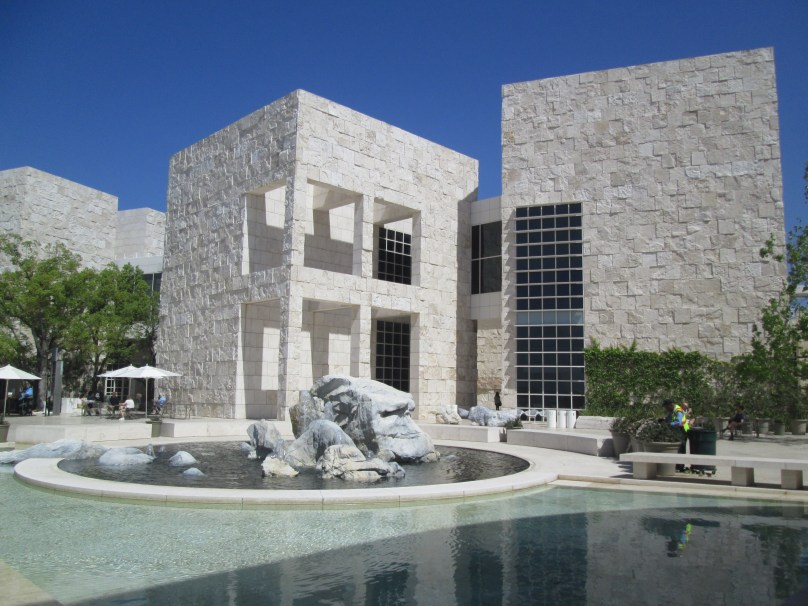
The Getty Center in Los Angeles

In general, I am not a big fan of contemporary architecture. I get tired of giant rectangles constructed of steel and glass. Ever since it opened its doors in 1997, I have come to love the Getty Center. (I also love the Getty Villa in Malibu, but I’ll save that for another time.)

Architect Richard Meier spent thirteen years designing the center, with the kind of attention to detail used to site ancient Egyptian or Meso-American temples. For instance, some of the buildings on the campus are oriented north/south. Others parallel the line of the I-405 freeway, which is 22.5° degrees off the north/south axis—which is exactly one-half of 90° and one-fourth of 180°.

The buildings are faced with blocks of travertine from Italy or aluminum tiles, both of which are 30 inches square (or 76.2 centimeters). Below is a close-up of one of the highly textured travertine walls:

Travertine Blocks Forming Getty Center Outer Wall

When I open the front door of my apartment in the morning to pick up my copy of the Los Angeles Times, I can actually see the Getty Center atop its hill some 4.5 miles (7.24 kilometers) as the crow flies. For more info about the Center’s design, click here.

Rambles, Dreams, and Shadows

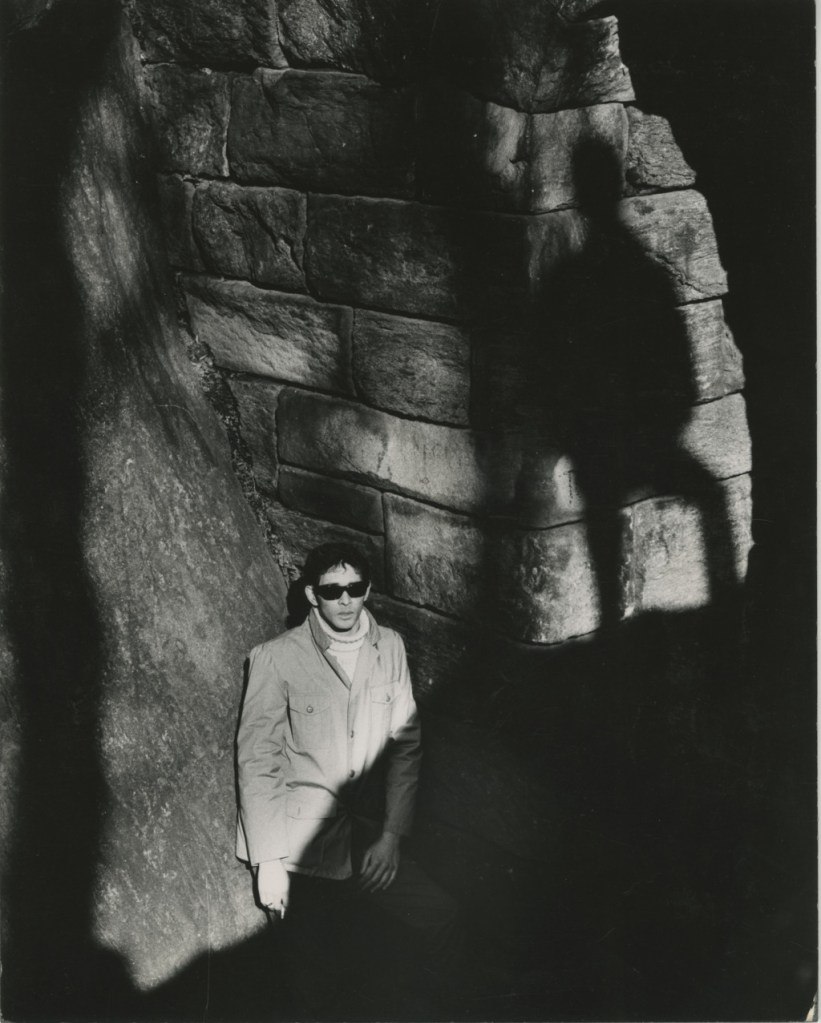
Two Men Cruising Central Park

In last Thursday’s visit to the Getty Center, I concentrated on the prints of William Blake, but I also checked the photography exhibits, which are always changing and always interesting. I particularly enjoyed the “Rambles, Dreams, and Shadows” exhibit consisting mostly of cityscapes by Arthur Tress (born 1940).

Tress had a particular vision of a New York City shrouded in mystery. In the photo above, only one human figure is readily visible, until you notice the shadow of another in the upper right of the image.

Boy on Bike Crossing Williamsburg Bridge

I love this image of the cyclist on the long straight bridge with no other human beings in sight. There is a sort of last man on earth feeling about this image that appealed to me.

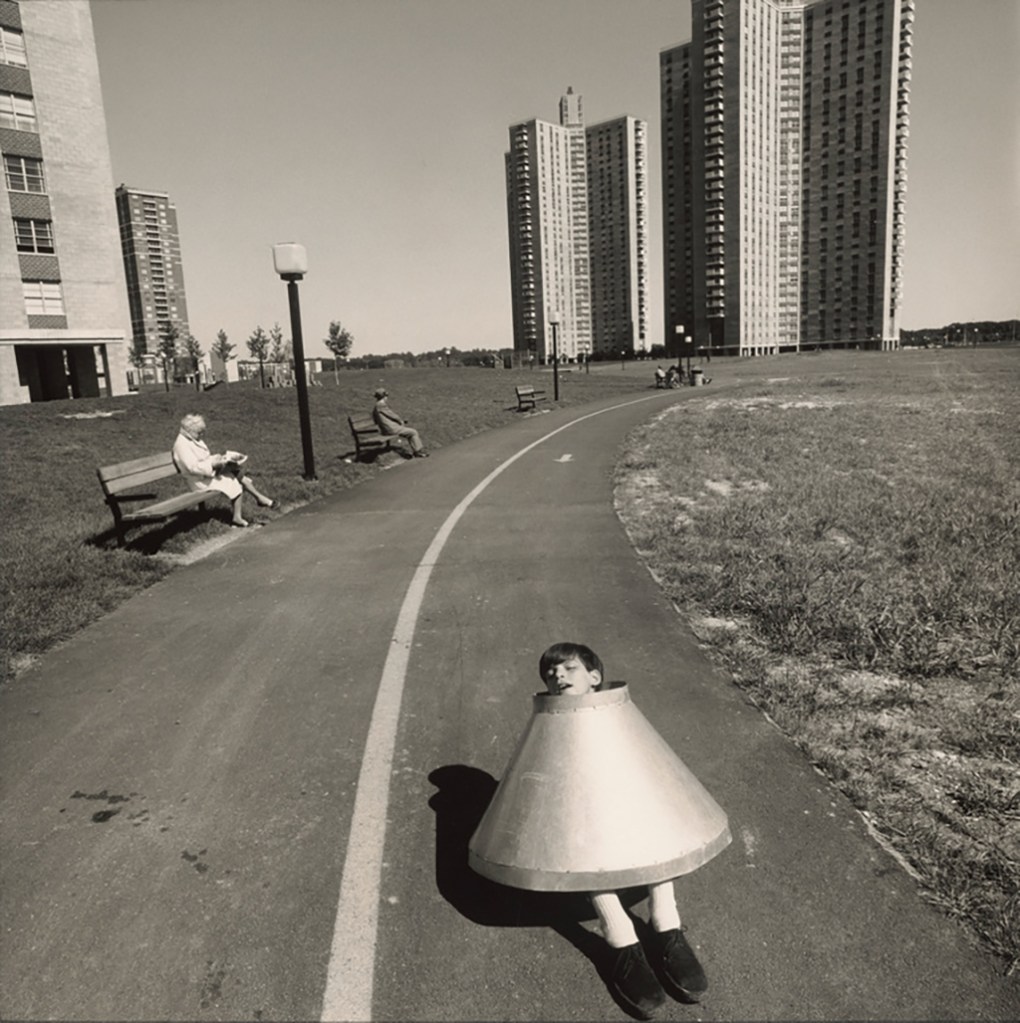
Boy in Tin Cone, Bronx

What the … ? Another mysterious image, this time of a boy wearing a metallic cone that gives him an otherworldly aspect, especially as the feet do not quite seem to match with the boy’s head.

Tuesday at the Getty Center

On the 781 Metro Bus to the Getty Center

In my retirement years, I sometimes drive where I’m going; sometimes I just take public transportation. The two Getty museums in Los Angeles are a good example of the advantage of traveling by bus. There is no admission fee, but parking at each museum costs twenty dollars. Compare that with an outlay of seventy cents for a round trip between Sepulveda & Exposition and the Getty Center. A big plus is that the 781 Metro bus runs every few minutes, so that waiting is not a big factor.

The reason for my visit is an exhibit entitled “William Blake: Visionary,” which closes on January 14. Organized with the cooperation of London’s Tate Museum, it includes a large number of Blake’s prints. I even dished out the money for the exhibit book. It costs a fortune, but I know I would have kicked myself had I passed up the opportunity.

In the next few days, I will write several posts about my visit to the Getty, particularly relating to William Blake, who is probably the only human being who is at one and the same time a great poet and a great visual artist.

The Getty’s Cactus Garden with Westwood and the 405 Freeway in the Background

I like to visit the Getty whenever they have a special exhibit that interests me. This time, I saw only the Blake exhibit and also a large selection of great photographs by Arthur Tress. (The Getty Center always has interesting photographic exhibits.)

Later this month, I will also trek to the Getty Villa in Pacific Palisades to see an exhibit on the Egyptian Book of the Dead. Unlike the Getty Center, the Getty Villa concentrates on ancient Greek and Roman art in a building whose design is a re-created Roman country home within view of the beach.

The Flight Into Egypt

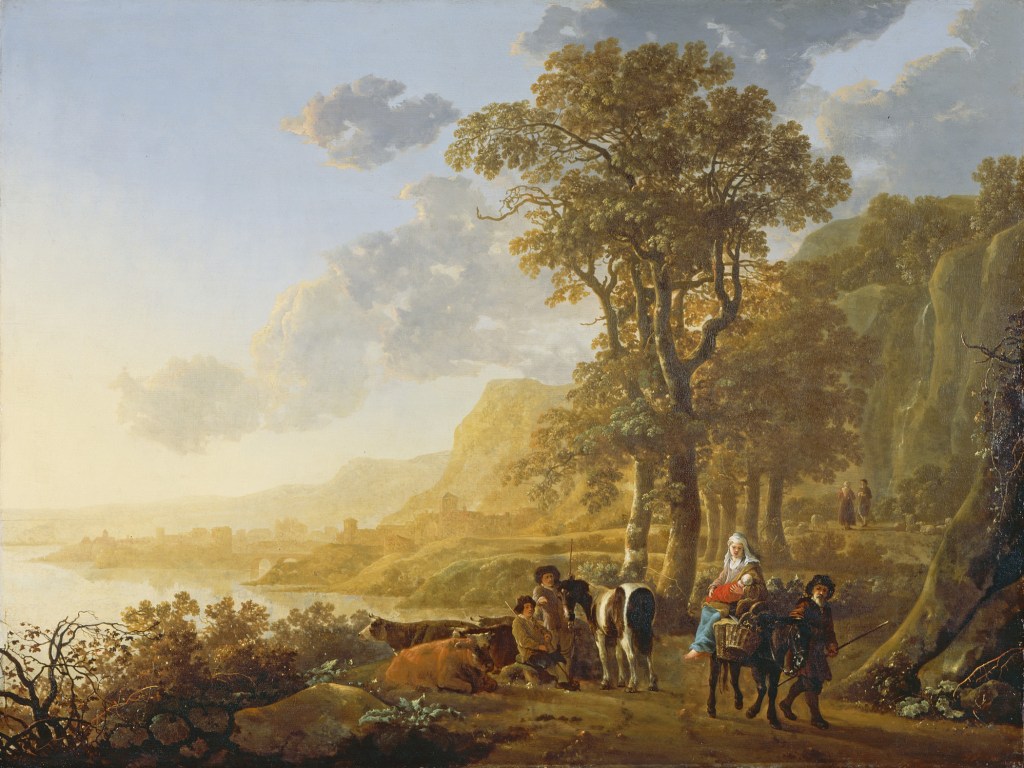
Aelbert Cuyp’s “The Flight Into Egypt” (ca. 1665)

Although I saw this painting at the Getty Center in Los Angeles, it is actually on loan from the Los Angeles County Museum of Art. Apparently Aelbert Cuyp (1620-1691) painted several canvases of the Holy Family’s flight into Egypt to escape Herod’s massacre of the innocents born around Bethlehem. According to the Gospel of St. Matthew (2:16):

Then Herod, when he saw that he was mocked of the wise men, was exceeding wroth, and sent forth, and slew all the children that were in Bethlehem, and in all the coasts thereof, from two years old and under, according to the time which he had diligently inquired of the wise men.

This painting appealed to me because it moves its subject into an obviously European setting—certainly as far removed from the Sinai Peninsula as it is possible to be. At the same time, the scene is as peaceful as a bucolic Poussin or Lorrain painting of the same period.

Cuyp was noted for his landscapes. According to the Wikipedia entry on him, “he is especially known for his large views of Dutch riverside scenes in a golden early morning or late afternoon light.”

A Calm and Serene Time

Nicolas Poussin’s “Landscape with a Calm” (ca. 1650)

I choose to translate the title of painting as “A Calm and Serene Time” (from the French “Un temps calme et serein”). Ever since I first ran into his paintings at the Cleveland Museum of Art as a high school student, I have loved the work of Nicolas Poussin and his near contemporary Claude Lorrain (about whom in a follow-up post).

The 17th century in France has always been a special interest of mine, and Lorrain, Poussin, and a handful of others have only engaged my interest the more in the intervening years.

According to the description on the Getty Center’s website”

In the late 1640s and early 1650s, at the height of his artistic maturity, Nicolas Poussin turned from historical narrative to landscape painting. Landscape with a Calm does not illustrate a story but rather evokes a mood. The ordered composition and clear, golden light contribute to A Calm’s utter tranquility, while glowing, gem-like colors and fluid paint strokes enliven this scene of benevolent nature. Poussin’s sketching campaigns in the Roman countryside with his friend and fellow landscape painter Claude Lorrain account, in part, for its fresh observation of cloud-scattered sky and grazing goats.

The peacefulness of this image and its subtle classical overtones makes me regard this as one of my favorite paintings at the Getty Center.

25 Years of the Getty

This year the Getty Center in Los Angeles is celebrating its silver anniversary. I took the MTA 761 bus to the museum (neatly avoiding the $20 parking fee) and spent several hours looking at the new exhibits and reacquainting myself with the Medieval, Renaissance, and 19th century artworks in the permanent collection.

The Cy Twombly (1928-2011) special exhibit left me speechless. Who slipped up? The man’s work left me shaking my head: Nothing in the gallery spoke to me except to say, “Just pass on through, Bud—the quicker the better.” There was another exhibit on “Conserving de Kooning,” but as I didn’t give a hang for Willem de Kooning’s work, I passed up on it.

Curiously, for the first time, I began to have my doubts about French Impressionism. There was a huge crowd around a Van Gogh still life which was nice, but not spectacular. I disliked some of the Claude Monets: There were some haystacks and a study of the Cathedral of Rouen, but I thought they were merely experiments in the quality of sunlight at different times of the day.

Claude Monet’s “Sunrise”

The Monet that grabbed my attention was a painting titled “Sunrise.” According to the Getty:

In the muted palette of the emerging dawn, Claude Monet portrayed the industrial port of Le Havre on the northern coast of France. The brilliant orange of the rising sun glimmers amid the damp air and dances on the gentle rippling water, lighting up its iridescent blues and greens. Barely discernible through a cool haze, pack boats on the left billow smoke from their stacks. Painted during the spring of 1873 as the country struggled to rebuild following the Franco-Prussian war, this Sunrise might also metaphorically suggest a new day dawning in France.

What struck me about the painting was its hovering on the edge of abstractness while still being clearly representational. I love the sun trying to break through the early morning fog and clouds.

In the days to come, I will discuss some other paintings and photographs that favorably impressed me. My visits to the Getty Center and the Getty Villa always energize me. I have long since given up regularly visiting the Los Angeles County Museum of Art as it is expensive ($16 for Seniors) and they are perennially suffering attacks of constructionitis. They are replacing their perfectly adequate main building with a more jazzy building with less exhibition space.

How Not to Serve Clam Chowder

Today, for the first time since quarantine began, I went to visit the Getty Center. There was an interesting exhibit of paintings by Hans Holbein the Younger, plus the usual permanent collection.

After seeing the Holbeins, I walked down to the café and ordered a cup of clam chowder. It was good and hot and tasty. I got up to get some black pepper, but when I returned to the table, I managed to dump most of the chowder into my lap, with some going on my shirt and other bits on my work boots.

There is no way to look cool when you are wearing a serving of clam chowder. I did the best I could to wipe the chunky bits off my clothes. Then I looked for a bench in an isolated part of the grounds and sat there to let the soup dry off my clothing.

On the plus side, I did see some interesting paintings. The idea came to me to write follow-up postings on individual art works that particularly impressed me—which I will start in a day or two.

I regret to say that I am off clam chowder for the time being.

Fêtes Galantes

“The Italian Comedians”

Today, Martine and I took the bus to the Getty Center (to avoid paying the $20.00 parking fee). Each time I visit, I make surprising discoveries. Today’s surprise was two paintings by the French Painter Antoine Watteau (1684-1721). In the 36 years of his life, Watteau combined two themes again and again in his fêtes galantes, both of which figured in paintings on display at the Getty Center.

On one hand, there are theatrical characters from the Italian commedia dell’arte. To serve as contrast, they are usually outdoors in natural settings. According to he museum’s description:

Five comedians have just finished their performance in a verdant park on the outskirts of Paris and look expectantly at their audience. Pierrot, the clown in a baggy white suit, is already holding his hat in his hand, hoping that a few coins might be thrown into it.

Flanking Pierrot are four other performers dressed as characters from the Italian commedia dell’arte, which enjoyed great popularity in 18th-century Paris. Brighella wears a splendid greenish-gold suit and shoulder cape trimmed with black stripes. Mezzetin strums a few chords on his guitar, while Harlequin in a black mask with its horsehair eyebrows and moustache peers over his shoulder. A mock Spanish costume of black velvet with a white ruff identifies the figure on the far right as Scaramouche.

The actors penetrate our world with an intense humanity and vivid reality, far removed from the theatrical artifice and caprice of the stage they have just left.

“The Surprise”

A smaller painting is the same artist’s “The Surprise”:

In a verdant park at sunset, a young woman abandons herself to her tousle-haired companion’s ardent embrace. Coiled up in a pose of centrifugal energy, the impulsive lovers are oblivious to the third figure: Mezzetin, sitting on the same rocky outcrop. Drawn from the theatrical tradition of the commedia dell’arte, this character represents a poignant foil to the couple’s unbridled passion. Introverted and with a melancholy air, he tunes his guitar, knowing that his serenading will mean nothing to the lovers and serve only to heighten his own sense of lonely longing as he gazes upon them. His costume, a rose-coloured jacket and knee-britches slashed with yellow and adorned with blue ribbons as well as a lace ruff and cuffs, is reminiscent of the paintings of Anthony van Dyck. The small dog at lower right, a quotation from Rubens, watches the couple with considerably more appreciation than Mezzetin can muster.

Curiously, both paintings share a sense of sadness. Common to both paintings is the character of Mezzetin, both times strumming on a guitar. In the commedia productions, he plays the part of a schemer and trouble-maker, one who tries to flirt, but frequently comes across as a little creepy in his efforts. He is a frequent subject in Watteau’s paintings, perhaps personifying a kind of talented loneliness.