
Semuc Champey: “Where the River Hides Under the Stones”

A Land Bridge With Pools Under Which the River Flows

My niece Hilary has been to Guatemala a few years back. When I talked to her a couple of weeks ago, I asked which place impressed her the most. Her answer sent me to the index of my guidebook. It was Semuc Champey in the department of Alta Verapaz. This is what I found in my Moon Guatemala guide from 2015:

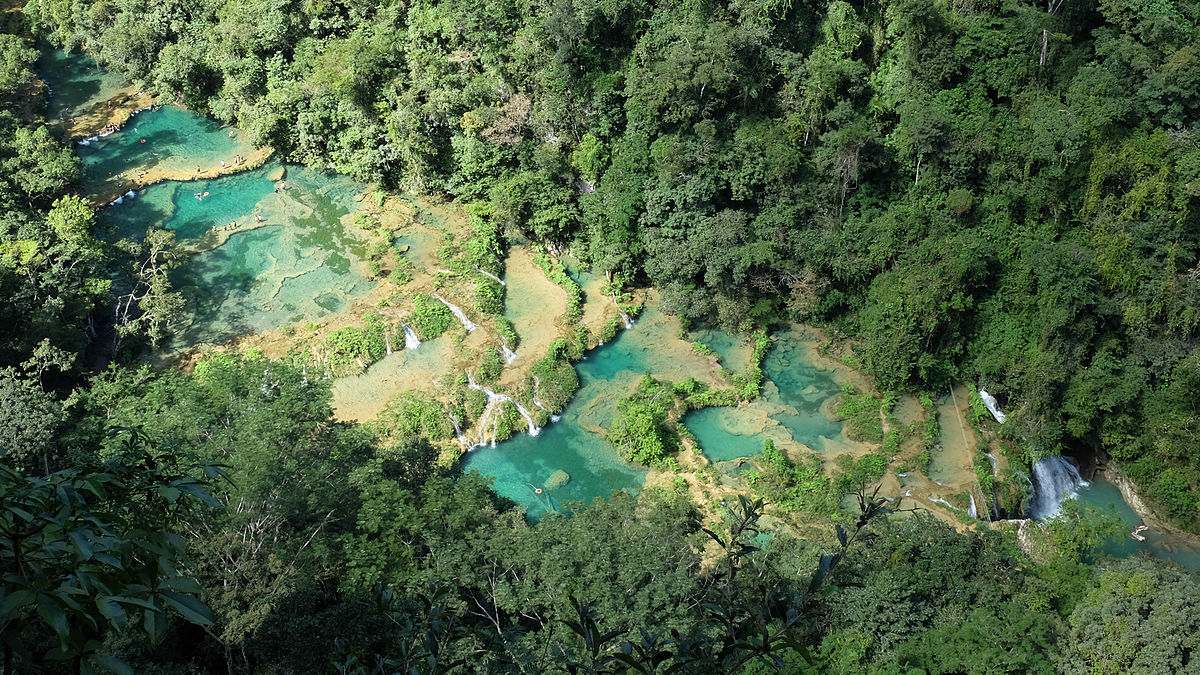
A giant, 300-meter-long limestone bridge forms the backbone for the descending series of pools and small waterfalls that makes up Semuc Champey. The water that fills the pools is the product of runoff from the Río Cahabón, churning as it plunges into an underground chasm from where it reemerges downstream at the end of this massive limestone overpass.

One can swim in these pools—it does look refreshing considering the surrounding jungle. There are also trails to a lookout point (from which the above photo was probably taken) and down to another point where the river plunges into an underground cavern. Sounds like Coleridge’s Xanadu:

In Xanadu did Kubla Khan
A stately pleasure-dome decree:
Where Alph, the sacred river, ran
Through caverns measureless to man
Down to a sunless sea.

The only problem is that Semuc Champey is not really on the road to anywhere. My first reaction to that, though, is “sounds like fun.” I may just decide to take my swimsuit and try a dip in the waters.



Looking South to Guatemala

Temple I at Tikal in the Petén

It’s time to resume visiting Mayan ruins, after a hiatus of twenty-five years. It was in 1992 that I went to Yucatán with Martine and several friends from work. For years I had wanted to see the ruins in Guatemala, but there was something like a civil war going on under the dictatorship of Efraín Ríos Montt, whose “Evangelical” regime was slaughtering the Mayans. For most of the 1980s, the U.S. State Department recommended that Americans stay out of Guatemala.

Later this year, I hope to visit the ruins of Tikal and Quiriguá in Guatemala and hop over the border into Honduras to see the ruins of Copán. Half the trip will be devoted to ruins, and the other half to visiting picturesque Highland Mayan towns like Antigua, Huehuetenango, Chichicastenango, and Panajachel. It would be nice if I could talk someone into accompanying me, but even at my advanced age, I am too adventurous for most of my friends.

I am starting my planning early, because I have a lot of reading to do before the rainy season ends in Central America.


“A Man of Great Personal Integrity”

Efrain Rios Montt and Henchmen

Efrain Rios Montt and Henchmen

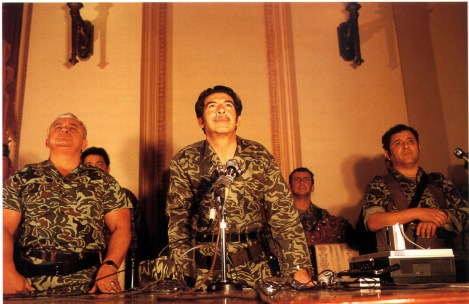
For many years, between 1975 and 1992, I traveled across Southern Mexico in search of Mayan ruins. Friends have asked me whether I have seen the ruins at Tikal in Guatemala, but all I could do was sadly shake my head. The closest I came to Guatemala was the Mexican State of Quintana Roo on the Yucatán Peninsula. I would dearly love to have crossed the border into Belize, and from there proceeded to Tikal, but it was not to be. The reason was the ugly stories filtering across the border of massacres, torture, rape, and genocide, especially of the native Mayan population. The perpetrator? One Efrain Rios Montt (pictured in the center above), who had staged a rightist coup in 1982.

It was only when President Ronald Reagan called Rios Montt “a man of great personal integrity” who had been given a “bum rap” as a human rights abuser when I knew that we were dealing here with a world-class criminal rat. Out of a population of some seven million in 1980, Rios Montt and his death squads were responsible for some 200,000 extra-judicial murders in Guatemala, “the land of the eternal spring.” Over a million natives fled the country for safety in the United States and elsewhere. Yet the Reagan administration continued to support the man and offer him aid.

In 2012, Rios Montt was charged with genocide and was convicted. But then his daughter Zury warned other of the nation’s leaders that, if Rios Montt served any time, they would be next. The verdict was repudiated by the Constitutional Court, and Rios walked a free man. The people of Guatemala are still trying, however, to have him called to account for his crimes against his people, either at home or at The Hague. Rios might be in his eighties, but he should not be allowed to die as a free man.