Day of Infamy

On our first full day in Hawaii, Martine and I plan to visit the Pearl Harbor National Memorial in Honolulu. We had been there before, in 1996, but I am more interested this time in reading up on Hawaii history before I go. The last time, I frankly thought I wouldn’t care for O’ahu, because it was so touristy. Now I begin to realize that it is touristy for good reason.

There are many stories about how the Pearl Harbor attack of December 7, 1941 came to be. Some have even speculated that Franklin Roosevelt knew in advance about the attack, since we had already cracked the Japanese Navy secret code. According to this theory, FDR wanted the U.S. in the war, and he was tired of the Congress lollygagging about what to do about Germany and Japan. It is interesting that none of the aircraft carriers were in the harbor during the time of the attack; and the battleships there were pretty long in the tooth.

That’s not to take away from Japan’s accomplishment. We lost a lot of good men—but probably no more than we would have lost of Congress had delayed for another six months to a year.

I remember that the whole Pearl Harbor National Memorial was pretty impressive back then. I am sure that it is even more impressive now.

This afternoon, I did a bit of research on how to use the Honolulu bus system to travel between Waikiki and the Memorial. I suppose we could pay big bucks and take a shuttle, but we could get off by paying four dollars for the both of us, round trip. I used the website TheBus.Org to obtain route maps and schedules.
It Is Done

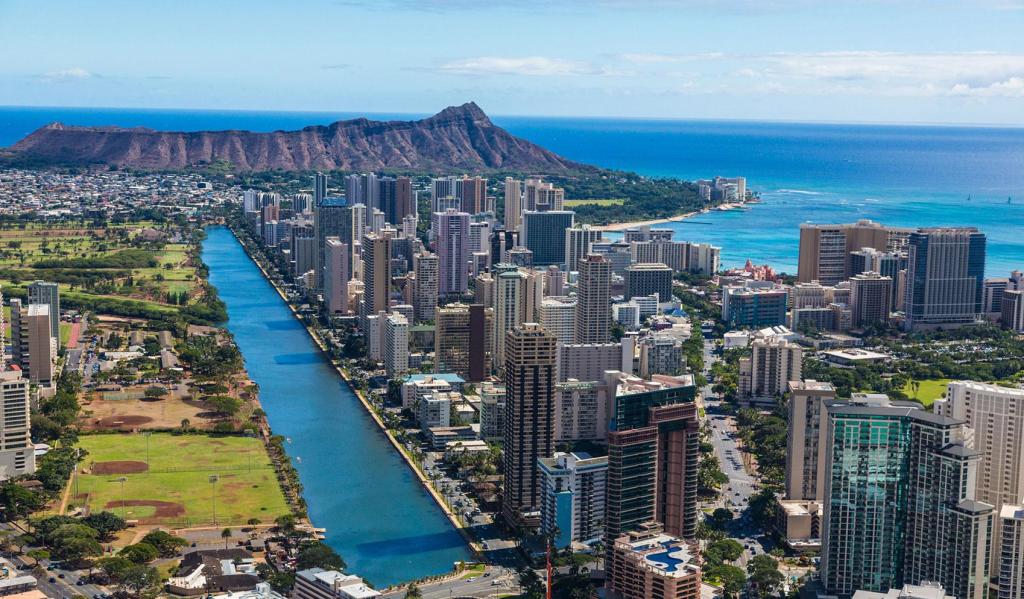
Waikiki, the Ala Wai Canal, and Diamond Head

Today I made the final payment on our September vacation in Honolulu. We got a good price on a package deal including the flight, transfer to and from the airport, and the hotel. All that remains are meals, admission fees, shopping, and public transportation.

Notice, I do not include an automobile. When Martine and I stayed at the Pacific Beach Hotel in 1996, a rental car was included, with no parking fees at the hotel. Today, car rental fees have gone through the roof, and hotels charge anywhere from $35 to $45 a night just for parking on their grounds.

How much will Martine and I pay for public transportation on Honolulu’s bus system? For both of us, the total will come to a mere $12.00 total. Right after we check in at our hotel, we head to the nearby Ala Moana shopping center and pick up a HOLO card for seniors, free of charge, at the office of the Satellite City Hall there. Thereafter, once we have dished out $12.00 in fares (three round rips for two people at $2 each), the bus is free.

Americans hate taking public transportation. Neither Martine nor I mind it. In 1996, we drove all around the island; consequently, we don’t feel we have to repeat it.

In future posts, I will describe the places we plan to visit.

Fun in the Sun?

Family On Summer Beach Vacation Run Out Of Sea Towards Camera

Ah yes, Paradise on Earth. As a people, we have traditionally viewed summer beach vacations as the closest one could get to Heaven while alive. When I first came out to California in the late 1960s, I thought so, too. While working part-time at System Development Corporation in Santa Monica, I spent many afternoons lying on a towel and reading steamy fiction like Lawrence Durrell’s Alexandria Quartet.

The water was fun to a certain extent, but I was never a board or body surfer, though I went in often enough to be savaged by the occasional rough wave. Also, I tended to burn—especially as I had no one to slather my back with sun tan lotion.

While I live only two miles from the beach at Santa Monica, I don’t spend time there any more, unless I take a walk on the boardwalk connecting Santa Monica to Venice. Part of the reason is that the water is more polluted than ever, especially because we are only 20-30 miles (32-48 km) from the nation’s largest port, where freighters and tankers regularly foul the waters with petrochemical waste.

So when Martine and I go to Hawaii in a couple months, are we planning for any beach time? Not really. Although the waters at Waikiki are less polluted, the sun is stronger; and we both have fair skin. We are more interested in visiting Honolulu as a destination rather than trying to live in a pharmaceutical commercial.

I suppose if we lived east of the Mississippi, we would yearn for sunshine; but, living in Southern California, we have sunshine on most days of the year. In fact, September tends to be one of the hottest months of the year in Los Angeles. So we are likely escaping even hotter (albeit drier) weather at home.

Fragrant Hills

The Tomb of the Kamehameha Dynasty of Hawaiian Kings

Honolulu’s Royal Mausoleum (or Mauna ‘Ala, “Fragrant Hills”) is the home of most of the two Hawaiian Royal Families of the Kamehameha and Kalakaua dynasties—with the sole exception of Kamehameha I “The Great,” who is buried in Maui.

As you can see from the fresh flower leis on the tomb, today’s Hawaiians revere the memory of their kings and regard the mausoleum as holy ground. Martine and I hope to visit it when we go to Hawaii in three months, perhaps visiting nearby Queen Emma’s Summer Palace the same day.

The Tomb of the Kalakaua Dynasty

It was King Kamehameha IV and his consort Queen Emma who had the mausoleum built in 1862. Unfortunately, the first occupant was their four-year-old son Prince Albert.

In addition to all the Hawaiian kings after Kamehameha I, many of the retainers and chiefs are also interred nearby. For a list of the occupants, click here.

Queen Lili‘uokalani on Hawaiian Postage Stamp

I include the above postage stamp image just to demonstrate that the Kingdom of Hawaii was a self-governing entity before being annexed by the United States in 1898. Queen Lili‘uokalani was the last monarch of the Hawaiian Islands.

Ozzie’s Islands

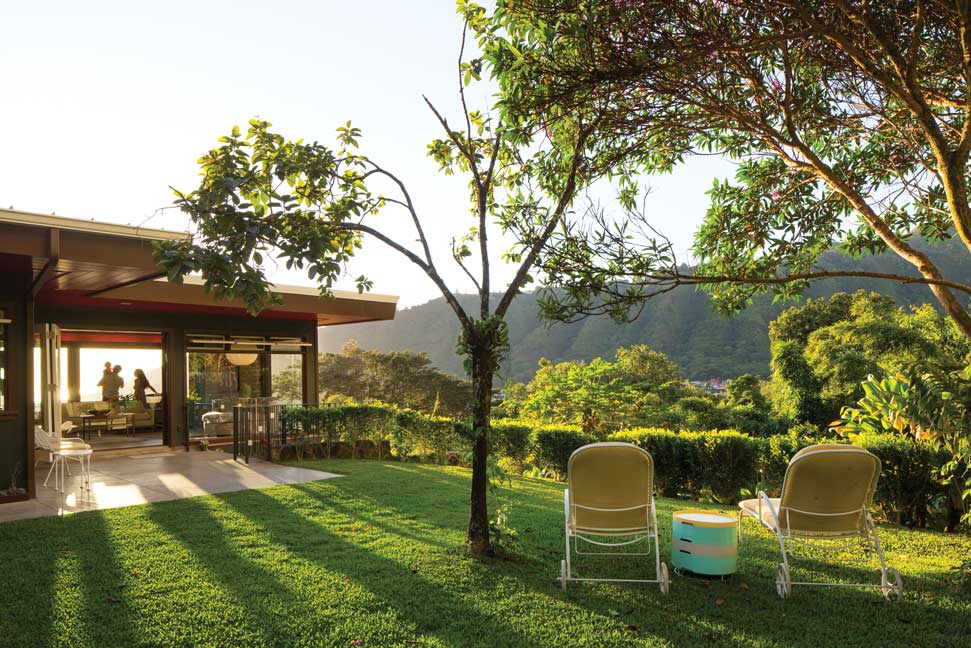
O. A. Bushnell’s Home in Manoa Valley

Who is the great novelist of Hawaii? (If you say James Michener, deduct a thousand points and surf off a cliff.)

When Martine and I went to Hawaii in 1996, I did some research on the subject and came up with the name O. A. (short for Oswald Andrew) Bushnell. I promptly bought all five of his novels:

  • The Return of Lono (1956), about the death of Captain Cook on the Big Island of Hawai’i
  • Ka’a’awa: A Novel About Hawaii in the 1850s (1972)
  • Moloka’i (1975) about Father Damien and the leper colony at Kalaupapa
  • The Stone of Kannon (1979) and its sequel The Water of Kane (1980) about Japanese immigration to Hawaii
O. A. Bushnell (1913-2002)

I am ashamed to say that, to date, I have read only the first two books. Between now and our trip to Hawaii this fall, I will also add Moloka’i to my to-be-read pile.

What I find interesting about Bushnell is that he was a professor of microbiology at the University of Hawai’i at Manoa. In fact, he also wrote a book on the subject: Gifts of Civilization: Germs and Genocide in Hawaii (1993). Yet he was also a natural at writing fiction. Come to think of it, much of his novel Ka’a’awa dealt with the devastating smallpox and influenza epidemics of the 1850s

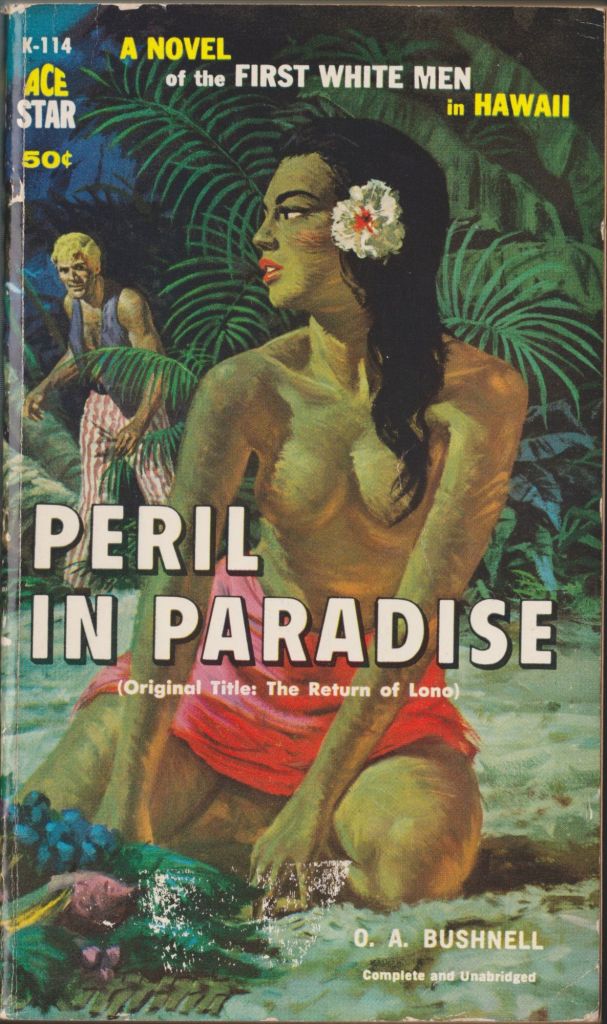
How to Make Serious Literature Look Cheap

I remember visiting the Los Angeles Times Book Fair around 2000 and coming upon a booth staffed by the University of Hawai’i Press. At the time, I had not yet read any of my Bushnell titles, but I asked about how the author was doing. “Ah, poor Ozzie!” came the answer. “He’s pretty ill, and we can only hope he pulls through.” Alas, he was to die shortly after.

But his work lives on, and it is definitely worth reading.

Mauka and Makai

Postcard Map of O’ahu

This afternoon I finally took the plunge. I had been delaying reserving my flight and hotel in Hawaii until Martine got her passport (without which she couldn’t take a flight, as she doesn’t have a REAL ID drivers license). She finally got her passport in the mail on Saturday; and, today I went to the Culver City office of the Auto Club and made our reservation.

Now I have some direction and can do some more detailed planning on destinations and public transportation.

Speaking of direction, the whole north/south/east/west system of directions is generally not used in Hawaii. Think of it for a second: Hawaii is a collection of volcanic mountains upraised from the floor of the ocean. With few exceptions, most people live within hailing distance of the Pacific; and relatively few live in the interior. Therefore, the words Hawaiians most frequently used for directions are mauka and makai—namely, inland and shore.

In Honolulu, the same words are used; but since it is a big city, there are two additional directions: Toward Ewa (west of Pearl Harbor) or toward Diamond Head.

It’ll take some getting used to, but I can understand its usefulness.

Royal Palaces on American Soil

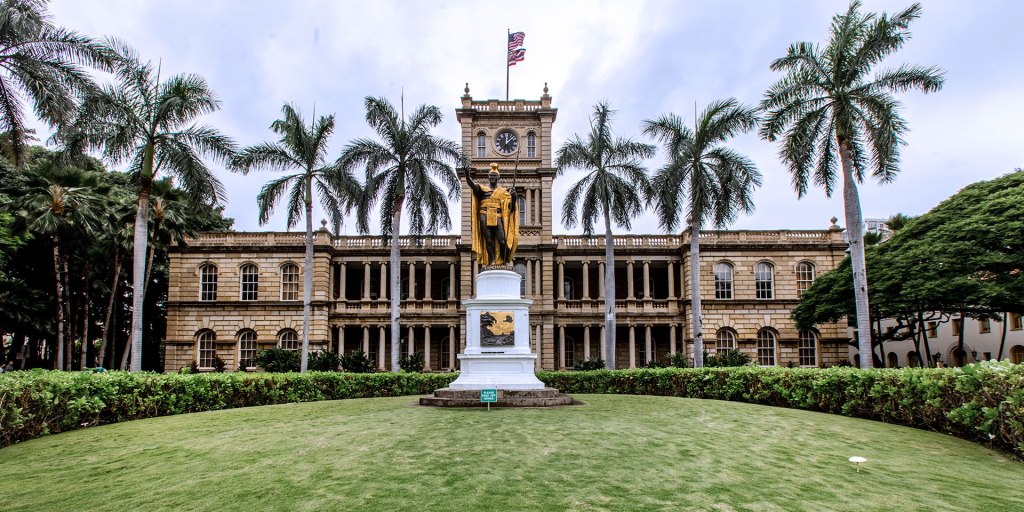
The Iolani Palace, Honolulu

Most Americans are not aware that there are at least three royal palaces in the Hawaiian Islands. Two of them are in the Honolulu area: the Iolani Palace downtown and Queen Emma’s Summer Palace on the Pali Highway. Martine and I have been to the Iolani Palace in 1996 and intend to revisit it on our upcoming trip to O’ahu along with Queen Emma’s Summer Palace.

Hawai’i was a perfectly viable kingdom when the United States annexed the islands in 1898. In the wake of the Spanish-American War, Americans were eager for new colonies; and there was already in place a willing cadre of American settlers willing to raise Old Glory. The reigning monarch, Queen Lili’uokalani was kept a prisoner in the Iolani Palace under suspicion of “treason,” namely for being loyal to her country.

Interior Queen Emma’s Summer Palace

The other palace is connected with a happier time, when Queen Emma (1836-1885), wife to King Kamehameha IV preferred the cooler temperatures of her hillside retreat, which today is a museum operated by the Daughters of Hawai’i. The same group operates a third royal palace on the Big Island of Hawai’i, the Hulihe’e Palace in Kailua-Kona.

In my reading in preparation for our trip, I am concentrating on the period between Captain Cook’s landing on the islands in 1778 and the American annexation in 1898. The memory of the royal families of Kamehameha and Kalakaua is still alive in the islands. There is even a Royal Mausoleum in Honolulu where most of the royal family is interred.

WW2-Land

The USS Arizona Memorial

It’s a strange feeling to be standing on the Arizona Memorial at Pearl Harbor. Beneath your feet is a sunken battleship in which 1,277 sailors are interred. That is roughly half the total U.S. casualties from the Japanese attack on Pearl Harbor.

The island of O’ahu has numerous military and naval bases, roughly 21% of the total land area. That includes not only Pearl Harbor itself, but Fort De Russy on Waikiki, Schofield Barracks, Hickam Air Force Base, Dillingham Field, Fort Shafter, and a whole host of others.

In fact, if there is anywhere on American soil that is a center of World War Two commemoration, it would have to be O’ahu. There have been at least four films made about the attack:

  • From Here to Eternity (1953) with Burt Lancaster and Montgomery Clift
  • Tora! Tora! Tora! (1970) with an American and Japanese Cast
  • Pearl Harbor (2001) directed by Michael Bay
  • Midway (2019), which begins with the attack on Pearl Harbor

There have also been numerous books on the subject. (And there still continue to be.) No doubt about it, America is still stuck on WW2.

When Martine and I visit Honolulu later this summer, we will spend a day going over all the exhibits and taking the shuttle over to the Arizona Memorial, as we did back in 1996. No doubt a lot has changed since then.

A Tricky Language

Children learning their native language in Hawaii don’t study their ABCs. For one thing, there is no “B” or “C” in the Hawaiian alphabet. In fact, their are only twelve letters in all—the same five vowels we have and seven consonants. Then, too, there is the okina, or glottal stop, which looks like a single apostrophe. You can see it in the above illustration next to the Hawaiian flag.

The sparseness of the alphabet could be the reason there are so many long words in the language. For instance, my favorite Hawaiian singer, the late Israel Kamakawiwo’ole has a name that is virtually unpronounceable to us haoles (i.e., mainlanders). When Bruddah Iz, as he was called, died in 1997 at the age of 38, he was well over 700 pounds. The flag of Hawaii flew at half mast—the only non-governmental-official to be so honored. He had the voice of an angel. I own several of his albums on CD and regard them among my most treasured possessions.

As a rare treat, here is Iz singing “Somewhere over the Rainbow”:

The video also shows his funeral, when his ashes were scattered in the Pacific.

Here are just a few Hawaiian street and neighborhood names in Honolulu. Imagine trying to pronounce them aloud to a native after you’ve had a few drinks::

  • Kaka’ako
  • Kekeaulike
  • Kalakaua
  • Kawaiaha’o
  • Nu’uanu
  • ’Aihualama
  • Pu’uohi’a
  • Likelike
  • Kapahulu
  • Kapi’olani

Sadly, the Hawaiian language is endangered, with most natives reverting to Pidgin, which I discussed in an earlier post.

Hawaiian Cuisine

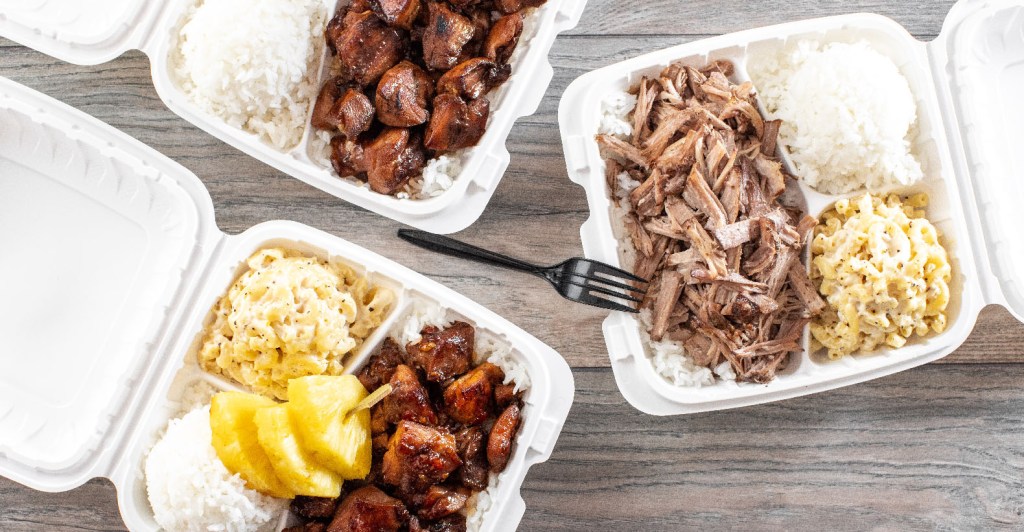
Three Typical Hawaiian Plate Lunches

There is more to Hawaiian cuisine than the simple “plate lunch,” but it is as typical for Honolulu as Hamburgers and French Fries are on the mainland. Typically it consists of:

  • A meat serving, such as kalua pork in the meal on the right
  • One or two scoops of plain white rice
  • Macaroni salad

What you don’t see is a salad. You get meat and a ton of carbs. Usually it tastes pretty good, but it drives haolies (mainlanders) nuts not to see their favorite grindz (food) on the menu. So many of them stick to hotel restaurants that cater to their expectations.

Oh, yes, there’s also poi, made from taro leaves.

Actually, poi is supposed to be very nutritious—even if it resembles slimy purple goop. I’ve never had any, but promise to sample some when Martine and I go to Honolulu later this year.

There are several other Asian cuisines that are part of Hawaiian food, especially Japanese and Chinese, with a hint of Portuguese in the form of their excellent linguica sausage.

Since Martine flat out doesn’t like Chinese food, and will only eat one or two Japanese dishes, I suspect we will eat mostly plate lunches (but no poi for her) or whatever mainland American chow she can find, even hamburgers and fries.