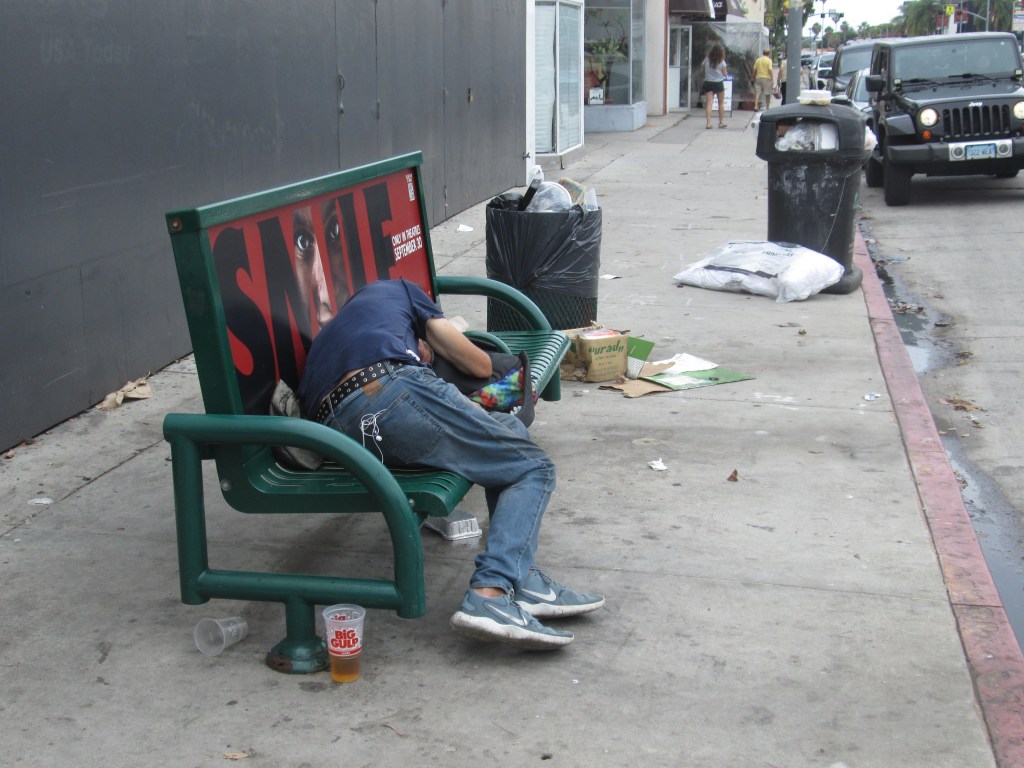
Yesterday afternoon, I heard some strange animal-like sounds coming from below my living room window. I pushed back the blinds, only to see several policemen and paramedics tending to something hidden by the hedge separating my building from the neighboring building. As I continued to look, I saw the paramedics hauling a black man in a bloodied t-shirt who was still howling.
Just another day on the streets of L.A., watching as our civilization is being eclipsed. And not just for a few minutes, either, but for the long count.
I do not understand why anyone would think that recreational drugs would be an improvement on real life. Even when real life is grim, it beats madness and suicide by chemical.
What is the tipping point after which there are so many people on drugs that reality has been supplanted? For a possible picture, read Polish sci-fi author Stanislaw Lem’s The Futurological Congress.
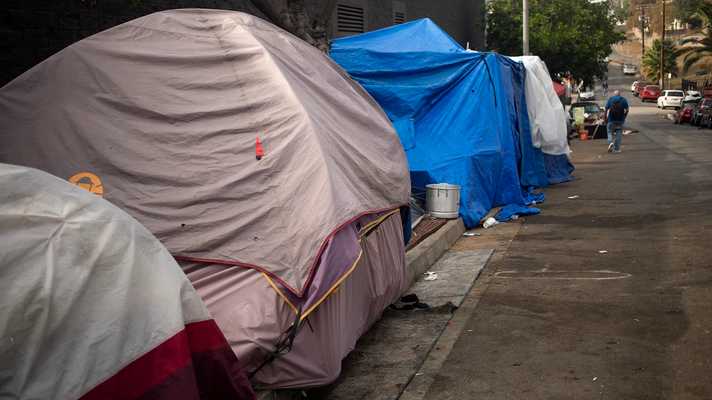
In our 21st Century city of Los Angeles, there are tens of thousands of people who are living in scattered Medieval tent cities. Even though the city has banned tents from across the street from my apartment, there are a number of bums who “sleep rough” on the sidewalk. Martine and I can hear them when they raise their voices in anger in the middle of the night, particularly if they are competing for the attentions of a homeless woman.
I am very happy that I am not a politician, because then I would have to pretend as they do they these homeless are all poor unfortunates who need to be placed in public housing. That’ll work for some of them, the roughly 50% who really just need a place to bed down and are willing to follow the rules about drink, drugs, and violence. Except a very large percentage don’t want to follow any rules whatsoever. When they are offered housing, they will get drunk or stoned and smear their feces on the wall—whereupon they find themselves in the street again.
America is full of raggedy men who do not give a tinker’s damn about THE RULES. What they want is the freedom to live as they want to, even if they are burying the city of their residence in piles of fetid garbage. They don’t particularly care if their pursuit of freedom is toxic to others.
It’s kind of like American politics as a whole, which can best be summarized by who can say EFF YOU the loudest and longest. We used to have two political parties with platforms. Now we have one party that has a platform, and the rest have EFF YOU as their platform.
The homeless who don’t want to be homeless I can understand. The ones who want to spend all night drinking, shouting, getting high and meth and Fentanyl, and whoring with female ratbags do not have my sympathies.
During the course of her daily walks, Martine finds the strangest things. Today, it was a hoard of undelivered mail consisting of invoices from which the checks paying them had been removed—presumably to find some checks that could be altered in favor of the thieves.
Mixed in with the bag of mail were food containers with food scraps, typical of the garbage stewed around my neighborhood by the homeless. It is likely that the thief was a homeless ex-con who had learned how to modify checks during a previous imprisonment.
I no longer pay bills by mail. Instead, I use the BillPay service of Bank of America. In five years of usage, I have had no problems; whereas, in previous years, I had problems with mail being delivered late or not at all. This cuts out the Postal Service and all those larcenously inclined bums who prey on it.
Tomorrow, I will give Martine a ride to the main Santa Monica Post Office with the bag of stolen mail, which she brought home from her walk. The mail was scattered all over the intersection of Wilshire Blvd. and 20th Street in Santa Monica.
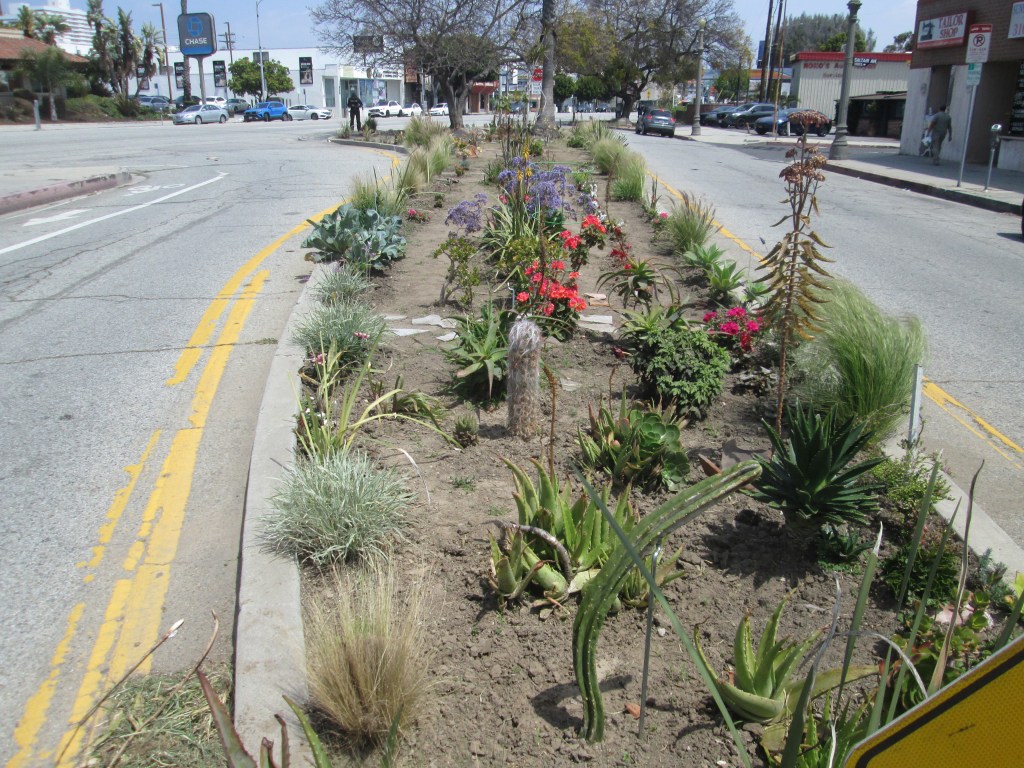
The Traffic Island at the Corner of Ohio Avenue and Santa Monica Blvd
You have not heard me say many good things about the legions of homeless that live in the streets of Los Angeles. Today, I will make an exception. Two blocks east of me is a little traffic island where Ohio Avenue intersects at an angle with Santa Monica Blvd.
The City of Los Angeles does not get the credit for digging up the earth of the island and planting it with succulents and other water-saving plants. The man responsible is a homeless man who lives in a tent to the left of the traffic island. Martine and I have seen him at work planting and weeding.
It is more often the case that the homeless who live in tents in West Los Angeles are known for accumulations of garbage, vandalism, panhandling, and getting into fights with other homeless in the wee hours of the morning.
I have not spoken to the man who created this little garden, but I wish him well. May he find a home where his talent at gardening will be more appreciated. I also hope that some idiotic city administrator does not decide to dig up the garden and replace it with something more boring.
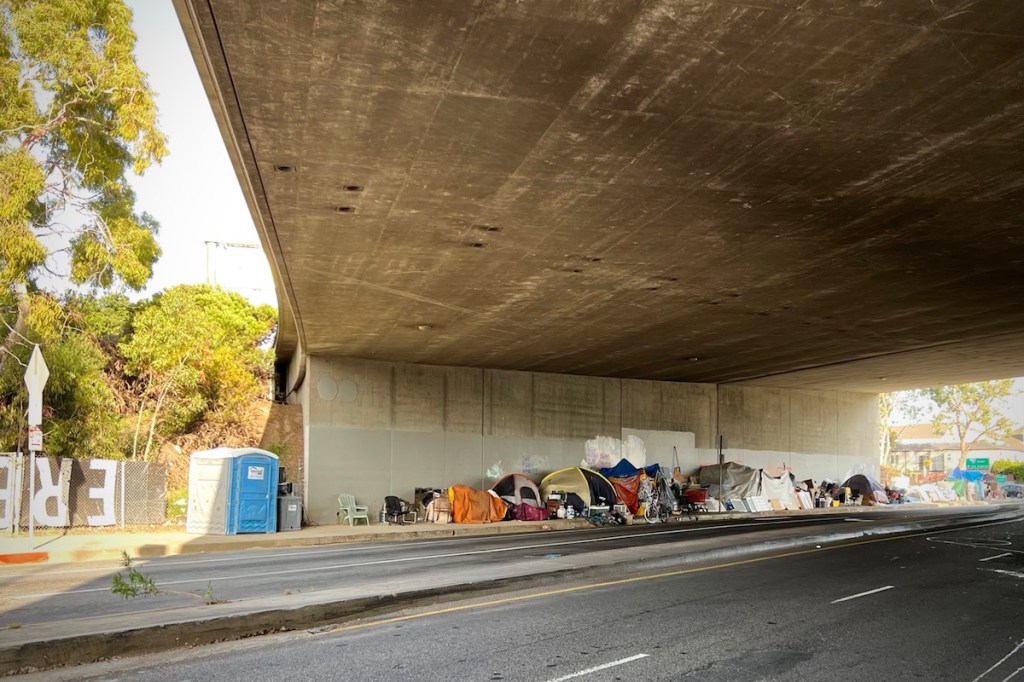
The Homeless Encampment Under the I-10 Bridge Over Centinela Avenue in West L.A.
There is no monolithic group which falls under the term “homeless.” It includes a wide variety of people, some of whom are in transition to a better life, some of whom are out of their gourds, some of whom want to be able to take drugs and drink excessively without police interference, and some of whom are psychotic criminals.
In Los Angeles, they are begging for “spare change” by every freeway onramp and in front of virtually every convenience store. Many of them have sad stories to tell, some of which are partially true. They stretch out on bus seats and commuter trains and ride back and forth all day, occasionally hassling the other riders. The police are reluctant to deal with them because so many are vectors of communicable diseases. (I once worked with a secretary who was married to a U.S. Marshal who contracted tuberculosis from escorting a prisoner.)
Unlike the terminally Woke, my attitude toward the homeless is not: “Oh, the poor homeless!” In my mind, I separate the ones who are capable of being re-housed and following rules regarding behavior, booze, and drugs from those who actually prefer to live and die on the streets. It is my belief that most of the homeless fall into this latter category. I regard them as intractable bums who should be locked up.
Most bum encampments are surrounded by piles of trash of no earthly use to anyone. Martine and I have seen some bums emptying trash cans into the street or even setting fire to them. I am not inclined to be gentle with such rapscallions. Unless these sociopathic types are incarcerated, setting up a tent on the sidewalk will become an attractive alternative to anyone who is not interested in anything but destroying their minds and bodies.
An intense campaign is shaping up for Los Angeles’s City Council District 11 between two defense attorneys: Erin Darling, a Progressive Democrat, and Traci Park, probably a Republican. At stake is the proliferation of homeless encampments in the district.
On Saturday morning, Martine and I had a chance to see a debate between Darling and Park. We were unimpressed by both of the candidates—though we suspect that Park is more willing to enforce existing laws forbidding encampments near schools, churches, and public parks.
In general, there are two prevailing voter viewpoints regarding the homeless: On one hand, there are the Mother Teresas and, on the other, the Darth Vaders. If a homeless person is willing to observe the law and is seriously interested in leaving the street encampments, I am willing to join the Mother Teresas to assist them. For those who are mentally hill and are unwilling to obey rules regarding alcohol and recreational drugs, I prefer the Darth Vader approach: drive them off the streets, by force if necessary.
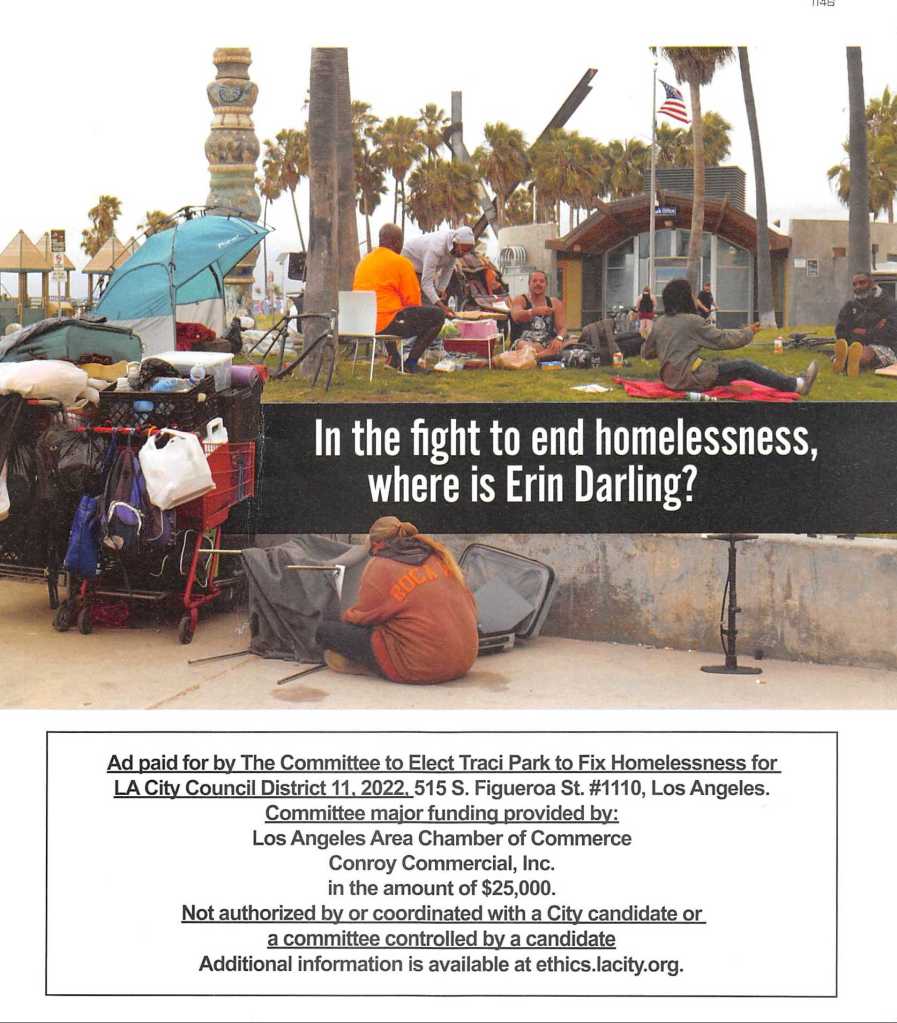
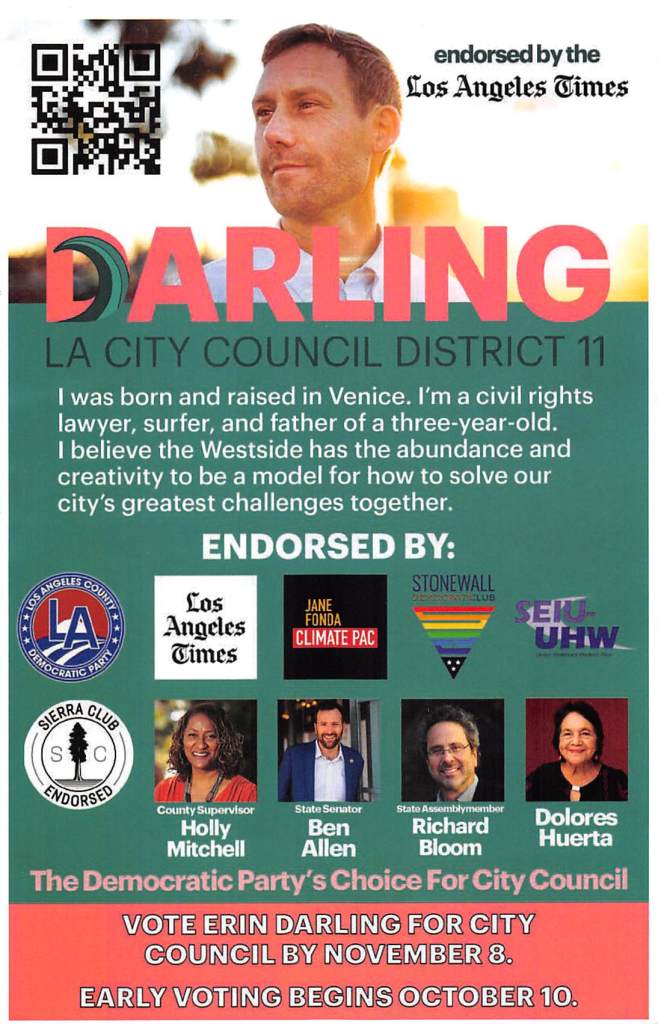
Political Handout for Erin Darling
Although Erin Darling is endorsed by the Los Angeles Times and several liberal politicians and organizations, I see that Traci Park is endorsed by the Fire Department and local Police Departments. I rather suspect that Darling is one of those Woke Liberals I dislike as much as Trump’s MAGA insurrectionists. At one point in the debate, he spoke glowingly of the skateboarding community. What, aren’t they all still in Middle School? Sheesh!
The older I get, the more I realize that we are rarely presented with candidates and issues which we can enthusiastically support. All Martine and I care about is cleaning the garbage piles off the streets (usually associated with bums living in tents); cutting down on petty thefts of bicycles, medications, food, and drink; and threats of violence from rampaging bums (which have affected both Martine and me).
When I first arrived in Southern California at the tail end of 1966, I was pleasantly surprised by how crisp and clean it looked. Coming from grungy red-brick Cleveland, coated with decades of industrial grime, I really felt I was making a new beginning.
Cut to today. The city is crawling with bums (excuse me, “the homeless”) who think nothing of spreading garbage all around. The trash cans are all filled to overflowing, and alleyways are festooned with human excrement.
It seems that every year there are more men living in tents and ratty looking old Winnebago RVs parked up and down the streets. There has been a bum encampment now for upwards of ten years right across the street from my apartment. When I go to the local Seven-Eleven, there are scruffy men asking for “spare change.”
There are also a few women in these encampments, but their appearance usually begins a new round of competition for their favors, marked with nights of cursing and violence.
I still love L.A., but am dismayed that politicians don’t seem to want to face the problems that confront them. On one side, they face opposition from woke liberals who think they should be left alone, and the majority of the population, which would rather see them housed somewhere else. Considering that most bums are not into following rules regarding alcohol and recreational drugs, or any kind of personal hygiene, the latter is not a viable option.
Times are tough when vagrancy is considered the norm.
I woke up this morning to bad news. A notice was taped to our front door indicating that our water would be shut off on Tuesday between 8 am and 4 pm. That meant I would have to camp out for several hours where I would have access to a lavatory. What came to mind was the Westfield Shopping Center in Culver City, perhaps after I took my car in for an inspection of hoses, belts, fluids, and tires for next week’s trip to Las Vegas.
The apartment building management stated that the water shut-off was for “maintenance repairs,” never specifying the exact nature of the maintenance repairs.
Today meant even more bad news for the homeless encampment across the street. The police showed up with several trucks and disposed of a number of (but not all) the tents, and most of the associated piles of rubbish that accompanied them.
I have tried to avoid interacting with these campers, though I had a run-in when I returned from the desert two weeks ago. Tired from a 130-mile (201 km) drive from Palm Desert, I pulled into my parking spot only to find it occupied by a bicycle bum sitting on the pavement and eating a bowl of cereal. He was incensed that I asked him to move and urged me to go f—k myself. I returned the favor, and he left in a surly mood. When next I returned to my parking spot, I saw that my vehicle was decorated with spilled milk and some kind of multi-colored fruity cereal. Naturally, I had to get my car washed that afternoon.
I have been accused by some people of being mean to the homeless, typically by people whose experience of homelessness has been very different from what I have encountered. There are people who manage to get out of living on the streets. Usually, this applies to women, especially women with children. I write mostly about people who can more accurately be described as bums and their associated scags.
Does that sound mean? It should given my experience with garbage, poop, fights and screams in the middle of the night, vandalism, aggressive begging, theft, and stench. And this all is less than a hundred feet from my front door. Let us look at three levels of opposition to homeless encampments:
Approach with flamethrowers and baseball bats.
Apply political pressure to get them off the streets.
Refuse to engage with them in conversation.
I am at level 3. When approached by a bum, usually to request a cash donation, I talk to them only in Hungarian. Ever since running into a Hungarian beggar in Vancouver, BC, I do not swear at them in Hungarian. All I want is for them to walk away looking confused.
Is this mean and heartless? Not really. I do not think much of the bums who live across the street from me. I do not sneer at them or give them any indications of opposition. If they want to talk to me, I just insist that it be in Hungarian. And I do not work with politicians on the problem, because I think they have no idea of the nature of the problem. There are just too many widely varying opinions across the entire political spectrum. Mine is just one of them, and by no means the most heartless.
TLOS ANGELES, CA – JANUARY 24: Lisa Rogers, a homeless woman, carries her tent as she relocates her camp on January 24, 2017 in Los Angeles, California. According to a 2016 report by the U.S. Department of Housing and Urban Development, Los Angeles has the highest number of homeless people in the nation with close to 13,000 living on the streets. The annual Greater Los Angeles Homeless Count begins today and will continue through Thursday. (Photo by Justin Sullivan/Getty Images)
To begin with, there are a hell of a lot more than 13,000 homeless living on the streets of Los Angeles. I would put the number at close to 5-10 times that many. I have just finished reading Sam Quinones’s excellent book The Least of Us: True Tales of America and Hope in the Time of Fentanyl and Meth, from which the following paragraph is taken:
We used to believe people needed to hit rock bottom before seeking treatment. That’s another idea made obsolete by our addiction crisis and the current synthetic drug supply. It belongs to an era when drugs of choice were merciful. Nowadays people are living in tents, screaming at unseen demons, raped, pimped, beaten, unshowered, and unfed. That would seem to be rock bottom. Yet it’s not enough to persuade people to get treatment. In Columbus, Ohio, Giti Mayton remembers a meth addict who was hospitalized with frostbitten, gangrenous hands, yet who left the hospital in midwinter to find more dope. San Francisco and Philadelphia, two cities with years of experience with heroin, are seeing users homeless and dying like never before. The dope is different now. Today, rock bottom is death.
You must be logged in to post a comment.