Tiny Bubbles

Martine and I returned late last night from Hawaii. I decided to begin my vacation posts with a tribute to a Hawaiian singer much loved by Martine. I am referring to Donald Tai Loy Ho, better known as Don Ho (1930-2007). His most famous songs are“Tiny Bubbles” and “Pearly Shells.”

In the weeks before our flight to Honolulu, Martine spent hours on YouTube playing some of Don Ho’s songs. So I made a point of taking pictures of the street sign for Do Ho Street, which runs between Lewers St, and Royal Hawaiian Ave. for one block just south of the main drag at Kalakaua Avenue.

At the International Marketplace Shopping Center, there is a statue of Don Ho next to one of the escalators. Below is a picture of Martine in her aloha shirt standing next to the statue:

For those of you who are interested, here are the lyrics for Don Ho’s most iconic song, “Tiny Bubbles.” As many times as I heard Martine play the song, I never really got tired of hearing it:

Tiny bubbles (tiny bubbles)
In the wine (in the wine)
Make me happy (make me happy)
Make me feel fine (make me feel fine).

Tiny bubbles (tiny bubbles)
Make me warm all over
With a feeling that I‘m gonna
Love you till the end of time'

So here‘s to the golden moon
And here‘s to the silver sea
And mostly here‘s a toast
To you and me.

So here’s to the ginger lei
I give to you today
And here’s a kiss
That will not fade away.

Day of Infamy

On our first full day in Hawaii, Martine and I plan to visit the Pearl Harbor National Memorial in Honolulu. We had been there before, in 1996, but I am more interested this time in reading up on Hawaii history before I go. The last time, I frankly thought I wouldn’t care for O’ahu, because it was so touristy. Now I begin to realize that it is touristy for good reason.

There are many stories about how the Pearl Harbor attack of December 7, 1941 came to be. Some have even speculated that Franklin Roosevelt knew in advance about the attack, since we had already cracked the Japanese Navy secret code. According to this theory, FDR wanted the U.S. in the war, and he was tired of the Congress lollygagging about what to do about Germany and Japan. It is interesting that none of the aircraft carriers were in the harbor during the time of the attack; and the battleships there were pretty long in the tooth.

That’s not to take away from Japan’s accomplishment. We lost a lot of good men—but probably no more than we would have lost of Congress had delayed for another six months to a year.

I remember that the whole Pearl Harbor National Memorial was pretty impressive back then. I am sure that it is even more impressive now.

This afternoon, I did a bit of research on how to use the Honolulu bus system to travel between Waikiki and the Memorial. I suppose we could pay big bucks and take a shuttle, but we could get off by paying four dollars for the both of us, round trip. I used the website TheBus.Org to obtain route maps and schedules.

It Is Done

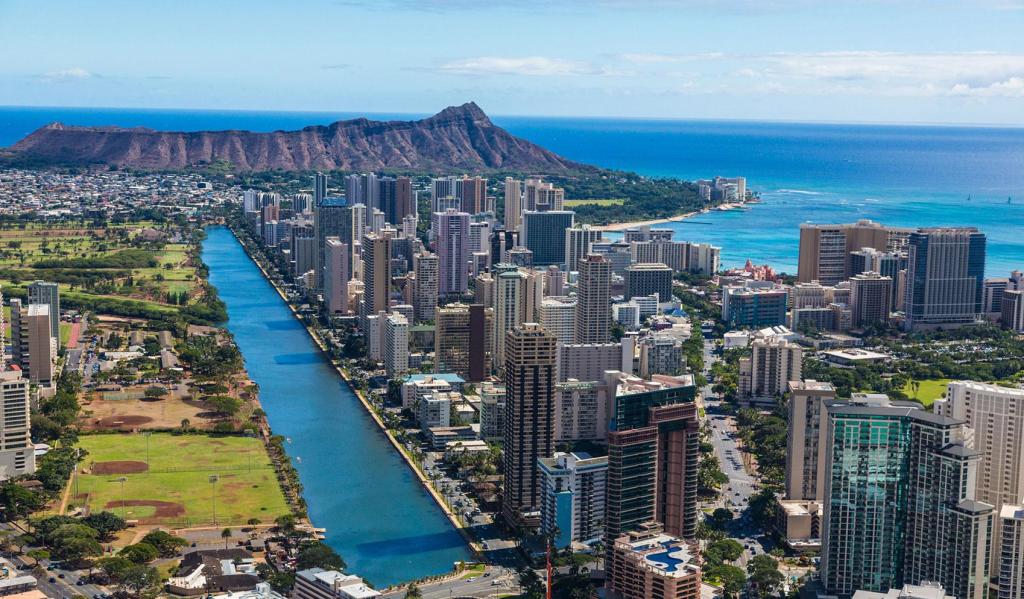
Waikiki, the Ala Wai Canal, and Diamond Head

Today I made the final payment on our September vacation in Honolulu. We got a good price on a package deal including the flight, transfer to and from the airport, and the hotel. All that remains are meals, admission fees, shopping, and public transportation.

Notice, I do not include an automobile. When Martine and I stayed at the Pacific Beach Hotel in 1996, a rental car was included, with no parking fees at the hotel. Today, car rental fees have gone through the roof, and hotels charge anywhere from $35 to $45 a night just for parking on their grounds.

How much will Martine and I pay for public transportation on Honolulu’s bus system? For both of us, the total will come to a mere $12.00 total. Right after we check in at our hotel, we head to the nearby Ala Moana shopping center and pick up a HOLO card for seniors, free of charge, at the office of the Satellite City Hall there. Thereafter, once we have dished out $12.00 in fares (three round rips for two people at $2 each), the bus is free.

Americans hate taking public transportation. Neither Martine nor I mind it. In 1996, we drove all around the island; consequently, we don’t feel we have to repeat it.

In future posts, I will describe the places we plan to visit.

Fragrant Hills

The Tomb of the Kamehameha Dynasty of Hawaiian Kings

Honolulu’s Royal Mausoleum (or Mauna ‘Ala, “Fragrant Hills”) is the home of most of the two Hawaiian Royal Families of the Kamehameha and Kalakaua dynasties—with the sole exception of Kamehameha I “The Great,” who is buried in Maui.

As you can see from the fresh flower leis on the tomb, today’s Hawaiians revere the memory of their kings and regard the mausoleum as holy ground. Martine and I hope to visit it when we go to Hawaii in three months, perhaps visiting nearby Queen Emma’s Summer Palace the same day.

The Tomb of the Kalakaua Dynasty

It was King Kamehameha IV and his consort Queen Emma who had the mausoleum built in 1862. Unfortunately, the first occupant was their four-year-old son Prince Albert.

In addition to all the Hawaiian kings after Kamehameha I, many of the retainers and chiefs are also interred nearby. For a list of the occupants, click here.

Queen Lili‘uokalani on Hawaiian Postage Stamp

I include the above postage stamp image just to demonstrate that the Kingdom of Hawaii was a self-governing entity before being annexed by the United States in 1898. Queen Lili‘uokalani was the last monarch of the Hawaiian Islands.

Mauka and Makai

Postcard Map of O’ahu

This afternoon I finally took the plunge. I had been delaying reserving my flight and hotel in Hawaii until Martine got her passport (without which she couldn’t take a flight, as she doesn’t have a REAL ID drivers license). She finally got her passport in the mail on Saturday; and, today I went to the Culver City office of the Auto Club and made our reservation.

Now I have some direction and can do some more detailed planning on destinations and public transportation.

Speaking of direction, the whole north/south/east/west system of directions is generally not used in Hawaii. Think of it for a second: Hawaii is a collection of volcanic mountains upraised from the floor of the ocean. With few exceptions, most people live within hailing distance of the Pacific; and relatively few live in the interior. Therefore, the words Hawaiians most frequently used for directions are mauka and makai—namely, inland and shore.

In Honolulu, the same words are used; but since it is a big city, there are two additional directions: Toward Ewa (west of Pearl Harbor) or toward Diamond Head.

It’ll take some getting used to, but I can understand its usefulness.

Royal Palaces on American Soil

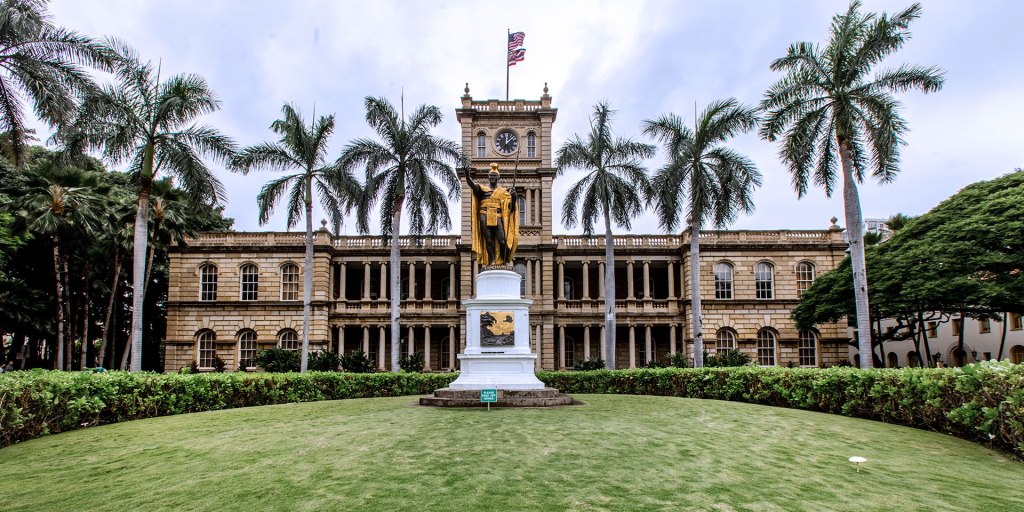
The Iolani Palace, Honolulu

Most Americans are not aware that there are at least three royal palaces in the Hawaiian Islands. Two of them are in the Honolulu area: the Iolani Palace downtown and Queen Emma’s Summer Palace on the Pali Highway. Martine and I have been to the Iolani Palace in 1996 and intend to revisit it on our upcoming trip to O’ahu along with Queen Emma’s Summer Palace.

Hawai’i was a perfectly viable kingdom when the United States annexed the islands in 1898. In the wake of the Spanish-American War, Americans were eager for new colonies; and there was already in place a willing cadre of American settlers willing to raise Old Glory. The reigning monarch, Queen Lili’uokalani was kept a prisoner in the Iolani Palace under suspicion of “treason,” namely for being loyal to her country.

Interior Queen Emma’s Summer Palace

The other palace is connected with a happier time, when Queen Emma (1836-1885), wife to King Kamehameha IV preferred the cooler temperatures of her hillside retreat, which today is a museum operated by the Daughters of Hawai’i. The same group operates a third royal palace on the Big Island of Hawai’i, the Hulihe’e Palace in Kailua-Kona.

In my reading in preparation for our trip, I am concentrating on the period between Captain Cook’s landing on the islands in 1778 and the American annexation in 1898. The memory of the royal families of Kamehameha and Kalakaua is still alive in the islands. There is even a Royal Mausoleum in Honolulu where most of the royal family is interred.

WW2-Land

The USS Arizona Memorial

It’s a strange feeling to be standing on the Arizona Memorial at Pearl Harbor. Beneath your feet is a sunken battleship in which 1,277 sailors are interred. That is roughly half the total U.S. casualties from the Japanese attack on Pearl Harbor.

The island of O’ahu has numerous military and naval bases, roughly 21% of the total land area. That includes not only Pearl Harbor itself, but Fort De Russy on Waikiki, Schofield Barracks, Hickam Air Force Base, Dillingham Field, Fort Shafter, and a whole host of others.

In fact, if there is anywhere on American soil that is a center of World War Two commemoration, it would have to be O’ahu. There have been at least four films made about the attack:

  • From Here to Eternity (1953) with Burt Lancaster and Montgomery Clift
  • Tora! Tora! Tora! (1970) with an American and Japanese Cast
  • Pearl Harbor (2001) directed by Michael Bay
  • Midway (2019), which begins with the attack on Pearl Harbor

There have also been numerous books on the subject. (And there still continue to be.) No doubt about it, America is still stuck on WW2.

When Martine and I visit Honolulu later this summer, we will spend a day going over all the exhibits and taking the shuttle over to the Arizona Memorial, as we did back in 1996. No doubt a lot has changed since then.

Blue Hawai’i

Waimanalo Beach on the Windward Side of O’ahu

Martine and I are planning a trip to Hawaii this September, after all the kids are back in school. We plan to visit only the island of O’ahu, as that’s where all the museums and special attractions that Martine wants to see are located. This won’t be our first trip: We were there in 1996, staying at what then was called the Pacific Beach Hotel.

We plan to revisit some of the sights we saw then, including:

Some sights I would like to add to what we’ve already seen: Waimanalo Beach, Honolulu’s Chinatown, and the Ala Moana Shopping Center.

Some things have changed for the worse since our last visit. Not only are automobile rentals more expensive than ever, but some hotels charge as much as $50 a night just for parking. Then, too, many hotels now charge up to $50 a day for “resort fees,” whether or not you use their resort services. Since I am now on a fixed income, I will be particularly interested in saving money.

Before September, I would like to read some of O. A. Bushnell’s novels about Hawaiian history and see some movies set in Hawaii, such as Elvis Presley in Blue Hawaii and several movies featuring the Japanese attack on Pearl Harbor (Tora Tora Tora and From Here to Eternity).