When You Strip Away the Surface …

Dancers from the Kárpátok Folk Dance Ensemble

… of me, what you will find is a strange sort of Hungarian. Although I have read no studies to this effect, I think that the first language you learn to speak is what determines, at the deepest level, who you are. My first language was an older dialect of the Magyar language from the region just to the southwest of Budapest. Today, when I speak the language—haltingly—Hungarians laugh at my choice of words and horrible grammar. Yet, my ever-so-sophisticated American English is merely an overlay on a base that was set in concrete before I was five. I feel myself to be a kind of Brummagem Hungarian.

Last night, Martine and I attended a Hungarian folk dance program at St. Stephen’s Catholic Church just south of downtown L.A. The dance was put on by the Kárpátok Folk Dance Ensemble, which has just recently celebrated its 50th anniversary. That a city like Los Angeles, which does not have that large a Hungarian population, could support an organization like Kárpátok is an unending surprise to me.

For many of the fifteen-odd dances they performed, I was in tears. There are certain themes in Hungarian music that take me way back to my beginnings. I could not lay my finger on it, but a deep emotional chord is struck deep in my core.

The people in attendance were curious about me. My pronunciation is near perfect, but I might as well be retarded. As for Martine, she doesn’t know a word of Magyar and depended on me for many things I was unable to explain.
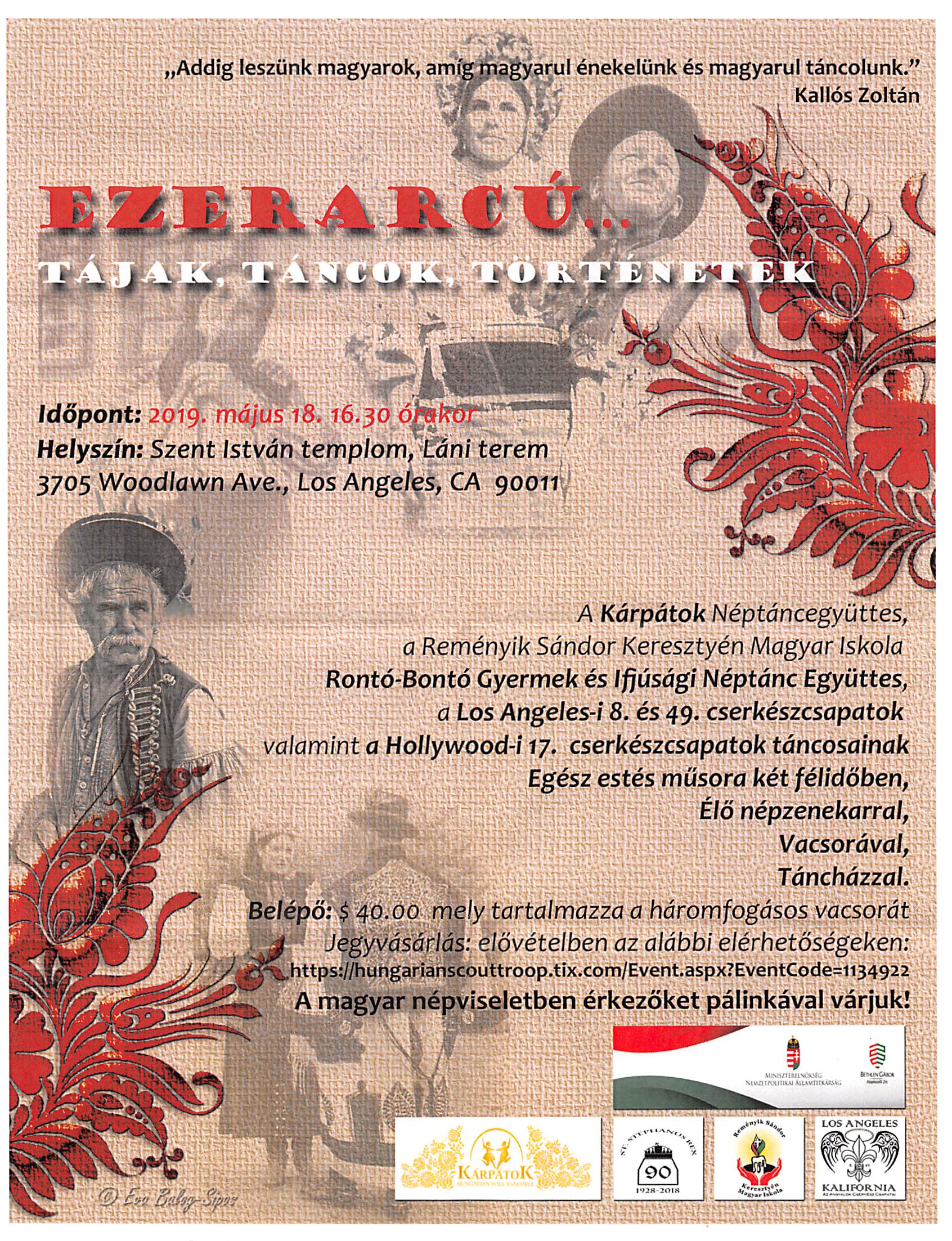
Flyer for the “Thousand Faces” Dance Concert We Attended

That didn’t keep up from enjoying the music and dances—and the Hungarian meal that was served afterwards—even though we were both suffering from nasty colds. She might be French, but Martine enjoys these Hungarian events as much as I do, though in a different way. I do believe she prefers Hungarian food to the great cuisine of France, especially where pastries are involved.

 

27. Magyar Majális és Tavaszi Fesztival

Don’t Worry If You Can’t Read This

Every year on the first Sunday in May, the Grace Hungarian Reformed Church in Reseda has a festival with authentic Magyar cuisine and Mothers’ Day entertainment. Unlike previous years, I couldn’t find any mention of the festival on the Church’s website. Martine made the perfectly logical suggestion for me to call the Church, except she made it to the wrong person. I have something of a telephone phobia, especially when I’m calling people I do not personally know. So Martine went and made the phone call herself. And yes, the festival was taking place at the usual time and place.

My rudimentary knowledge of my native language prevents me from being able to translate the above information sheet in its entirety, but I got the gist of it. The festival is a combination Spring, May Day, and Mothers’ Day event. For an admission fee of five dollars, one could have some of the best homemade Hungarian food in Southern California. For lunch, I went for the Gulyás Leves, usually referred to in English as Hungarian Goulash. What most Americans don’t know is that it is a hearty beef and vegetable soup served with chile peppers. After the kiddie Mothers’ Day entertainment, which was exceedingly cute, we ordered two stuffed cabbage dinners to go, which furnished our supper once we got home.

The highlight of Hungarian cuisine for Martine—and, in fact, for most Hungarians—is the pastry, particularly a kind of cheesecake referred to as crémes, pronounced KRAY-mesh. I get the impression that Hungarians in a pastry shop are even more dangerous than bulls in a china shop, and that they are not above packing away 25,000 calories or more.

This is aided and abetted by the Hungarian love of a fried dough concoction called lángos (pronounced LAHN-goash), richly slathered with sour cream, cheese, or garlic. It’s very like Indian fry bread, except with a different selection of toppings.


My Early Career

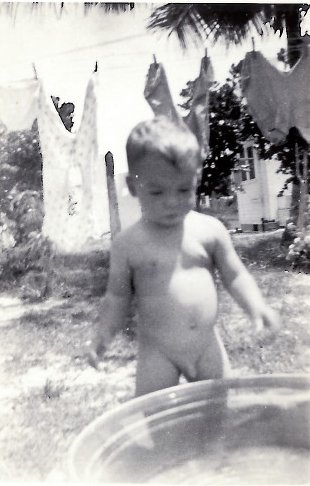
Yes, That’s Me at the Age of 18 Months

Now that you’ve seen me without a stitch of clothing on, and facing you with the situation, I thought I’d bring you up to date about the second home of my young life. When I was only a little over a year old, my Mom, Dad, and I moved to Lake Worth, Florida. As I was much too young at the time, I have no memory of my first trip to the Land of Sunshine. My Dad worked for the city, which is a southern suburb of West Palm Beach, and my Mom had her hands full with the above illustrated hedonist.

Unfortunately, my father did not have the best of times in Florida. His job was to remove the bodies of dead and rotting alligators. Now Dad had a tricksy stomach, so instead of job satisfaction, he was mostly involved in projectile vomiting at the time. The move to Florida was declared a failure, so Dad insisted that the family relocate to the Hungarian neighborhood of Cleveland, on the East Side’s Buckeye Road. Which is what we did.

My third home was the second floor of a duplex at 2814 East 120th Street. I was able to put down some roots there, as we were to remain there until 1951, after my brother Dan was born. Since I didn’t know a word of English, Mom and Dad figured we should relocate to the suburbs, a few miles east of Buckeye Road. It was time for me to learn English and become a red-blooded American. Which I proceeded to do, with such dispatch that after three more years, I was no longer regarded as a problematical retard with a funny accent.

BTW: My Mom adored the above picture. She showed it to all my girlfriends….


The Centenary of a Hungarian Poet’s Death

Hungarian Poet Endre Ady (1877-1919)

It was a hundred years ago that Endre Ady died of syphilis in Budapest. Like most Hungarian poets, he is virtually unknown in the West. I present here two of his shorter works.

Who Come from Far Away

We are the men who are always late,
we are the men who come from far away.
Our walk is always weary and sad,
we are the men who are always late.
We do not even know how to die in peace.
When the face of distant death appears,
our souls splash into a tam tam of flame.
We do not even know how to die in peace.
We are the men who are always late.
We are never on time with our success,
our dreams, our heaven, or our embrace.
We are the men who are always late.

Also very Hungarian in its bitterness is “The Magyar Messiah.” Hungary was on one of the two invasion paths into Europe from the East. (The other is Poland.) Likewise, it was convenient for invasion from the West, say, from Germany.

The Magyar Messiah

More bitter is our weeping,
different the griefs that try us.
A thousand times Messiahs
are the Magyar Messiahs.
A thousand times they perish,
unblest their crucifixion,
for vain was their affliction,
oh, vain was their affliction.


A Budding Artist

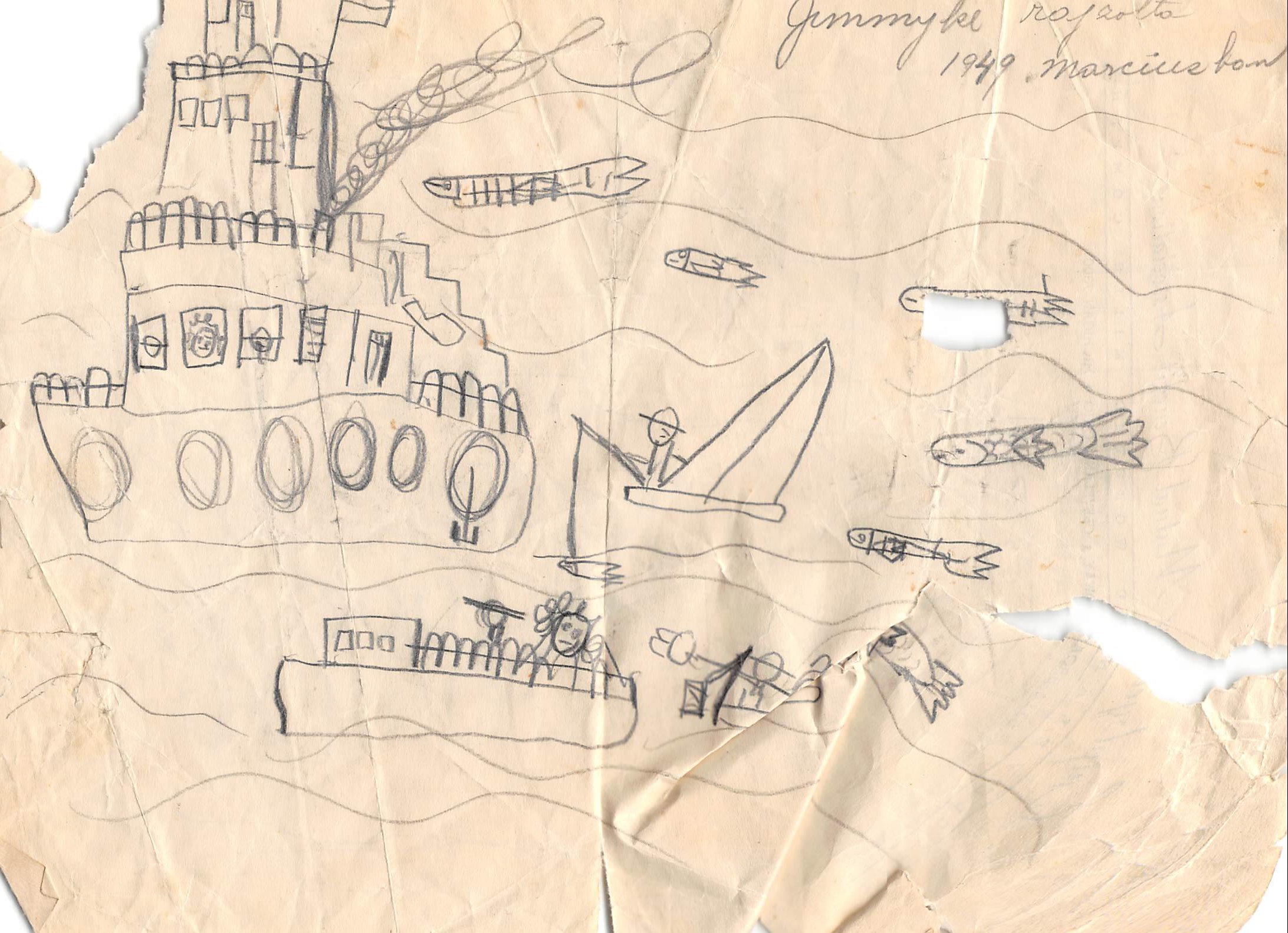
My Oldest Surviving Kid Drawing

The notation at the top right was written by my Mom in Hungarian: “Jimmy drew this 1949 March.” I was a little over four years old at the time. I had not yet entered school only to find that I was a retard who couldn’t speak English. (Of course, now I would prefer to think I was smart because I could speak a foreign language.) In fact, this ratty little pencil drawing is probably the oldest thing I have, and the only thing dating from my early years in the Hungarian neighborhood on Buckeye Road.

At the time, Mom liked to take me to the library on East 116th Street and pick a book to read to me. As the children’s books were all in English, she would pick something with nice illustrations and make up her own stories in Hungarian to fit the pictures, more or less. I have fond memories of that library. Was it perhaps because there was a great doughnut shop next door?

I just checked a map. Not only is the library no longer there; but Harvey Rice Elementary School, where I had my traumatic introduction to the American educational system, is likewise gone. They seem to have been replaced by healthcare facilities, which makes sense as St. Luke’s Medical Center is nearby. That’s where I was taken a year later because my parents thought I was too skinny. The doctors there told my parents, “Don’t worry: He’ll wind up eating you out of house and home.”

My memories of life at 2814 East 120th Street were for the most part good ones. I had good friends, like András and Joycey—Hungarians like me. We had not yet been introduced to television: That was to come a year later. And it was probably television that taught me English as much as anything else. I remember the TV station started broadcasting around 4 PM with the Kate Smith Hour, followed at 5 PM by the Howdy Doody Show, which I dearly loved.


Boldog új évet!

And My Computer Is Now Working!

I will start 2019 with my old office computer, which has been newly updated with additional memory and a new graphics card. Apparently, the computer freezes I described were mostly the fault of the graphics card, which was installed late in 2015.

As long as the Trumposaurus is occupying the White House—or, even, earth, above ground, that is—2019 can’t really be a great year. But we can make the best of things. It’s how we tackle adversity that really counts. We cannot expect to live a live that is devoid of adversity. Real happiness is not the result of living in lucky times: It’s creating our own luck in dicey times.

So, to all my readers, I wish you all the best.

By the way, the title of my post is Happy New Year in Hungarian. All of you, be boldog.


My Rudeness Backfires

The Santa Monica Pier at Sunset

I was waiting for the Number 1 Santa Monica bus on 4th Street, near the Expo Line Terminus, when two young women suddenly hove into view as my bus was approaching. When I don’t want to talk to strangers—and I almost never do—I answer them … in Hungarian. Well, these two girls went away thinking I was some kind of a genius instead of a rude bastard manqué.

In English, they asked me which way was the ocean.

In Hungarian, I answered, “You mean the beach?” Their eyes widened. How did I know they were Hungarian? I gestured toward the beach and said, “That way!” in my best Magyar. They thanked me profusely as I boarded my bus.

Actually, they were rather cute.


So Long, White America

Is This What We’ve Come To?

In an essay on James Fenimore Cooper appearing in his 1923 Studies in Classical American Literature, British novelist D. H. Lawrence wrote:

But you have there the myth of the essential white American. All the other stuff, the love, the democracy, the floundering into lust, is a sort of by-play. The essential American soul is hard, isolate, stoic, and a killer. It has never yet melted.

I can’t believe that Lawrence got it so right on the money a hundred years ago.

Last year, I gave up on the Democratic Party. This year, I’m giving up on the white race. When I get the 2020 Census form, I will identify myself as being of Other race. The peoples belonging the the Finno-Ugric Language Family—comprising Finns, Hungarians, Estonians, Karelians, Komi, Udmurts, Mari, Mordvins, Khanties, and Mansis—derive ultimately from the Ural Mountains, which straddle the border between Europe and Asia. Rather than count myself in the same race as the a**holes in the above photo, I am now of Finno-Ugric race. I can also called myself Asian. I’ll see how I feel about it later.

But white? Uh-uh!


Food Scraps

What Ever Happened to Good Plain Food?

I open this post by splitting a couple of hairs. First of all, this has nothing to do with Anthony Bourdain’s unfortunate demise. I am not familiar either with his work as chef or his book(s) or his television program. Secondly, I am writing this at Martine’s behest. Anyone who knows me well knows that I like ethnic food best. It is Martine whose digestive system shies away from any attempt at fanciness, which she associates with things like raw onions or strong spices. Going to an unfamiliar restaurant is something she associates with an assault on her Irritable Bowel Syndrome (IBS).

As the cook in our little household, I try my best to prepare simple dishes without too many exotic ingredients but with a good, clean taste. At times, I am tempted to add hot chilis, as I am a notorious chili-head. But I resist the temptation, or my little girl goes hungry. Restaurants are even more difficult: Martine aims for the tried and true places, like Sevan Chicken and Elena’s Greek and Armenian Restaurant in Glendale; All India Cafe, the Rosemary Grill,  and Darya Persian Restaurant in my neighborhood; Label’s Table and Canter’s Deli East of here; and The Main Course in Rancho Park. At each of those places, she will typically order the same dish every time, while I typically skip around the menu. If that one dish doesn’t satisfy, she writes the restaurant off her list as a lost cause.

Several years ago, I wrote a post entitled “Don’t Toque to Me About Chefs!” in which I lambasted the profession for trying too hard to be creative without necessarily serving good food. It almost seems as if many chefs were trying too hard to be original. There used to be a great Hungarian restaurant in the San Fernando Valley called the Hórtobágy owned by a chef called Lászlo. Apparently, the genius in the kitchen at his restaurant was an elderly lady who cooked delicious Hungarian meals that reminded me of my childhood. Then Lászlo opened another restaurant nearby called Maximilian’s at which he was the chef. Every dish was smothered with raw onions. Yeccch!


Fading Away

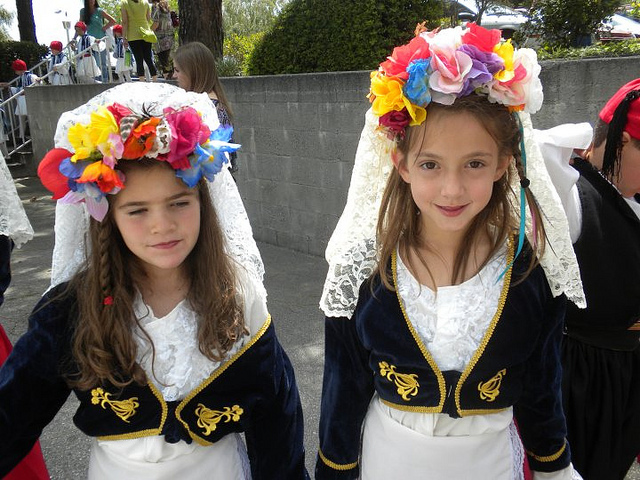
Little Girls in Greek Dance Costumes (2011)

In the time that Martine and I have been going to Greek church festivals in Los Angeles, we’ve noticed several trends:

  • The food is getting less authentic. Today, Martine ordered a spanakopita (spinach and cheese pie) that did not contain any cheese.
  • It seems that fewer of the parishioners speak Greek. Is it that the older generation is passing on?
  • The priests are less involved personally with the festivals, particularly in offering church tours to visitors.

This is less true of Saint Sophia Cathedral in downtown L.A. which draws crowds from a much larger area, and which is across the street from Papa Cristo’s, the most authentic Greek restaurant in town.

The same is true of the Hungarian festivals. At first, I felt abashed by my poor command of the Magyar language. Now my Hungarian seems to have gotten better, or again, are the old immigrants dying off and making my poor language skills look better by comparison?

I suppose this is a natural process. Many of the places we visit may not even be around in a few years. For instance, there do not seem to be any Hungarian restaurants left in our nation’s second largest city. Back when I first moved to L.A., there were a number of choices, especially the much lamented Hortobagy.

If you want a more authentic ethnic experience in Los Angeles, you have to look to Latin America and Asia. There is a bustling Thai and Korean scene; and numerous options involving Mexican, Central and South American culture. There are numerous places offering Oaxacan food. Culver City has an Indian restaurant offering the cuisine of Southern India’s State of Kerala.

As to the girls in the above photograph, I could have sworn that they were in a group of teenage girls who passed us on the way to our parked car. They were busy calling each other “chicken butt.”