White Dove of the Desert

The Mission Church of San Xavier del Bac

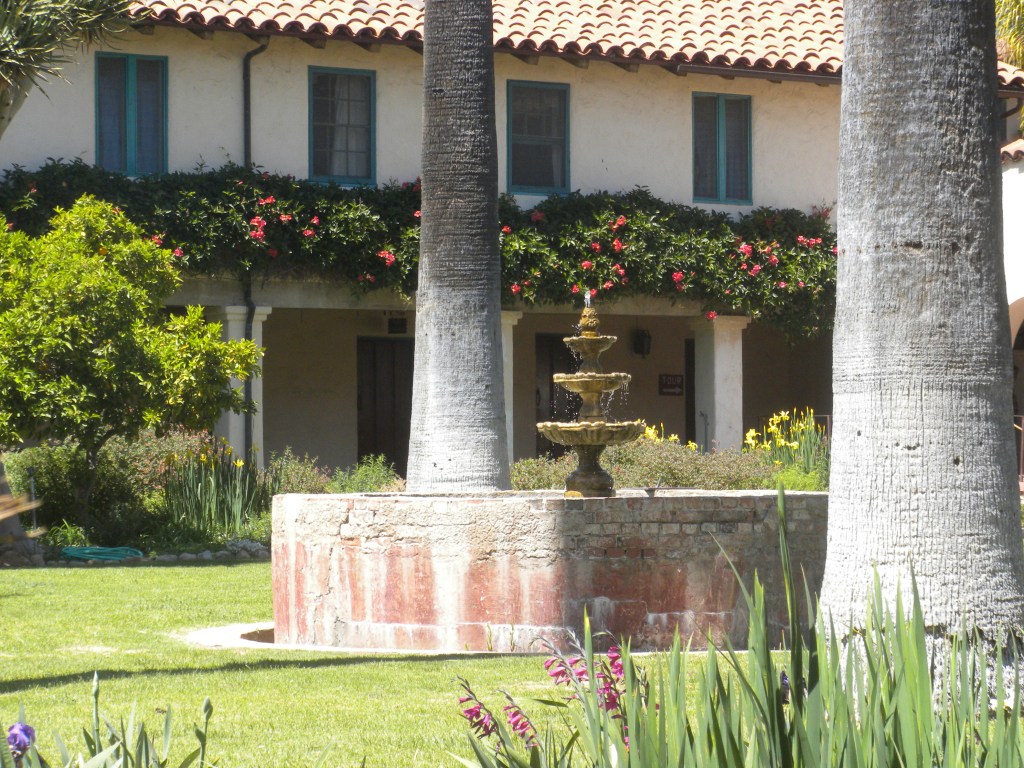
South of Tucson, visible from I-17, is the mission church of San Xavier del Bac. On Indian land belonging to the Tohono O’odham (Papago) tribe, the church was originally founded by the Jesuit Father Eusebio Kino in 1692 and is the oldest European structure in the State of Arizona, although it has been rebuilt several times. In fact, there is still scaffolding by the church’s entrance.

The mission has been called the White Dove of the Desert. The name fits, as the church’s interior and exterior are nothing short of beautiful.

To get a feeling for the church’s interior, click on this tour of the interior. Just pan the view by moving your mouse to the left or right.
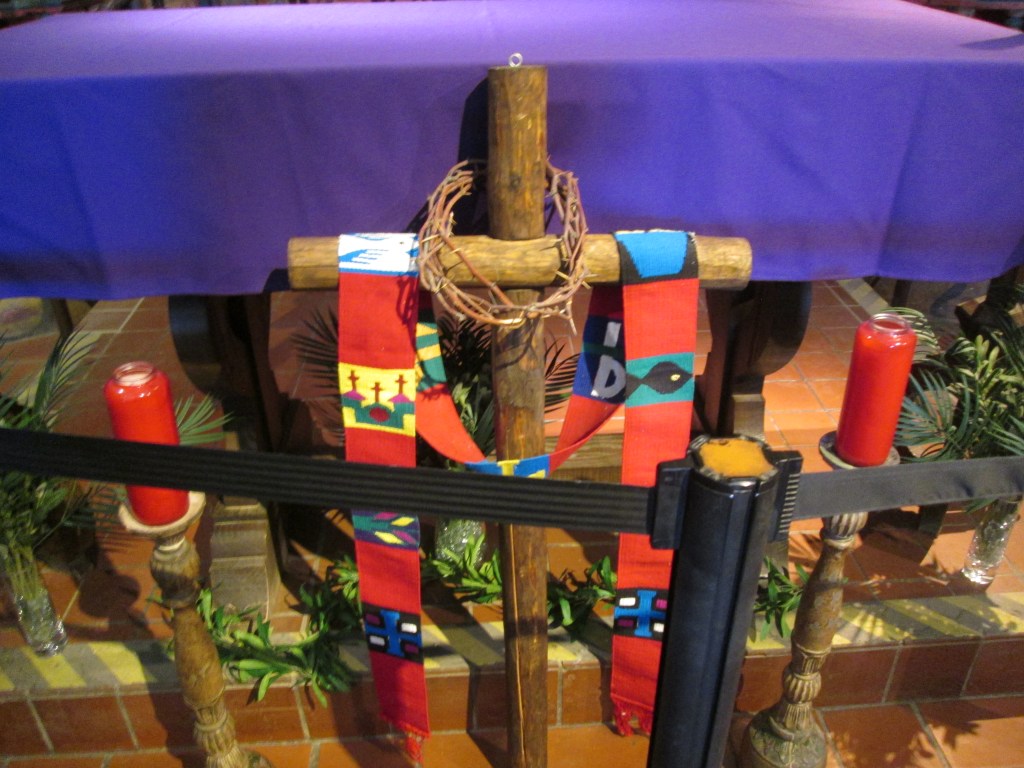
Crucifix with Crown of Thorns and Decorative Papago Cloth

Needless to say, it was another hot day; and I was content to take a pew and ogle the church’s interior. None of the Junipero Serra missions in California could hold a candle to San Xavier del Bac. It is easily worth two or three hours to view the church and its grounds. Afterwords, you can go get some good Indian fry bread at the little cafe just south of the church. (I always like my fry bread topped only with honey.)

Although we had a whole half day of sightseeing left after visiting San Xavier, we ran into some bad luck. We couldn’t visit the Arizona State Museum on the University of Arizona grounds because we could not find anyplace to park. Then, we attempted to visit the International Wildlife Museum on Gates Pass Road, but found it was unaccountably closed.

The Man Who Killed Thanksgiving

The Famous 1975 Cartoon by Ron Cobb About Thanksgiving

Even back in 1975 when I saw the famous R. Cobb cartoon depicting a family saying grace over a Thanksgiving turkey while the ground beneath them is littered with the bones of massacred Indians. Of course, even back then I didn’t like Thanksgiving. I had too many memories of dry bird carcasses drenched in fat to make them palatable.

Curiously, we never had Thanksgiving turkey at home. Turkey just wasn’t a Hungarian meat; and my father, like me, didn’t want my Mom to ever cook any. So we always went out for Thanksgiving.

The whole nonsense about the Pilgrims making nice with the Indians before wiping them out in King Philip’s War and other conflicts. The holiday is based on a myth designed to make us feel good about violently supplanting the indigenous peoples of the New World. If you want to get a more balanced picture of what happened, I suggest you read Eduardo Galeano’s trilogy entitled Memory of Fire. I read all three volumes in the 1980s, which served only to solidify my dislike of the holiday.

On this and many other issues, I find myself in the minority. So enjoy your dry bird. And think of all the football games you can watch this weekend!

By the way, Martine loves turkey; so I’ll be taking her out for a turkey dinner tomorrow. Needless to say, I will order something else.

The Alligator Dream

The following is a dream that poet Joy Harjo, a Creek/Mvskoke Indian, had when she was a child and it was feared that she had polio. The excerpt comes from her book Crazy Brave: A Memoir.

It was shortly after the polio scare that I began to dream the alligator dream.

I am a young girl, between four and five years old. It’s early in the morning. I delight in my feet touching the ground and in the plant beings who line the trail to the river. I breathe in playful energy from small, familiar winds as I walk to get water for the family. The winds appear to part the tall reeds through which I walk with my water jar.

An alligator whips me suddenly to the water and pulls me under. I struggle, and then I am gone. My passing from earth is a quick choke. To my mourning family, my life has been tragically ended. They did not see that I entered an underwater story to live with alligators and become one of them.

I believe now that I had the beginnings of polio. The alligators took it away. It is possible. The world is mysterious.

The Medicine of Bow-Returning

An Excerpt from a Short Story by Mary Austin

Some of the best books about the American West were written by Mary Hunter Austin (1868-1934). In the last year of her life, she published a collection of short stories entitled One-Smoke Stories, in which the following appears:

So Taku-Wakin, who was afterward called Bow-Returning, went toward the mountain called Going-to-the-Sun for his fast, and as he went he felt the thoughts of his mother push him. He went far, climbed the high mountains and bathed in the sacred lakes, keeping holy science. On the mountain, when by fasting he was removed from himself, his eyes were opened. He saw all the earth and the sky as One Thing, even as the bow is one thing and the cord of the bow which draws it. Even so he saw the thoughts of men pulling at the corners of the world as the cord pulls at the bow, and the bow bending and returning. In the silence he heard in his heart the One-Who-Walks-in-the-Sky talking.

‘This is true medicine, Taku-Wakin. All things are one, man and the mire, the small grass and the mountain, the deer and the hunter pursuing, the thing that is made and the maker, even as the bow and the cord are one thing. As the bow bends to the cord, so all things bend and return, and are opposed and together. The meaning of the medicine is that man can hurt nothing without also hurting himself.’ Thus said the One-Who-Walks-in-the-Sky to Taku-Wakin….

After long seeking he heard the voice of the Sky-Walker. Then said Bow-Returning: ‘This is my medicine, that everything is One Thing, and in this fashion I have kept it. Meat I have taken for my needs according to the law of food-taking, but I have hurt no man. Neither the flower in the field have I crushed, nor trodden on the ant in my pathway. How is it, then, that my wife is dead, my son given to another, and my medicine is gone from me?’

Then said the One-Who-Walks-in-the-Sky to Bow-Returning, ‘Did I not also make woman?’

Sacred Mountain

Frank LaPeña’s Painting Sacred Mountain

Yesterday, Martine and I visited the Autry Museum of the American West in Griffith Park. Many of the galleries were still closed due to the Covid-19 outbreak, but what there was, was choice. I am specifically referring to the exhibit of California Indian art entitled “When I Remember I See Red: American Indian Art and Activism in California.” What impressed me the most was work from a Nontipom Wintu artist from Northern California named Frank LaPeña (1937-2019).

Artist Frank LaPeña

What draws me to American Indian art is its spirituality and brilliant imagery—both qualities notably lacking in so many academic artists. These are not works to decorate a corporate boardroom: Instead, they are works to make you feel grounded in a separate reality, one that is part of the world from which the artist comes.

Frank LaPeña’s Dream Song

In a strange coincidence, there is an accused murderer with the same name who is totally unrelated to the artist. This other Frank LaPeña was recently released from prison in Nevada where he was wrongfully incarcerated for hiring a hit man to kill the wife of a Caesars Palace in 1974.

I will try in the week ahead to highlight some more California Indian artists from the Autry show.

Under Our Feet

As we tread upon the ground, we tend not to think of what lies beneath our feet. I thought about this after I wrote yesterday’s blog post entitled “Mission Creep.” The small size of the cemeteries at the Santa Barbara and Santa Ynez missions in Southern California troubled me because of the large number of bodies said to be buried there. The Catholic Church did not sanction cremation at that time, so literally thousands of bodies, mostly of Indians, were interred over a 65-year period in these small burial grounds.

I live within walking distance of Kuruvungna Springs, a place where the Tongva or Gabrielino Indians congregated f0or ceremonies or just a fresh drink of spring water. It is entirely possible that as I walk along Santa Monica Boulevard and the streets feeding into it I am walking on the bones of Indians who died in the area—at least those which weren’t carted away by dirt haulers as the area was built up with multi-story commercial and residential buildings.

And then I thought of a great English writer who thought the same way. The quote is from an essay by Sir Thomas Browne (1605-1682) called “Hydriotaphia, urn-burial, or, A discours of the sepulchral urns lately found in Norfolk ….” The 17th century English is hard to read, but I promise that it is rewarding.

In the deep discovery of the Subterranean world, a shallow part would satisfie some enquirers; who, if two or three yards were open about the surface, would not care to rake the bowels of Potosi, and regions towards the Centre. Nature hath furnished one part of the Earth, and man another. The treasures of time lie high, in Urnes, Coynes, and Monuments, scarce below the roots of some vegetables. Time hath endlesse rarities, and shows of all varieties; which reveals old things in heaven, makes new discoveries in earth, and even earth it self a discovery. That great Antiquity America lay buried for a thousand years; and a large part of the earth is still in the Urne unto us.

Though if Adam were made out of an extract of the Earth, all parts might challenge a restitution, yet few have returned their bones farre lower then they might receive them; not affecting the graves of Giants, under hilly and heavy coverings, but content with lesse then their owne depth, have wished their bones might lie soft, and the earth be light upon them; Even such as hope to rise again, would not be content with centrall interrment, or so desperately to place their reliques as to lie beyond discovery, and in no way to be seen again; which happy contrivance hath made communication with our forefathers, and left unto our view some parts, which they never beheld themselves.

Sir Thomas Browne

The reference to Potosi is to the fabulous silver mines at the Cerro Rico (Rich Hill) of Potosi in Bolivia. The mines are at an altitude of approximately 13,300 feet (4,050 meters).

Wherever we may go, we are walking a very few feet above the remnants of the past. We tend to forget this as we follow the latest trends and knock ourselves into a digital frenzy that only hastens us to our own grave.

Mission Creep

Mission Santa Barbara

California has given birth to many beautiful myths. Unfortunately, they frequently have little bearing on the actual history of the Golden State. For instance, the twenty-one Franciscan missions founded by Father Junipero Serra—who has been canonized a saint by Pope Francis in 2015—are among the most peaceful places I have ever visited. Yet they were little more than rural concentration camps in which thousands of Californian Indians found their way to early graves.

If you look at a map of the mission location, you will find that they are all strung out like so many pearls along the Camino Réal closely following the coastline. Indians who dwelt close to the coast were rounded up and assigned as peons to the various missions, where they were worked to death. During the heyday of the missions from 1769 to 1834, some 53,600 adult Indians were baptized, and 37,000 were buried.

The Graveyard of the Santa Barbara Mission

Visiting the Santa Barbara and Santa Ynez missions, I was stunned to find that the postage-stamp-sized cemeteries adjoining the missions held 3,936 and 1,227 bodies respectively. Why is this? The Indians attached to the missions (they were not allowed to leave) were essentially overworked and underfed. When they lived in the missions, the Indians lived in permanent adobe structures that were infested with fleas. Young Indian maidens were treated as nuns and confined to barracks in which the rooms were 50 feet long by 21 feet wide with bunks ranged around the walls. A single high window provided the only ventilation, while the center of the room was an improvised sewer or latrine.

According to Carey McWilliams in Southern California Country: An Island on the Land:

To understand what conversion meant to the Indian, it should be remembered that the process of Missionization necessitated a sudden transition from the settled, customary existence of the Indian in a small rancheria or village to the almost urban conditions that prevailed in the larger Mission establishments. The change … must have come as a deep mental shock to the Indian.

As much as I respect much of Catholic teaching from my long education in religious elementary and high schools, I cannot condone many practices of the past, such as the Inquisition and the treatment of native peoples in the missions.

The Spiral Road

U.S. Poet Laureate Joy Harjo

Here is another poem by Joy Harjo, a member of the Muscogee Nation (Este Mvskokvlke), belonging to Oce Vpofv (Hickory Ground). Considering all that has happened to her people, she is curiously optimistic “for earth’s grandsons.” And that is the title of her poem.

For Earth’s Grandsons

Stand tall, no matter your height, how dark your skin
Your spirit is all colors within
You are made of the finest woven light
From the iridescent love that formed your mothers, fathers
Your grandparents all the way back on the spiral road—
There is no end to this love
It has formed your bodies
Feeds your bright spirits
And no matter what happens in these times of breaking—
No matter dictators, the heartless, and liars
No matter—you are born of those
Who kept ceremonial embers burning in their hands
All through the miles of relentless exile
Those who sang the path through massacre
All the way to sunrise
You will make it through—

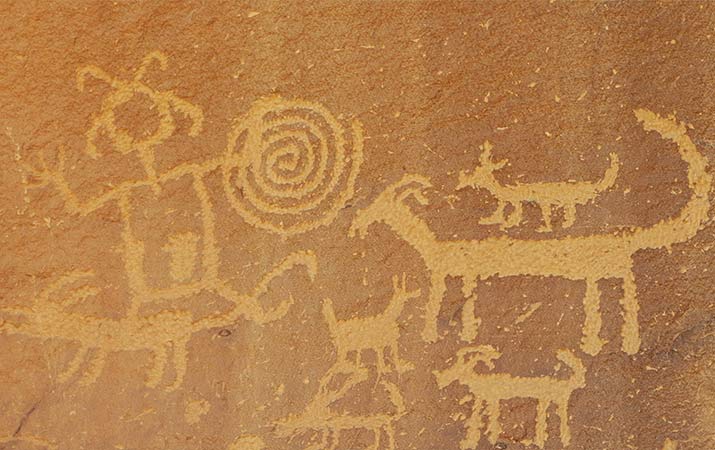
Pictograph at Chaco Canyon Showing the Spiral Road

I liked the way the poem ends with a dash: All this is still happening. I posted another poem by Joy Harjo on October 20 here. Both poems are taken from her recent book An American Sunrise (New York: W.W. Norton, 2019).

Seven Questions

Poet Laureate of the United States Joy Harjo

I present for your enjoyment—and serious consideration—a poem about politics by Joy Harjo, the Poet Laureate of the U.S., who is also a Muscogee Creek Indian whose people have suffered grievously from lying, weaselly politicians of all stripes through their history as the first real Americans.

The poem is from her collection entitled An American Sunrise.

For Those Who Would Govern

First question: Can you first govern yourself?

Second question: What is the state of your own household?

Third question: Do you have a proven record of community service and compassionate acts?

Fourth question: Do you know the history and laws of your principalities?

Fifth question: Do you follow sound principles? Look for fresh vision to lift all the inhabitants of the land, including animals, plants, elements, all who share this earth?

Sixth question: Are you owned by lawyers, bankers, insurance agents, lobbyists, or other politicians, anyone else who would unfairly profit by your decisions?

Seventh question: Do you have authority by the original keepers of the lands, those who obey natural law and are in the service of the lands on which you stand?


I found interesting Joy’s use of the word principalities in the fourth question. She herself is a member of a sovereign nation that is affiliated with the U.S.

In the sixth question, I would have included real estate developers, who are in my book archvillains.

Looking at our current president, he comes off in honest answers to these questions as a suppurating vessel of gangrenous pus.

Outliers: Rick Bartow, Mad River Wiyot

Deer Spirit by Rick Bartow (1946-2016)

Today, Martine and I visited the Autry National Center, which was putting on a show of the late American Indian painter and sculptor, Rick Bartow, entitled “Things You Know But Cannot Explain.” I was enthralled by Bartow’s vision of people and the wild animals whose spirits have invaded them. A member of the Mad River Band of Wiyot Indians, Bartow  lived much of his life around Newport, Oregon.

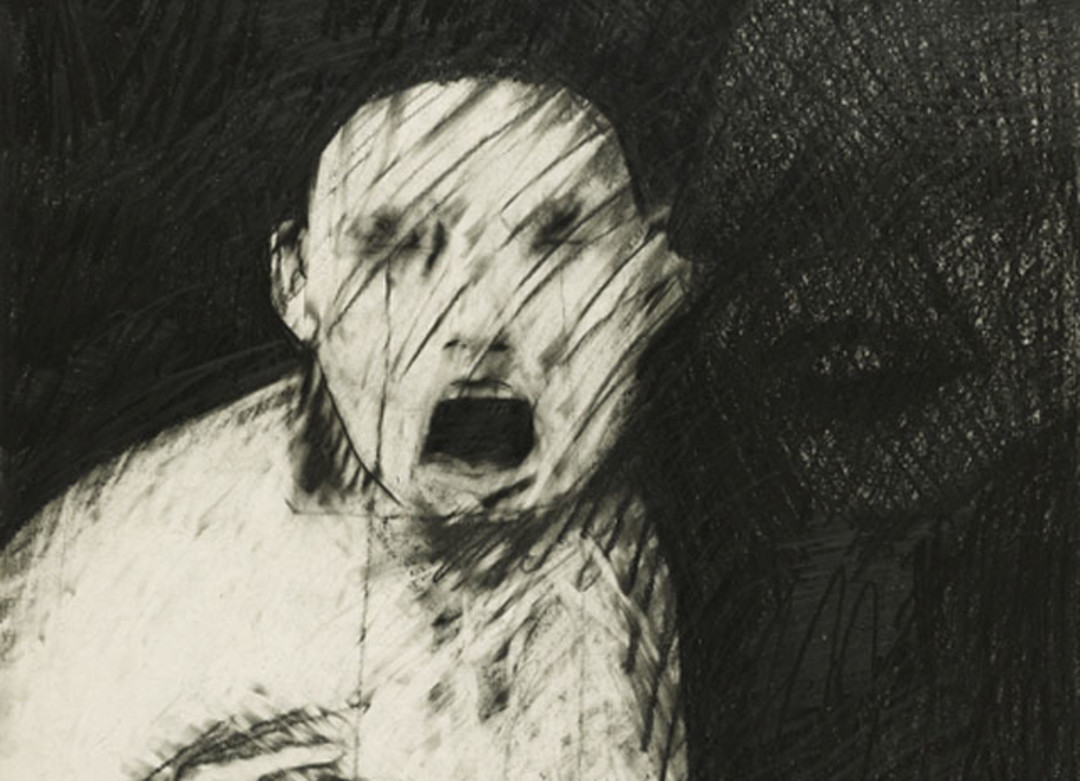
The deer spirit illustrated above is typical of Bartow’s depiction of human verging on totemic animal. Another is the drawing that gave its name to the show:

“Things You Know But Cannot Explain”

Note the face seeming to emerge from the upper right behind the foreground figure, who appears to be paralyzed with fright. Much more traditional is the drawing of three hawks below.

“Three Hawks”

I may not have a drop of Native American blood in me, but I am always delighted to see creative depictions of animals I consider to be my own personal totems, among whom I include the coyote, the raven, and the bear. Because I live at the edge of the desert and Bartow lived in the wet forests of the north, he did not depict my other totems, the frog and the turtle, both of whom I associate with life-giving rain.

Some of Bartow’s most impressive works are his sculptures. Perhaps I will do another posting on those later on. They are usually formed of wood, nails, and various found objects.

At a time when much of the art work is ruled by abstract expressionist garbage, I find Rick Bartow to be rooted in an ancient tradition that manages to speak to me today.