Zoophilomania

I have been reading Norman Douglas’s travel classic Old Calabria, which was written in 1915. Here he talks about the Southern Italians’ attitude toward pets. I include the footnote, which discusses how the ancient Greeks treated their animals.

To say that our English zoophilomania—our cult of lap-dogs—smacks of degeneracy does not mean that I sympathize with the ill-treatment of beasts which annoys many visitors to these parts and has been attributed to “Saracenic” influences. Wrongly, of course; one might as well attribute it to the old Greeks.‡ Poor Saracens! They are a sort of whipping-boy, all over the country. The chief sinner in this respect is the Vatican, which has authorized cruelty to animals by its official teaching. When Lord Odo Russell enquired of the Pope regarding the foundation of a society for the prevention of cruelty to animals in Italy, the papal answer was: “Such an association could not be sanctioned by the Holy See, being founded on a theological error, to wit, that Christians owed any duties to animals.” This language has the inestimable and rather unusual merit of being perspicuous. Nevertheless, Ouida’s flaming letters to “The Times” inaugurated an era of truer humanity. . . .

Here follows the footnote:

‡Whose attitude towards animals, by the way, was as far removed from callousness as from sentimentalism. We know how those Hellenic oxen fared who had laboured to draw up heavy blocks for the building of a temple—how, on the completion of their task, they were led into green fields, there to pasture unmolested for the rest of their lives. We know that the Greeks were appreciative of the graces and virtues of canine nature—is not the Homeric Argo still the finest dog-type in literature? Yet to them the dog, even he of the tender Anthology, remained what he is: a tamed beast. The Greeks, sitting at dinner, resented the insolence of a creature that, watching every morsel as it disappeared into the mouth of its master, plainly discovered by its physiognomy the desire, the presumed right, to devour what he considered fit only for himself. Whence that profound word [Greek: kunopes]—dog-eyed, shameless. In contrast to this sanity, observe what an Englishman can read into a dog’s eye:

                That liquid, melancholy eye,
                From whose pathetic, soul-fed springs
                Seemed surging the Virgilian cry—
                The sense of tears in mortal things. . . .

That is how Matthew Arnold interprets the feelings of Fido, watching his master at work upon a tender beefsteak.

Norman Douglas’s work contains surprises on virtually every page. If I have time, I will quote him about the flying monk, Saint Nicholas of Cosentino.

To Prince or Not To Prince

Statue of Niccolò Machiavelli in Florence’s Uffizi Gallery

Will the real Niccolò Machiavelli please stand up. For over five hundred years, his name has been synonymous with cruelty and immorality in governance. But is that the real Machiavelli, or was his work The Prince not meant to be taken seriously?

Even Jean-Jacques Rousseau in The Social Contract had his doubts:

Machiavelli was a proper man and a good citizen; but, being attached to the court of the Medici, he could not help veiling his love of liberty in the midst of his country’s oppression. The choice of his detestable hero, Cesare Borgia, clearly enough shows his hidden aim; and the contradiction between the teaching of The Prince and that of the Discourses on Livy and the History of Florence shows that this profound political thinker has so far been studied only by superficial or corrupt readers. The Court of Rome sternly prohibited his book. I can well believe it; for it is that Court it most clearly portrays.

I am currently reading Machiavelli’s The Discourses and find it entirely different from The Prince, Instead of advice to princes to be evil, he comes across as altogether more reasonable. For instance:

All writers on politics have pointed out, and throughout history there are plenty of examples which indicate, that in constituting and legislating for a commonwealth it must needs be taken for granted that all men are wicked and that they will always give vent to the malignity that is in their minds when opportunity offers.

And: “Men never do good unless necessity drives them to it; but when they are too free to choose and can do just as they please, confusion and disorder become everywhere rampant.” It certainly does not look as if the writer were urging confusion and disorder on the people of Florence. In fact, everything he wrote other than The Prince shows him to be a loyal and responsible citizen of Florence.

Could it be that The Prince was written as a warning to his readers of what happens when their leaders are cruel and uncaring?

Pitocchetto

Giacomo Ceruti’s “The Beggar at Rest”

Yesterday, I decided to escape the summer heat by visiting the Getty Center and reveling in some great works of art. One of my favorite discoveries was a whole gallery full of paintings by the Italian Giacomo Ceruti (1698-1767). He was known as Pitocchetto, which means “The Little Beggar,” probably because so many of his paintings highlighted beggars, the poor, and people in humble occupations.

It’s a nice change from all the magnificent kings, princes, and nobles resplendent in gold and silk. One art critic, Mira Pajes Merriman, writes that Ceruti’s paintings confront us with

the detritus of the community; the displaced and homeless poor; the old and the young with their ubiquitous spindles, eloquent signs of their situationless poverty and unwanted labor; orphans in their orderly, joyless asylums plying their unpaid toil; urchins of the streets eking out small coins as porters, and sating them in gambling; the diseased, palsied, and deformed; lonely vagabonds; even a stranger from Africa—and all in tatters and filthy rags, almost all with eyes that address us directly…

And yet, confronted with one of his paintings, one is arrested by a different vision of the baroque era, not so different from our own tent encampments of the homeless.

“The Dwarf” by Giacomo Ceruti

One thing that sets Ceruti apart is that he allows his subjects their dignity, irrespective of the lowliness of their social status. He is above all a compassionate artist who is not above showing us an alternative picture of his times.

It’s Greek to Me

Basil

They both look rather similar if you’re not a botanist: basil and oregano. I remember attending a cooking demonstration at a Greek Orthodox Church in Redondo Beach and being told by Pitsa Captain and Akrevoe Emmanouilides, the instructors, that in Greek cuisine the preferred spice was oregano. And that despite the fact that basil grew wild everywhere!

Although oregano is used in Italian cooking, the predominant flavor is of basil.

Oregano

In point of fact, I love both herbs. And I have even been known to use both of them in the same dish, especially pizza.

I love using fresh basil in my Italian cooking, even though I have to pay a bundle each time I buy it. Some day, I will probably create my own little herb garden in a box that hangs from the iron railing on the back steps of my apartment.

As for oregano, I have only ever used it dry and have not encountered any recipes that call for the fresh herb. I wonder why.

Favorite Films: Europa 51

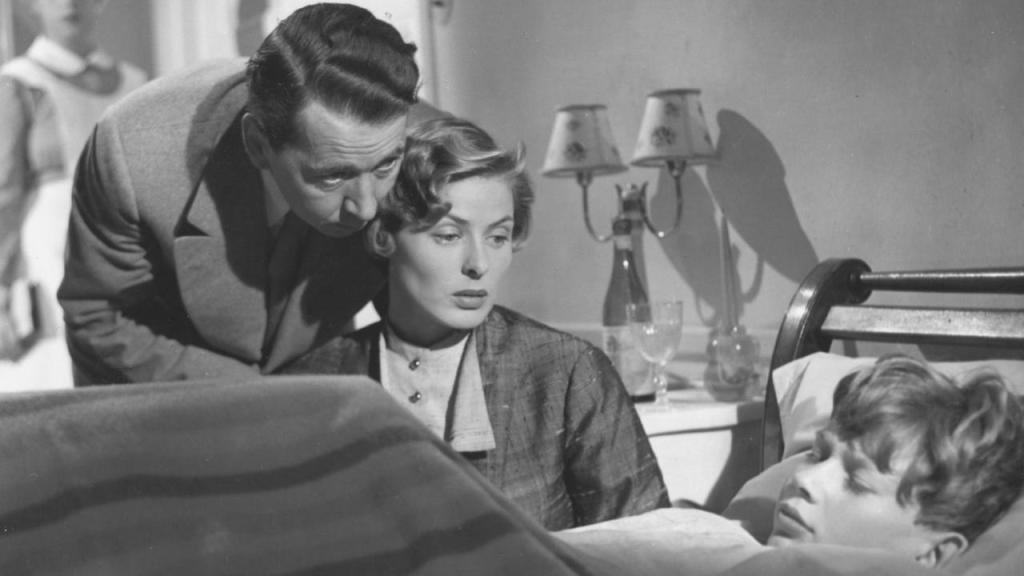
Of the greatest filmmakers, the one I know the least about is Roberto Rossellini. Today, I had a chance to view his Europa 51 (1952) and found it to be a masterpiece. For some reason, the great postwar Italian films (dubbed Neorealism) have, for some reason, faded from view. Included were films by Federico Fellini, Vittorio De Sica, Luchino Visconti, Giuseppe De Santis, and Roberto Rossellini.

The films I have seen by Rossellini dealt with the fragility of life in Italy as part of the aftermath of the Second World War. And, when you think of it, the problems for Italy really began in the early 1920s with the rise of Fascism and Benito Mussolini. By 1945, it was an exhausted nation.

In Europa 51, the Girards have a sullen twelve-year-old son who, to get attention, falls down a flight of stairs during a party. He seems to be recovering, but suddenly dies from a blood clot. The mother, Irene (Ingrid Bergman) suddenly finds her life at home as totally unfulfilling. With urging from a communist relative, she begins to try to help the miserable slum dwellers of Rome, one of whom is played by Giulietta Masina of La Strada fame.

As her marriage begins to fall apart, she gets committed to a mental institution. Abandoned by her upper middle class family, she is revered by the poor families she has helped.

Whereas in the United States, the postwar period saw growth and prosperity, much of Europe lay in ruins. Beginning with Rome, Open City (1945), Rossellini concentrated on the devastation with some films like Paisan (1946), Germany, Year Zero (1948), and Stromboli (1950). I think these films need to be seen, especially as we have developed a whole basket of myths surrounding World War Two and “The Greatest Generation” and other such rot.

If you were to read Tony Judt’s prizewinning history, Postwar: A History of Europe Since 1945, you would find that he begins with the horrors of the immediate postwar years in Europe. I was born in 1945, and I remember my mother sending packages to our relatives in Hungary, which were under a Stalinist Communist dictator in the early 1950s. When I visited Budapest in 1945, I saw a city that still had the bullet holes of not only the Hungarian Revolution of 1956, but the Nazi siege of the city at the end of the war.

How To Survive the Red Brigades

Kidnap Victim of Italy’s Red Brigades in the 1970s

I have just finished reading a fascinating novel by Rachel Kushner entitled The Flamethrowers. In it, the author describes a young woman named only Reno who races motorcycles on Utah’s Bonneville Salt Flats, gets involved in the New York art scene of the 1970s, and even winds up in the middle of a Red Brigades terrorist cell in Rome. She manages to survive by not letting herself get weighted down.

The following is from my review of the book on Goodreads:

The heroine, referred to only as Reno (from where she was born), is a young woman into motorcycle racing and art circa 1975. She goes to New York, where she gets into the art scene and gets involved with two men, Ronnie Fontaine (briefly) and Sandro Valera, scion of the Italian family that manufactures Moto Valera motorcycles.

Few reviewers, I thought, understood where the book title came from. At one point, Sandro’s father criticizes his son’s admiration of the Italian motorcyclists who went into battle during World War I with flamethrowers on their backs:

Flag of the Red Brigades

But then his father told him the flamethrowers were a hopeless lot. Their tanks were cumbersome and heavy and they were obvious and slow-moving targets and if they were ever caught they were shown no mercy. That’s not a thing you want to be, his father said, after which Sandro continued to love the flamethrowers best, to reserve for them a special fascination, in their eerie, hooded asbestos suit, the long and evil nozzle they aimed at enemy holdouts.

There are two related images to which the author refers. One is to native Brazilians who tapped the Valera-owned rubber trees carrying heavy stones so that their souls wouldn’t drift away. Another is to a would-be suicide Sandro saves from drowning in the East River: He had deliberately weighted himself down with multiple overcoats to facilitate his exit.

Reno carries no such weights. She doesn’t even seem to bear a last name. She goes through life without attaching herself irrevocably to someone who is too weighted down to survive in this world. At one point, she is in Italy among the Red Brigades, who were staging a mass demonstration with kidnappings. She moves through what is a terrorist cell without becoming weighted down with any of the ideology.

An interesting message from an interesting novelist.

A Villa on Capri

Italian Writer Curzio Malaparte’s Villa on Capri

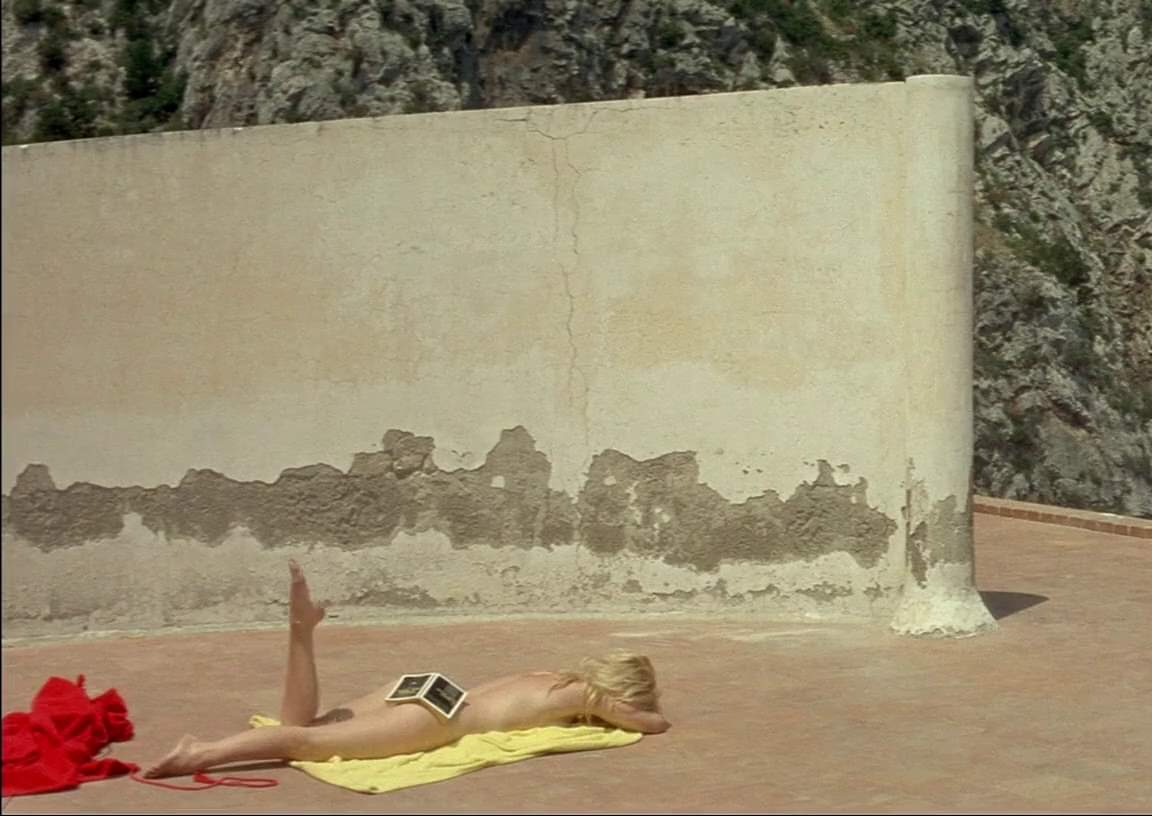
This is the story of a coincidence that I didn’t realize at the time (in the 1960s), but that I learned about much later as I became more well read. I will start with the film, Jean-Luc Godard’s Contempt (in French Le Mépris) filmed in 1963. Based on a 1954 novel by Alberto Moravia, known in the English world as either Contempt or A Ghost at Noon, the Godard film tells the tale of a marriage between a writer named Paul Javal (played by Michel Piccoli) whose marriage to his wife Camille (Brigitte Bardot) falls apart as Camille is used as bait an American film producer named Jeremy Prokosch (Jack Palance). The second half of the film was shot at a beautiful villa in Capri (shown above).

In the late 1960s, I thought the film one of the greatest ever made, largely because I was so impressed by the nude body of Brigitte Bardot. Now, I no longer think of it even as Godard’s best film. For that, I would now select either Alphaville or Pierrot le Fou, both made in 1965.

Brigitte Bardot Sunbathing on the Roof of Malaparte’s Villa in Contempt

Only much later did I learn that the villa featured in Contempt was actually the villa of a great—albeit twisted—Italian writer who called himself Curzio Malaparte (1898-1957). Born Curt Erich Suckert of a German father and an Italian mother, he chose the pen name Malaparte because it was the opposite of Napoleon’s family name: Malaparte means “bad side,” whereas Buonaparte means “good side.” And he tried in his works to live up to his pen name. If you are interested in acquainting yourself with his works, I suggest you read Kaputt (1944) about the German Eastern Front and The Skin (1949) about the American invaders of Italy in Naples.

Curzio Malaparte

Oh, and I still think you should see Godard’s Contempt. Even after all these years, Bardot’s derrière is still capable of inspiring lofty thoughts.