
Bukowski Had It Right

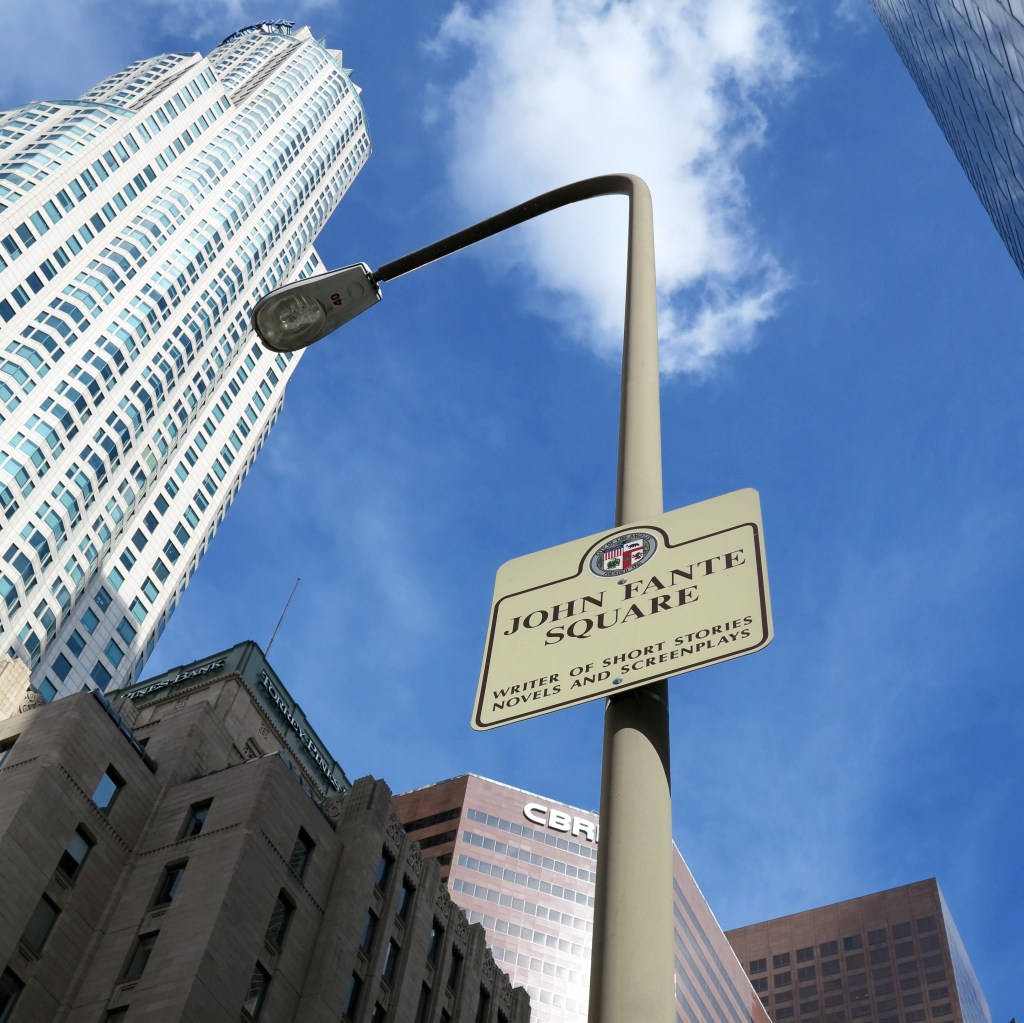
At the Corner of West 5th Street and South Grand in Downtown L.A.

It’s just outside the Central Library, a square (actually, just an intersection) dedicated to the Los Angeles writer John Fante (1909-1983). He is not well known outside of Los Angeles, In fact, he is not well known in Los Angeles either. Fortunately, Charles Bukowski made sure he was not forgotten:

I was a young man, starving and drinking and trying to be a writer. I did most of my reading at the downtown L.A. Public Library, and nothing that I read related to me or to the streets or to the people about me.”

Then one day I pulled a book down and opened it, and there it was. I stood for a moment, reading. Then like a man who had found gold in the city dump, I carried the book to a table. The lines rolled easily across the page, there was a flow. Each line had its own energy and was followed by another like it. The very substance of each line gave the page a form, a feeling of something carved into it. And here, at last, was a man who was not afraid of emotion. The humour and the pain were intermixed with a superb simplicity. The beginning of that book was a wild and enormous miracle to me.

This was in Bukowski’s introduction to the book he describes, John Fante’s Ask the Dust.

Having read four of Fante’s novels, I have to agree. I have just finished Dreams from Bunker Hill, the last of the novels featuring Arturo Bandini, the author’s stand-in for himself. Toward the end of his life, Fante became blind from diabetes; and he dictated the novel to his wife, Joyce.

As I find myself at the Central Library fairly often, I take some pleasure crossing John Fante square and remembering the writer who gave us an inimitable portrait of Los Angeles in his novels.

L.A. Writer: John Fante

John Fante, L.A. Novelist, Short Story Writer, and Scriptwriter

John Fante, L.A. Novelist, Short Story Writer, and Scriptwriter

This is a series about writers whose work is predominantly set in Los Angeles.Last Month, I wrote about Eve Babitz (who is still alive).  I am wondering whether to open this series up to people who came from other countries, such as Aldous Huxley or Raymond Chandler, who have written works that have added to the Southern California scene. Omitted will be writers like Nathanael West (The Day of the Locust) who are primarily oddities or one-shots.

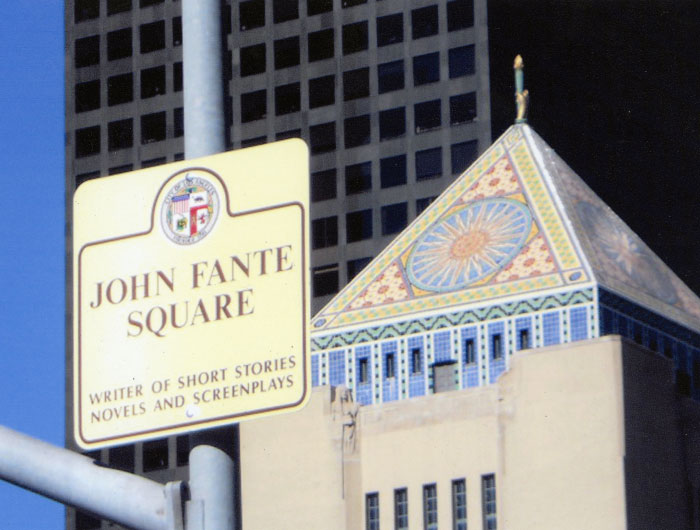
At the corner of West 5th Street and South Grand Avenue, hard by the Los Angeles Central Library, is a sign commemorating John Fante Square (see below), just on the edge of the old Bunker Hill neighborhood made famous by the writer’s Arturo Bandini novels. These include:

  • Wait Until Spring, Bandini (1938)
  • The Road to Los Angeles (1936, Published 1985)
  • Ask the Dust (1939)
  • Dreams from Bunker Hill (1982)

The best of them that I have read is Ask the Dust, which I finished reading this morning in the Central Library just outside the foot of Bunker Hill, where Fante and his hero Bandini lived.

Sign Commemorating John Fante Square with the Tower of the Central Library

Sign Commemorating John Fante Square with the Tower of the Central Library

Arturo Bandini wanted more than anything else to be a great writer, but we see him on the edge of poverty and trying unsuccessfully to find a love interest—in the worst possible way. His choice in Ask the Dust is a hophead Mexican waitress named Camilla Lopez with whom he has a love/hate relationship that ends badly. He is torn between his Italian Catholic upbringing and the glitzy Hollywood life of famous writers and film people.

It is in no way a Hollywood novel. In fact, Bandini and Lopez don’t even drive through Hollywood or have any interest in seeing films together.

Today, Bunker Hill is no longer a ghetto of cheap boarding houses; rather, it is full of high rise banks and corporate headquarters that tower over the lowlands of Downtown L.A. The old funicular, Angel’s Flight, which rises to the top of Bunker Hill from Hill Street across from the Grand Central Market is still in existence, though it is not presently in operation.

The life of John Fante has a particular interest for me because the end of his life was characterized by severe diabetes. In 1978, he went blind. Subsequently, he lost both of his legs to the disease. He died in 1983 at the age of 74.