
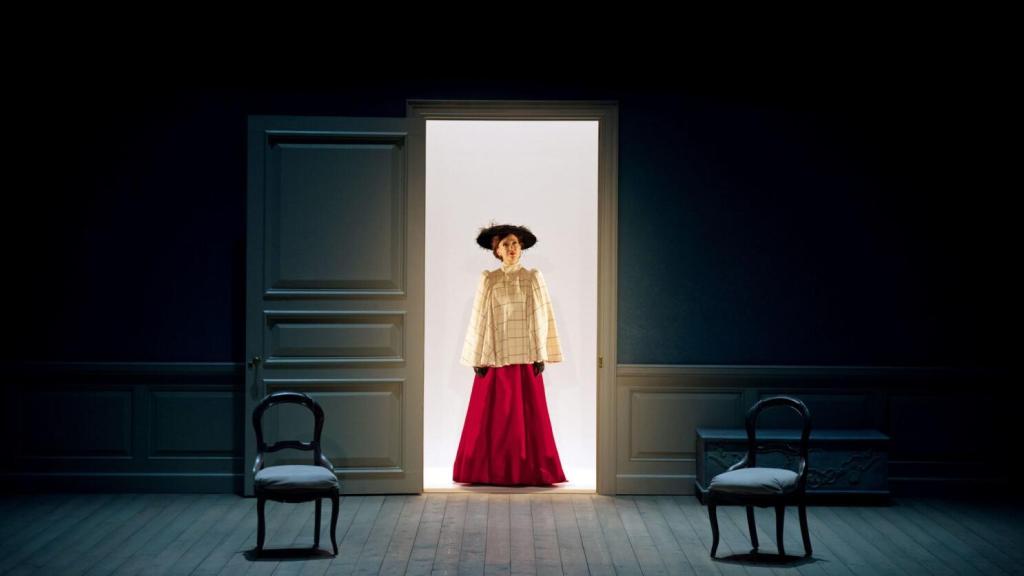
A New Ending for “A Doll’s House”

Nora Helmer Walking Out of Her Marriage

One of the characters in Kurt Vonnegut Jr’s Bluebeard has an interesting take on Henrik Ibsen’s play A Doll’s House, which ends shockingly (for its time) by the wife, Nora Helmer, walking out on her husband. Speaking is Marilee Kemp, with whom the artist Rabo Karabedian, is in love.

Her sense of her lace in the world back in 1933, with the Great Depression going on, revealed itself, I think, in a conversation we had about A Doll’s House, the play by Henrik Ibsen. A new reader’s edition of that play had just come out, with illustrations by Dan Gregory, so we both read it and then discussed it afterwards.

Gregory’s most compelling illustration showed the very end of the play, with the leading character, Nora, going out the front door of her comfortable house, leaving her middle-class husband and children and servants behind, declaring that she had to discover her own identity out in the real world before she could be a strong mother and wife.

. . .

That is how the play ends. Nora isn’t going to allow herself to be patronized for being as uninformed and helpless as a child anymore.

And Marilee said to me, “That’s where the play begins as far as I’m concerned. We never find out how she survived. What kind of job could a woman get back then? Nora didn’t have any skills or education. She didn’t even have money for food and a place to stay.”

. . .

That was precisely Marilee’s situation, too, of course. There was nothing waiting for her outside the door of Gregory’s very comfortable dwelling except hunger and humiliation, no matter how meanly he might treat her.

A few days later, she told me that she had solved the problem. “That ending is a fake!” she said, delighted with herself. “Ibsen just tacked it on so the audience could go home happy. He didn’t have the nerve to tell what really happened, what the whole rest of the play says has to happen.”

“What has to happen?” I said.

“She has to commit suicide,” said Marilee. “And I mean right away—in front of a streetcar or something before the curtain comes down. That’s the play. Nobody’s ever seen it, but that’s the play!”


The LA Times Book Festival

Book Dealers at the 2023 Los Angeles Times Book Festival

I have always loved attending the Los Angeles Times Book Festival at the University of Southern California (USC). Last year, Martine and I showed up; but I wasn’t feeling well, so we didn’t stick around for long. This year, I feel fine; and I intend to attend both days of the festival. Today was uncomfortably warm. Fortunately, the morning was comfortable. Around two in the afternoon, I took the E-Line back to West L.A.

As in previous festivals, I was most interested in the poetry readings, which are sponsored by Small World Books on the Venice Boardwalk. I listened to several readings, and after lunch I dropped in at the Kurt Vonnegut Library’s booth. (Kurt and I go way back, at least half a century since I first read Slaughterhouse Five.)

By the afternoon, the festival was starting to get too crowded. Morning is definitely the best time to attend. I hope to write several posts in the coming week describing my impressions.

The Eight Rules of Writing

Kurt Vonnegut (1922-2007)

Kurt Vonnegut (1922-2007)

I admire the simplicity of Kurt Vonnegut’s eight rules of writing, as set down below:

  1. Use the time of a total stranger in such a way that he or she will not feel the time was wasted. [Maybe this is the best rule of them all.]
  2. Give the reader at least one character he or she can root for.
  3. Every character should want something, even if it is only a glass of water.
  4. Every sentence must do one of two things—reveal character or advance the action.
  5. Start as close to the end as possible.
  6. Be a Sadist. No matter how sweet and innocent your leading characters, make awful things happen to them—in order that the reader may see what they are made of.
  7. Write to please just one person. If you open a window and make love to the world, so to speak, your story will get pneumonia.
  8. Give your readers as much information as possible as soon as possible. To hell with suspense. Readers should have such complete understanding of what is going on, where and why, that they could finish the story themselves, should cockroaches eat the last few pages.

Now these rules pertain almost exclusively to writing fiction. I wonder if I could adapt them to writing blogs. I’ll have to get back to you on that.


“Like Beads on a String”

Kurt Vonnegut

The most important thing I learned on Tralfamadore was that when a person dies he only appears to die. He is still very much alive in the past, so it is very silly for people to cry at his funeral. All moments, past, present and future, always have existed, always will exist. The Tralfamadorians can look at all the different moments just that way we can look at a stretch of the Rocky Mountains, for instance. They can see how permanent all the moments are, and they can look at any moment that interests them. It is just an illusion we have here on Earth that one moment follows another one, like beads on a string, and that once a moment is gone it is gone forever.

When a Tralfamadorian sees a corpse, all he thinks is that the dead person is in bad condition in the particular moment, but that the same person is just fine in plenty of other moments. Now, when I myself hear that somebody is dead, I simply shrug and say what the Tralfamadorians say about dead people, which is “So it goes.”—Kurt Vonnegut, Slaughterhouse Five