
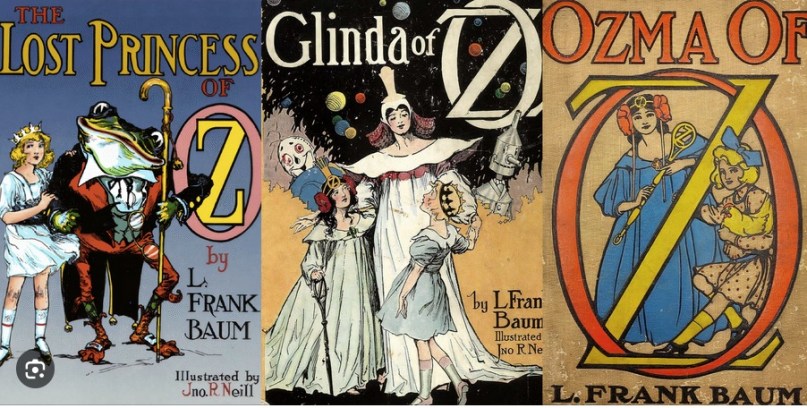
Original Covers of Three of L. Frank Baum’s Oz Books
It’s all well and good to read serious literature, but every once in a while it is good to return to the land of childhood. Why? It is a place where imagination rules, and we can all use a little childlike imagination to see us through the consequences of our bad decisions.
After reading a serious Russian novel (Eugene Vodolazkin’s The Aviator), I decided to read the sequel to L. Frank Baum’s The Wonderful Wizard of Oz, namely: The Marvelous Land of Oz. In all, Baum wrote some fourteen books set in the Land of Oz, and I intend to read all of them—even the ones I have read some decades ago.
In this second book of the series, there is no Wizard, no Dorothy, no Toto, and no Kansas. We do, however, encounter the Scarecrow and the Tin Woodsman and even the Good Witch Glinda. As Baum was no slave to precedent, he introduces several new characters: the boy Tip, Jack Pumpkinhead, an animated sawhorse, and others. There are in addition the moderately bad witch Mombi, the feminist General Jinjur, the Gump (an animated flying machine made of inanimate spare parts), and H. M. Woggle-Bug, T. E. (The H. M. is short for Highly Magnified, and T. E. refers to his being Thoroughly Educated.)
The closest thing to a villain is Mombi, who is allied with General Jinjur and his all-girl army to rule Oz after the Scarecrow and his friends are driven out. Jinjur’s army does not come across as much of a threat, as they are armed only with knitting needles.
I plan to read one Oz book per month until I have finished the series, which I have complete on my Kindle.
 Tarnmoor
You must be logged in to post a comment.