
Epiphanies: Borges’ Labyrinths

Jorge Luis Borges Story “Tlon, Uqbar, Orbis Tertius”

This is the first of a series of posts about literary works that got ,e started in becoming the person I am today. It all started with a New Yorker article around 1970 which introduced me to Latin American magical realism. I was enthralled, so I hunted up the two Jorge Luis Borges (1899-1986) books it mentioned: Labyrinths and Ficciones.

Borges really got me started on a quest that is still going strong more than half a century later. The first book I read was Labyrinths, and the first story in that collection was “Tlon, Uqbar, Orbis Tertius.” As soon as I read the following, I was on my way:

From the remote depths of the corridor, the mirror spied on us. We discovered (such a discovery is inevitable in the late hours of the night) that mirrors have something monstrous about them. Then [Argentinian writer Adolfo] Bioy Casares recalled that one of the heresiarchs of Uqbar had declared that mirrors and copulation are abominable, because they increase the numbers of men.

It turns out that Bioy Casares was quoting from a strange encyclopedia that the two of them decide to look up, but have difficulty finding, because different editions of the Anglo-American Cyclopedia have different articles.

I now own everything that Borges ever wrote that has been translated into English, and several in the original Spanish. Borges sent me in many directions. The next time, I will talk about how he turned me on to G. K. Chesterton.
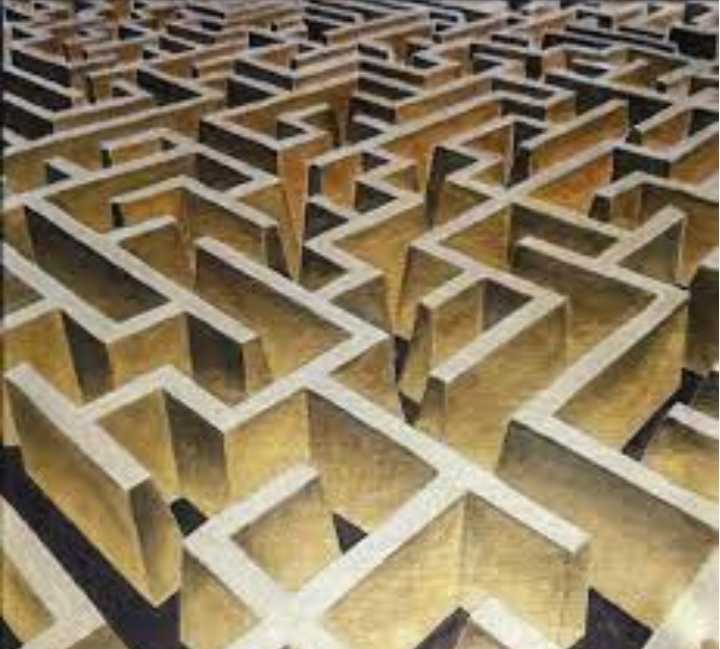

The Labyrinth

I keep returning to the poems of Jorge Luis Borges in the labyrinthine journey of my life. For over half a century, his writings have shone a strong light on my path forward. Several years after Borges died, John Updike translated his poem “The Labyrinth” and had it published in The New Yorker.

The Labyrinth

Zeus, Zeus himself could not undo these nets
Of stone encircling me. My mind forgets
The persons I have been along the way,
The hated way of monotonous walls,
Which is my fate. The galleries seem straight
But curve furtively, forming secret circles
At the terminus of years. And the parapets
Have been worn smooth by the passage of days.
Here, in the tepid alabaster dust,
Are tracks that frighten me. The hollow air
Of evening sometimes brings a bellowing,
Or the echo, desolate, of bellowing.
I know that hidden in the shadows there
Lurks another, whose task is to exhaust
The loneliness that braids and weaves this hell,
To crave my blood, and fatten on my death.
We seek each other. Oh, if only this
Were the last day of our antithesis!

Two Nightmares

In his collection Seven Nights (1984), Jorge Luis Borges wrote:

I have two nightmares that often become confused with each other. I have the nightmare of the labyrinth, which comes, in part, from a steel engraving I saw in a French book when I was a child. In this engraving were the Seven Wonders of the World, among them the labyrinth of Crete. I believed when I was a child (or I now believe I believed) that if one had a magnifying glass powerful enough, one could look through he cracks and see the Minotaur in the terrible center of the labyrinth. My other nightmare is that of a mirror. The two are not distinct, as it takes only two facing mirrors to construct a labyrinth. I always dream of labyrinths or of mirrors. In the dream of the mirror another vision appears, another terror of my nights, and that is the idea of the mask. Masks have always scared me. No doubt I felt in my childhood that someone who was wearing a mask was hiding something horrible. These are my most terrible nightmares: I see myself reflected in a mirror, but the reflection is wearing a mask. I am afraid to pull the mask off, afraid to see my real face.