“Worse Than Worthless”?

Tattooed Boy

Tattooed Boy

I tried to point out some of the cultural meanings of the vogue for tattooing. First, it was aesthetically worse than worthless. Tattoos were always kitsch, implying not only the absence of taste but the presence of dishonest emotion.

Second, the vogue represented a desperate (and rather sad) attempt on a mass scale to achieve individuality and character by means of mere adornment, which implied both intellectual vacuity and unhealthy self-absorption.

And third, it represented mass downward cultural and social aspiration, since everyone understood that tattooing had a traditional association with low social class and, above all, with aggression and criminality. It was, in effect, a visible symbol of the greatest, though totally ersatz, virtue of our time: an inclusive unwillingness to make judgments of morality or value.—Theodore Dalrymple

“A Frail Jetty Facing North”

Oedipus and Antigone

Oedipus and Antigone

What is unwisdom but the lusting after
Longevity: to be old and full of days!
For the vast and unremitting tide of years
Casts up to view more sorrowful things than joyful;
And as for pleasures, once beyond our prime,
They all drift out of reach, they are washed away.
And the same gaunt bailiff calls upon us all,
Summoning into Darkness, to those wards
Where is no music, dance, or marriage hymn
That soothes or gladdens. To the tenements of Death.

Not to be born is, past all yearning, best.
And second best is, having seen the light,
To return at once to deep oblivion.
When youth has gone, and the baseless dreams of youth,
What misery does not then jostle man’s elbow,
Join him as a companion, share his bread?
Betrayal, envy, calumny and bloodshed
Move in on him, and finally Old Age—
Infirm, despised Old Age—joins in his ruin,
The crowning taunt of his indignities.

So is it with that man, not just with me.
He seems like a frail jetty facing North
Whose pilings the waves batter from all quarters;
From where the sun comes up, from where it sets,
From freezing boreal regions, from below,
A whole winter of miseries now assails him,
Thrashes his sides and breaks over his head.—Sophocles, Oedipus at Colonus (Trans. Anthony Hecht)

Frenchness

French Girl

French Girl

Now, “Frenchness” may seem to be an intolerably vague idea, and it smells of related notions like Volksgeist that have acquired a bad odor since ethnography became polluted with racism in the 1930s. Nonetheless, an idea may be valid even if it is vague and has been abused in the past. Frenchness exists….[I]t is a distinct cultural style; and it conveys a particular view of the world—a sense that life is hard, that you had better not have any illusions about selflessness in your fellow men, that clear-headedness and quick wit are necessary to protect what little you can extract from your surroundings, and that moral nicety will get you nowhere. Frenchness makes for ironic detachment. It tends to be negative and disabused. Unlike its Anglo-Saxon opposite, the Protestant ethic, it offers no formula for conquering the world. It is a defense strategy, well suited to an oppressed peasantry or an occupied country.—Robert Darnton, The Great Cat Massacre and Other Episodes in French Cultural History

The Lion’s Share

Lion
Lion

A lion, an ass, and a fox entered into a partnership whereby they would share in common whatever they caught by hunting. When they got their prey, the lion ordered the ass to divide it. Stupid as he was, the ass divided it into three equal parts. Wherefore at once the lion, outraged that he was made equal with the others, attacked the ass and tore him to pieces. The fox was left; the lion ordered her to make the division anew; she gave almost all of the prey to the lion, keeping for herself only a few meager scraps. The lion approved the division and asked the fox who had taught her the art of dividing. The fox answered, “The fate of the ass.”—Erasmus, Adages

Unmoved by Crowds

Not for Me

Not for Me

I belong to that class of unhappy people who are not easily affected by crowd excitement. Too often I find myself sadly unmoved in the midst of multitudinous emotion. Few sensations are more disagreeable. The defect is in part temperamental, and in part due to that intellectual snobbishness, that fastidious rejection of what is easy and obvious, which is one of the melancholy consequences of the acquisition of culture. How often one regrets this asceticism of the mind! How wistfully one longs to rid oneself of the habit of rejection and selection, and to enjoy all the dear, obviously luscious, idiotic emotions without an after-thought. And indeed, however much we may admire the Chromatic Fantasia of Bach, we all of us have a soft spot somewhere in our minds that is sensitive to “Roses in Picardy.” But the soft spot is surrounded by hard spots, the enjoyment is never unmixed with critical disapprobation. The excuses for working up a communal emotion, even communal emotion itself, are rejected as too gross. We turn from them as a cenobite of the Thebaid would have turned from dancing girls or a steaming dish of tripe and onions.—Aldous Huxley, Complete Essays, Vol. I.

In Praise of Past Times

Roman Forum

Roman Forum

For several months now, I have been lifting quotes from a website called Laudator Temporis Acti, a blog site where I go to get inspired. And it never fails to do so. The Latin means, roughly, “One who praises past times.” About half of my long quotations are lifted bodily from the site, with the only acknowledgment being a tag at the end that reads laudator-temporis-acti.

Run by a scholar in Conyers, Georgia, by the name of Michael Gilleland, the website pays homage to the thinking of times past, from ancient Greece and Rome through the nineteenth century. Each quotation is well documented. When translation is necessary, an honest attempt is made to get to the gist accurately and, sometimes, elegantly.

Some people—my own brother included—think that I live in the past. If that were so, why would I be blogging here? Why would I own a cellphone? Why would I drive to work in an automobile? No, I like to investigate the past because nothing serves to help me understand the present than to see what is both constant and meritorious in the human condition. That’s why I am concurrently reading Marcus Tullius Cicero and William H. Prescott (History of the Conquest of Peru). Oh, I could be reading something contemporary about philosophy, but I probably wouldn’t understand it as easily as I could understand the Roman. And I can (and will) be reading contemporary books about Peru, but it was Prescott who originally got the ball rolling. Everything since published about the Inca owes a debt to the Harvard-educated historian of the 1800s. And no one has written on the subject more eloquently.

I don’t frequently recommend websites, and none do I recommend so whole-heartedly as Laudator Temporis Acti. I visit it several times a week and urge you to do so as well. Among other things, you will discover what William Faulkner did, that “the past is never dead. It’s not even past” (from his Requiem for a Nun).

Sir Walter Scott, Bookworm

Sir Walter Scott

Sir Walter Scott

He at this time occupied as his den a square small room, behind the dining parlour in Castle Street. It had but a single Venetian window, opening on a patch of turf not much larger than itself, and the aspect of the place was on the whole sombrous. The walls were entirely clothed with books; most of them folios and quartos, and all in that complete state of repair which at a glance reveals a tinge of bibliomania. A dozen volumes or so, needful for immediate purposes of reference, were placed close by him on a small moveable frame—something like a dumb-waiter. All the rest were in their proper niches, and wherever a volume had been lent, its room was occupied by a wooden block of the same size, having a card with the name of the borrower and date of the loan, tacked on its front. The old bindings had obviously been retouched and regilt in the most approved manner; the new, when the books were of any mark, were rich but never gaudy—a large proportion of blue morocco—all stamped with his device of the portcullis, and its motto, clausus tutus ero—being an anagram of his name in Latin. Every case and shelf was accurately lettered, and the works arranged systematically; history and biography on one side—poetry and the drama on another—law books and dictionaries behind his own chair. The only table was a massive piece of furniture which he had had constructed on the model of one at Rokeby; with a desk and all its appurtenances on either side, that an amanuensis might work opposite to him when he chose; and with small tiers of drawers, reaching all round to the floor. The top displayed a goodly array of session papers, and on the desk below were, besides the MS. at which he was working, sundry parcels of letters, proof-sheets, and so forth, all neatly done up with red tape. His own writing apparatus was a very handsome old box, richly carved, lined with crimson velvet, and containing ink-bottles, taper-stand, &c. in silver—the whole in such order that it might have come from the silversmith’s window half an hour before. Besides his own huge elbow chair, there were but two others in the room, and one of these seemed, from its position, to be reserved exclusively for the amanuensis. I observed, during the first evening I spent with him in this sanctum, that while he talked, his hands were hardly ever idle—sometimes he folded letter-covers—sometimes he twisted paper into matches, performing both tasks with great mechanical expertness and nicety; and when there was no loose paper fit to be so dealt with, he snapped his fingers, and the noble Maida aroused himself from his lair on the hearth-rug, and laid his head across his master’s knees, to be caressed and fondled. The room had no space for pictures except one, an original portrait of Claverhouse, which hung over the chimneypiece, with a Highland target on either side, and broadswords and dirks (each having its own story), disposed star-fashion round them. A few green tin-boxes, such as solicitors keep title-deeds in, were piled over each other on one side of the window; and on the top of these lay a fox’s tail, mounted on an antique silver handle, wherewith, as often as he had occasion to take down a book, he gently brushed the dust off the upper leaves before opening it. I think I have mentioned all the furniture of the room except a sort of ladder, low, broad, well carpeted, and strongly guarded with oaken rails, by which he helped himself to books from his higher shelves. On the top step of this convenience, Hinse of Hinsfeldt—(so called from one of the German Kinder-märchen )—a venerable tom-cat, fat and sleek, and no longer very locomotive, usually lay watching the proceedings of his master and Maida with an air of dignified equanimity; but when Maida chose to leave the party, he signified his inclinations by thumping the door with his huge paw, as violently as ever a fashionable footman handled a knocker in Grosvenor Square; the Sheriff rose and opened it for him with courteous alacrity,—and then Hinse came down purring from his perch, and mounted guard by the footstool, vice Maida absent upon furlough. Whatever discourse might be passing, was broken every now and then by some affectionate apostrophe to these fourfooted friends. He said they understood every thing he said to them, and I believe they did understand a great deal of it. But at all events, dogs and cats, like children, have some infallible tract for discovering at once who is, and who is not, really fond of their company; and I venture to say, Scott was never five minutes in any room before the little pets of the family, whether dumb or lisping, had found out his kindness for all their generation.—John G. Lockhart, Memoirs of the Life of Sir Walter Scott, Bart., Vol V


“The Divine Felicity of His Style”

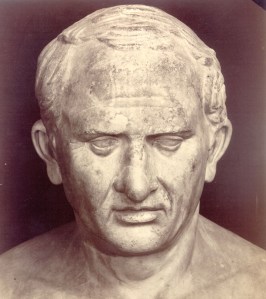
Marcus Tullius Cicero

Marcus Tullius Cicero

When I was a boy, I was fonder of Seneca than of Cicero, and till I was twenty years old could not bear to spend any time in reading him; while all the other writers of antiquity generally pleased me. Whether my judgment be improved by age, I know not; but am certain, that Cicero never pleased me so much when I was fond of those juvenile studies as he does now when I am grown old; not only for the divine felicity of his style, but the sanctity of his heart and morals: in short, he has inspired my soul, and made me feel myself a better man. I make no scruple, therefore, to exhort our youth to spend their hours in reading and getting his books by heart, rather than in the vexatious squabbles and peevish controversies with which the world abounds. For my own part, though I am now in the decline of life, yet as soon as I have finished what I have in hand, I shall think it no reproach to me to seek a reconciliation with my Cicero, and renew an old acquaintance with him, which for many years has been unhappily intermitted.—Erasmus, Letter #499 to Johannes Ulattenus

A Polish Poet Learns Latin

Zbigniew Herbert

Zbigniew Herbert

In my interest in Latin and my admittedly mediocre progress in that sphere there lay an element I might call personal. In the apartment building across the road from us there lived a young person, whose full shape, auburn hair, and dimples stirred my senses and gave me vertigo. She was the daughter of a Latin professor—not from our gymnasium, it is true, but known to us as the author of the book of adapted texts over which we labored; he also published articles in the monthly Philomat, to which Grzesio obliged us to subscribe through him. I used to sit on the balcony with my Auerbach & Dąbrowski Latin grammar and pretend that reading this exceptionally dull tome put me in ecstasy.

It was in fact an act of despair. If the object of my passionate feelings appeared on the balcony, it was not for my sake. She sometimes brushed me with a distracted look, as one glances at clouds moving across the sky. She was waiting for an older colleague of mine from the lyceum, a tall youth with a wavy blond crop, undeniably handsome (he was the standard-bearer of our school and wearing a sash and white gloves at celebrations he really did present well)—but I knew he could never make her happy. Every day around five in the afternoon she would leave the house with my mortal enemy and disappear around the corner into a little street shaded by chestnut trees, where (my feverish imagination told me) terrible things happened: he would take her arm (against the severest injunctions of the middle school rules) and perhaps press a fiery kiss on her silken glove. A storm of contradictory feelings in my tormented heart:

Odi et amo. Quare id faciam, fortasse requiris.
Nescio, sed fieri sentio et excrucior.

What did I think to achieve, holding my Auerbach & Dąbrowski Latin grammar on the balcony so that its cover would be visible from afar? I thought that one day her father—the classical philologist—would notice me and shout across to me: “I have been observing you for a while now, my boy. Your modesty and industry, your love for the Roman tongue are a warranty that you are a proper candidate for my daughter’s husband. I therefore grant you her hand.” And from then on things would proceed as in a fairy tale.

They didn’t. On the other hand, I learned many examples of the use of the more complicated grammatical forms by heart and was able to shine in class, even winning a cordial look from Grzesio.

We labored in the sweat of our brows. The time to reap drew near: the next year we were to proceed to the poetry of Catullus and Horace. But then the barbarians invaded.—Zbigniew Herbert, “A Latin Lesson,” Collected Prose

NOTE: Translated, the above Latin quote reads:

“I hate and I love. Why do I do it, perchance you might ask?
I don’t know, but I feel it happening to me and I’m burning up.”

The lines are from Catullus.

“A Heart-Breaking Shop”

Bookstore Window

Bookstore Window

But what were even gold and silver, precious stones and clockwork, to the bookshops, whence a pleasant smell of paper freshly pressed came issuing forth, awakening instant recollections of some new grammar had at school, long time ago, with “Master Pinch, Grove House Academy,” inscribed in faultless writing on the fly-leaf! That whiff of russia leather, too, and all those rows on rows of volumes, neatly ranged within—what happiness did they suggest! And in the window were the spick-and-span new works from London, with the title-pages, and sometimes even the first page of the first chapter, laid wide open; tempting unwary men to begin to read the book, and then, in the impossibility of turning over, to rush blindly in, and buy it! Here too were the dainty frontispiece and trim vignette, pointing like hand-posts on the outskirts of great cities, to the rich stock of incident beyond; and store of books, with many a grave portrait and time-honored name, whose matter he knew well, and would have given mines to have, in any form, upon the narrow shelf beside his bed at Mr Pecksniff’s. What a heart-breaking shop it was!—Charles Dickens, Martin Chuzzlewit