Jivaro Juice

Shrunken Heads from the Amazon

Shrunken Heads from the Amazon

I did not visit the Amazonian regions of Peru for two simple reasons:

  1. Mosquitoes and I do not get along well together
  2. I did not want to have my head shrunken like the two individuals above

Everything I know about shrunken heads—and many other subjects as well—come from a misspent youth reading Uncle Scrooge comics. In 1958’s “The Money Champ,” Scrooge McDuck is in competition with South African squajillionaire Flintheart Glomgold to see who has the most money. Unfortunately for the Duckburg millionaire, Flintheart has a supply of Jivaro Juice which he had obtained from head-hunting and -shrinking natives, and which he intends to use to shrink Scrooge’s money pile. In the following panel, Donald’s truck has been shrunk by the ruthless Glomgold:

What Jivaro Juice Did to Uncle Donald’s Truck

What Jivaro Juice Did to Uncle Donald’s Truck

The shrunken heads above come from Lima’s massive Museo Nacional de Arqueología, Antropología e Historia del Perú. Maybe next time I’ll visit the Amazon, but don’t count on it!


Where Did the Other 80% Go?

The Altar of La Merced Church in Lima

The Altar of La Merced Church in Lima

According to John Hemming’s excellent history, The Conquest of the Incas, only 20% of the gold went to the King of Spain. Where did the rest go? Pizarro and the conquistadores probably got the lion’s share, but after visiting dozens of Peruvian churches, I am beginning to think that the Church came in for a huge windfall, if not sooner, then later. You can see it at the Cathedral and San Pedro in Lima, in addition to the Church of the Company in Arequipa and the massive Cathedral in Cusco.

The first church I visited in Lima was La Merced on Jirón de la Union, whose altar is shown above. As I visited more and more churches, I saw the tons of gold and silver lavishly displayed, so much so that many of them are victims of larceny, such as the church at Maca at Colca Canyon. (Although stripped of much of its gold, it still looks impressive to me.) In the nearby church at Coporaque, I discovered a motion detector that tracked my movements in the nave with an audible beep.

Nowhere have I ever seen such a display of wealth. It is no surprise that many of the churches, such as the Cathedral at Cusco, have security personnel to protect the churches’ wealth.

There was another side to the splendor of the great Peruvian churches.

The Birthplace and Chapel of St. Martin de Porres in Lima

The Birthplace and Chapel of St. Martin de Porres in Lima

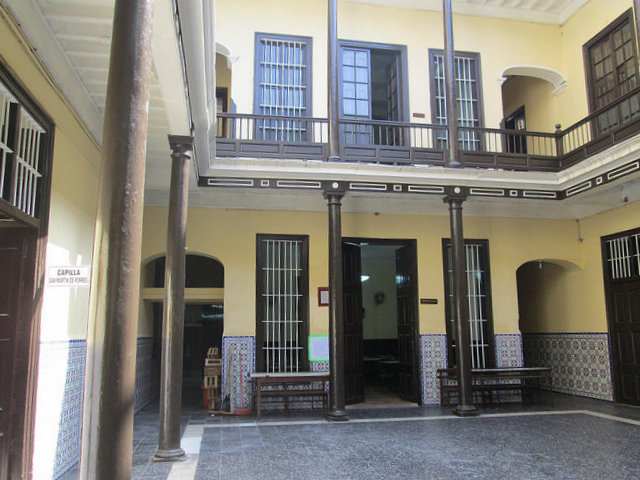
On Callao near the intersection with Tacna is the birthplace and chapel of St. Martin de Porres. The chapel is tiny (you can see the sign by the leftmost door) and contains only a prie dieu and a statue of the saint, along with a bin for prayer requests and another for contributions. The building also contains doctors’ offices and a cafeteria for the elderly poor of the neighborhood. In fact, when I was waiting for the building to open at 2:30 pm, I shared the doorway with one of the volunteers, a sweet lady who spoke little English, which added to my little Spanish, managed to allow us to communicate. Needless to say, I made a contribution.

I neglected to say that St. Martin de Porres was black and a descendent of slaves. The stories about his life have a certain sweetness to them, and he is much loved by the people of Lima.


Take the Bus to Callao?


Which Bus? Going Where and When? And Taking Which Route?

Which Bus? Going Where and When? And Taking Which Route?

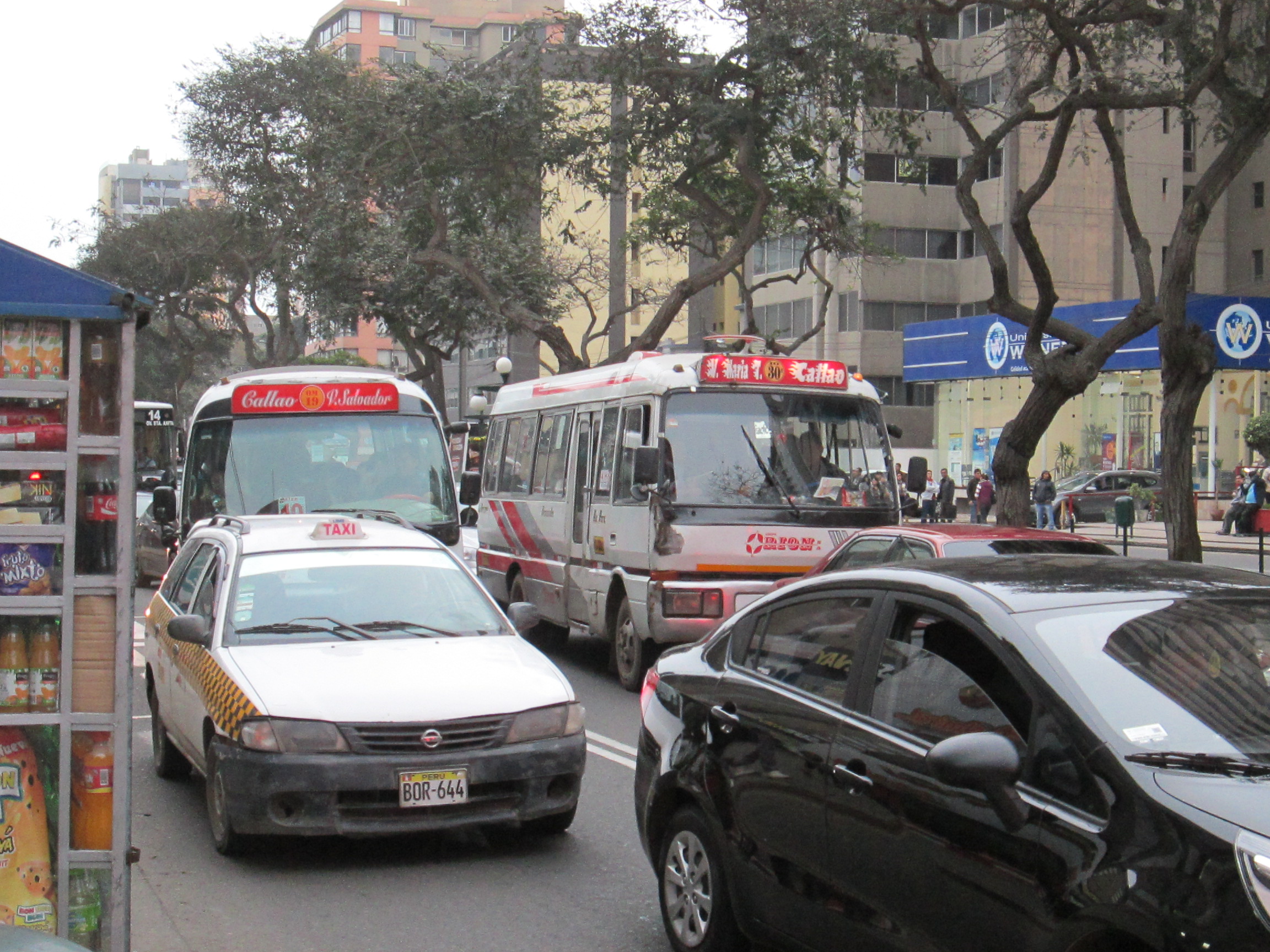
I enjoy taking public transportation in other countries, even in Argentina, which manages to make sense out of several hundred bus lines. But in Lima, you pretty much have to know in advance which bus to take. There is no handy-dandy website as in France or Iceland which makes you feel confident that you’ll get where you want to go.

The street above—Avenida Jose Pardo—is probably Lima’s most European-looking thoroughfare. Both of the above buses are going to Callao (pronounced Cah-YOW), Lima’s somewhat grungy seaport, and the location of its classy airport, but I could not find any body of information that helped me decide to take the bus.

Instead, I took cabs everywhere. Even an hour-long ride from the Plaza Major to Miraflores, where I was staying, in heinous rush hour traffic cost me only about 40 soles, or about $14-16. Although one has to be careful about taking an unregistered cab, one quickly becomes used to telling the difference. When approached by a tout, who wants to take you for a roundabout walk to his ramshackle vehicle, it is best to just say no and run like hell.

Most cabbies, however, were competent and friendly and drove newish cars. No one who takes pride in his vehicle is likely to “express kidnap” you and take you a series of ATMs, where you will be forced at gunpoint to drain your bank account(s). This practice is sometimes known as the “millionaires’ tour.” Trust me, this is one tour you don’t want to take.

In addition to taking cabs, I walked for miles in Lima, Cusco, Puno, and Arequipa. By evening, I was so tired that I had no trouble sleeping for nine or even ten hours.


Who Was More Civilized?

Moche Ceramics at Lima’s Museo Larco

Moche Ceramics at Lima’s Museo Larco

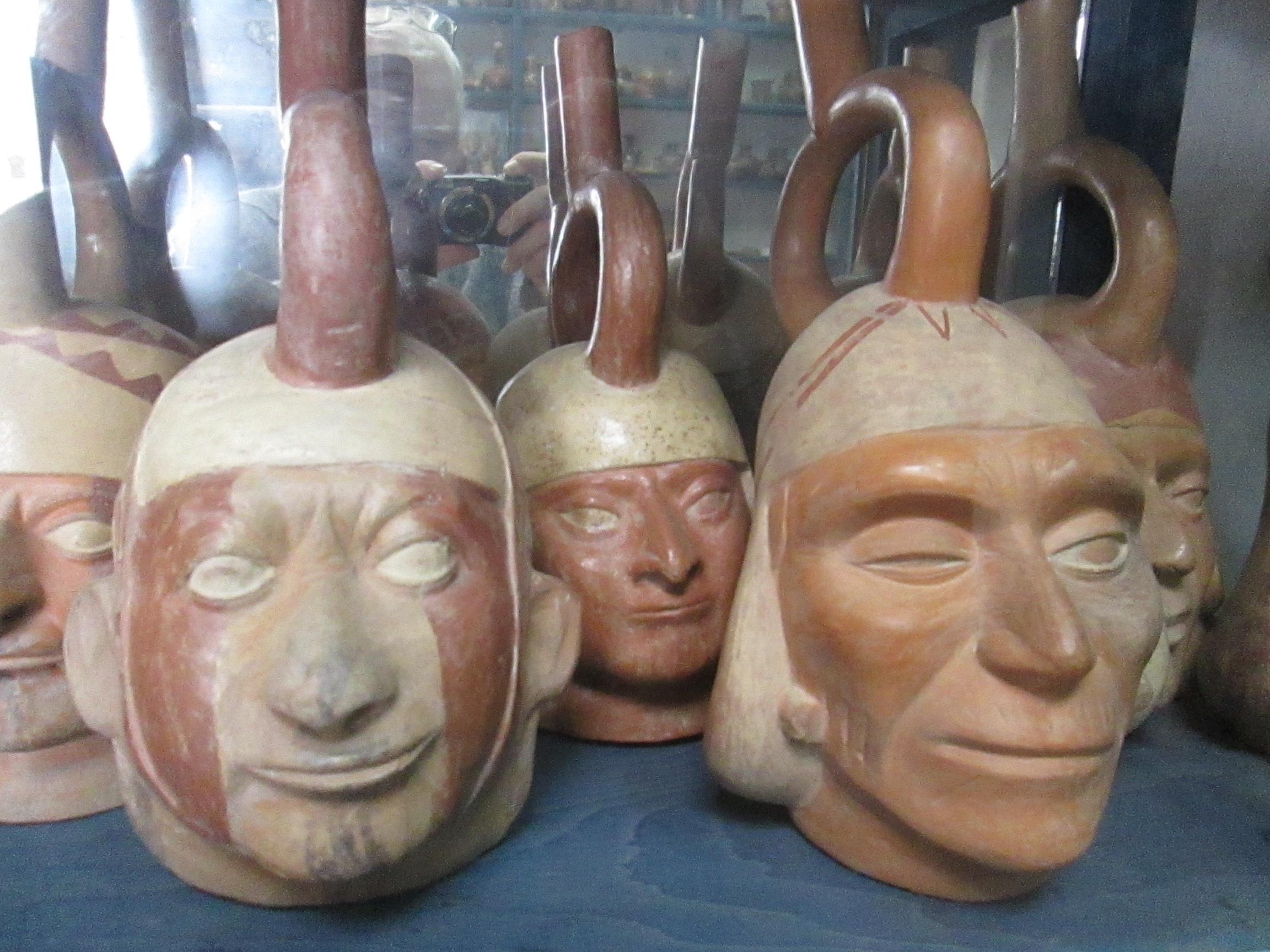
Who really was more highly civilized—the Incas or some of the peoples who preceded them? While it is unquestionable that the Incas were the greatest stonemasons and road builders, they could not hold a candle to the Moche in their artwork. Look at the faces above: They are remarkably individualized, especially the one to the right.

If you should find yourself in Lima, I would highly recommend a visit to the Museo Larco in Pueblo Libre. Dedicated primarily to Moche ceramics and metal-working, it is a phenomenal collection, originally put together by Rafael Larco Hoyle in Northern Peru. It is a delightful place to spend several hours, especially if one eats at the museum’s excellent restaurant. (Try the tiraditos.) After visiting the Museo Larco, you could follow the painted blue line on the sidewalk for some twenty minutes or so and end up at the Museo Nacional de Arqueología Antropología e Historia del Perú, with its excellent exhibition on the Paracas Culture.

The Incas were, in their time, an up-and-coming military power that conquered most of Peru, Bolivia, Ecuador, and parts of Chile. In the process they supplanted many talented peoples who were set to working raising crops and building roads and structures. Gone forever were the brilliant ceramics. Fortunately, enough was left to leave a brilliant picture of a culture that flourished from 100 to 800 AD, centuries before the Inca rose to power.


On Foot in Lima

I finally made it to Lima, where I am staying at the Antigua Miraflores Hotel. Because no one sleeps well on a long flight—regardless of what they may claim—I am a bit groggy. All the more so as I have just made the acquaintance of the Peruvian national drink, the Pisco Sour, a brandy and egg white cocktail that is as smooth as a baby’s bum.

Today was dedicated to cleaning up loose ends. I got lost several times, and I covered approximately ten miles on foot, but I did manage to

  • Locate the South American Explorers, which had moved a mile from its old 135 Piura adress.
  • Obtain my train ticket for the Andean Explorer route between Puno and Cusco
  • Buy some prescription meds over the counter that my pharmacy muffed back in Los Angeles

Tomorrow, I visit the Museo Larco and the National Museum of Anthropology, which should pretty much take up the whole day.


The Cloud-Covered City of the Kings

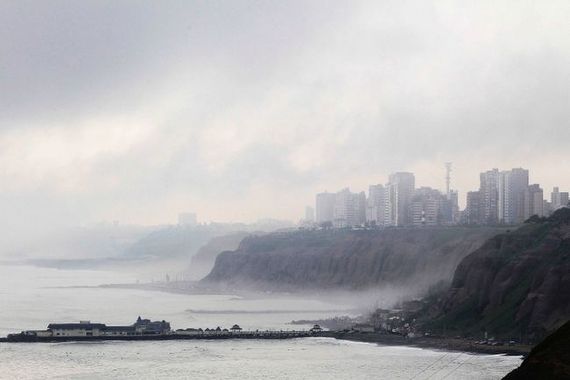
The Garúa Investing the Coastline of Lima

The Garúa Investing the Coastline of Lima

Just because Peru is a few degrees south of the Equator doesn’t mean the sun is always shining. In fact, from June through November, a warm wind interacting with the cold Humboldt current results in a condition around Lima locally referred to as la garúa. As one American expat describes it:

It is more than a fog, less than a rain. It is the heavy mist that sometimes appears in the winter in Lima. The locals call it la garúa, a sea mist caused by warm winds interacting with the cool water of the ocean. It is a condition found usually from June through November along the Peruvian Coast.

Arriving in Lima as I am in September, I will be in the Peruvian equivalent of March (subtract six from the ninth month of the year), which means it will still be winter. That will be fine with me, because I abhor hot weather. I expect Lima will be similar to our spring marine layers in Los Angeles that we usually refer to as “June Gloom.”

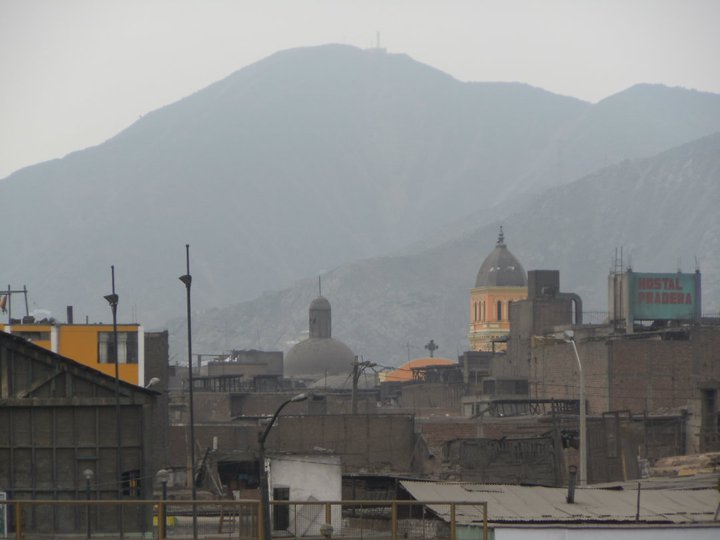
Here is another view, taken from the historic center of the City of Kings:

Foothills of the Andes from Central Lima

Foothills of the Andes from Central Lima

It will be a challenge to me as a photographer to make my scenic views interesting, but it will be fun. Once I leave Lima, I will be in the bright sunny mountains with their spectacular clouds.