Nisei Week in Little Tokyo

Japanese Tea Ceremony

This morning, Martine and I took the E-Train downtown to Little Tokyo. It was the beginning of Nisei Week, and there were some interesting events and exhibits to experience.

We had not attended Nisei Week since before the Covid-19 lockdown, so we were surprised by the smaller crowds and the obvious cutbacks. There were no events in the large Japanese American Cultural and Community Center (JACCC) courtyard. Some dozen years or so ago, I remember fondly seeing a program of five films starring Raizo Ichikawa at the center’s Aratani Theatre. This year, there were no film programs, no musical programs.

On the plus side, there was a fascinating Japanese tea ceremony. Martine did not know what she was missing when she decided not to attend. The forty-five minute program included a re-enactment of the tea ceremony in a little wooden tea house on the ground floor of the JACCC. There is something about the ritual and multiple exchange of bows that is somehow close to the very soul of the Japanese. And, at the end of the ceremony, we were given some excellent matcha tea and a Japanese sweet.

On the ground floor of the center, we saw a beautiful flower arrangement exhibit. I could kick myself for forgetting to bring my camera, because some of the arrangements were highly artistic; and there was even enough light in the room to make good pictures without flash.

On the fifth floor, we also saw an exhibit of Japanese dolls (not my cup of tea) and ceramics.

After the JACCC events, we trudged to Weller Court and had a so-so Chinese meal until such time as the karate event at the Terasaki Budokan gymnasium on Los Angeles Street was to start. Most of the event was like watching people do calisthenics, except for the team match-ups where there was something that looked like real fighting. There were teams from Japan, the United States, France, and Canada—and that was the order in which they finished.

Some of the Japanese participants were really fierce and fun to watch.

Will we go again next year? Probably not, but we’ll check first to see what they’ll have to offer.
On the Mean Streets of DTLA

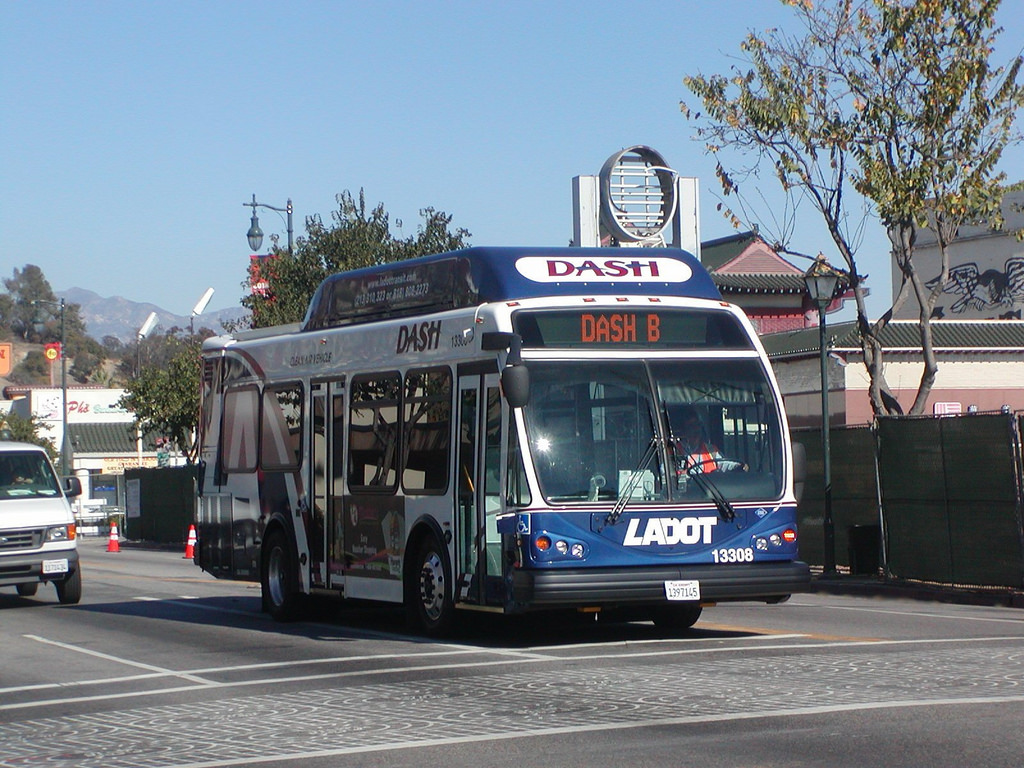
The Dash B Bus to Chinatown

The Dash B Bus to Chinatown

Today, as usual, I took the Expo Line train to downtown L.A. (or DTLA), as it is being called colloquially. It was a strange ride: During the last half hour of the trip, a black passenger was loudly swearing at and berating the woman he was with, and cursing at everything and everyone else along the way. The other passengers just became ever more absorbed in their reading or their smart phones. They did not want to draw any irate loony-bird attention to themselves.

When we pulled into the 7th Street Metro terminal, I made a beeline for the Central Library. I returned all the books I had checked out and took the elevator to the third floor Literature and Fiction section, where I spent a couple hours reading James Ellroy’s Blood on the Moon, the first volume of an early trilogy featuring Detective Sergeant Lloyd Hopkins of LAPD Homicide.

Just before 12:30, I made my way to Conference Room A for my weekly Mindful Meditation class, taught by Giselle Jones of the Mindful Awareness Research Center at UCLA. I have become dependent on these weekly sessions to help keep my feet on the ground. Also, they give me a feeling of tranquillity which lasts for hours.

After the session, I grabbed the Dash B bus to 1st Street, where I was planning to transfer to the Dash A bus to Little Tokyo. Opposite me on the sideways bench seating was a slim young barefoot black woman who was stunningly beautiful. She seemed to be looking straight at me and talking, but I never could understand what she was trying to say; and she got off after a couple of stops.

In Little Tokyo, I made my way to Weller Court, where there were a number of Japanese restaurants. I had a bowl of spicy chashu ramen at the Hot Pot Galaxy and walked over to the Kinokuniya Bookstore, where I bought a book by the Dalai Lama.

From Little Tokyo, I made my way to the Santa Monica Rapid 10 bus stop opposite Union Station and waited the usual maximum time for the next bus to appear. I was dropped off at Bundy and Idaho, from where I walked back to my apartment.


DTLA

Los Angeles’s Central Library on 5th Street & Hope

Los Angeles’s Central Library on 5th & Flower

On Thursdays, I find myself taking the Expo Line Train into downtown Los Angeles, or as the locals call it, DTLA. Before the free mindful meditation classes at 12:30 (taught by UCLA’s Mindful Awareness Research Center—or MARC), I spend a couple hours reading in the literature and fiction center on the third floor. Then I make my way to lunch at one of several locations: Chinatown, Olvera Street, Little Tokyo, or the Grand Central Market on Broadway. Sometimes I stop at the Last Bookstore at 5th and Spring. When the afternoons are hot, as it was today, I return by the air-conditioned Santa Monica Bus Line Rapid 10 Freeway Flyer, which lets me off a block from home.

Since I started exploring the downtown area, I have gotten a better, more favorable feel for the city in which I live. LADT is nowhere near as white bread as the outlying areas, and there are interesting ethnic enclaves scattered about.

When it gets a little cooler, I hope to wander farther afield, perhaps taking in bits of Koreatown and Filipinotown.


Ginza West

Christmas Tree at Japanese Village Shopping Center

Christmas Tree at Japanese Village Plaza

Before ascending the foothills to visit my friend Bill Korn in his Altadena mountain fastness, Martine and I stopped in Little Tokyo for lunch. As usual, we ate at the Suehiro Cafe on First Street. Both of us had bento box lunches (the Okonomi Plate) with miso soup and a choice of optional mains and sides as shown on the menu. Then we walked over to the Kinokuniya Bookstore on Weller Court where—miraculously—I didn’t buy any books or samurai films on DVD. Then, we went over to the Yamazaki Bakery at the Japanese Village Plaza. As a diabetic, I was only able to watch as Martine bought some tiramisu for herself and strawberry cream puffs for Bill and Kathy Korn.

Had we the time and inclination, we could also have visited several other adjacent Japanese shopping centers, two Buddhist temples, dozens of gift shops and food stores, and the Japanese-American National Museum. There is also the Japanese American Cultural & Community Center, where one delirious day I once saw four consecutive Raizo Ichikawa films, including one of the now hard-to-see Kyoshiro Nemuri samurai films directed by Kazuho Ikehiro.

Immersing ourselves in another culture is one of the most fun things to do in Los Angeles. My interest in the Southern California Japanese began early, in 1967, when I lived in a little Japanese neighborhood off Sawtelle Boulevard in West Los Angeles. Around the same time, I started going by bus to the Toho La Brea Theater to see Hiroshi Inagaki’s Samurai trilogy and all the latest films from Akira Kurosawa. As I made more friends in the film department at UCLA, I discovered four other Japanese cinemas in the area: the Kokusai and Sho Tokyo (both running films exclusively from Daiei Studios), the Kabuki (Shochiku Studios), and the Linda Lea (Tohei). We used to eat at the old Ichiban Cafe at the corner of First Street and San Pedro Street.

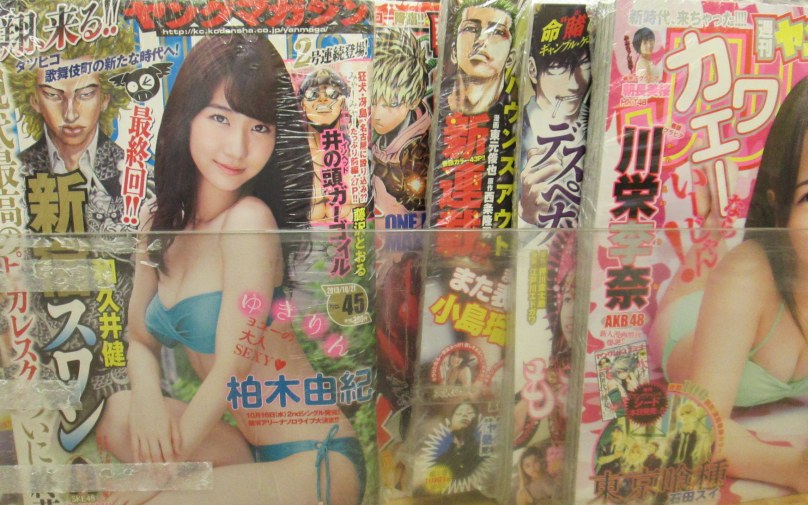
Japanese Magazines at the Kinokuniya Bookstore

Japanese Magazines at the Kinokuniya Bookstore

There are a number of other ethnic neighborhood concentrations in Southern California. The largest are probably the Mexican neighborhood in “East Los” (East Los Angeles) and Boyle Heights; the sprawling Koreatown along Olympic Boulevard as it approaches downtown; and Little Saigon in Orange County. Then there are the Central Americans in Pico-Union, the Armenians in Glendale, and the Russians in Hollywood and West Hollywood. And those are just the ones I’ve visited!