“A Great Earthquake”

In his novel Dombey and Son (1848), Charles Dickens had a striking passage about the effect that railroad construction was having on parts of London. I remember this passage vividly from when I first read the book decades ago.

The first shock of a great earthquake had, just at that period, rent the whole neighbourhood to its centre. Traces of its course were visible on every side. Houses were knocked down; streets broken through and stopped; deep pits and trenches dug in the ground; enormous heaps of earth and clay thrown up; buildings that were undermined and shaking, propped by great beams of wood. Here, a chaos of carts, overthrown and jumbled together, lay topsy-turvy at the bottom of a steep unnatural hill; there, confused treasures of iron soaked and rusted in something that had accidentally become a pond. Everywhere were bridges that led nowhere; thoroughfares that were wholly impassable; Babel towers of chimneys, wanting half their height; temporary wooden houses and enclosures, in the most unlikely situations; carcases of ragged tenements, and fragments of unfinished walls and arches, and piles of scaffolding, and wildernesses of bricks, and giant forms of cranes, and tripods straddling above nothing. There were a hundred thousand shapes and substances of incompleteness, wildly mingled out of their places, upside down, burrowing in the earth, aspiring in the air, mouldering in the water, and unintelligible as any dream. Hot springs and fiery eruptions, the usual attendants upon earthquakes, lent their contributions of confusion to the scene. Boiling water hissed and heaved within dilapidated walls; whence, also, the glare and roar of flames came issuing forth; and mounds of ashes blocked up rights of way, and wholly changed the law and custom of the neighbourhood.

In short, the yet unfinished and unopened Railroad was in progress; and, from the very core of all this dire disorder, trailed smoothly away, upon its mighty course of civilisation and improvement.

But as yet, the neighbourhood was shy to own the Railroad. One or two bold speculators had projected streets; and one had built a little, but had stopped among the mud and ashes to consider farther of it. A bran-new Tavern, redolent of fresh mortar and size, and fronting nothing at all, had taken for its sign The Railway Arms; but that might be rash enterprise—and then it hoped to sell drink to the workmen. So, the Excavators’ House of Call had sprung up from a beer-shop; and the old-established Ham and Beef Shop had become the Railway Eating House, with a roast leg of pork daily, through interested motives of a similar immediate and popular description. Lodging-house keepers were favourable in like manner; and for the like reasons were not to be trusted. The general belief was very slow. There were frowzy fields, and cow-houses, and dunghills, and dustheaps, and ditches, and gardens, and summer-houses, and carpet-beating grounds, at the very door of the Railway. Little tumuli of oyster shells in the oyster season, and of lobster shells in the lobster season, and of broken crockery and faded cabbage leaves in all seasons, encroached upon its high places. Posts, and rails, and old cautions to trespassers, and backs of mean houses, and patches of wretched vegetation, stared it out of countenance. Nothing was the better for it, or thought of being so. If the miserable waste ground lying near it could have laughed, it would have laughed it to scorn, like many of the miserable neighbours.
An Embarrassment of Riches

Is This the Attic of Western Civilization?

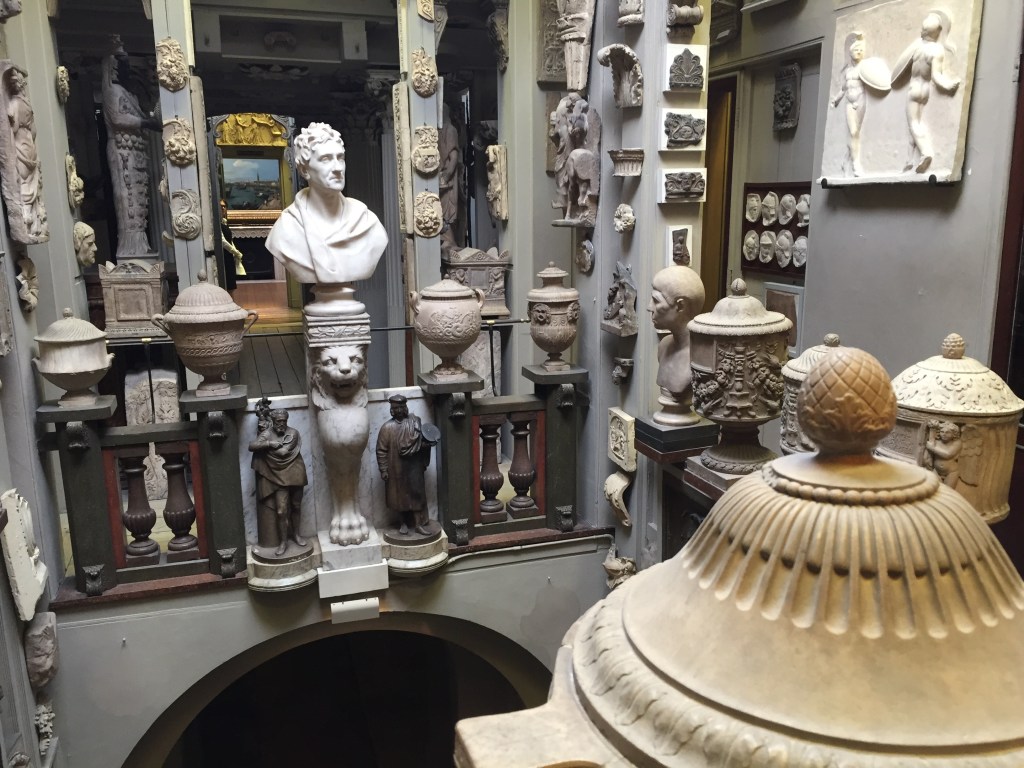
If I were asked to pick my favorite museum, I would have a hard time deciding; but I might very well end up by picking Sir John Soane’s Museum by Lincoln’s Inn Fields in London. Each time I have visited London, I have spent time marveling at the collections represented, whether of Egyptian, Greek, or Roman antiquities or 18th century paintings.

The original Sir John Soane (1753-1837) was the architect who designed the Bank of England, Not the present one, but the old one that was demolished in the 1920s. While I cannot comment on Soane’s skills as an architect, I am nothing short of amazed by Soane the art collector.

Walk through the museum, and it’s as if you were carefully edging your way through an overcrowded attic—except that Soane was no mere hoarder. He is, as it were, at the very pinnacle of a cultivated English artist circa 1800.

Paintings and Sketches Line the Walls from Floor to Ceiling

And I mean English with a vengeance. You would not find anything like this in France. The story of how the museum came to be is archetypally English (quoted from Wikipedia):

The museum was established during Soane’s own lifetime by a private Act of Parliament … in 1833, which took effect on Soane’s death in 1837. The act required that No. 13 [Lincoln’s Inn Fields] be maintained “as nearly as possible” as it was left at the time of Soane’s death, and that has largely been done. The act was necessary because Sir John had a living direct male heir, his son George, with whom he had had a “lifelong feud” due to George’s debts, refusal to engage in a trade, and his marriage, of which Sir John disapproved. He also wrote an “anonymous, defamatory piece for the Sunday papers about Sir John, calling him a cheat, a charlatan and a copyist.”

Oh, you can view the changing of the guards at Buckingham Palace, ride in giant Ferris Wheel in Greenwich, visit the British Museum, but nowhere else could you see the odd genius of a single human being—one who left us a Pisgah view of the 18th century.

Check out the museum’s website if you have a few minutes.

London Circa 1700

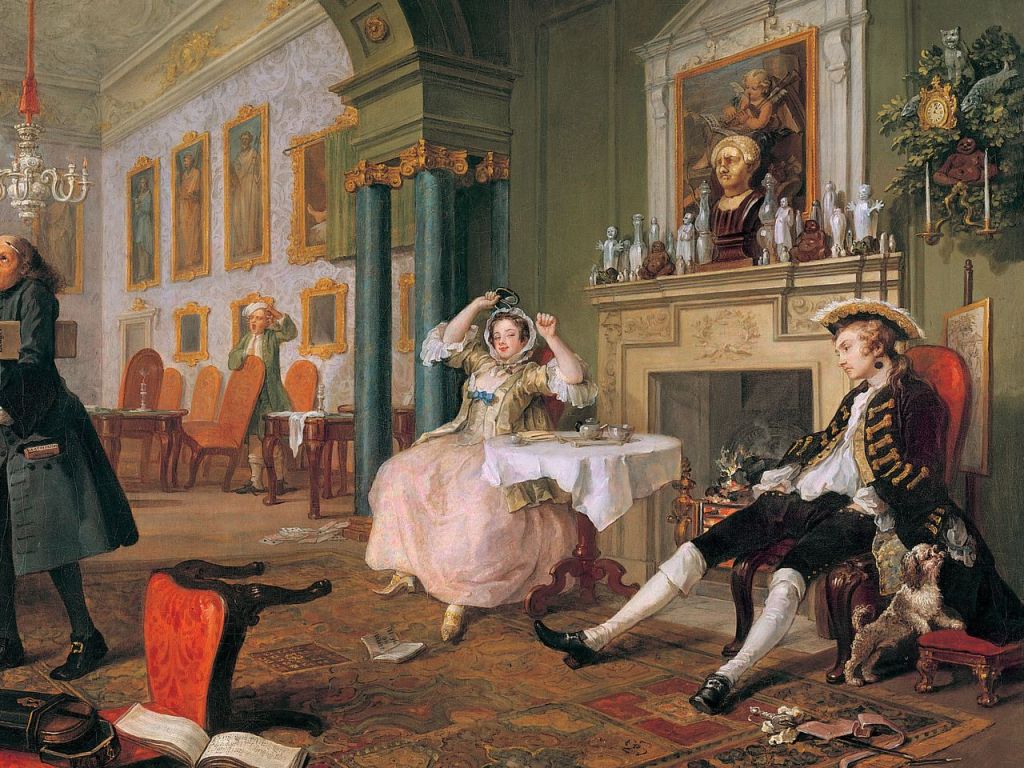
Detail from ‘The Tête à Tête,’ a painting from William Hogarth’s series ‘Marriage A-la-Mode’ (1743-45)

I have always had a love for Eighteenth Century Literature. It stems from the time I had a course in the novel of the period taught by my favorite professor at Dartmouth, the late Chauncey Chester Loomis. Swift not only wrote great prose, as vouched by Gulliver’s Travels and a slew of essays, but he was a formidable poet as well. The following poem gives us a feeling for the period in much the same way that James Boswell’s London Journal does.

A Description of the Morning

Now hardly here and there a hackney-coach
Appearing, show'd the ruddy morn's approach.
Now Betty from her master's bed had flown,
And softly stole to discompose her own.
The slip-shod 'prentice from his master's door
Had par'd the dirt, and sprinkled round the floor.
Now Moll had whirl'd her mop with dext'rous airs,
Prepar'd to scrub the entry and the stairs.
The youth with broomy stumps began to trace
The kennel-edge, where wheels had worn the place.
The small-coal man was heard with cadence deep;
Till drown'd in shriller notes of “chimney-sweep.”
Duns at his lordship's gate began to meet;
And brickdust Moll had scream'd through half a street.
The turnkey now his flock returning sees,
Duly let out a-nights to steal for fees.
The watchful bailiffs take their silent stands;
And schoolboys lag with satchels in their hands. 

Kennel is a gutter or drain
Brickdust Moll is a street vendor selling powdered brick, used for cleaning knives

Boswell’s Clap

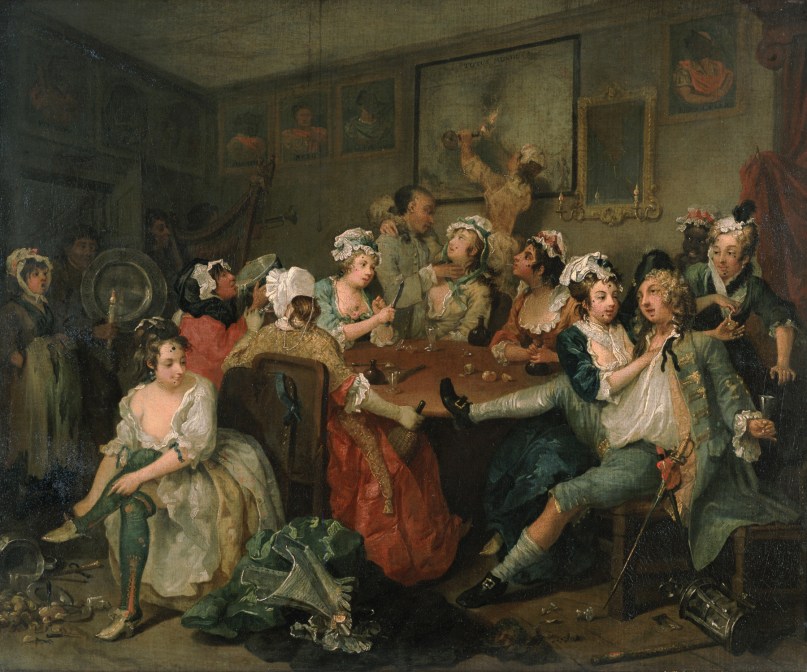
A Scene from William Hogarth’s The Rake’s Progress

I have been reading James Boswell’s London Journal 1762-1763. Inasmuch as I thought Boswell’s Life of Samuel Johnson LLD was one of the greatest books ever written, I thought it a shame that I had not read more of the great biographer.

At the time, Boswell was in his early twenties. His father, Lord Auchinlech (pronounced Affleck), had insisted that his son become a lawyer or merchant. Instead, James wanted to become an officer of the Guards, stationed in London. I am currently halfway through the book. Boswell spent many an anxious hour trying to win the patronage of powerful Scottish lords of the King’s party currying favor to this end. But, alas, no one went out of his way to help him.

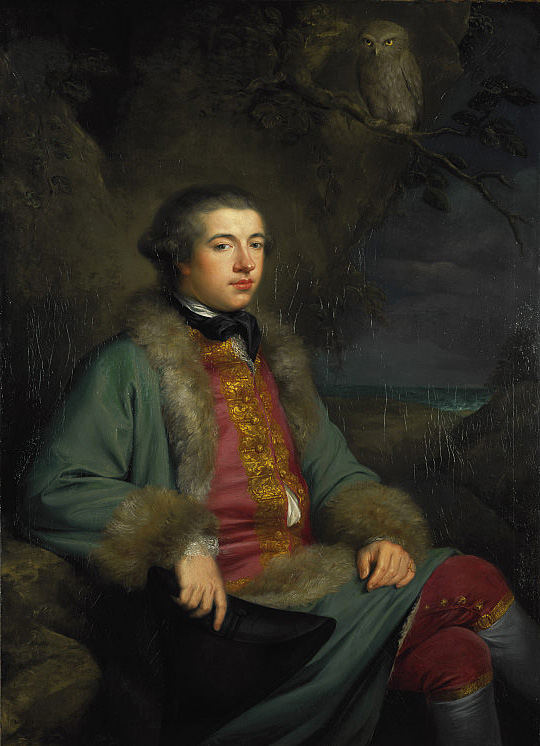
James Boswell (1740-1795)

What the young Scot found was a stubborn case of gonorrhea contracted from a pretty young actress whom he code-named Louisa. He built up to the affair with many weeks of visitations and gifts, only to come down with the clap for the third time in his life.

When he discovered he had been infected, Boswell mused about the effect his cure would have on his daily journal:

What will now become of my journal for some time? It must be a barren desert, a mere blank. To relate gravely that I rose, made water, took drugs, sat quiet, read a book, saw a friend or two day after day, must be exceedingly poor and tedious. My journal must therefore, like the newspapers, yield to the times.

Sounds like the coronavirus quarantine, doesn’t it?

Boswell’s journal makes for excellent reading. It shows its author to be an ambitious and randy young man who delights in conversation, especially with his fellow Scots. I can see myself making several more posts based on or inspired by this excellent book.

What, Me, Getting Lost?

This Image Is Practically Engraved in My Memory

Apparently, I have this phobia of getting lost. When my brother and I were in Ecuador last October, we could not find any street atlases; though, it wouldn’t have done us any good if we had them, because outside the central tourist area of the cities, there were no street signs. Dan made fun of me for my meltdowns when we wandered off what maps we had. There mus have been an incident in my childhood when getting lost from my Mommy and Daddy terrified me. I wrote a blog about this entitled Where the Streets Have No Name.  (Sorry, Edge and Bono!)

Where this is all leading to is a dream I had last night. I was traveling alone in the City of London. Having been there five or six times and having expended fierce amounts of shoe leather each time, I have a good picture of the city permanently resident in my head. I was trying to find a bookstore near Charing Cross Road, but had no idea where I was. And, even more peculiar, there did not appear to be any Underground or Tube stations on the inadequate map I had.

I had had some sort of meeting and was wandering around the city with some of the participants. At one point, they decided to stop and have an impromptu cricket match, which fortunately did not last long. When they stopped, we kept wandering in an easterly direction, coming on a square with a large Catholic church and a troupe of nuns ministering to the need of a large bump encampment. I thought to myself, “Gee, I had no idea there were so many bums in London.”

In the end, the dream just came to a stop. (Did I wake up at that point?) Although I jnever got to my bookstore nor to any other recognizable monument or building, I was more perplexed than terrified.

Thi9s is not the first time I got lost in my dreams. In none of them did my reaction rise to nightmare levels, but it is an interesting recurring theme—sort of like having to give a public speech while buck naked.


Dreaming of … London?

50327110. Tulum, QRoo.- Los voladores de Papantla y los Guerreros Mayas, dan la bienvenida a los más de dos mil turistas locales, nacionales y extranjeros, que día a día visitan la zona arqueológica, que es de un kilómetro, donde algunos prefirieren hacerlo caminando o existe a su disposición un pequeño transporte en forma de tren. NOTIMEX/FOTO/FRANCISCO GÁLVEZ/COR/ACE/

Totonac Voladores at El Tajin

Last night I had particularly vivid dreams. Was it because I had eaten watermelon before going to bed? If so, I might be in for more dreams tonight.

Martine and I were in London at a large museum. I noticed that a number of English dressed in red “Beefeater” costumes were flying in the air by their feet just like the Totonac voladores at the ruins of El Tajin in Mexico’s State of Veracruz. I mentioned to Martine that it must be a traditional English Maypole ceremony—though, God knows, the real Maypole does not involve anything quite so spectacular.

At the same time, I noticed that several large buildings in London were aflame. Since the fires were several blocks away, I didn’t particularly care. I was slightly miffed that Martine, as usual, was being too slow and meticulous about seeing all the exhibits. I, on the other hand, wanted to catch a particular train to the north.

Somewhere along the line, my desire to go was also to visit a particular bookstore. At that point, I woke up.