Mr Thoreau Is Agitated

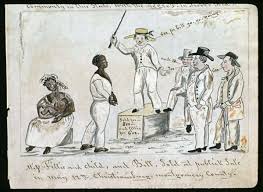
Drawing of a Slave Sale in Virginia

In his Journal, Henry David Thoreau did not choose often to intrude politics. On June 16, 1854, however, he became irate when an escaped slave named Anthony Burns was returned to his former owners by the State of Massachusetts. The state was complying with the terms of the Fugitive Slave Act of 1850. Thoreau not only wrote the following in his Journal, but used the same text in his essay “Slavery in Massachusetts”:

The effect of a good government is to make life more valuable—of a bad one, to make it less valuable. We can afford that railroad and all merely material stock should lose some of its value, for that only compels us to live more simply and economically; but suppose that the value of life itself should be diminished! How can we make a less demand on man and nature, how live more economically in respect to virtue and all noble qualities, than we do? I have lived for the last month- and I think that every man in Massachusetts capable of the sentiment of patriotism must have had a similar experience- with the sense of having suffered a vast and indefinite loss. I did not know at first what ailed me. At last it occurred to me that what I had lost was a country. I had never respected the government near to which I lived, but I had foolishly thought that I might manage to live here, minding my private affairs, and forget it. For my part, my old and worthiest pursuits have lost I cannot say how much of their attraction, and I feel that my investment in life here is worth many per cent less since Massachusetts last deliberately sent back an innocent man, Anthony Burns, to slavery. I dwelt before, perhaps, in the illusion that my life passed somewhere only between heaven and hell, but now I cannot persuade myself that I do not dwell wholly within hell. The site of that political organization called Massachusetts is to me morally covered with volcanic scoriae and cinders, such as Milton describes in the infernal regions. If there is any hell more unprincipled than our rulers, and we, the ruled, I feel curious to see it. Life itself being worth less, all things with it, which minister to it, are worth less. Suppose you have a small library, with pictures to adorn the walls- a garden laid out around- and contemplate scientific and literary pursuits and discover all at once that your villa, with all its contents is located in hell, and that the justice of the peace has a cloven foot and a forked tail- do not these things suddenly lose their value in your eyes?

I feel that, to some extent, the State has fatally interfered with my lawful business. It has not only interrupted me in my passage through Court Street on errands of trade, but it has interrupted me and every man on his onward and upward path, on which he had trusted soon to leave Court Street far behind. What right had it to remind me of Court Street? I have found that hollow which even I had relied on for solid.

I am surprised to see men going about their business as if nothing had happened. I say to myself, “Unfortunates! they have not heard the news.” I am surprised that the man whom I just met on horseback should be so earnest to overtake his newly bought cows running away—since all property is insecure, and if they do not run away again, they may be taken away from him when he gets them. Fool! does he not know that his seed-corn is worth less this year—that all beneficent harvests fail as you approach the empire of hell? No prudent man will build a stone house under these circumstances, or engage in any peaceful enterprise which it requires a long time to accomplish. Art is as long as ever, but life is more interrupted and less available for a man’s proper pursuits. It is not an era of repose. We have used up all our inherited freedom. If we would save our lives, we must fight for them.

Tolstoy’s Journal

Count Leo Tolstoy (1828-1910)

Toward the end of his life, Count Leo Tolstoy wrote entries in a journal. He was a desultory writer by this time, frequently skipping days, weeks, and even months. Many entries end with the expression “If I Live,” highlighting to Tolstoy that he was approaching the end of his life. Most of his entries are about man’s relationship with his Creator and frequently end with short criticisms of what he wrote, such as “Stupid,” “Not clear and not what I want to say,” “I have not succeeded,” “Again, not what I want to to say,” and “I feel that there is something in this, but I can not yet express it clearly.” But then, even when he is struggling, Tolstoy is worth reading. Following are several excerpts from the first 80 pages.

Oh, not to forget death for a moment, into which at any moment you can fall! If we would only remember that we are not standing upon an even plain (if you think we are standing so, then you are only imagining that those who have gone away have fallen overboard and you yourself are afraid you will fall overboard), but that we are rolling on, without stopping, running into each other, getting ahead and being got ahead of, yonder behind the curtain which hides from us those who are going away, and will hide us from those who remain. If we remember that always, then, how easy and joyous it is to live and roll together, yonder down the same incline, in the power of God, with Whom we have been and in Whose power we are now and will be afterwards and forever. I have been feeling this very keenly.

§

I am alive, but I don’t live…. I lay down to sleep, but could not sleep, and there appeared before me so clearly and brightly, an understanding of life whereby we would feel ourselves to be travellers. Before us lies a stage of the road with the same well-known conditions. How can one walk along that road otherwise than eagerly, gaily, friendly, and actively together, not grieving over the fact that you yourself are going away or that others are going ahead of you thither, where we shall again be still more together.

§

I was going from the Chertkovs on the 5th of July. It was evening, and beauty, happiness, blessedness, lay on everything. But in the world of men? There was greed, malice, envy, cruelty, lust, debauchery. When will it be among men as it is in nature? Here there is a struggle, but it is honest, simple, beautiful. But there it is base. I know it and I hate it, because I myself am a man.

Boswell’s Clap

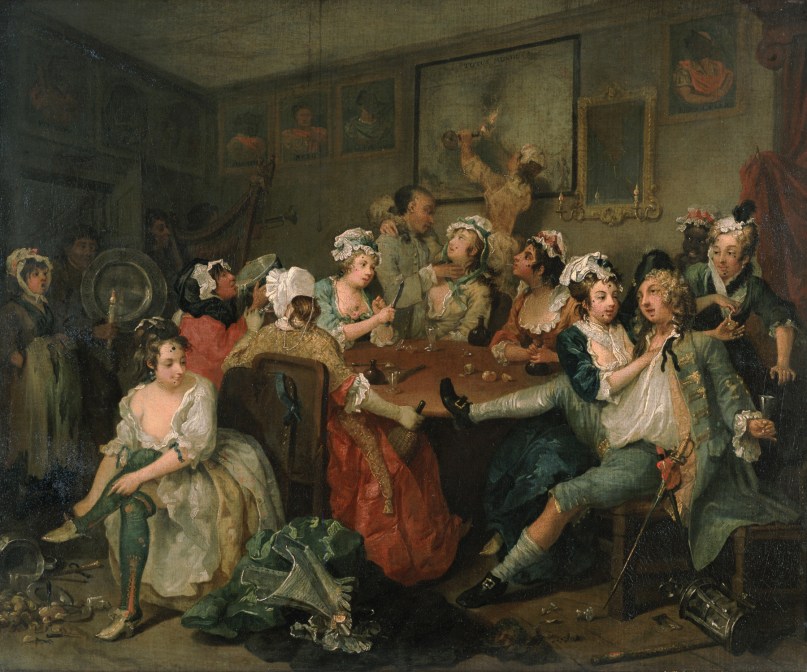
A Scene from William Hogarth’s The Rake’s Progress

I have been reading James Boswell’s London Journal 1762-1763. Inasmuch as I thought Boswell’s Life of Samuel Johnson LLD was one of the greatest books ever written, I thought it a shame that I had not read more of the great biographer.

At the time, Boswell was in his early twenties. His father, Lord Auchinlech (pronounced Affleck), had insisted that his son become a lawyer or merchant. Instead, James wanted to become an officer of the Guards, stationed in London. I am currently halfway through the book. Boswell spent many an anxious hour trying to win the patronage of powerful Scottish lords of the King’s party currying favor to this end. But, alas, no one went out of his way to help him.

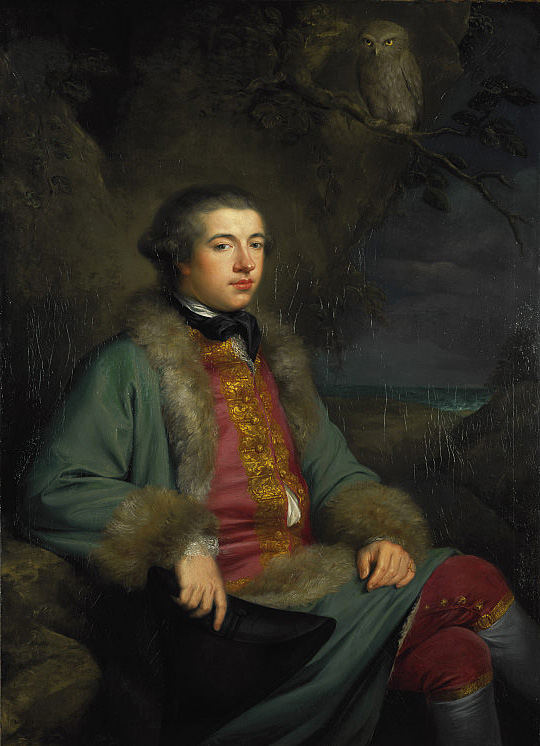
James Boswell (1740-1795)

What the young Scot found was a stubborn case of gonorrhea contracted from a pretty young actress whom he code-named Louisa. He built up to the affair with many weeks of visitations and gifts, only to come down with the clap for the third time in his life.

When he discovered he had been infected, Boswell mused about the effect his cure would have on his daily journal:

What will now become of my journal for some time? It must be a barren desert, a mere blank. To relate gravely that I rose, made water, took drugs, sat quiet, read a book, saw a friend or two day after day, must be exceedingly poor and tedious. My journal must therefore, like the newspapers, yield to the times.

Sounds like the coronavirus quarantine, doesn’t it?

Boswell’s journal makes for excellent reading. It shows its author to be an ambitious and randy young man who delights in conversation, especially with his fellow Scots. I can see myself making several more posts based on or inspired by this excellent book.