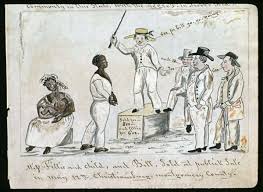
Drawing of a Slave Sale in Virginia
In his Journal, Henry David Thoreau did not choose often to intrude politics. On June 16, 1854, however, he became irate when an escaped slave named Anthony Burns was returned to his former owners by the State of Massachusetts. The state was complying with the terms of the Fugitive Slave Act of 1850. Thoreau not only wrote the following in his Journal, but used the same text in his essay “Slavery in Massachusetts”:
The effect of a good government is to make life more valuable—of a bad one, to make it less valuable. We can afford that railroad and all merely material stock should lose some of its value, for that only compels us to live more simply and economically; but suppose that the value of life itself should be diminished! How can we make a less demand on man and nature, how live more economically in respect to virtue and all noble qualities, than we do? I have lived for the last month- and I think that every man in Massachusetts capable of the sentiment of patriotism must have had a similar experience- with the sense of having suffered a vast and indefinite loss. I did not know at first what ailed me. At last it occurred to me that what I had lost was a country. I had never respected the government near to which I lived, but I had foolishly thought that I might manage to live here, minding my private affairs, and forget it. For my part, my old and worthiest pursuits have lost I cannot say how much of their attraction, and I feel that my investment in life here is worth many per cent less since Massachusetts last deliberately sent back an innocent man, Anthony Burns, to slavery. I dwelt before, perhaps, in the illusion that my life passed somewhere only between heaven and hell, but now I cannot persuade myself that I do not dwell wholly within hell. The site of that political organization called Massachusetts is to me morally covered with volcanic scoriae and cinders, such as Milton describes in the infernal regions. If there is any hell more unprincipled than our rulers, and we, the ruled, I feel curious to see it. Life itself being worth less, all things with it, which minister to it, are worth less. Suppose you have a small library, with pictures to adorn the walls- a garden laid out around- and contemplate scientific and literary pursuits and discover all at once that your villa, with all its contents is located in hell, and that the justice of the peace has a cloven foot and a forked tail- do not these things suddenly lose their value in your eyes?
I feel that, to some extent, the State has fatally interfered with my lawful business. It has not only interrupted me in my passage through Court Street on errands of trade, but it has interrupted me and every man on his onward and upward path, on which he had trusted soon to leave Court Street far behind. What right had it to remind me of Court Street? I have found that hollow which even I had relied on for solid.
I am surprised to see men going about their business as if nothing had happened. I say to myself, “Unfortunates! they have not heard the news.” I am surprised that the man whom I just met on horseback should be so earnest to overtake his newly bought cows running away—since all property is insecure, and if they do not run away again, they may be taken away from him when he gets them. Fool! does he not know that his seed-corn is worth less this year—that all beneficent harvests fail as you approach the empire of hell? No prudent man will build a stone house under these circumstances, or engage in any peaceful enterprise which it requires a long time to accomplish. Art is as long as ever, but life is more interrupted and less available for a man’s proper pursuits. It is not an era of repose. We have used up all our inherited freedom. If we would save our lives, we must fight for them.




You must be logged in to post a comment.