A Major Assumption

The Image of Christ Pantokrator at Assumption Greek Orthodox Church

The assumption of which I speak is that of the Blessed Virgin Mary Theotokos, or “God Bearer.” Today Martine and I drove to Long Beach to visit the Greek festival at Assumption of the Blessed Virgin Mary Greek Orthodox Church.

According to both the Catholic and Greek Orthodox churches, when the Blessed Virgin died, she was taken up body and soul to heaven. Her feast day is celebrated by both religions on August 15.

There was music, dancing, Greek food (including scrumptious cookies), and a tour of the colorful church. The Assumption of the BVM Church in Long Beach is particularly colorful: The walls have painted images of literally hundreds of saints in addition to Biblical scenes from both the Old and New Testaments.

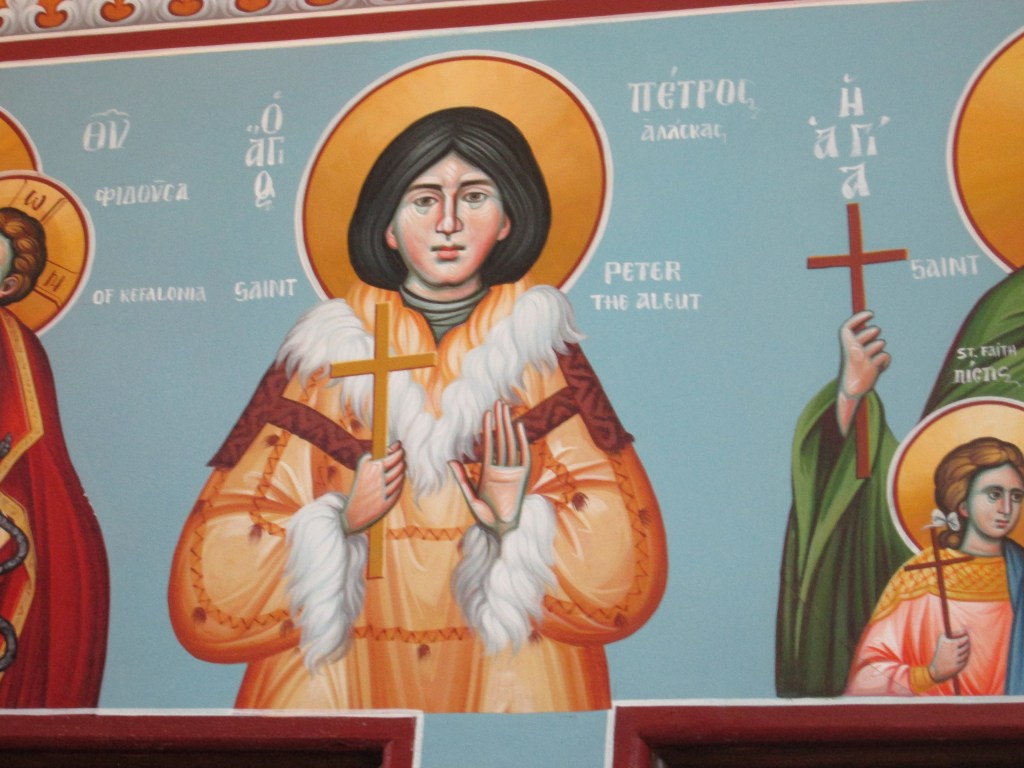
One of the saints depicted was Peter the Aleut, surnamed Cungagnak, who was martyred in 1815 after being tortured and killed by the Spanish in California. There are some doubts as to whether Peter ever existed, as the Russian Orthodox ministers on Kodiak Island said the Jesuits were behind the martyrdom. There were no Jesuits in California at that time, just mostly Franciscans. But it’s a nice story anyway.

It’s Greek To Me

The Iconostasis at Assumption of the BVM in Long Beach

On Saturday, Martine and I attended the annual festival at Assumption of the Blessed Virgin Mary Greek Orthodox Church in Long Beach. It was our third Greek festival of the year, and probably not the last. We like the food, the music, and the churches. The Long Beach church was perhaps a bit on the gaudy side, but it was all reverently done.

There remain two more Greek festivals over the next six weeks: St Anthony Greek Orthodox Church on September 20-22 and the big event at Saint Sophia Greek Orthodox Church on October 5-6. I am pretty sure that we’ll be at Saint Sophia. We’ve never been to St Anthony, but we’ll go if I could talk Martine into it.

I love ethnic festivals, particularly if they’re Hungarian. But these are becoming fewer in number as time goes on, and the Magyar population of Southern California becomes more acculturated and dispersed. The Greek festivals seem to be more of a going thing. I hope that it continues to be.

With Saints and Angels in Long Beach

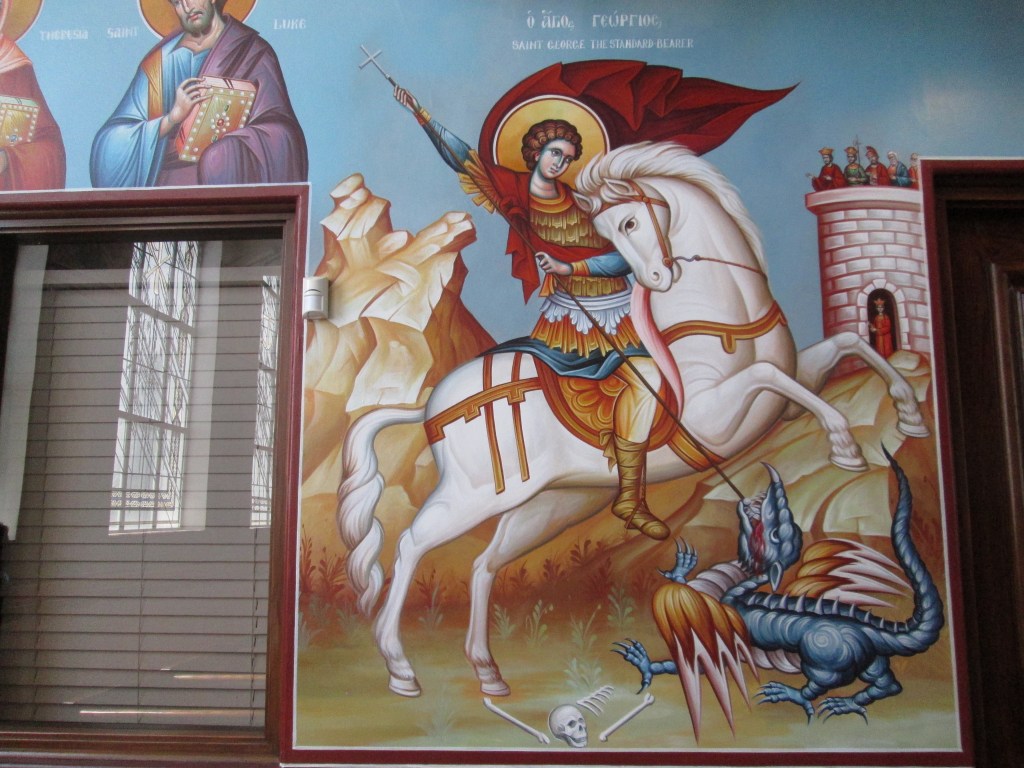
Saint George Slaying the Dragon

With the continuing heat dome over Southern California, Martine and I took a chance and went to the Long Beach Greek Festival at the Assumption of the Blessed Virgin Church. Although it was as hot as Hades, I’m glad we went. The food was good, there were tons of tasty Greek pastries, and the church itself was outstanding.

The church was not as wealthy as Saint Sophia in downtown L.A. or Saint Nicholas in Northridge, but it was beautifully painted with what seemed to be hundreds of saints and angels. And, unlike many Greek Orthodox churches, most of them were identified in both Greek and English.

There were a few surprises, the most prominent one being an Eskimo—actually an Aleut—called Saint Peter the Aleut:

Saint Peter the Aleut, aka Cungagnaq

For an Aleut to be a Greek Orthodox martyr requires a leap of faith. And for Cungagnaq, it came in 1815 when the Spanish, who were uneasy about the Russian occupation of Alaska, captured him near San Francisco and had him put to death at the instigation of some Catholic priests who were upset that he was a heretic. Read about it on Wikipedia.

Just about every square inch of the Assumption of the Blessed Virgin church was covered with images of Christ, Mary, and the saints and angels. The effect was quite stunning. Martine and I spent an hour studying the sacred images.

I might be an indifferent lapsed Catholic, but the simplicity and sincerity of the church held my respect and even awe.

Southeast

This Is the Part of Los Angeles County That Most People Know

Although I have lived in the Los Angeles area for over half a century, there are parts that are almost totally unfamiliar to me. Today, I had a chance to visit one of them as I drove Martine to a ophthalmologist appointment in Lakewood, which is a place I have whizzed past on the freeway, but never stopped to visit.

The part of LA that is most unfamiliar to me are the so-called “Gateway Cities” in the southeastern part of the county. I am somewhat familiar with Long Beach, which I regard as part of the tierra cognita of my experience.

The City of Los Angeles occupies much of the center of the county. Then there is a narrow corridor of the city that stretches down to San Pedro and the Port of Los Angeles. To the right of that corridor are a number of independent cities that include such names as Bell, Bell Gardens, Bellflower, Cudahy, Downey, Hawaiian Gardens, Lakewood, Lynwood, Maywood, and presumably other -woods.

Here is a map of the Gateway Cities:

Los Angeles’s “Gateway Cities”

When you remove the dark blue of Long Beach, you are left with a bunch of small, tightly squeezed together communities that for all intents and purposes have little of interest for people visiting Southern California. There are a couple of colleges, no major museums, only one ethnic community (the Indian and Pakistani enclave along Pioneer Avenue in Artesia), and a couple of historical places, mostly in Whittier. Other than Long Beach, the only community people outside of California are likely to have heard of is Compton, mostly as a high-crime place to avoid.

Martine is due for another appointment in Lakewood in a couple of weeks, so I should probably learn a little more about this apparent black hole in the city where I dwell.

And where do I live? If you look at the top map for Santa Monica slightly to the left of center, look for the number oval 2, which indicates Santa Monica Boulevard. I live right under that oval 2.

L.A. and L.B.

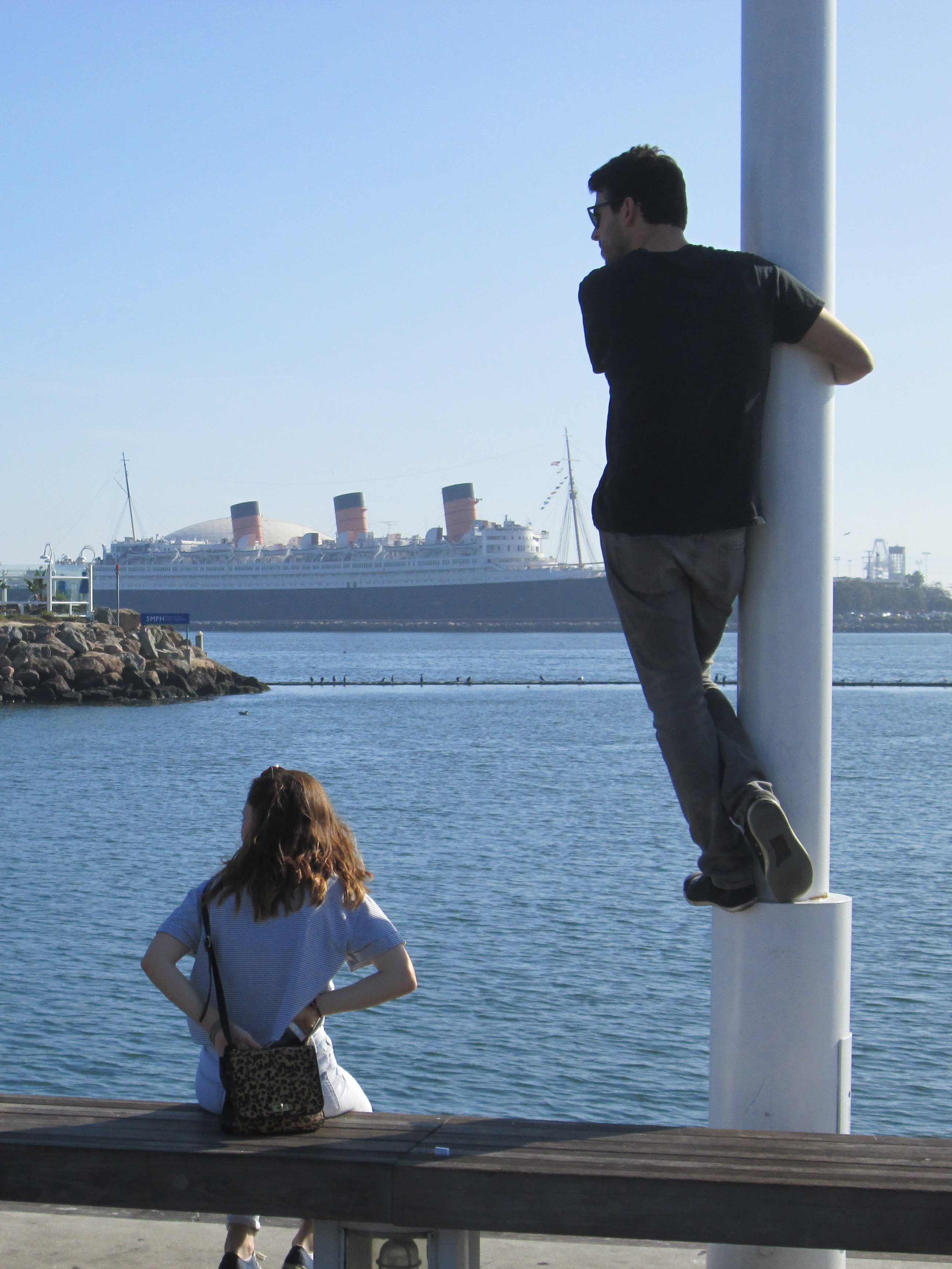
Looking Across the Harbor at the Queen Mary

Looking Across the Harbor at the Queen Mary

At least a couple times a year, Martine and I like to spend a day in Long Beach. We park the car in the Aquarium parking structure and walk on the path surrounding the yacht harbor and along the ocean, halfway to Belmont Shores. Usually, it’s in conjunction with a visit to the Aquarium, but I prefer to go there early before all the strollers armed with ankle-killing spikes show up. Today, we just enjoyed the sunshine and the nice weather.

I always like to see the Queen Mary across the harbor, always remembering that in 1937 it brought my mother back to the United States by way of Cherbourg, France, and Southampton, England. Fortunately, I was able to take her to see the ship docked in Long Beach Harbor, where she was able to tour the luxury cabins which, as a steerage passenger, she and her grandparents never had a chance to see on their passage.

The beach city has been interesting me more and more since I started reading the Long Beach Homicide detective novels by Tyler Dilts, namely A King of Infinite Space and A Long and Broken Hallelujah. (That leaves only The Pain Scale before I’ve read his entire opus.) As I wrote in his review of A King of Infinite Space:

It’s good to think that noir has a future in Southern California, where it was born under the skillful pens of Raymond Chandler and Dashiell Hammett. Tyler Dilts teaches writing at Cal State Long Beach. He comes to the genre with an extensive background and a rich frame of reference. In addition, he has such a good ear for the Long Beach area that I feel like dropping in at some of the restaurants he mentions and checking them out.

Long Beach has some nice areas; it also has some heinous slums. But then, I guess that goes for Los Angeles as well.