The Communion of Saints

Today, on a hot and humid afternoon following a rare September rainstorm, Martine and I attended the Greek festival at Assumption of the Blessed Virgin Mary in Long Beach. We love the church with its rich iconography and display of saints, many of which were unknown to me with my Roman Catholic background.

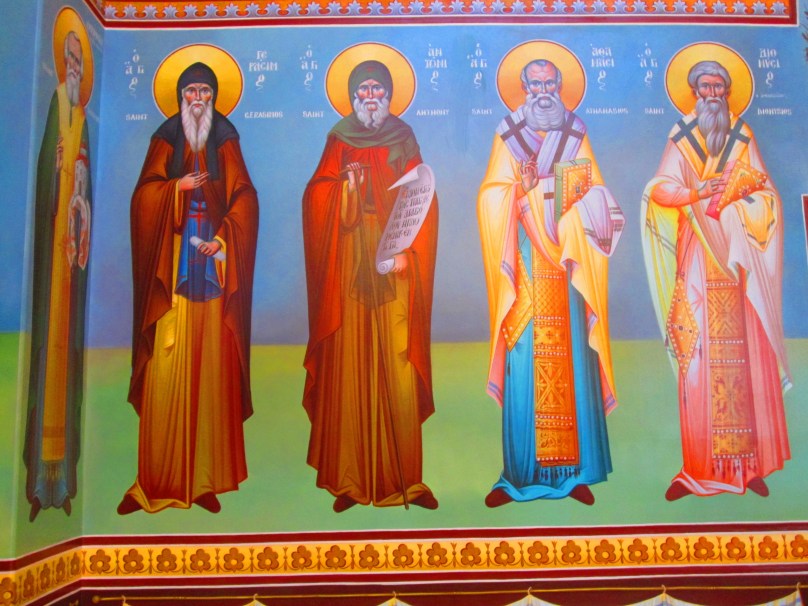
The four saints in the panel above are Gerasimos, Anthony, Athanasius, and Dionysios. The first and fourth are likely celebrated in the Eastern Orthodox Church.

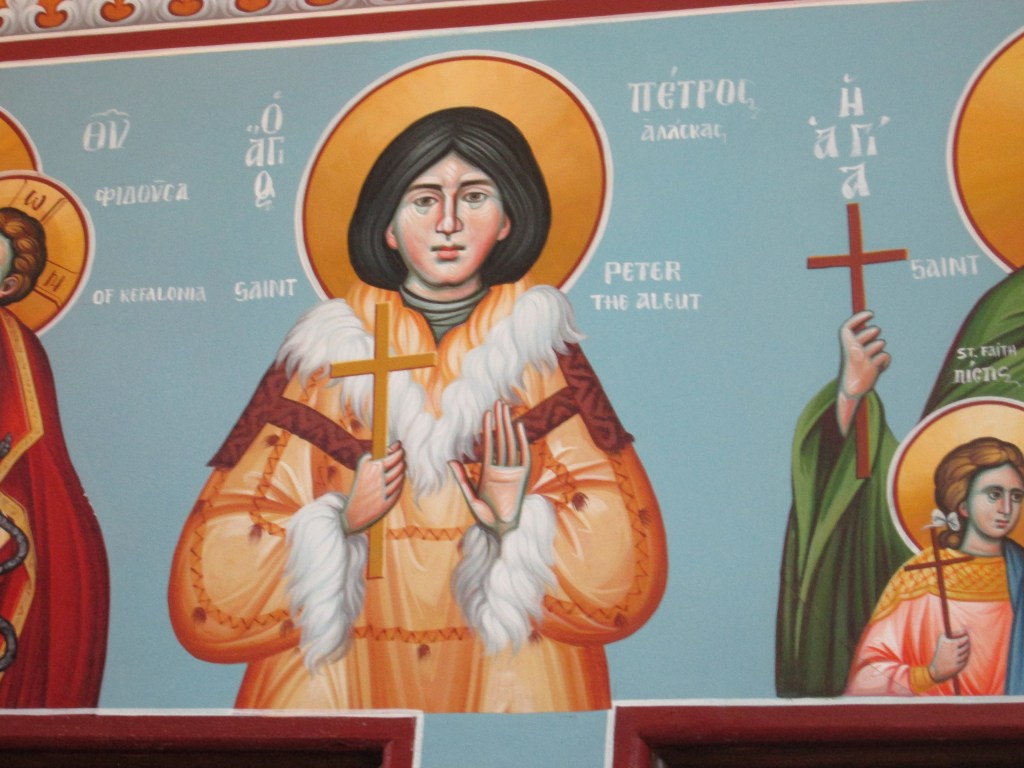
Four years ago, I wrote about discovering an Eskimo saint, Peter the Aleut, whose icon is shown on the back wall of the nave. This time, I discovered a Saint Aphrodite, who is totally unrelated to the Greek goddess of love and beauty.
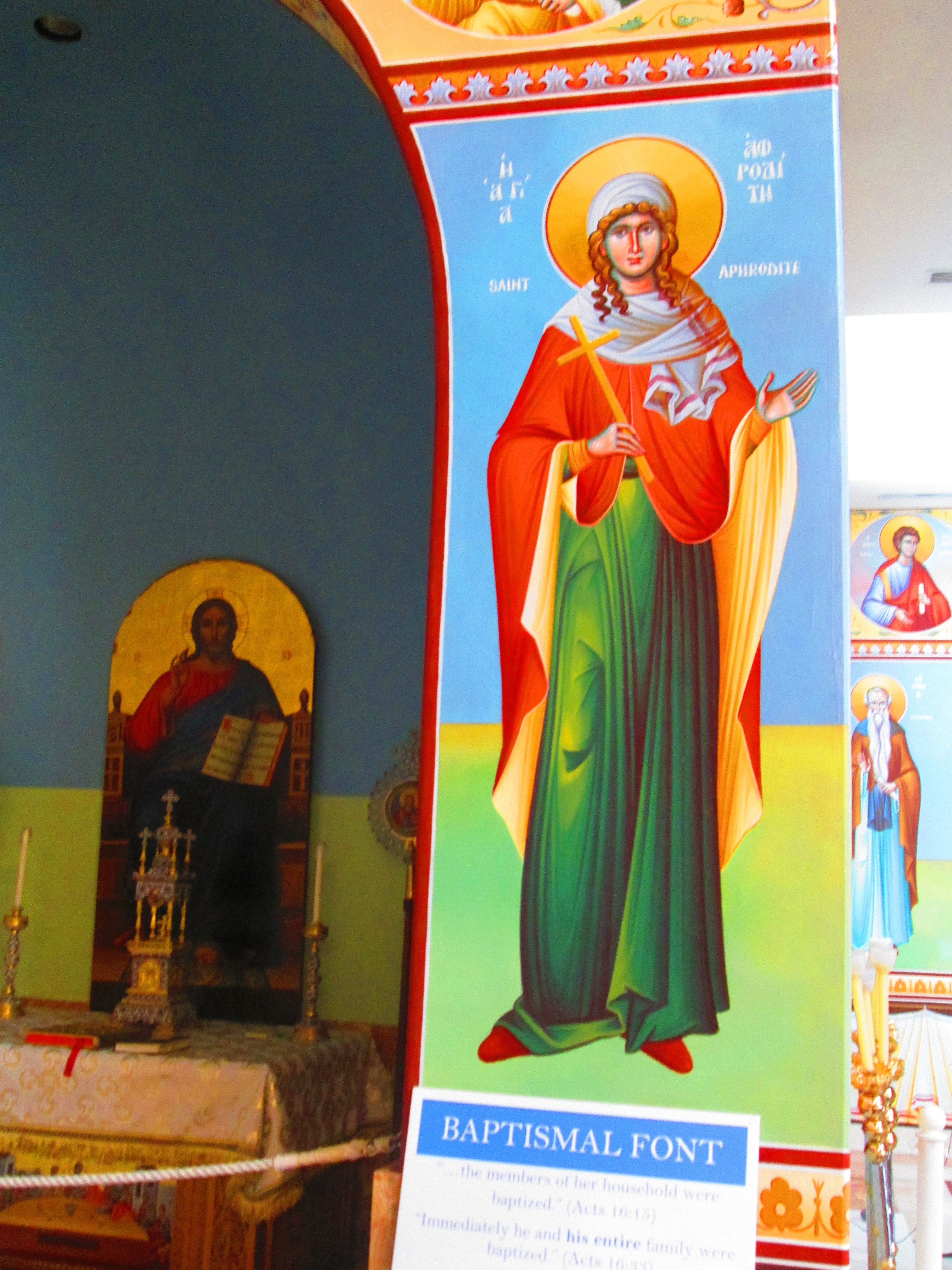
Saint Aphrodite?

According to Wikipedia, Saint Aphrodite was a virgin who was martyred for her Christian beliefs during a local persecution in Adrianople, Thrace, around the year AD 305. The Orthodox Church celebrates her feast day on September 1.

I mentioned Saint Dionysios above. Wasn’t he named after a Greek deity as well? The saint was also known as Dionysios of Zakynthos, According to Wikipedia:

In his early life, Dionysios joined a monastery a few miles off the coast of Zakynthos. After a while living there, he was encouraged by his fellow monks to be ordained as a priest, which he did. He eventually decided to travel to the Holy Land by way of Athens. After arriving in Athens, he was made Archbishop of Aigina despite personal protests in humility. In about the year 1589, the Patriarch of Constantinople made Archbishop Dionysios the Archbishop of Zakynthos, he stayed in this position until a permanent Archbishop arrived. After this, he returned to his island monastery where he lived out the rest of his life until his death on December 17, 1622.

This doesn’t sound like much, but he probably made a good impression.

A Major Assumption

The Image of Christ Pantokrator at Assumption Greek Orthodox Church

The assumption of which I speak is that of the Blessed Virgin Mary Theotokos, or “God Bearer.” Today Martine and I drove to Long Beach to visit the Greek festival at Assumption of the Blessed Virgin Mary Greek Orthodox Church.

According to both the Catholic and Greek Orthodox churches, when the Blessed Virgin died, she was taken up body and soul to heaven. Her feast day is celebrated by both religions on August 15.

There was music, dancing, Greek food (including scrumptious cookies), and a tour of the colorful church. The Assumption of the BVM Church in Long Beach is particularly colorful: The walls have painted images of literally hundreds of saints in addition to Biblical scenes from both the Old and New Testaments.

One of the saints depicted was Peter the Aleut, surnamed Cungagnak, who was martyred in 1815 after being tortured and killed by the Spanish in California. There are some doubts as to whether Peter ever existed, as the Russian Orthodox ministers on Kodiak Island said the Jesuits were behind the martyrdom. There were no Jesuits in California at that time, just mostly Franciscans. But it’s a nice story anyway.

With Saints and Angels in Long Beach

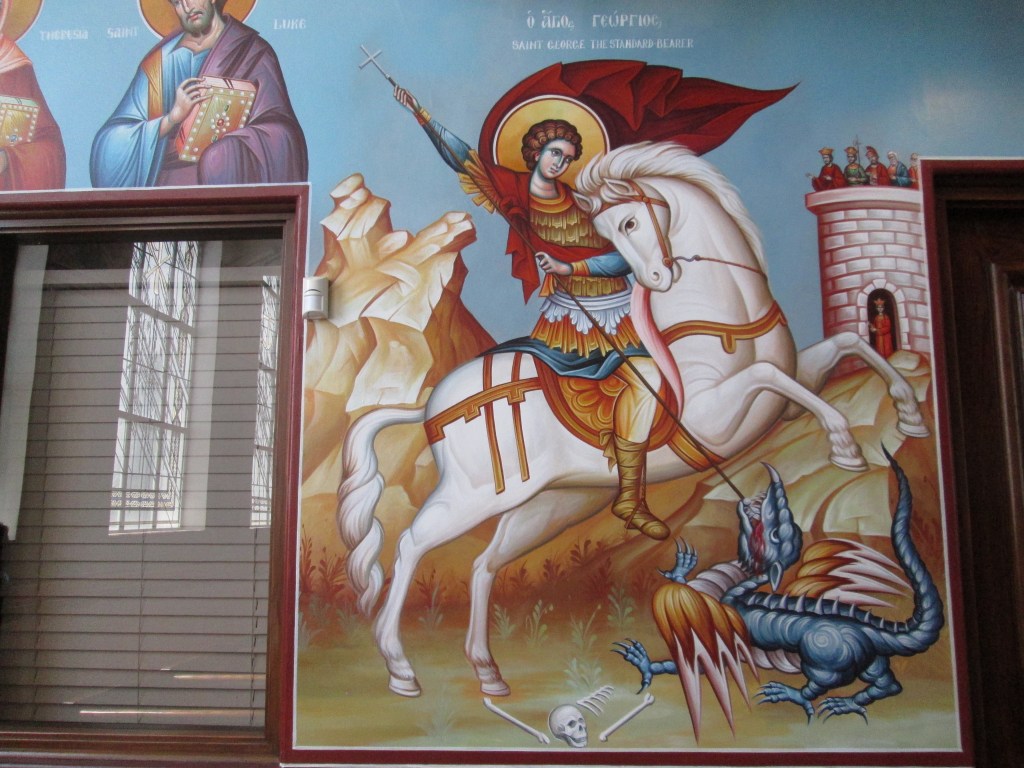
Saint George Slaying the Dragon

With the continuing heat dome over Southern California, Martine and I took a chance and went to the Long Beach Greek Festival at the Assumption of the Blessed Virgin Church. Although it was as hot as Hades, I’m glad we went. The food was good, there were tons of tasty Greek pastries, and the church itself was outstanding.

The church was not as wealthy as Saint Sophia in downtown L.A. or Saint Nicholas in Northridge, but it was beautifully painted with what seemed to be hundreds of saints and angels. And, unlike many Greek Orthodox churches, most of them were identified in both Greek and English.

There were a few surprises, the most prominent one being an Eskimo—actually an Aleut—called Saint Peter the Aleut:

Saint Peter the Aleut, aka Cungagnaq

For an Aleut to be a Greek Orthodox martyr requires a leap of faith. And for Cungagnaq, it came in 1815 when the Spanish, who were uneasy about the Russian occupation of Alaska, captured him near San Francisco and had him put to death at the instigation of some Catholic priests who were upset that he was a heretic. Read about it on Wikipedia.

Just about every square inch of the Assumption of the Blessed Virgin church was covered with images of Christ, Mary, and the saints and angels. The effect was quite stunning. Martine and I spent an hour studying the sacred images.

I might be an indifferent lapsed Catholic, but the simplicity and sincerity of the church held my respect and even awe.