Today, on a hot and humid afternoon following a rare September rainstorm, Martine and I attended the Greek festival at Assumption of the Blessed Virgin Mary in Long Beach. We love the church with its rich iconography and display of saints, many of which were unknown to me with my Roman Catholic background.
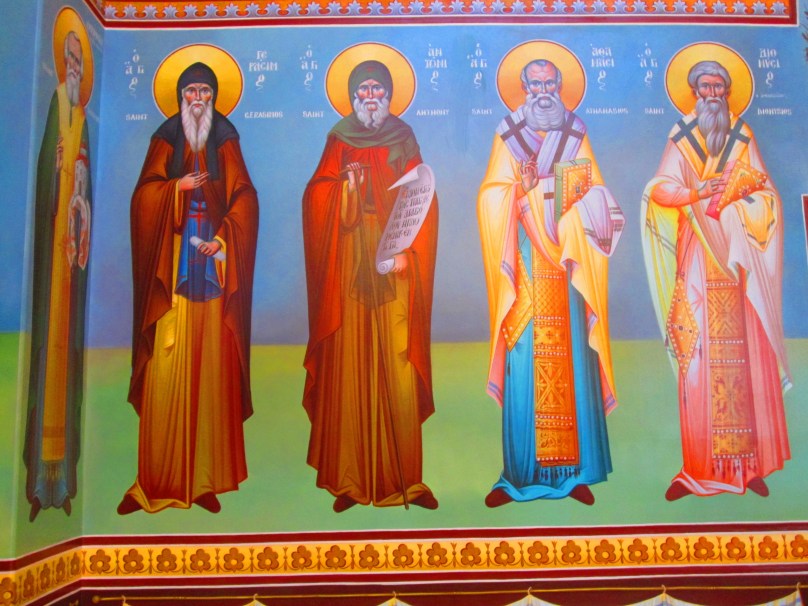
The four saints in the panel above are Gerasimos, Anthony, Athanasius, and Dionysios. The first and fourth are likely celebrated in the Eastern Orthodox Church.
Four years ago, I wrote about discovering an Eskimo saint, Peter the Aleut, whose icon is shown on the back wall of the nave. This time, I discovered a Saint Aphrodite, who is totally unrelated to the Greek goddess of love and beauty.
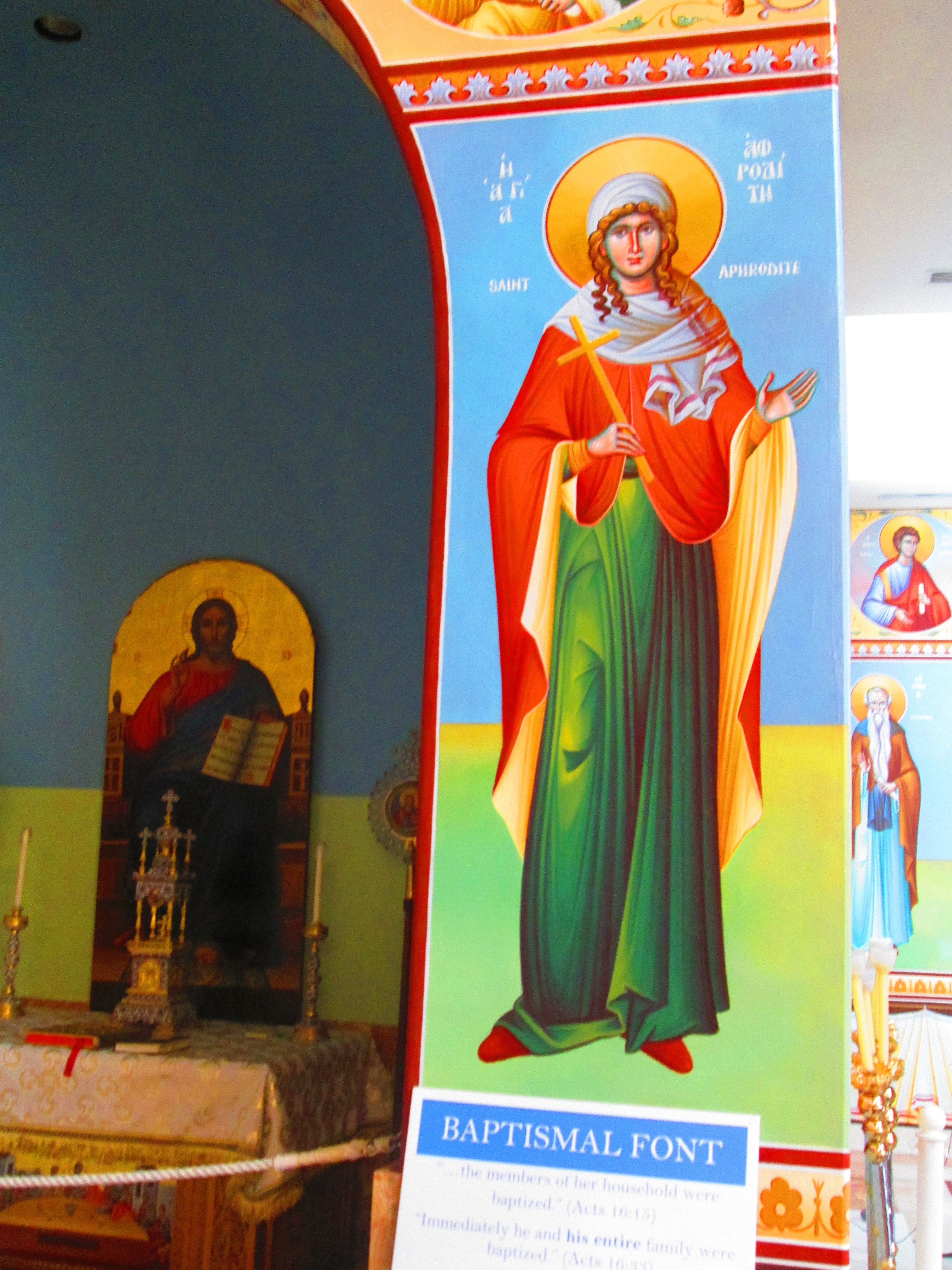
Saint Aphrodite?
According to Wikipedia, Saint Aphrodite was a virgin who was martyred for her Christian beliefs during a local persecution in Adrianople, Thrace, around the year AD 305. The Orthodox Church celebrates her feast day on September 1.
I mentioned Saint Dionysios above. Wasn’t he named after a Greek deity as well? The saint was also known as Dionysios of Zakynthos, According to Wikipedia:
In his early life, Dionysios joined a monastery a few miles off the coast of Zakynthos. After a while living there, he was encouraged by his fellow monks to be ordained as a priest, which he did. He eventually decided to travel to the Holy Land by way of Athens. After arriving in Athens, he was made Archbishop of Aigina despite personal protests in humility. In about the year 1589, the Patriarch of Constantinople made Archbishop Dionysios the Archbishop of Zakynthos, he stayed in this position until a permanent Archbishop arrived. After this, he returned to his island monastery where he lived out the rest of his life until his death on December 17, 1622.
This doesn’t sound like much, but he probably made a good impression.


Like Roman Catholics Greek Orthodox celebrate the Assumption of Mary on August 15. They sometimes call it the Dormition of the Theotokos (God bearer). Perhaps the festival you just attended was to celebrate the Nativity of the Theotokos on September 8 whose Immaculate Conception (by her mother Anne and father Joachim i.e. presumably the natural way) both Greeks and Catholics celebrate nine months earlier on December 8. I don’t know Greek either, but occasionally I do say the Catholic Rosary in Modern Greek just to get the flavor of Greek in my mouth. Here’s the Hail Mary in Modern Greek followed by Google translate’s very helpful phonetic English version. Incidentally Google translate’s phonetic English version works with Arabic, Chinese, Japanese and several south Asian Indian languages I have tried — again just to get the approximate flavor. Χαίρε, Μαρία, κεχαριτωμένη
ο Κύριος είναι μαζί Σου,
ευλογημένη Εσύ μεταξύ των γυναικών,
και ευλογημένος ο καρπός της κοιλίας Σου, ο Ιησούς.
Αγία Μαρία, Θεοτόκε,
παρακάλει για μας τους αμαρτωλούς,
τώρα και στην ώρα του θανάτου μας. Αμήν.
Chaíre, María, kecharitoméni
o Kýrios eínai mazí Sou,
evlogiméni Esý metaxý ton gynaikón,
kai evlogiménos o karpós tis koilías Sou, o Iisoús.
Agía María, Theotóke,
parakálei gia mas tous amartoloús,
tóra kai stin óra tou thanátou mas. Amen.
I wouldn’t be able to read or pronounce the words. Excusing me for saying so, but it’s all Greek to me.