Odette

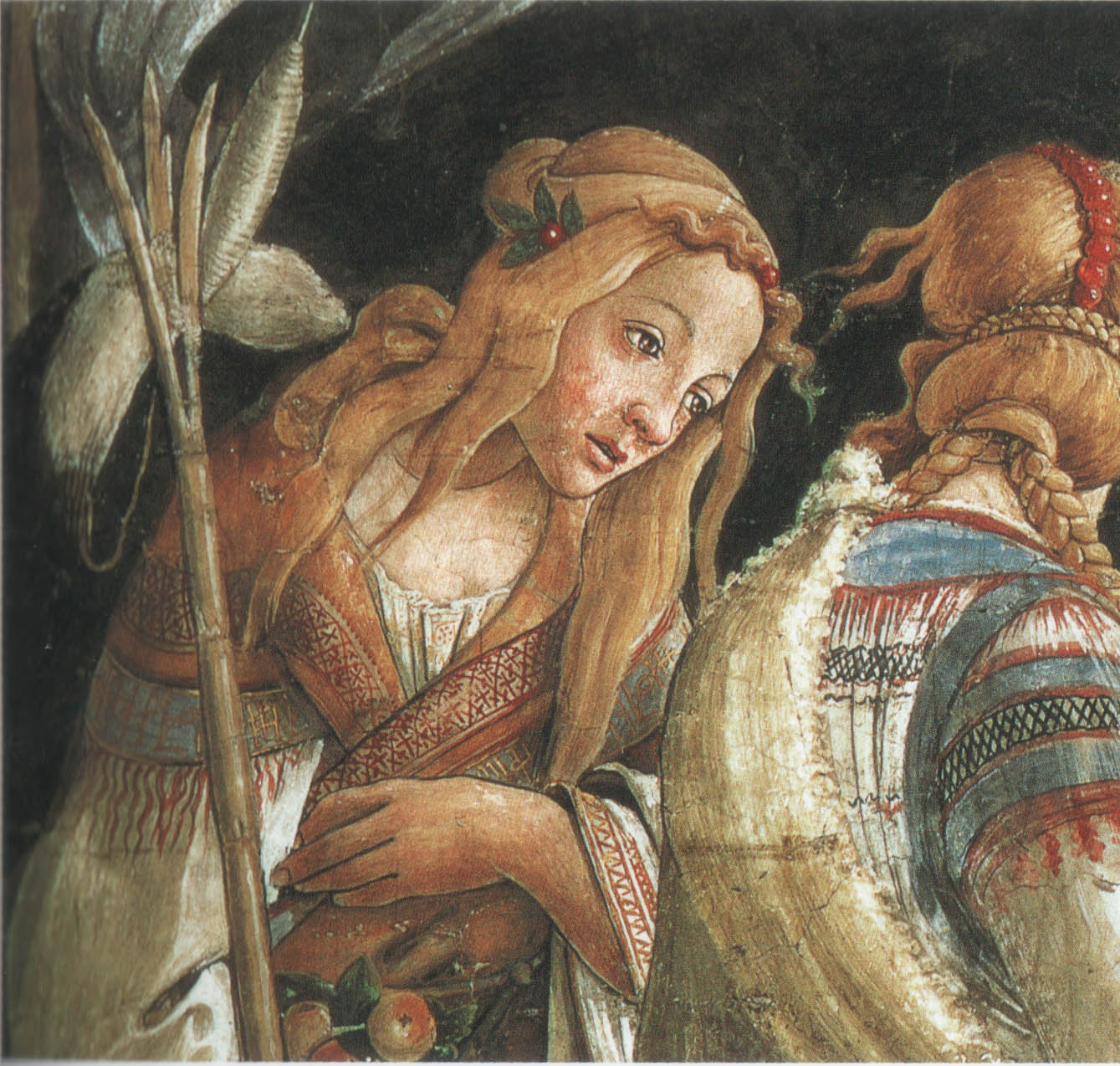
Detail of Zipporah from Botticelli’s The Trials of Moses

Detail of Zipporah from Botticelli’s The Trials of Moses

Shown above is a detail from Sandro Botticelli’s painting “The Trials of Moses” depicting Jethro’s daughter Zipporah. It is this image which Marcel Proust used to describe the love of Charles Swann’s life, Odette de Crécy. It was a mammoth undertaking, especially as Proust was gay: He constantly had to translate heterosexual behavior through a homosexual template, which was more familiar to him. (In later volumes, Marcel’s lover Albertine was thus “translated” from his Italian chauffeur, Alfred Agostinelli.) As difficult as it seems to do this, Proust succeeded so well that Swann’s Way is perhaps the greatest work in literature about disappointment in love.

Swann was not immediately taken with Odette:

[S]he had seemed to Swann not without beauty, certainly, but of a type of beauty that that left him indifferent, that aroused no desire in him, even caused him a sort of physical repulsion, one of those women such as everyone has his own, different for each, who are the opposite of the kind our senses crave. Her profile was too pronounced for his taste, her skin too delicate, her cheekbones too prominent, her figures too pinched. Her eyes were lovely, but so large they bent under their own mass, exhausted the rest of her face, and always gave her a look of being in ill health or ill humor.

A few pages later, we see what Swann (and by extension Proust) was doing in crystallizing his feelings toward this young woman::

He placed on his worktable, as if it were a photograph of Odette, a reproduction of Jethro’s daughter. He admired the large eyes, the delicate face, which allowed one to imagine the imperfect skin, the marvelous curls of the hair along the tired cheeks, and adapting what he had found aesthetically beautiful up to then to the idea of a living woman, he translated it into physical attractions which he rejoiced to find united in a creature whom he could possess. The vague feeling of sympathy that draws us toward a masterpiece as we look at it became, now that he knew the fleshly original of Jethro’s daughter, a desire that henceforth compensated for the desire that Odette’s body had not at first inspired in him. When he looked at that Botticelli for a long time, he would think of his own Botticelli, whom he found even more beautiful, and bringing the photograph of Zipporah close to him, he would believe he was clasping Odette against his heart.

Alas, Odette is openly unfaithful to Swann and drives him crazy with envy as the Comte de Forcheville moves in on his woman, while their friends at the Verdurins’ salon conspire against him. In the process, Swann’s life becomes bitter; and he no longer derives any joy from the things that hitherto had sustained him, his friends, his art, and high society. In the end, Swann admits to himself: “To think that I wasted years of my life, that I wanted to die, that I felt my deepest love, for a woman who did not appeal to me, who was not my type!”

Of course, that didn’t keep him from marrying her. But that is another story.

A Polish Poet Learns Latin

Zbigniew Herbert

Zbigniew Herbert

In my interest in Latin and my admittedly mediocre progress in that sphere there lay an element I might call personal. In the apartment building across the road from us there lived a young person, whose full shape, auburn hair, and dimples stirred my senses and gave me vertigo. She was the daughter of a Latin professor—not from our gymnasium, it is true, but known to us as the author of the book of adapted texts over which we labored; he also published articles in the monthly Philomat, to which Grzesio obliged us to subscribe through him. I used to sit on the balcony with my Auerbach & Dąbrowski Latin grammar and pretend that reading this exceptionally dull tome put me in ecstasy.

It was in fact an act of despair. If the object of my passionate feelings appeared on the balcony, it was not for my sake. She sometimes brushed me with a distracted look, as one glances at clouds moving across the sky. She was waiting for an older colleague of mine from the lyceum, a tall youth with a wavy blond crop, undeniably handsome (he was the standard-bearer of our school and wearing a sash and white gloves at celebrations he really did present well)—but I knew he could never make her happy. Every day around five in the afternoon she would leave the house with my mortal enemy and disappear around the corner into a little street shaded by chestnut trees, where (my feverish imagination told me) terrible things happened: he would take her arm (against the severest injunctions of the middle school rules) and perhaps press a fiery kiss on her silken glove. A storm of contradictory feelings in my tormented heart:

Odi et amo. Quare id faciam, fortasse requiris.
Nescio, sed fieri sentio et excrucior.

What did I think to achieve, holding my Auerbach & Dąbrowski Latin grammar on the balcony so that its cover would be visible from afar? I thought that one day her father—the classical philologist—would notice me and shout across to me: “I have been observing you for a while now, my boy. Your modesty and industry, your love for the Roman tongue are a warranty that you are a proper candidate for my daughter’s husband. I therefore grant you her hand.” And from then on things would proceed as in a fairy tale.

They didn’t. On the other hand, I learned many examples of the use of the more complicated grammatical forms by heart and was able to shine in class, even winning a cordial look from Grzesio.

We labored in the sweat of our brows. The time to reap drew near: the next year we were to proceed to the poetry of Catullus and Horace. But then the barbarians invaded.—Zbigniew Herbert, “A Latin Lesson,” Collected Prose

NOTE: Translated, the above Latin quote reads:

“I hate and I love. Why do I do it, perchance you might ask?
I don’t know, but I feel it happening to me and I’m burning up.”

The lines are from Catullus.

“A Spark from the Original Soul”

Martin Buber

Martin Buber

Question: We are commanded to love our neighbor as ourselves. How do I do this if my neighbor has wronged me?

Answer: You must understand these words rightly. Love your neighbor as something which you yourself are. For all souls are one. Each is a spark from the original soul, and this soul is inherent in all souls, just as your soul is inherent in all the members of your body. It may come to pass that your hand will make a mistake and strike you. But would you take a stick and chastise your hand because it lacked understanding, and so increase your pain? It is the same if your neighbor, who is of one soul with you, wrongs you because of his lack of understanding. If you punish him, you only hurt yourself.

Question: But if I see a man who is wicked before God, how can I love him?

Answer: Don’t you know that the primordial soul came out of the essence of God, and that every human soul is a part of God? And will you have no mercy on man, when you see that one of his holy sparks has been lost in a maze and is almost stifled?—Martin Buber, Ten Rungs: Hasidic Sayings

“You Are Here to Risk Your Heart”

Louise Erdrich

Louise Erdrich

Life will break you. Nobody can protect you from that, and living alone won’t either, for solitude will also break you with its yearning. You have to love. You have to feel. It is the reason you are here on earth. You are here to risk your heart. You are here to be swallowed up. And when it happens that you are broken, or betrayed, or left, or hurt, or death brushes near, let yourself sit by an apple tree and listen to the apples falling all around you in heaps, wasting their sweetness. Tell yourself you tasted as many as you could.—Louise Erdrich, The Painted Drum LP

To Love Is To Be Vulnerable

To love at all is to be vulnerable. Love anything and your heart will be wrung and possibly broken. If you want to make sure of keeping it intact you must give it to no one, not even an animal. Wrap it carefully round with hobbies and little luxuries; avoid all entanglements. Lock it up safe in the casket or coffin of your selfishness. But in that casket, safe, dark, motionless, airless, it will change. It will not be broken; it will become unbreakable, impenetrable, irredeemable. To love is to be vulnerable.—C.S. Lewis, The Four Loves