To understand this cynical poem by Endre Ady (1877-1919), you should first read my post entitled “A Legacy of Losers,” posted last week. The word “Magyar” means “Hungarian” in the Hungarian language.
The Magyar Messiahs
More bitter is our weeping, different the griefs that try us. A thousand times Messiahs are the Magyar Messiahs. A thousand times they perish, unblest their crucifixion, for vain was their affliction, oh, vain was their affliction.
Yesterday, Martine and I attended the 30th Magyar Majális és Tavaszi Fesztivál at the Grace Hungarian Reformed Church in Reseda. This is perhaps the fifth or sixth year we have attended, and each time I was powerfully reminded of my Hungarian roots. I, who speak Hungarian most of the time to confound strangers with whom I do not wish to converse, was surrounded by friendly people speaking, for the most part, the Magyar tongue.
And with the continuing decline of European ethnic restaurants in Los Angeles, it is also the best place in Southern California to find good Hungarian home cooking. Martine had her beloved crémes pastry—sort of a sweet Hungarian cheesecake. I had my favorite gulyás leves (Hungarian goulash soup).
I get very sentimental about my Hungarian roots. Maybe because I am surrounded by non-Hungarians. It requires an effort to keep up my mother tongue for the actual purposes of communication. My pronunciation is right on the money, but my vocabulary and grammar are atrocious. That’s because I essentially ceased using Hungarian as my main language at the age of six.
The Program for the Festival
As I continue to age, I expect to see myself reading more Hungarian literature and seeing more Hungarian movies. The Hungarian Reformed church in Reseda is not really my religion, though it was my mother’s. My parents decided that all boys born into the Páris family were to be Catholics, like my Slovak father; and all girls, to be Hungarian Reformed Protestants. As it turned out, I have only one sibling, my brother Dan.
Folk Dancers from the Kárpátok Troupe at Grace Hungarian Reformed Church
For the first time since the Covid lockdown began, Martine and I were able to attend a church festival, in this case the Hungarian festival at Grace Hungarian Reformed Church in Reseda. I was raised on Hungarian food, and Martine, although French, prefers Hungarian food to the cuisine of her native land.
So we chowed down on stuffed cabbage and krémes (Hungarian style cheesecake) and watched a program of folk dancing. Plus I had the opportunity of practicing my rusty Hungarian. Although it is my native language, my vocabulary and grammar are atrocious. Yet my pronunciation is still pretty accurate. As I’ve mentioned before, I speak a rural Fehérmegye dialect dating back to the 1930s. This is what we spoke at home in Cleveland.
Still and all, I want to stay close to my Magyar roots as much as possible. I see it as an escape hatch when I get too disgusted with my fellow Americans. I like to stay current with Hungarian literature, even though I have to rely on translations into English, of which there are few.
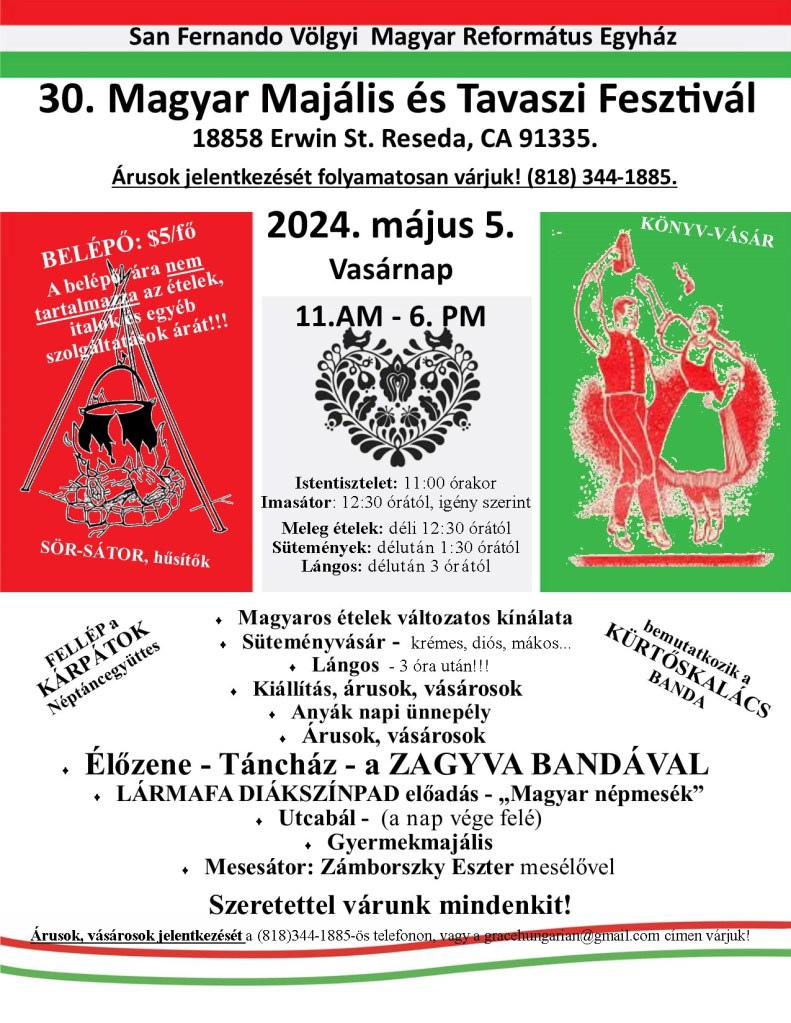
Below is the announcement for the festival we attended today:
Not a single word is in English, and yet I understood most of it. And what I didn’t understand, I looked up.
Martine and I have been attending this church’s spring festivals for most of the last eleven or twelve years. Great fun!




 Tarnmoor
You must be logged in to post a comment.