Quai des Orfèvres

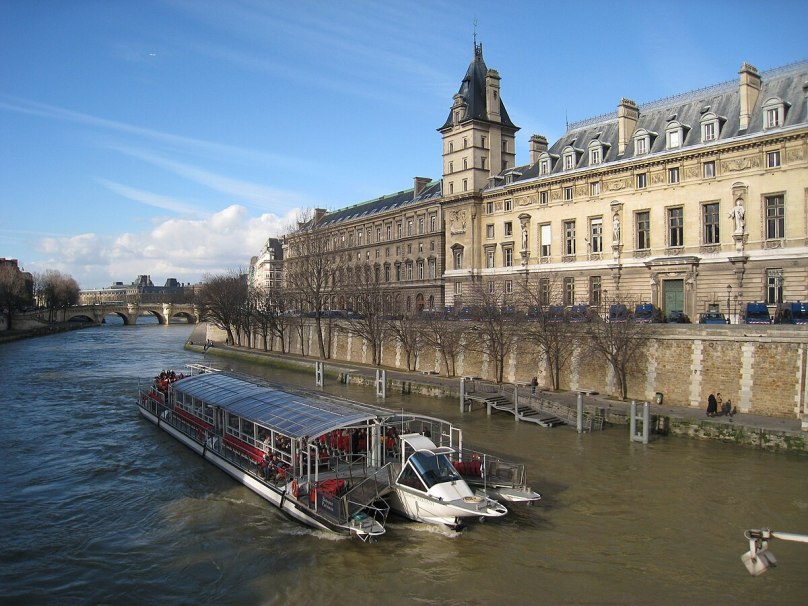
The Quai des Orfèvres, Former HQ of the French Police Judiciaire

Right across the way from the cathedral of Notre Dame on the Île de la Cité is the Quai des Orfèvres, former headquarters of the French Police Judiciaire and office of Inspector Jules Maigret, Georges Simenon’s hero in some seventy-five mystery novels.

What better way to end 2025, I thought to myself, than to read a Maigret novel I had never read before. Since I have read most of them by now, that was not an easy decision to make. Fortunately, I dug deep in one of my book piles and came up with Maigret and the Apparition (aka Maigret and the Ghost), published in 1964 as Maigret et le fantôme.

The book starts with the shooting of a detective inspector from the 18th Arrondissement who was a friend of Maigret’s. At first, nothing seems to make sense; and there are no Sherlockian clues that give the crime away. Simenon’s Maigret novels are not tales of ratiocination à la Edgar Allan Poe. This is not the Anglo-Saxon world of crime: What Maigret adheres to is a Gallic combination of thoroughness and intuition. The solution eventually emerges only when he has looked hard at every detail in the case.

Famously, Maigret does not come up with any theories as he follows through on the investigation. The active principle here is not ratiocination, but se débruillier, to, in effect, “defog” the mass of evidence and suspects. As Google’s artificial intelligence summary has it:

Débrouiller (reflexive: se débrouiller) is a versatile French verb meaning to manage, cope, get by, sort out, or figure things out, especially when facing challenges, implying resourcefulness to overcome obstacles and find solutions, like “I can manage” (Je me débrouille) or “to sort out a situation” (débrouiller une situation). 

Apparently, it worked for Simenon, whose works continue to enthrall after many decades..

The Patience of Maigret

Writer Georges Simenon (1903-1989)

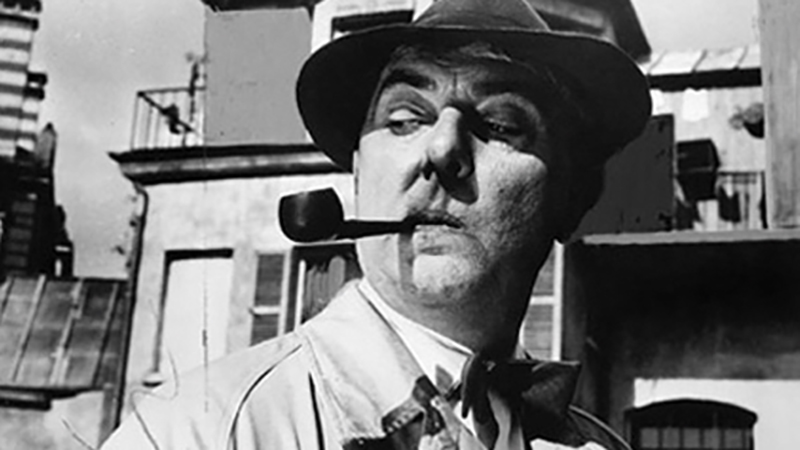
Whenever I am looking for a great crime read, my first choice is usually the late Georges Simenon, the creator of Inspector (later Superintendent) Jules Maigret. Like the author, Maigret always had a pipe in his mouth. I cannot help but think that Simenon thought of himself as his hero, but whenever I visualize the French detective, I have a different image in my mind, that of the film comedian Jacques Tati (1907-1982), Simenon’s near contemporary. (See photo below.)

I have just finished reading The Patience of Maigret [La Patience de Maigret] (1965), the 92nd Maigret in a series extending to 103 titles. Although the ones he wrote in the 1930s were brilliant, there was no noticeable falling-off with the later novels.

Maigret is in many ways the anti-Sherlock-Holmes. His cases are not solved as much through ratiocination as by a fanatical thoroughgoing diligence and its hero’s trust in the picture of the crime that emerges as a result. Near the beginning, Simenon describes Maigret going through his paces: “And yet that was how the Superintendent had succeeded with most of his investigations: climbing stairs, sniffing in the corners, having a chat here and there, and asking apparently futile questions, often spending hours in rather shady bistros.”

Comic Jacques Tati in Monsieur Hulot’s Holiday—The Very Image of the Paris Detective

At another point, he writes: “People had a mania about asking him about his methods. Some of them even thought they could analyse them and he would look at them with bantering curiosity because they knew more about it than he, who usually improvised at the whim of his instinct.”

In The Patience of Maigret, everyone is stumped. In fact, the jewel crimes at the heart of them have been going on for over twenty years, but no one could figure out who was cutting the gemstones out of their settings in order to fence the loot. The answer comes at blinding speed in response to a comment made during a phone call to the former mayor of Douai. When that happens, Maigret corrals the guilty parties and ties everything together with giftwrap for the examining magistrates who will do the heavy lifting for the prosecution.