Three Journeys West, 1859

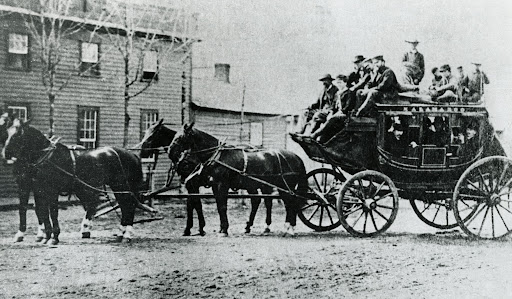
It was ten years before the completion of the transcontinental railroad in 1869. Just by chance, there were three notable journeys across the Plains to the West that year which were described in books that are still worth reading and readily available:

  • Mark Twain’s Roughing It is partly fictionalized but largely true, and it is still one of the funniest books ever written
  • Sir Richard Francis Burton’s The City of the Saints: Among the Mormons and Across the Rocky Mountains to California is mostly about a trip to visit Salt Lake City and Brigham Young, but includes the whole journey from East to West
  • Newspaper Editor Horace Greeley’s An Overland Journey from New York to San Francisco in the Summer of 1859 is not as well known but equally valuable

If you are interested in the history of the Western United States, these three books together constitute a priceless snapshot of what it was like in one particular year.

The Tao of Travel

Quito, Ecuador

One of my favorite travel books is Paul Theroux’s The Tao of Travel. When my favorite travel writer writes on the subject of travel literature, the result is nothing less than armchair satori. Take the following quote from his The Old Patagonia Express (1979), my first introduction to South America:

Travel is at its best a solitary enterprise: to see, to examine, to assess, you have to be alone and unencumbered. Other people can mislead you: they crowd your meandering impressions with their own; if they are companionable they obstruct your view, and if they are boring they corrupt the silence with non sequiturs, shattering your concentration with, “Oh, look, it’s raining” and “You see a lot of trees here.

It is hard to see clearly or to think straight in the company of other people. What is required is the lucidity of loneliness to capture that vision which, however banal, seems in your private mood to be special and worthy of interest.

Theroux’s book is full of such gems, such as this one from Mark Twain’s The Innocents Abroad (1869):

Travel is fatal to prejudice, bigotry and narrow-mindedness and many of our people need it sorely on those accounts. Broad, wholesome, charitable views of men and things cannot be acquired by vegetating in one little corner of the earth all one’s lifetime.

Here is a poetic contribution from Rudyard Kipling (“The Winners”:

Down to Gehenna or up to the Throne,
He travels the fastest who travels alone.


In Virginibus Puerisque, Robert Louis Stevenson imparts this wisdom:

Little do ye know your own blessedness; for to travel hopefully is a better thing than to arrive, and the true success is to labor.

As I return to this book, which I do often, I just want to set out for somewhere, anywhere. Well, maybe not Cleveland. Been there, done that!

Never the Twain Shall Meet

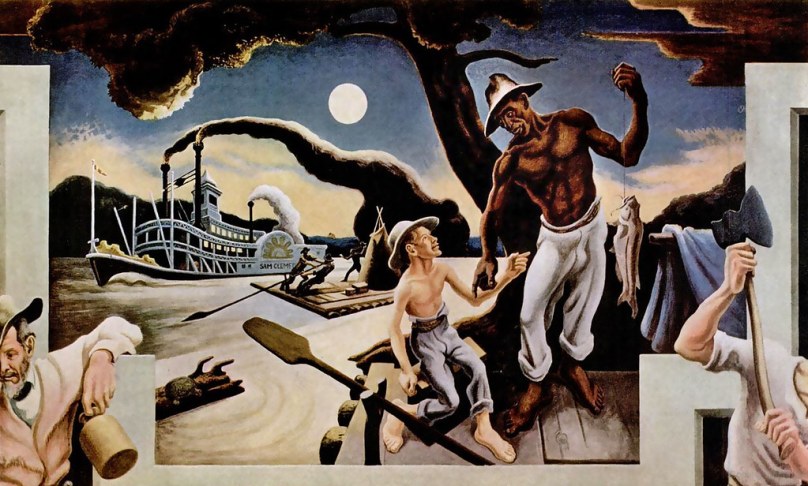
Thomas Hart Benton Mural of Huck with N-Word Jim

This is a re-post from my January 7, 2011 blog for the late unlamented Multiply.Com.

As one who has frequently been accused of speaking in an “inappropriate” way, I am still grateful that no one has attempted to apply a muzzle to my face. (Not that some haven’t been thinking about it.) If someone tried, I would resist—which is more than poor Mark Twain can do a hundred years after his death.

Unless you have spent the last few weeks visiting the moons of Jupiter, you’ve probably heard that some publisher has attempted to bowdlerize Huckleberry Finn by giving the slave Nigger Jim a more respectable name, and I don’t mean Reginald or Percival. It’s the first word of his name—the so-called N-word—that many find objectionable.

So be it! While I would never venture to call a person of color a nigger under any circumstances, I find any attempt to tinker with a great author’s work objectionable on the face of it. If the name “Nigger Jim” is objectionable, I suggest that the offended parties restrict themselves to reading kiddie books written by the oh-so-politically-correct.

You can’t wipe out the sins of the past as if with an eraser on a clean board: People thought and wrote differently then. The past, they say, is a different country.

Yet it has not stopped people from trying. In the Eighteenth Century, Shakespeare’s plays were substantially re-written before being put on the stage—just to make them more acceptable. As soon as the powder fell out from peoples’ wigs, the changes were canned and the original was restored.

So you PC types can get all het up about this nonsense. Me, I’m going to go home and read Joseph Conrad’s The Afro-American of the Narcissus.

The picture above is a detail from a mural by Thomas Hart Benton of Huck Finn and Colored-Person James from the Missouri State Museum.

The Travel Cure

Nariz del Diablo Train in Sibambe, Ecuador

I have a simple plan to cure the ignorance of most Americans who think themselves to be proud because they have lived in the same shithole all their lives. The idea came to me from reading Mark Twain, who wrote in The Innocents Abroad (1868):

Travel is fatal to prejudice, bigotry and narrow-mindedness and many of our people need it sorely on those accounts. Broad, wholesome, charitable views of men and things cannot be acquired by vegetating in one little corner of the earth all one’s lifetime.

Lest we all become too place-proud, we need to send our people to travel in the so-called Third World. And I don’t mean First Class seating on jet aircraft and staying at luxury hotels and ordering room service. I mean forcing them to take buses and trains, struggle with the language, and eat what the ordinary people eat. In every way, such an experience will open their eyes and, when they return to East Jesus, Arkansas, they will be better people for it.

And no, it isn’t an ordeal—not by a long shot! When I first started to travel, I had experience of only four places: Cleveland, Ohio (most of my life to that point); Hanover, New Hampshire (my 4 years at Dartmouth); Los Angeles (eight years at UCLA and after); and Lake Worth Florida (just a few weeks, not counting my infancy). Growing up in the Midwest, we never went anywhere for any length of time. My first whiff of Yucatán not only opened my eyes, my nasal passages, and my taste buds, but I felt I was at the beginning of a more wondrous existence.

Work kept me from traveling as much as I wanted to, but I traveled enough to have many happy memories.


“This Moldy and Piety-Mouthing Hypocrite”

King Leopold II of Belgium (1839-1909)

King Leopold II of Belgium (1839-1909)

The writer of these lines was none other than Mark Twain, whose dander was up when he learned of the mutilations and massacres in the Congo attributable to Leopold II, the King of Belgium:

In fourteen years Leopold has deliberately destroyed more lives than have suffered death on all the battlefields of this planet for the past thousand years. In this vast statement I am well within the mark, several millions of lives within the mark. It is curious that the most advanced and most enlightened century of all the centuries the sun has looked upon should have the ghastly distinction of having produced this moldy and piety-mouthing hypocrite, this bloody monster whose mate is not findable in human history anywhere, and whose personality will surely shame hell itself when he arrives there—which will be soon, let us hope and trust. [from King Leopold’s Soliloquy (1905)]

Of course, Twain had not yet seen the likes of Adolph Hitler, Josef Stalin, or Pol Pot because that was to come later.

I have just finished reading Adam Hochschild’s King Leopold’s Ghost: A Story of Greed, Terror, and Heroism in Colonial Africa. The Belgian monarch brought something new to colonialism: He designated the Congo as his personal property, making sure that all the wealth that came in went into his personal coffers. No, the Belgians did not enjoy any of that wealth directly. It went into ostentatious palaces, young concubines, and villas on the Mediterranean—all of which were his personal property. He did not even have the saving grace of being a patron of the arts. He was a patron of whatever enriched him. He even made his people “lend” him millions to develop the slave economy of the Congo.

Congolese with Their Hands Cut Off

Congolese with Their Hands Cut Off

At first, the wealth of the Congo came from ivory. It was not long, however, that Leopold realized he could have a corner in rubber. Trees had been planted throughout Asia and Latin America, but would not come to maturity for a number of years. Therefore, Leopold ruthlessly turned the Congolese to harvesting rubber from the rubber trees that grew wild throughout the region. Women and children were held as hostages while their men were sent out to bring in their quota of rubber.

Woe betide any Congolese who didn’t fulfill his quota. They were killed; they hand their hands cut off; or both—and the hostages being held were likewise brutalized.

Eventually, the world caught on to what Leopold was doing—and many other European colonial powers such as France and Germany were also guilty, but not on the same grandiose scale.