“Are You Comfortable in Bed?”

I’m More Comfortable Than HE Is, As I Don’t Sleep on Rocks

I’m More Comfortable Than HE Is, As I Don’t Sleep on Rocks

In my last batch of spam e-mail, I got one entitled “Are You Comfortable in Bed?” As my answer is yes, I did not see fit to open the e-mail, which probably sold vigara [sic] or cialas [sic] or something like that. Thankfully, I am not suffering from electoral dysfunction. Which is to say, I usually vote Democratic.

Getting eight hours of sleep a night is important to me. That is challenged by my massive intake of iced Baruti Assam tea this time of year, but I usually manage to sink back into sleep quickly after draining my lizard. Occasionally Martine and I make like buzz saws, but curiously it doesn’t bother us much. I actually feel reassured that Martine is asleep next to me; and she graciously refrains from kicking me when I start sawing wood.

Every once in a while, I have a difficult time dropping off to sleep because my mind is racing in an infinite loop. I find that the only way to deal with that is to get up and either a bit of a TV movie (the only time I watch TV) or read a book. That somehow closes the infinite loop and allows me to doze. The one thing that does not work in that case is to twist and turn for hours. Better not to even try!

I am appalled when I hear of people getting by on five or fewer hours a night. Sometimes Martine can’t sleep because of her back pain. Frequently she wakes at five in the morning and twists and turns until morning light (or later).

We have an extra firm mattress which helps Martine somewhat. And our living room sofa is similarly firm. These things help (and they don’t bother me at all), but I would be happier if Martine’s back pain abated to the point that she could accompany me on my travels. It’s a lot more fun having her with me.

With Martine at Huntington

My First REAL Weekend After Tax Season

My First REAL Weekend After Tax Season

After the beginning of February, Martine and I really didn’t go places. We pretty much stayed at home, me to psychologically prep myself for those horrible Monday mornings in tax season, after having worked both Saturday and Sunday, Martine to endure. Then, no sooner did tax season end than I found myself in the emergency room at UCLA Santa Monica Hospital with an Addisonian Crisis. This weekend, we finally went somewhere, to the Huntington Gardens and Museum, of which we are members.

It’s a good thing I wore my hiking shoes, because we put in several miles walking through the Chinese and Japanese Gardens, not to mention the herb and cactus garden. And in between, we saw the rose garden and relaxed by the lily ponds, looking at ducks and turtles.

Afterwards, I took Martine to her favorite restaurant in Southern California, Sevan Chicken in Glendale at the corner of Glenoaks and Kensington. It’s not particularly famous, but it has the best Armenian rotisserie chicken around, beating even Zankou Chicken for the honors.

Tomorrow, Martine travels to Sacramento for a few days to see her dentist and visit the grave of her mother and brother. I wanted to make sure she had her favorite dark meat rotisserie chicken before setting out.


Bad Luck With Restaurants

Sambar and Idlis

Sambar and Idlis

Los Angeles has its very own India community in Artesia, just off the Pioneer Blvd. exit on he 91 Freeway. Martine and I decided to eat lunch there and shop at the nearby Stater Brothers Supermarket. So we went to Woodlands Restaurant, which specializes in South Indian (or, to be even more specific, Keralan) cuisine. I knew I was taking a chance with Martine, because she prefers standard North Indian cuisine. While I was having a great meal with sambar (a kind of spicy vegetarian soup) and idlis (little rice “flying saucers”) and a tasty glass of salt lassi, Martine was trying all the dishes that worked for her at her favorite North Indian restaurants. Unfortunately, it didn’t work for her here: the chicken was cold, the rice pudding was hot and watery, and so on and so forth.

Add to that the fact that, not being a cook and having any real food sense, Martine usually has difficulties in the dishes she selects at restaurants. At any given restaurant—and only if she were well familiar with it—she will typically select only one, or at the most two, dishes. Since I have more food smarts, I can usually please myself at places she winds up hating. It’s a pity, because I would like to go back to Woodlands one of these days to try their uppamav, a delightful South Indian dish made with Cream of Wheat!


Re-Orienting Myself to Peru

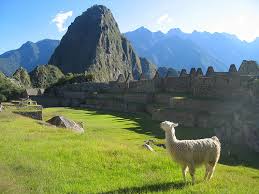
Spanish Colonial Architecture in Peru

Spanish Colonial Architecture in Lima, Peru

Because I place such a high value on traveling with Martine, I thought nothing last December of ditching my plans in an instant to visit Peru so that we could go to France and Italy. At that point, nothing was firm yet—I planned to go in September or October. (I frequently plan in advance by so many months that all my friends think that I have already gone and returned.) But continuing problems with her back, especially where soft beds are concerned, induced her to cancel the European trip.

There is never any guarantee when staying at strange hotels that your bed will be firm or mushy. Fortunately, I can tolerate a fairly wide range; but Martine’s range of acceptability is much narrower. It’s a pity, because her half-sister Madeleine in St-Lô (near the D-Day Beaches of Normandie)  is ailing and cannot travel herself.

In the meantime, I am resuming my Peru reading program, which consists primarily of:

  • Novels by Mario Vargas Llosa, Peru’s only Nobel Prize winner in literature
  • Novels and poems by other Peruvian literary notables, such as César Vallejo
  • Histories of the Spanish conquest of the Incas
  • Other Peruvian histories on subjects including the War of the Pacific, which Peru lost to Chile in the late 19th century
  • A biography of Simon Bolivar and possibly José de San Martín, the two principal liberators of South America

I don’t know how much I can read before the departure date, which has not  been set yet, but I will do my best.

All this preparation is, for me, a kind of courtesy. I do not believe in visiting another country without knowing enough of its language, culture and history to be conversant with the locals. That has helped me considerably in Argentina and Iceland. Plus, it is a pure pleasure for me to prepare a trip far enough in advance—especially during tax season, when there is little else to forward to. I have little truck with those travelers who believe in being “spontaneous” at the cost of making their fellow Americans look like dunces.

Traveling Alone

It Looks As If I’ll Be on My Own

It Looks As If I’ll Be on My Own

Martine and I had decided that, if she felt well enough to travel, we’d go together to France and Italy. If she felt unable to travel, I would go by myself to Peru and possibly Bolivia. At the end of January, we took a little test trip to the Anza-Borrego Desert in San Diego County. Although we had a firm bed, it wasn’t firm enough for Martine’s back. Fortunately, we had an air mattress that was firmer, so Martine slept on the floor. This option would not work as well for overseas travel, as both of us travel light.

On the plus side, Martine is getting better slowly; but she still depends heavily on a super firm couch and a super firm mattress for her comfort. Without these, she would be awake most of the night for all the days of our trip. Understandably, under those circumstances she would prefer to remain behind in Los Angeles.

I, on the other hand, have this great yearning for travel. The pity of it is, I will be deprived of my favorite traveling companion. I am used to this, as I have been alone in Iceland twice (2001 and 2013) and in Argentina once (2006). We will probably travel together to Southern Arizona by car—with the firm air mattress—so that Martine doesn’t get a case of cabin fever.

In the meantime, I am continuing my Peru reading program in preparation for a three week vacation there in September and October. As Rudyard Kipling wrote in his poem, “The Winners”:

Down to Gehenna or up to the Throne,
He travels the fastest who travels alone.

Most memorably, in Josef von Sternberg’s film Morocco (1930), Marlene Dietrich, writes these lines with her lipstick on a hotel room mirror before ditching Adolphe Menjou.

So I will travel faster, but I’d rather not be alone.


Diverted

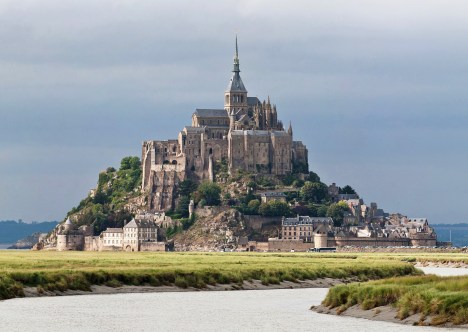
Mont St Michel in Normandy

Mont St Michel in Normandy

Yesterday was Martine’s birthday. In the mailbox was a card and letter from her half-sister Madeleine in St-Lô in Normandy. In her letter, she wrote that she hoped her sister could come and see her soon, as she is getting on in years. On a day when she should have been celebrating, there were tears in my little girl’s eyes. As it happened, I had the power to change that around. Martine is afraid of going to France alone because she is not good at transportation planning. As it happens, that is my specialty, and my French is better than hers, even though she was born in Paris.

So, I suggested to Martine that I could take a rain check on Peru and join her in France. I don’t think I could have given her a better gift. Martine started dreaming about croissants and how I could have great cheeses for breakfast (yes, I am a devoted cheese-eater). Within minutes, I came up with a plan: Fly to Paris and stay there for a couple of days while visiting her friend Angéla in Montmartre, then take the TGV direct from Gare Montparnasse to St Lô and visit Madeleine and a couple tourist sights, such as the big rock illustrated above. From there, it’s back to Paris to transfer to the TGV from Gare de Lyon to Avignon. A couple days there, then Arles, Nice, and Monte Carlo. Finally, we could take a train to the Cinque Terre in Italy for several days of peace and rest. Then a train to Milan, from which we would fly back to LAX. Martine approved on the spot.

It would have been easy for me to be selfish at this juncture, but I cannot be happy unless Martine is happy. Else my trip to Peru would have been an anxious dirge. Now there is a chance I can get Martine to accompany me to Peru in the future—if our health prevails. I think the trip to France would be a powerful motive for Martine’s back pain to disappear altogether. (So many ailments have a psychosomatic trigger.)

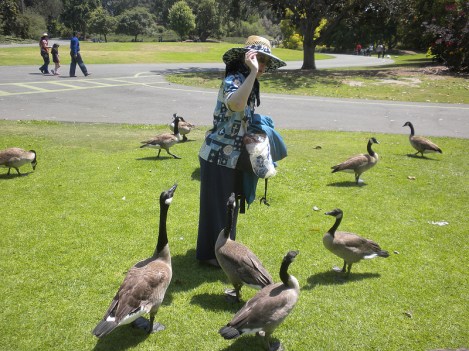
Martine Remonstrates with the Geese

Martine at the L.A. Arboretum

Martine at the L.A. Arboretum

Martine and my father have some interesting things in common. My Dad loved to feed the pigeons and, before he married my mother, had his own pigeon coop. Martine also likes to feed the birds, but she prefers ducks and especially geese.

Geese are not the most cooperative of birds. Years ago, when Martine lived in Twentynine Palms and worked at the U.S. Naval Hospital there, we used to have brunch at the Twentynine Palms Inn. On the premises, there was a little pond and some very obstreperous geese, who used to go after Martine. I would have to run at them shouting “Bo!” until they backed down. (Thus no one would claim that I couldn’t say “Bo!” to a goose.)

The last time we went to the L.A. Arboretum, Martine brought along with her a sack of stale bread which she threw at the resident geese and ducks. Predictably, the ganders were being hyper-aggressive and kept pecking at the females and beta and gamma ganders to monopolize the bread. In return, Martine would remonstrate with those geese and make a special effort to feed the better behaved birds more of the crumbs.

Anyhow, when she does that, I feel a special warmth for my little French girl. There is something so sweet about her criticizing the “bad” geese that my heart warms to her all the more.

The First Step Is Taken

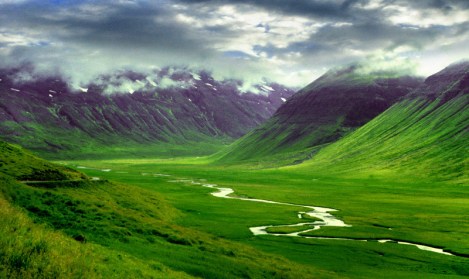
Icelandic Scenery

Icelandic Scenery

Today I finally booked my flight to Iceland. Note that I said my rather than our. Unfortunately, Martine will not be able to come with me. Ever since the beginning of the year, she has been suffering from what I think is fibromyalgia, characterized by neuromuscular pains in the neck, shoulder, and back and a difficulty with sleeping. She is currently working with a physical therapist to alleviate her symptoms. But, as things stand now, she is unable not only to carry her luggage, but to wear a purse on her shoulder. It will be a beautiful but lonely trip.

My plans are to leave in the middle of June and return early in July. I hope to see, in addition to the capital Reykjavik, the island of Heimaey, the Njals Saga country around Hvolsvöllur, the Egil’s Saga country around Borgarnes and Reykholt, the Snaefellsness Peninsula around Stykkishólmur, and the Westfjords from Isafjörður to the bird cliffs of Látrabjarg. Perhaps, if there is time, I could also visit Akureyri and the falls at Goðafoss.

My Kindle is already loaded with Icelandic Sagas, and before I leave for Reykjavik, I expect to read another half a dozen.

I could have taken the cheapest flight, but I hate being rushed from one gate to the other at a large airport, so I arranged to have four-hour stopovers in Toronto on the way out and Boston and the way back.

Iceland is beautiful, but I will miss Martine.

William of Lugos

BelaLugosiHeadstone

Headstone of Bela Lugosi at Holy Cross Cemetery in Culver City

His real name was Béla Ferenc Dezsö Blaskó, but that didn’t sound cool enough for the title role in Universal Pictures’ new film Dracula (1931). Béla, or William as it’s translated into English, was born in Lugos in then Austro-Hungarian Empire. Now it is known as Lugoj and is located in Rumania. And, just so you know, in Transylvania, near Timisoara, known by the Hungarians as Temesvár. So Béla Lugosi is none other than William of Lugos.

By the way, his name is really pronounced BAY-lah LOO-gauche-ee, with the accent on the first syllable of first and last name.

Martine has always loved Lugosi’s acting. In fact, on her favorite sweater, she wears a metal pin of a 32¢ stamp issued in his honor, as shown below:

1997 USPS Stamp Commemorating Famous Monsters of Hollywood

1997 USPS Stamp Commemorating Famous Film Monsters of Hollywood

Martine has a set of DVDs for Lugosi’s films; and when we visit Holy Cross Cemetery, we always check out his grave on a hillside near a grotto.

It always surprises me how many famous people don’t have any flowers or other marks of family or fan affection by their graves. Note, however, that there is a little votive candle by the bottom right of Béla’s headstone.

Saga Fiend

Page from One of the Icelandic Sagas

Page from One of the Icelandic Sagas

I am still contemplating going to Iceland this summer—though it may be without Martine. The poor girl has been suffering from what I think is fibromyalgia, which combines roving muscular pain in different parts of the back with the inability to get a good night’s sleep. She is currently undergoing physical therapy, which I hope moderates the symptoms, which have destroyed the last two months for her.

If Martine can come with me, we will concentrate on Southern Iceland. I will rent a car, and we will do all the sights along the southern rim of the island, from the “Golden Circle” of Thingvellir, Gullfoss, and Geysir (yes it’s a place) to the black sands of Breidamerkursandur and Skaftafell National Park. If I go alone, I will concentrate on the remote Westfjords, where I will do some serious bird-watching and hiking—and reading.

I have already loaded a collection of Icelandic sagas on my Kindle and have begun reading more of the same. So far within the last week, I have read Kormak’s Saga and The Saga of Hallfred Troublesome-Poet; I hope to re-read Egil’s Saga (which is one of the best) within the next couple of weeks.

Most of the Icelandic sagas were written in the Thirteenth Century and look back to the early days of settlement ranging from the 9th century to the introduction of Christianity around A.D. 1000 at the behest of King Olaf Tryggvason of Norway. In a way, it can be compared to the Western films that, until recently, have been made in the United States. Except for one thing: Many of the characters in the Icelandic sagas were actual people whose descendants are alive today. Many of the events, however, were quite fanciful, such as the one illustrated above in one of the old manuscripts.

In Reykjavik, I will visit the Arni Magnusson Institute for Icelandic Studies, which has an ongoing exhibit of Icelandic saga manuscripts. It was closed the last time I was in Reykjavik in 2001.

Just to show you how serious the Icelanders are about their literature, there are two museums in the country of 300,000 inhabitants dedicated to individual sagas: The Settlement Center in Borgarnes (with its permanent exhibition on Egil’s Saga) and The Icelandic Saga Center (about Njal’s Saga) at Hvolsvollur. In our nation of some 300 million inhabitants, do we have any museums dedicated to any single works of American literature?