The Flip Side of Gallup

The Gallup Inter-Tribal Indian Ceremonial

Gallup, New Mexico, in the 21st century would be nowhere without the Indians. Window Rock, Arizona, the capital of the Navajo Nation, is a short hop away across the state line. Yet, at the same time, Gallup is a dangerous place for Indians. The problem is that, with only 22,000 inhabitants, Gallup has 39 liquor licenses, or about 19 per 10,000 people—much larger than most big cities.

The Indians come to Gallup, get drunk, and frequently die. According to a 2015 article from the Indian Country Media Network:

In 2014, 36 unnatural deaths were recorded for Natives in or around the Gallup area. Almost all were alcohol related or caused from being homeless. Seventeen of those deaths were caused by motorists killing pedestrians attempting to cross major thoroughfares or I-40. Nearly all the victims were Native. This winter, too, has begun with record-setting deaths from exposure in McKinley County—12 so far; all the victims were Native.

Another lethal practice is for drunks in cold weather to lie down on the warmer asphalt highway, fall asleep, and get run over.

I have always seen Indians of the Southwest as a national treasure. Alas, it is a treasure that we have compromised by destroying their culture and leaving them to fend for themselves in the cold cruel world of contemporary America.

Why I’m REALLY Going to New Mexico

Hatch Chiles Roasting

After what I posted yesterday, I thought I’d say why I’m really going to New Mexico this summer. When you live in a particular climate zone for most of your life, you yearn for the foods of the region. As a not quite but almost native Californian, that means corn and chiles. And the best chiles in the world come from New Mexico. The joke is that there is a state question: “Red or green?” If you can’t make up your mind, there’s another answer: “Christmas” means a mixture of red and green. I will probably switch between red and green from meal to meal.

There is a nifty local restaurant site called Roadfood.Com. Take a look at the restaurants and dishes they recommend for New Mexico by clicking here. (Compare with what’s available in your state.)

Now poor Martine isn’t going to be able to eat any chiles, but she likes hamburgers and chicken and beans; so there’ll be plenty of generic American food to keep her happy.

The Frontier Restaurant Near the UNM Campus

Fortunately, there are some parts of the United States which have their own cuisine. Of particular interest to me are the shellfish of New England, the anything from Louisiana, the fried catfish and BBQ of the Southeast, and the chiles of New Mexico. All are American food at its best. Originally, I hailed from Ohio. Other than great home-cooked Hungarian food, I can’t say much good about the whole state.

Devil’s Highway

They Were Bound to Change the Name

When Martine and I have finished taking the Durango & Silverton Narrow Gauge Railroad connecting Durango with Silverton, we will head down to Gallup, NM, perhaps stopping for a few hours at Window Rock, AZ, the capital of the Navajo Nation.The road connecting Farmington, NM with Gallup used to be called U.S. 666, aka “The Devil’s Highway.” A few years back, the highway changed its number to the less apocalyptic U.S. 491.

Even 491 has a curious Biblical resonance. When Peter asked Jesus how many times shall he forgive his brother who sins against him. According to Matthew 18:22, Jesus answered him, “ I say not unto thee, Until seven times: but, Until seventy times seven.” Let’s see, that multiplies out to 490. In the 1960s, Vilgot Sjoman came out with a Swedish film entitled 491, presumably referring to the end of someone’s patience at being excessively sinned against.

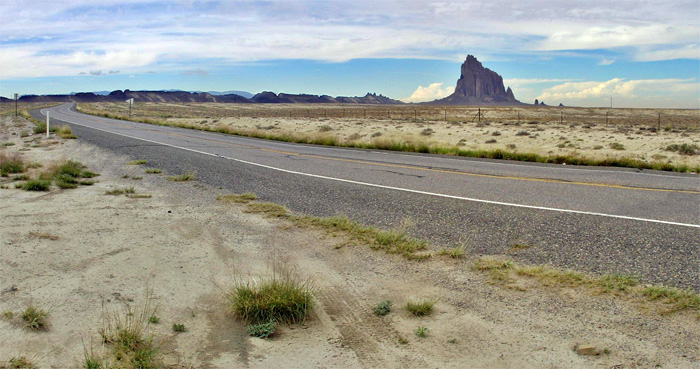
Highway 491 with Ship Rock in the Distance

When we take Highway 491 née 666, we will pass Ship Rock, sacred to the Navajos (see above photo). I’ve always wanted to take this route from Farmington to Gallup, but I usually traveled in the past via the Chaco Culture National Historical Park, which is my favorite destination in New Mexico. However, like many of the best places in New Mexico, I would not venture to take a rental car down the washboarded access road. That also goes for the Bisti Badlands and the De-Na-Zin Wilderness, all in the same general area.

Had I but world enough and time, however, ….

Very Large Array

One of 27 Giant Radio Antennas at the VLA

One of 27 Giant Radio Antennas at the VLA

One of the places that Martine and I would like to see on our trip to New Mexico is the Karl G. Janski Very Large Array some 50 miles west of Socorro along U.S. Route 60. It is part of the U.S. National Radio Astronomy Observatory (NRAO). If you are of a sci-fi turn of mind, you might think its related to SETI, the Search for Extra Terrestrial Intelligence—but actually it’s for taking images of radio waves directed at the earth. For some of the images created by the VLA, click here.

The twenty-seven 230-ton radio antennas are in one of four Y-shaped configurations and can be moved into position along rails using a special locomotive. Tours are available (we plan to take one).

Although there are many observatories in the United States, many are adversely affected by air pollution. The data from the various VLA radio antennas can be combined to give the resolution of an antenna 22 miles across with the sensitivity of a dish 422 feet in diameter.

I expect to be swept off my feet.

North America’s Own Lourdes

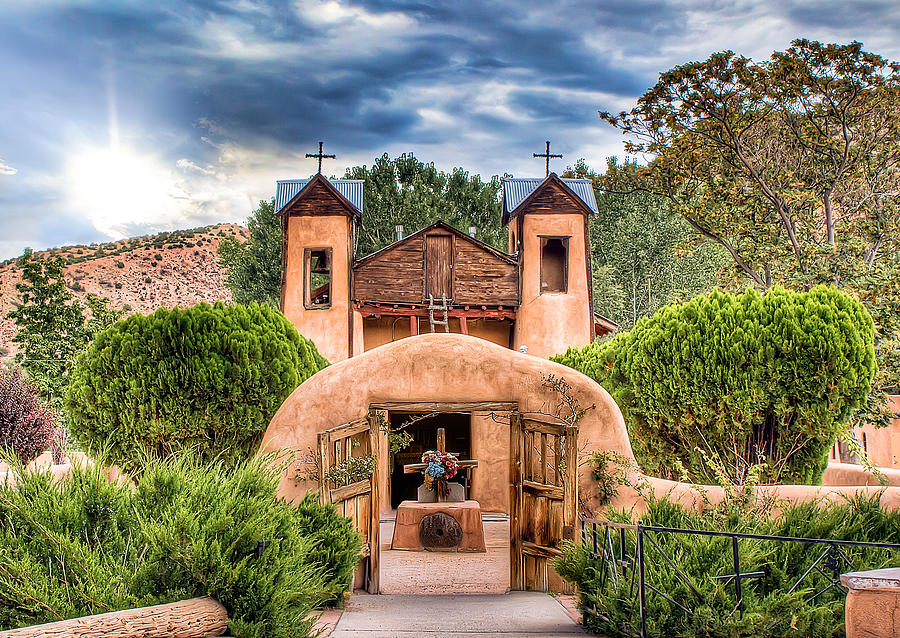
The Church at Chimayo, New Mexico

The Church at Chimayó, New Mexico

France has Lourdes; Portugal has Fatima; Argentina has Luján; Mexico has Guadalupe; and the United States has the Santuario de Nuestro Señor de Esquipulas, commonly known as El Santuario de Chimayó near Santa Fe, New Mexico. The little church is only 60 feet (18 meters) long and 24 feet (7.3 meters) wide. Yet, especially during Holy Week, some 30,000 pilgrims are in attendance.

The dirt floor has been known to have miraculous properties. Visiting pilgrims take some of the dirt for themselves or friends and relatives who are unable to visit. The church replaces the dirt, to the tune of 20 or 30 tons a year, from neighboring hillsides. The Catholic Church makes no claim as to the miraculous properties of the so-called sacred dirt.

Martine and I plan to visit Chimayo during our upcoming trip to Mexico. Maybe the sacred dirt will cure my diabetes. Or not.

Where Smokey Bear Is King

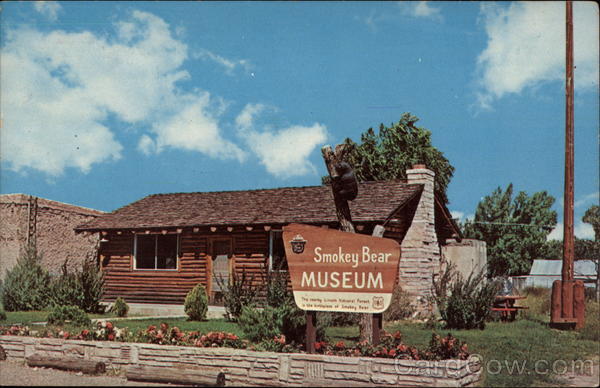
Smokey Bear Museum Capitan

Smokey Bear Museum Capitan

Everybody knows the Smokey Bear of advertising, but do you know there was a real living Smokey Bear.According to Wikipedia:

The living symbol of Smokey Bear was an American black bear three-month-old cub who in the spring of 1950 was caught in the Capitan Gap fire, a wildfire that burned 17,000 acres (69 km2) in the Lincoln National Forest, in the Capitan Mountains of New Mexico. Smokey had climbed a tree to escape the blaze, but his paws and hind legs had been burned. According to some stories, he was rescued by a game warden after the fire, but according to the New Mexico State Forestry Division, it was actually a group of soldiers from Fort Bliss, Texas, who had come to help fight the fire, that discovered the bear cub and brought him back to the camp.

Originally called Hotfoot Teddy, his name was changed to Smokey and he became a living symbol, ensconced at the National Zoo in Washington until his death in 1976. His remains were returned to Capitan, New Mexico, where there was a museum and a funerary monument in his honor.

The museum is still there, as well as a Smokey Bear Motel and a Smokey Bear Restaurant. We visited in 2003, and plan to drop in again to pay our homage to Smokey. Martine has a special devotion to Smokey. She has a special 50th anniversary stuffed Smokey Bear, as well as a zipper pull. Our refrigerator has two Smokey Bear magnets.

This Sign Appears All Over the Southwest

This Warning Sign Appears All Over the Southwest

There is even an Idaho company called Woodland Enterprises, which Martine has visited and which sells Smokey Bear (and Woodsy Owl) memorabilia. We shop there annually for gifts.

So Capitan, New Mexico, you can expect us some time this summer.

Ganging Aft Agley

I Seem to Have Miscalculated...

I Seem to Have Miscalculated…

A couple of weeks ago, I wrote a post entitled “From Chile Peppers to High Mountain Passes” in which I proposed  flying into El Paso, renting a car, driving in a more or less straight line without having to double back, and delivering the rental car in another city, say Denver or Salt Lake City.

But funny things happen when one doesn’t think things through. Can you imagine all the rental cars from an agency in Peoria disappearing down south and suddenly showing up in Miami or Houston or Chattanooga? How would the agency get the cars back? Would they ship them by rail or UPS or even truck? The cost would be prohibitive.

And the cost was prohibitive. Both Hertz and Enterprise would have charged an additional fee of over $1,500 for delivering the car to another city.

I immediately scrapped the idea and resolved instead to fly in and out of Albuquerque. To avoid doubling back, I would take a series of loops: For instance, I would drive to Chama to take the Cumbres & Tolec Railroad, Durango, Colorado, to take the Durango & Silverton, and return via Gallup and New Mexico Route 53 to see the El Morro National Monument, and on I-40, Acoma Pueblo, or “Sky City” on the way back to home base.

A second loop would take us south of Albuquerque to see Roswell, Capitan, and Alamagordo, with its great space museum.

The best laid plans of mice and men gang aft agley, or something like that.

The OTHER El Camino Real

This Camino Real Was Nowhere Near the Ocean

This Camino Real Was Nowhere Near the Ocean

If you drive north on U.S. 101, you will see scads of quaint mission bell markers identifying it as El Camino Real—and so it was! But it was not the only one. There is another one, every bit as picturesque but far deadlier, through the heart of New Mexico. It is called El Camino Real de Tierra Adentro, “The Royal Road to the Interior Lands.” These interior lands consisted primarily of the city of Santa Fe together with its constellation of pueblos.

Picture New Mexico as being divided into six roughly equal size vertical rectangles, three in the north and three in the south. The south central one is the northern reach of the Chihuahuan Desert, usually referred to as the Jornada del Muerto, the Journey of the Dead. The Chihuahuan Desert proper extends for 1,200 miles south to the Mexican State of Zacatecas. The rightmost two-thirds of the rectangle is occupied by the White Sands Missile Range.

The leftmost one-third of that rectangle includes the Rio Grande River, the El Camino Real de Tierra Adentro, and a lot of desolate, searing nothingness.

The Jornada del Muerto

The Jornada del Muerto

Martine and I will probably intersect the Jornada del Muerto from East to West as we travel along U.S. 380, right past where the first atomic bomb explosion occurred at the now (mostly) closed Trinity Site. We will be leaving Capitan, New Mexico, and heading northwest to Albuquerque, where we will stay for a few days.

I am now reading Alan Boye’s Tales from the Journey of the Dead: Ten Thousand Years of an American Desert (Lincoln: University of Nebraska Press, 2006), which examines the route along the Rio Grande to Mexico throughout history from Clovis and Folsom Man through to the Manhattan Project. In addition, the author describes his own jaunts through the Jornada today in an effort to give a feeling for the fierceness and beauty of the land.

From Chile Peppers to High Mountain Passes

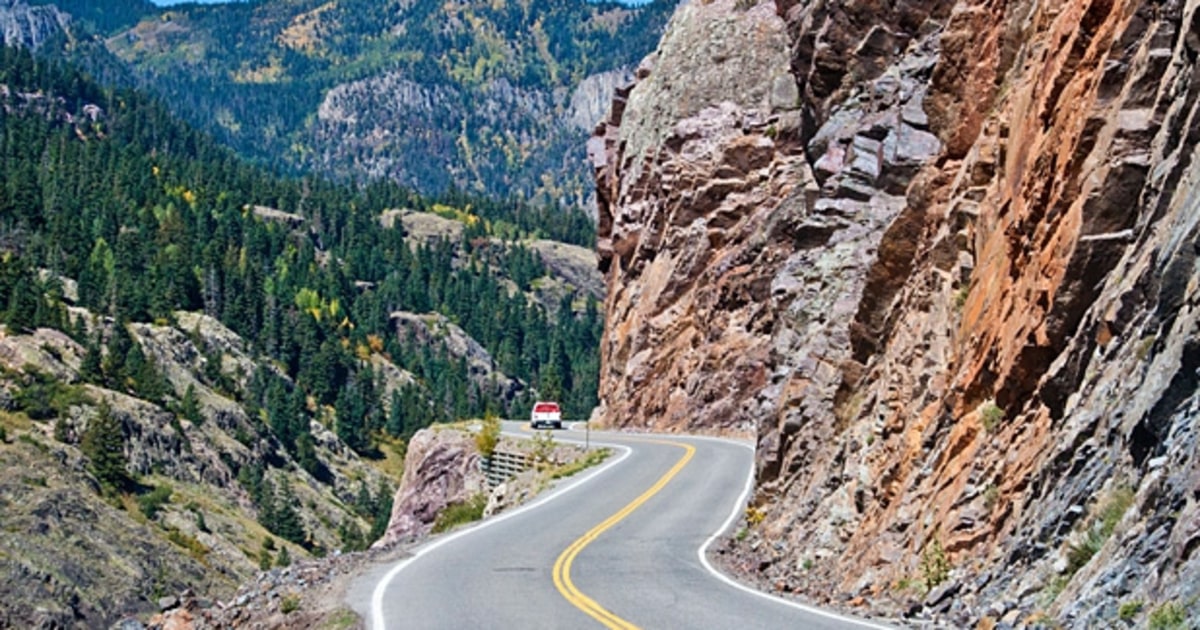
A Stretch of the Million Dollar Highway in Colorado

A Stretch of the Million Dollar Highway in Colorado

Is it too early to start planning my next vacation? Not at all—especially since Martine agreed to come with me this time, but only if I limited it to two weeks. “I could do this,” I thought. Some years ago, we traveled through Arizona, New Mexico, and bits of Utah and Colorado. I thought we could take a shorter version, timewise, at least.

I thought we could fly into El Paso, rent a car, and drive north to Alamogordo with its space museum and Capitan, a village dedicated to its most famous resident, Smokey Bear. There we will stay at the Smoky Bear Motel, dine at the Smokey Bear Restaurant, and certainly visit the Smokey Bear Museum. (Martine loves Smokey Bear.)

Then it’s north to Albuquerque, where we’ll stay for several days and maybe take side trips to Acoma, one of the two oldest continuously inhabited places in North America (the other is Old Oraibi on the Hopi Reservation in Arizona) and El Morro National Monument. Perhaps we will also re-visit the Wild Spirit Wolf Sanctuary in nearby Ramah. And while in Albuquerque, I will drink deep of the smoldering juices of red and green chiles—the best in the world.

From Albuquerque, we head north to Chimayo to visit its famous Sanctuary and on to Chama. Thereupon, we will take a ride on the Cumbres & Toltec Scenic Railroad, which runs between Chama, NM and Antonito, CO. Next on the roster will be a ride on the Durango & Silverton Narrow Gauge Railroad. Yes, I am a railroad fanatic

From Silverton we drive north on one of the most dangerous stretches of roadway in the United States, the Million Dollar Highway to Ouray, CO.

Finally, we’ll make our way to Denver, from where we fly back to Los Angeles.

One of the nice things about so-called “open jaws” flights is that you do not have to spend any time backtracking. Originally, I thought of flying to and from Albuquerque, a city I dearly love; but half the time we would be backtracking from side trips. This way, it’s all on a more or less straight line from El Paso to Denver.

“What about White Sands, Santa Fe, Chaco Canyon, Taos, and Mesa Verde?” you might ask. Martine and I have been there, and we are concentrating on places we haven’t visited.