
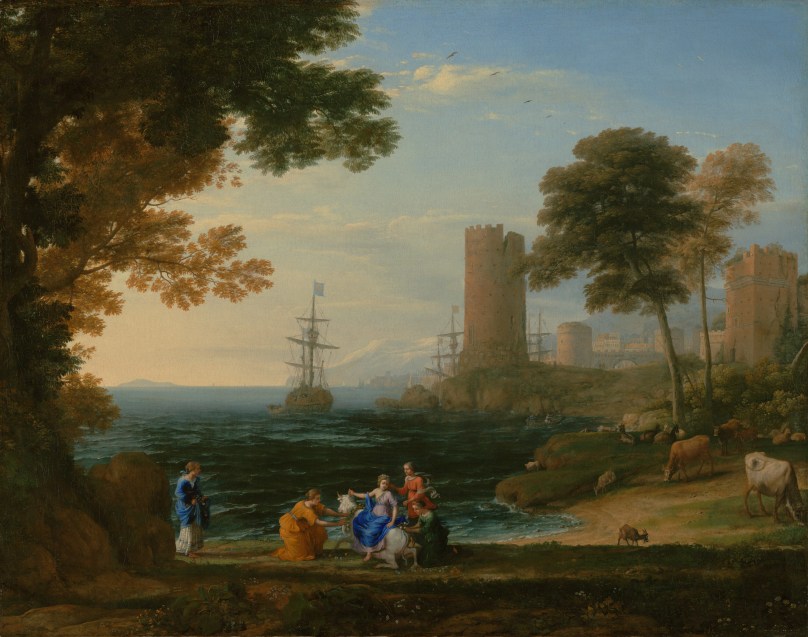
“The Harmonious Universe of His Soul”

Claude Lorrain’s “Coast View with the Abduction of Europa”

Goethe perhaps said it best: “Claude Lorrain knew the real world by heart, down to the minute details. He used it as a means of expressing the harmonious universe of his soul.”

Both Lorrain (1604-1682) and Nicolas Poussin (1594-1665) made a career of creating peaceful canvases that draw the viewer’s eye in and leave him or her in a meditative state. That is the case even though the subject matter of the above painting is of a violent rape:

The Abduction of Europa is a classical myth from Ovid’s Metamorphoses, in which Zeus transforms himself into a white bull to abduct the Phoenician princess Europa. He lures her onto his back and carries her across the sea to the island of Crete, where they have children, including Minos, who become the first king of Crete and one of the divine judges of the underworld.

Rembrandt also painted the scene in a much more dramatic fashion, but in Lorrain’s painting, it is almost an afterthought—as if it could have been replaced by dancing Naiads or a shepherd with his flock with no loss in overall effect.

Every time I visit the Getty Center in the Santa Monica Mountains, I feel a frisson of excitement as I take a fresh look at the museum’s incredible collection.

A Calm and Serene Time

Nicolas Poussin’s “Landscape with a Calm” (ca. 1650)

I choose to translate the title of painting as “A Calm and Serene Time” (from the French “Un temps calme et serein”). Ever since I first ran into his paintings at the Cleveland Museum of Art as a high school student, I have loved the work of Nicolas Poussin and his near contemporary Claude Lorrain (about whom in a follow-up post).

The 17th century in France has always been a special interest of mine, and Lorrain, Poussin, and a handful of others have only engaged my interest the more in the intervening years.

According to the description on the Getty Center’s website”

In the late 1640s and early 1650s, at the height of his artistic maturity, Nicolas Poussin turned from historical narrative to landscape painting. Landscape with a Calm does not illustrate a story but rather evokes a mood. The ordered composition and clear, golden light contribute to A Calm’s utter tranquility, while glowing, gem-like colors and fluid paint strokes enliven this scene of benevolent nature. Poussin’s sketching campaigns in the Roman countryside with his friend and fellow landscape painter Claude Lorrain account, in part, for its fresh observation of cloud-scattered sky and grazing goats.

The peacefulness of this image and its subtle classical overtones makes me regard this as one of my favorite paintings at the Getty Center.