On my kitchen table right where I sit to eat my meals are ten travel guides by Lonely Planet and Moon Travel Guides. Now that I’ve canceled my newspaper subscription, I spend a lot more time fantasizing about possible future trips. Since I am 81 years old and living on a fixed income, am I kidding myself? Maybe, but dreaming about travel is almost as much fun as travel itself.
My latest fantasy itinerary starts in the northernmost seaport in Chile, Arica, known for its surfing. The city used to belong to Bolivia, which at the time had access to the Pacific; however, in the 1880s, there was a bird poo war involving Chile, Bolivia, and Peru. It literally was about access to bird droppings for use as agricultural fertilizer. (It’s amazing sometimes how so much warfare is due to lust for various types of shit.) Peru and Bolivia lost, probably due to naval help for Chile from Britain.
From Arica, I would take a La Paloma bus to the village of Putre, which woulkd take me from sea level to an elevation of 11,060 feet (3,371 meters) within a couple of hours. There I would adjust myself to the altitude by reading a good book for a day or two while I felt slightly ill from soroche (altitude sickness).
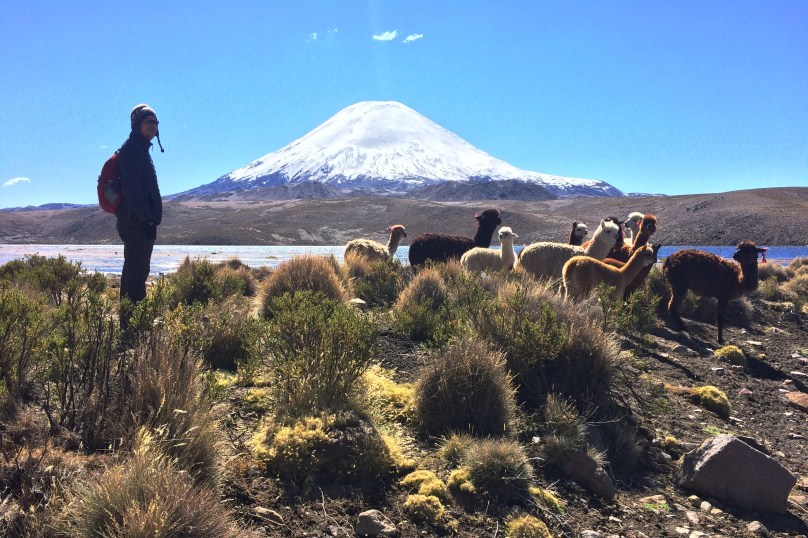
I would hire a tour guide in Putre to take me to the Parque Nacional Lauca, which is a region of snowcapped volcanoes and alpine lakes with wild vicunas and alpacas. Nearby are other high-altitude Andean parks.
From Putre, I could take a bus to La Paz, Bolivia, where I could rest a day or two before making my way to the ruins of Tihuanacu and the city of Copacabana on the eastern shore of Lake Titicaca. From there it is a quick bus trip to Puno in Peru, where I spent several days in 2014 on the western shore of Titicaca. If I am so minded, I can easily get from Puno to Cuzco and Machu Picchu and ultimately to Lima.
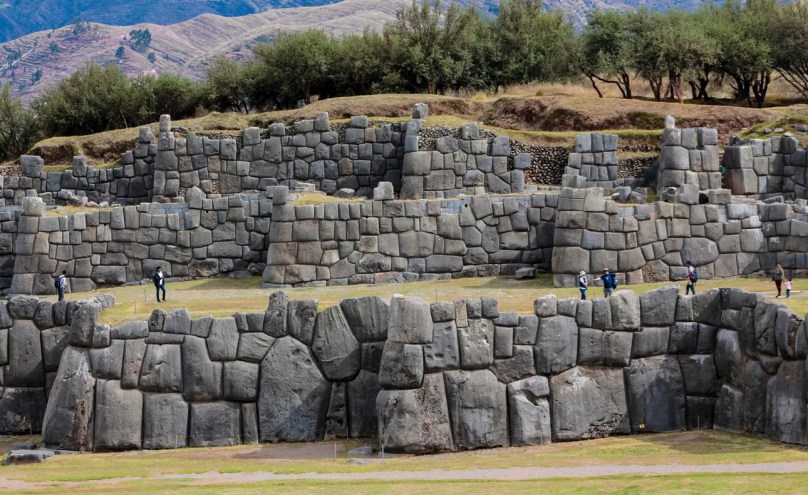
To a generation of Gringo tourists visiting Peru, the impressive ruins at Sacsayhuaman near Cuzco were as often as not pronounced “Sexy Woman.” This will probably persist as long as Americans refuse to learn the intricacies of the Quechua language. When I visited Peru in 2014, I never made it to Sacsayhuaman. I wish I had. I have just finished reading George Woodcock’s Incas and Other Men: Travels in the Andes about a six week trip he took in the Summer of 1956. In it, he had some interesting things to say on page 199 about Sacsayhuaman:
But in fact nothing less than the elaborate centralized organization of the Inca realm at its peak of power could have embarked on such a project [as Sacsayhuaman], and modern scholars are now agreed that the fortress represents the master work of the great public engineers of the fifteenth century. Victor von Hagen, who examined the evidence critically, suggests in his Realm of the Incas that it was started around 1440, not long after Pachacuti began his campaigns of conquest, and that construction took seventy years and employed about 30,000 men, recruited by the mita system of forced labour. The stones seem to have been dragged to the site by teams of men using wooden rollers (presumably brought from the montaña since few trees grew around Cuzco until the eucalyptus was introduced a few decades ago), and to have been placed into position by a complex system of levers and earth ramps. The final shaping and fitting, other archaeologists have suggested, may have been done, after a rough cutting to size, by rubbing the stones against each other, with sand and water between their edges. Again it is largely conjecture, but whatever the methods used to assemble these gigantic walls, their patterns of vast polygonal surfaces have an extraordinary beauty which, combined with the massiveness of the fortress as a whole, make Sacsayhuaman by far the most dramatic building in Peru.
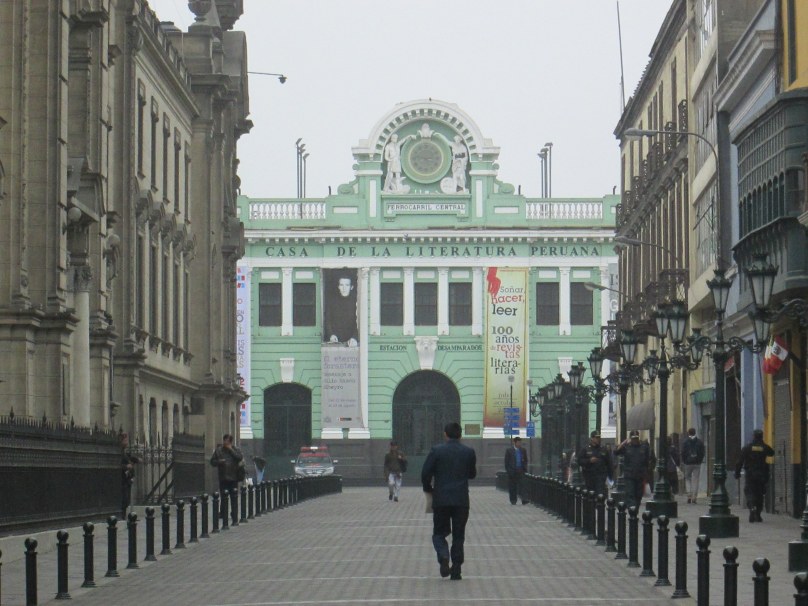
Lima Peru Looking Toward Desamparados Railway Station
As I read George Woodcock’s 1959 book about his travels in Peru (Incas and Other Men), I am reminded about what Herman Melville wrote in Moby Dick about the City of Kings:
Nor is it, altogether, the remembrance of her cathedral-toppling earthquakes; nor the stampedoes of her frantic seas; nor the tearlessness of and skies that never rain; nor the sight of her wide field of leaning spires, wrenched cope-stones, and crosses all adroop (like canted yards of anchored fleets); and her suburban avenues of house-walls lying over upon each other, as a tossed pack of cards;—it is not these things alone which make tearless Lima, the strangest, saddest city thou can’st see. For Lima has taken the white veil; and there is a higher horror in this whiteness of her woe. Old as Pizarro, this whiteness keeps her ruins for ever new; admits not the cheerful greenness of complete decay; spreads over her broken ramparts the rigid pallor of an apoplexy that fixes its own distortions.
Even knowing in advance Lima’s reputation as the Gray City, I wound up loving the place. It is a city of saints (count them: four!), churches, culinary delights, and a park full of friendly stray cats (Parque Kennedy in Miraflores). I wound up spending a week there on my 2014 trip to Peru.
If you are interested, you can read my blogs beginning on September 8, 2014 by clicking On to Peru and following subsequent posts.
This is a re-post of a blog I wrote ten years ago this month about my visit to the Chapel of St Martin de Porres in Lima, Peru.
He is usually depicted in the garb of a Dominican lay brother, holding a broom, and with a dog, a cat, and a mouse at his feet. St. Martin de Porres is one of my favorite saints. My memories of him go back to grade school, years before Pope John XXIII canonized him in 1962.
The following is taken from Ricardo Palma’s Peruvian Traditions and tells the story of his three pets:
And from the same dish ate a dog, a cat and a mouse.
With this couplet we come to the end of an account of the virtues and miracles attributed to Friar Martín de Porres. It was actually a broadside that was circulated in Lima about the year 1840 for the purpose of celebrating in our cultured and very religious capital city the solemn activities related to the beatification of this miracle worker.
This holy man, Friar Martín, was born on December 9, 1579, the natural son of the Spaniard Don Juan de Porres, Knight of Alcántara, and of a Panamanian slave. When he was still very young little Martín was taken to Guayaquil, where in a school in which the teacher made good use of the whip, he learned to read and write. Two or three years later his father and Martín returned to Lima and the boy was placed as an apprentice, learning the trade of barber and bloodletter in a barbershop on Malambo Street.
Martín wasn’t very adept with the razor and the lancet and this kind of work didn’t appeal to him so he opted for another career—that of sainthood, for in those days the career of a saint was just as legitimate a profession as any other. He took the habit of a lay brother at the age of twenty-one in the Monastery of San Domingo and remained there until he died in the odor of sanctity on November 3, 1639.
While he lived, and even after death, our countryman Martín de Porres performed miracles on a wholesale scale. He performed miracles as easily as others compose verses. One of his biographers (I don’t remember if it is Father Manrique or Doctor Valdés) says that the Prior of the Dominicans had to prohibit his continuing to perform miracles or milagrear (forgive me the use of the word). And to prove how deeply rooted in Martín the spirit of obedience was, on one occasion while he was passing a mason working on some scaffolding the worker fell a distance of some twenty-five to thirty feet. But while he was still in mid-air Martín stopped his fall—and there was the man suspended above the ground. The good Friar shouted, “Wait a moment, brother,” and the mason remained in the air until Martín returned with permission from his superior to complete the miracle.
That’s a doozy of a little miracle, don’t you agree? Well, if you think that one is great, wait until you read the next one.
The Prior sent the extraordinary lay brother on an errand to purchase a loaf of sugar for the infirmary. Perhaps he didn’t give Martín sufficient money to buy the white refined type so he returned with a loaf of brown sugar.
“Where are your eyes, Brother Martín,” said the Father Superior. “Can’t you see that it is so dark that it’s more like unrefined sugar?”
“Don’t get upset, Reverend Father,” answered Martín slowly. “All we have to do is wash this loaf of sugar right away and everything will be fine.”
Without allowing the Prior to argue the point the Friar submerged the loaf of sugar in the water in the baptismal font, and when he pulled it out it was white and dry.
Hey! Don’t make me laugh! I have a split lip!
Believe it or make fun of it. But let it be known that I don’t put a dagger at anyone’s breast forcing him to believe. Freedom must be free, as a newspaperman of my country once said. And here I note that because I had intended to speak of mice under Martín’s jurisdiction, I went off on a tangent and forgot what I was doing. That’s enough for the prologue; let’s get right down to business and see what happened to the mice.
* * *
Friar Martín de Porres had a special predilection for mice, unwelcome guests who came for the first time, it appears, with the Conquest, because until the year 1552 no mention of them was made. They arrived from Spain in a boat carrying codfish that had been sent to Peru by a certain Don Gutierre, Bishop of Palencia. Our Indians gave them the name hucuchas, which means creatures that came from the sea.
During the time that Martín was serving as a barber a mouse was still considered a curiosity, for the mouse population had just begun to multiply. Perhaps it was during that period that he began to concern himself with the welfare of the little animals, seeing in them the handiwork of God; that is to say he could see a relationship between himself and these small beings. As a poet put it:
The same time that God took to create me He also took to create a mouse, or perhaps two, at the most.
When our lay brother served as a male nurse in the Monastery the mice overran everything and made a nuisance of themselves in the cells, the kitchen and the refectory. Cats, which made their presence known in 1537, were scarce in the city. It is a documented fact that the first cats were brought by Montenegro, a Spanish soldier who sold one in Cuzco for 600 pesos to Don Diego de Almagro, the Elder.
The friars were at their wits’ end with the invasion of the little rodents and invented various kinds of traps to catch them, but with little success. Martín put a mouse trap in the infirmary and one rascal of a mouse who was inexperienced, attracted by the odor of some cheese, found himself trapped. The lay brother freed him from the trap, and then placing him in the palm of his hand said to him, “On your way, little brother, and tell your companions not to bother the friars in their cells. From now on all of you stay in the garden and I promise to take food to you every day.”
The ambassador complied with his mission and from that moment the mob of mice abandoned the cloister and took up residence in the garden. Of course Martín visited them every morning carrying them a basket of leftovers and other food and they would come to meet him as if they had been summoned by a bell.
In the cell Martín kept a cat and a dog. Through his efforts he had succeeded in having them live together in fraternal harmony, to such an extent that they both ate from the same dish.
One afternoon he was watching them eat in holy peace when suddenly the dog growled and the cat arched its back. What had happened was that a mouse had dared to stick its nose outside of its hole, attracted by the smell of the food in the dish. When Martín saw the mouse he said to the dog and cat, “Be calm, creatures of God. Be calm.” He then went over to the hole in the wall and said, “Come on out, brother mouse, have no fear. It appears that you are hungry; join in with the others. They won’t hurt you.” And speaking to the dog and cat he added, “Come on, children, always make room for a guest; God provides enough for the three of you.”
And the mouse, without being invited, accepted the invitation, and from that day on it ate in love in the company of the cat and dog.
And…, and…, and… A little bird without a tail? What nonsense!
Francisco Pizarro (1478-1541), Conqueror of the Incas
The two great Spanish conquerors of pre-Columbian civilizations could not have been more different from each other. Hernán Cortés was born of lesser Spanish nobility in Medellín, Castile. According to Bernal Díaz del Castillo, who served with him at the conquest of the Aztecs:
He was of good stature and body, well proportioned and stocky, the color of his face was somewhat grey, not very cheerful, and a longer face would have suited him more. His eyes seemed at times loving and at times grave and serious. His beard was black and sparse, as was his hair, which at the time he sported in the same way as his beard. He had a high chest, a well shaped back and was lean with little belly.
He was also fairly well educated, though his parents had despaired of making a lawyer out of him, though he did serve for two years as a notary, which did equip him with a legal background of sorts.
Francisco Pizarro, the conqueror of the Incas of Peru, was actually the second cousin once removed of Cortés, though nowhere near as well educated. In fact, he was illiterate as well as being illegitimate. Moreover, he was such a poor horseman that he confused Atahualpa, the Inca, because he was always on foot.
Where Pizarro’s background shows is that while Cortés wrote at great length to the King of Spain to justify his behavior in New Spain (Mexico and Central;America)., Pizarro never wrote anything. In addition, many of his soldiers were equally illiterate. In fact, when Agustín de Zarate was sent by the King to investigate the Inca conquest, he was forbidden by Francisco de Carvajel, a lieutenant of Gonzalo Pizarro’s, to “record his master’s deeds.” Zarate did it anyhow, but from the safety of His Majesty’s Dutch domains.
Did the difference between the two conquerors have any positive results for the conquered? Not at all. The record of misery for the native peoples of the New World was in both cases marked by death, disease, cruelty, and slavery.
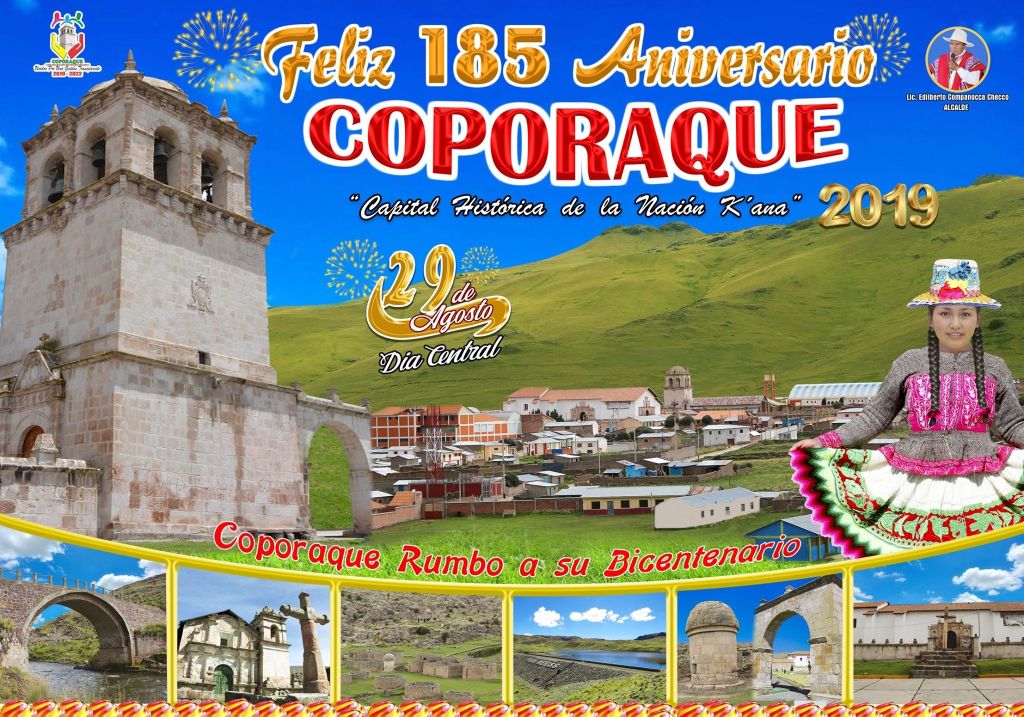
Poster Celebrating the 185th Anniversary of the Town
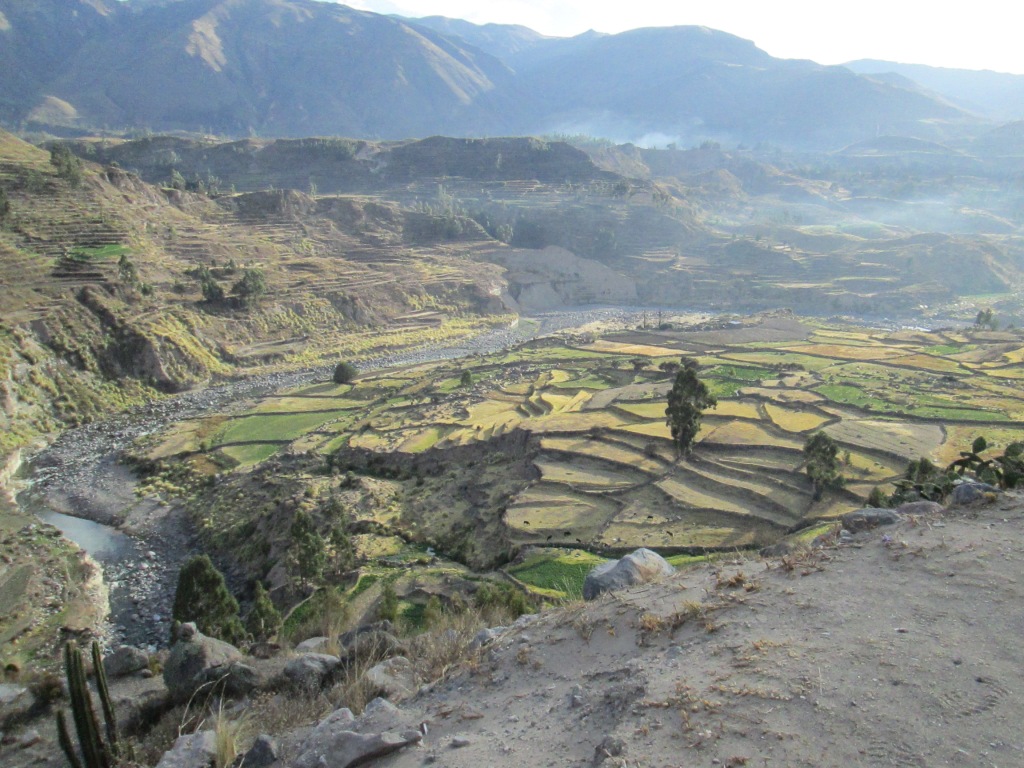
Now that I am retired and living on a fixed income, I like to remember some of the places I’ve been that impressed me. I spent only one night and part of two days in Coporaque, Peru near the north rim of Colca Canyon, but I wound up liking it more than Machu Picchu.
The area is split betweeen three ethnic groups: the Cabanas, the Kollawas (Collaguas), and the Ccaccatapay. The Canyon at its deepest point 3,400 meters or over 11,000 feet , almost twice the depth of Arizona’s Grand Canyon. Curiously, it’s not even the deepest canyon in Peru: nearby Cotahuasi Canyon wins that honor.
What comes to mind when I remember my visit to the area is that it is surrounded by volcanoes, one of which—Sabancaya—is in a permanent state of eruption. The terracing for agriculture goes back to the Incas.
Agriculture Terraces Going Back to the Incas
I wouldn’t mind going back to Colca Canyon, even though its 11,000-foot altitude requires that I chew coca leaves to avoid keeling over. En route to the canyon, we went over a mountain pass at Patapampas where the altitude was over 15,000 feet (4,572 meters). As I stepped out of the van to check out the view, I started to fall flat on my face, but was prevented from doing so by our Peruvian guide.
Wait a Sec! Pre-Columbian Warriors Had No Iron or Steel
I have been reading (and enjoying) Hugh Thomson’s A Sacred Landscape: The Search for Ancient Peru. In it, he discusses the nature of warfare during the Sechin culture (1800-1300 BC).
Before coming to Sechin I had talked to Henning Bischof, the distinguished German archaeologist now in his late sixties who had done pioneering work at Cerro Sechin between 1979 and 1984. Together with Peruvian colleagues, he had been the first to establish an accurate radiocarbon figure for the site, when they had found a wooden post supporting one wall and dated it around 1500 BC. I asked him about the intense debate on the meaning of the frieze [depicting human sacrifice].
What you have to remember,” said Henning in slightly accented but perfectly grammatical English, “is what was happening to Peru when all these different interpretations were being made.” He argued that Peruvian archaeology reflected political events far more than has ever been acknowledged. While the military governments of the sixties and seventies held sway, they welcomed a purely military interpretation of the frieze—Peru’s great military past, so to speak, which they were inheriting—“and that interpretation is precisely what the archaeologists gave them.”
But as Henning pointed out, there was a real problem with any interpretation of the frieze as military: without iron, the weapons available for actual warfare to the people of Sechin would never have been able to achieve such clean-cut savagery, Speaking in his precise German accent, Henning said: “It would have been impossible to cut off limbs in combat. You must remember that it is time-consuming work to disassemble a human body.” Any warfare would have been a far cruder process of slings and battering stones.
After Chachapoyas, my Northern Peru has one more destination to its farthest point, back to the coast to Chiclayo. The bus ride to Chiclayo is nine hours. Nine easy hours. No two mountain passes at Himalayan-like altitudes to cross on a dicey road hovering at the edge of a precipice like the one between Cajamarca and Chachapoyas.
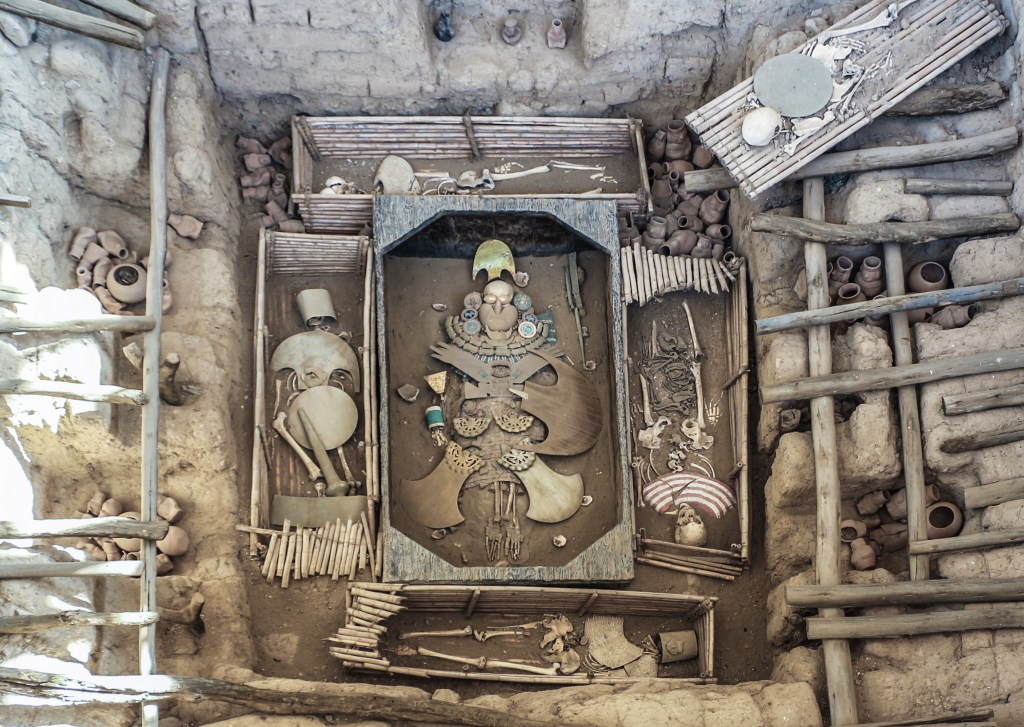
Also, we are in the land of the Moche, whose lifelike sculptures I have noted in an earlier post. As with Trujillo, there are numerous ruins, particularly those of Sipán, and museums to visit at Lambayeque, Ferreñafe, and Túcume.
And then it will be time to return to Lima. Chiclayo has an airport, but it is not an international one, so I will have to fly out of Lima’s Jorge Chávez Airport. So I could fly to Lima via Avianca or LATAM. Or I could even take a 12-14 hour bus trip arriving in Lima with a burst bladder.
What will I have accomplished with this trip, should I decide to eventually take it? Peru, Guatemala, and Southern Mexico were the homes of great urban civilizations—none of which had managed to invent the wheel. The Maya of Mexico and Central America did, however, develop a form of hieroglyphic writing. The civilizations of Peru did not, but they were nothing short of amazing with all their closely packed mountain civilizations. In the end, there is far, far more to Peru than just the Inca. They were just the final pre-Columbian civilization before the Spanish Conquistadores rode into town and took over.
As with the bus trip from Cajamarca to Chachapoyas, I am not sure I am in good enough physical shape to visit the mountaintop ruins of Kuelap. While the city of Chachapoyas presents no particular challenges, the journey to Kuelap consists of multiple parts:
Bus from Chachapoyas city to the Kuelap Cable Car Station (approximate time: one hour)
Take a private bus to the cable car platform (included in cost of ticket)
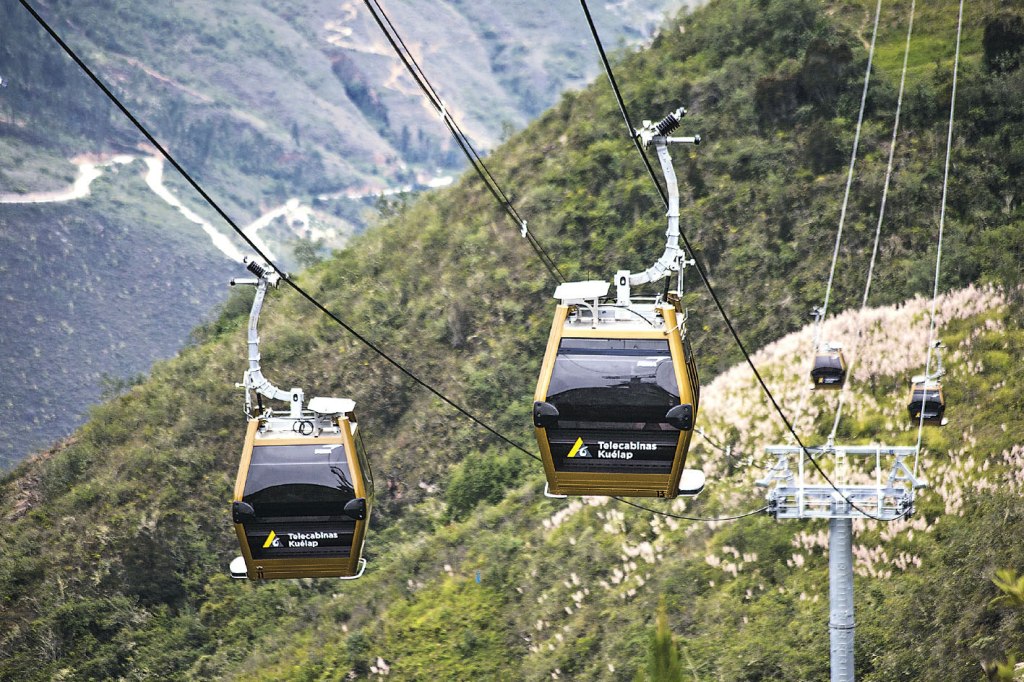
Ride the cable car 4,400 meters (14,435 feet) to the station at the top of the cable car route
Either walk or ride horseback to the entrance to the ruins
i
Two Kuelap Cable Cars Passing Each Other
What is so interesting to justify an arduous all day trip to ma mountaintop ruined city? Although they were conquered by the Incas, the Chachapoyas were an amazing people. These so-called cloud warriors controlled the swath of land around the city of Chachapoyas for a thousand years, until the Inca overcame them. Kuelaps’s “were thought to be great warriors, powerful shamans, and prolific builders who were responsible for one of the most advanced civilizations of Peru’s tropical jungles” (Lonely Planet).
I was hooked when I saw an episode of Lost Cities Revealed with Albert Lin in which the host used a drone and special archeological software to study the extent of Chachapoya civilization that digitally eliminated the foliage cover of the mountains to reveal ancient building sites.
Peru is eager to make Kuelap a popular tourist destination, as Machu Picchu is being worn away by the crush of foreign tourism. This whole itinerary as envisaged by me is a search for alternative destinations, some of which in their own way are as spectacular as Machu Picchu or perhaps even more so.
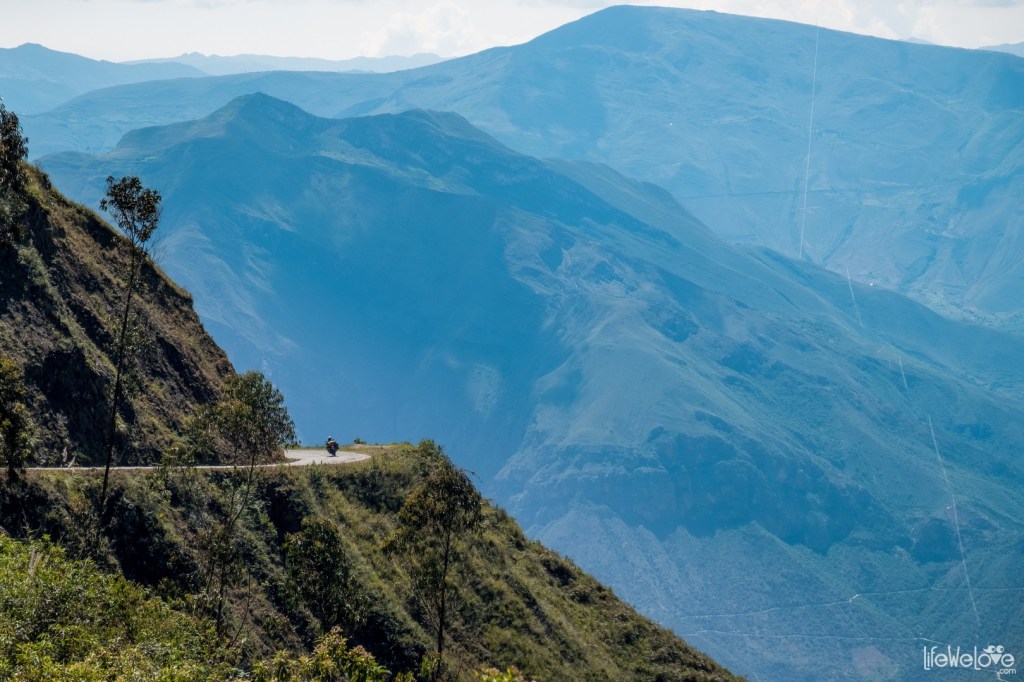
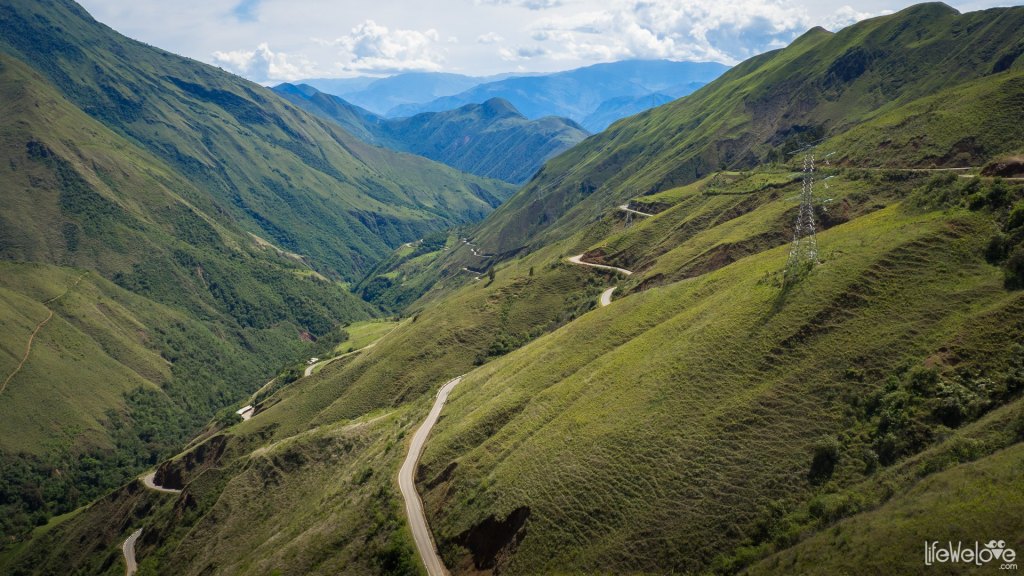
In my perhaps pipe dream (perhaps actual) plans to visit the pre-Columbian ruins of Northern Peru, the one big question is the side trip to Chachapoyas. The Andes at that point consist of a number of parallel mountain ranges. From Cajamarca (at 2,750 meters or 9,022 feet), one goes over a mountain pass of 3,085 meters (or 10,121 feet) to Balsas before tackling Abra de Barro Negro (“Black Mud Pass”) at 3,678 meters or 12,067 feet. From there, one can see the Rio Marañon, which is a tributary of the Amazon. A quick look at the map for this part of the trip will give you a general idea:
The Wiggly Line of Route 88
An even more specific look at the route:
Yup, It’s the Same Road
From what I understand, Route 88 is paved all or most of the way, but there are frequent floods and landslides during the rainy season, which runs from November to April. There is, I believe, one bus per day along this route from Cajamarca to Chachapoyas at 4 :00 AM using the Virgen del Carmen bus line.
This road is by no means the end of my troubles, as you shall see when the discuss the ruins of Kuelap. In fact, I will probably overnight at Leimebamba on the way, visiting their famous museum. My nerves will be plenty jangled by then, especially if I sit on the left hand side of the bus.






 Tarnmoor
You must be logged in to post a comment.