Costa, Sierra y Selva II

Physical Map of Ecuador

Physical Map of Ecuador

This is a kind of continuation of a blog I wrote a couple of years ago about Peru. In so many ways, Ecuador is a continuation of Peru—in terms of physical geography. Even a cursory glance at the above map shows that there are three distinctive zones vertically dividing the country:

  • Costa. This is the Pacific coast. While in Peru, much of the coast is a rainless desert, much of the Ecuadorian equivalent is a mangrove forest (I suspect perhaps mangrove swamp is a more appropriate term.). Guayaquil, the country’s largest city, is on the coast.
  • Sierra. The brown and purple zone occupying the center are the mountains and volcanoes of the Andes. This is where my brother and I will travel. The altitude ranges from 8,000 to 15,000 feet. The capital, Quito, is in this zone.
  • Selva. The pale green zone to the right of the Andes consists of jungle and a number of tributaries feeding the Amazon. Thanks the the mosquito population and the prevalence of Zika, I have no intention of seeing the Oriente region, as it is frequently called.

When I was in Peru, I spent a good part of the trip along or near the coast—especially since I fell in love with the raffish charms of Lima and the beauty of Arequipa and its volcanoes.


Pining for the Andes

There Is No Place Like the Andes

There Is No Place Quite Like the Andes

In less than a month’s time, my brother Dan and I will be landing in Quito, Ecuador. After a few days in the capital, we will rent a car and take to the Pan-American Highway north to Otavalo and south to Cuenca. The photo above is from my 2014 trip to Peru and taken in the town of Chivay, near Colca Canyon.

Unlike most of my solo trips, I am not planning all accommodations in advance. For one thing, we will have a car. For another, Dan always thinks I am the opposite of spontaneous. That’s all right with me, because there are compensations being with my brother. Anyhow, he will leave after two weeks, and I have a whole week to be unspontaneous in my own inimitable way.

I see Ecuador as being very similar to Peru, except not quite as high up and therefore not quite so cold. At Chivay and Patapampa, I was close to 15,000 feet (4,600 meters). When I got out of the van, I felt like pitching forward and planting my face on the rocky ground. Fortunately, our guide Luis grabbed me by the shoulder and urged me to remain vertical.

Currently, I am reading Cañar: A Year in the Highlands of Ecuador by Judy Blankenship. Tomorrow, at the L.A. Central Library, I will be looking for an Ecuadoran novel called Huasipungo by Jorge Icaza Coronel. As the departure day approaches, I get more excited.


A Thin Place

Religious Festival in Chivay

Religious Festival in Chivay, Peru

I was reading an article about a small town in Israel on the BBC News website when I came across an interesting term:

Throughout it all, though, Tzfat has remained a “thin place”.

This Celtic term, invented to describe a place where the distance between Heaven and Earth is compressed, neatly captures a subtle quality that a few places possess. Heaven and Earth, the Celts believed, are often closer than we think. But in thin places, you can feel the divine.

Thin places are often relaxing, but not always. They might be enjoyable, or they might not. What they always possess, though, is the capacity to transform, to strip away the layers of falseness and striving that define so much of our lives, and to reveal something deeper, something more essential.

My most recent encounter with a “thin place” was Colca Canyon high in the Andes. From an elevation of 15,000 feet (4,500 meters) at Patapampa, we dropped down by stages to the town of Chivay, where a religious procession was taking place. My head was buzzing from the high altitude, but I felt that I was in a sacred place, within view of the Apus of the Andes with their snow-covered peaks.

The View Across Colca Canyon Beyond Chivay

The View Across Colca Canyon Beyond Chivay

Chivay was inhabited by a mix of Collaguas and Cabanas in their colorful costumes. While I was wildly snapping pictures, I felt I was not only living in a different layer of reality from the indigenous locals, but I was privileged to see a religious ceremonial that just happened to be taking place when we arrived in the main square. The mountain peoples of Peru have not always been accepting of foreign visitors. Fortunately, I was not part of a large busload of tourists, and I was the only person from my party viewing the procession.

Throughout my stay in Chivay and nearby Corporaque, I felt I was in a thin place. Overhead huge condors rode the thermals, and I was as close as I ever hope to be to the heavens.


Gentleman, Vocative

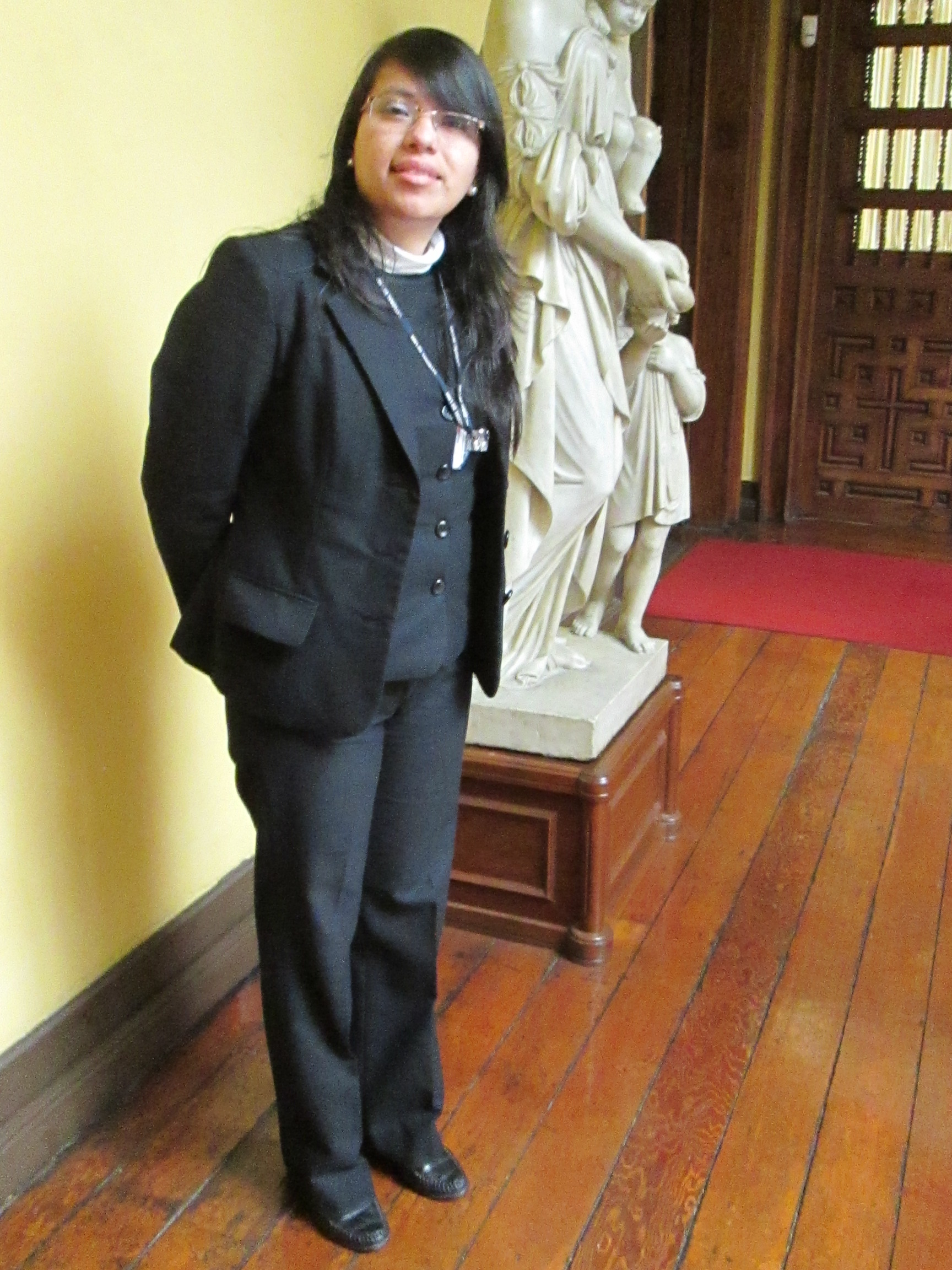
My Guide at the Archbishop’s Palace in Lima

My Guide at the Archbishop’s Palace in Lima

She was as cute as a button. On a whim, I had decided to take a tour of the Archbishop’s Palace at Lima’s Plaza de Armas, conveniently next door to the massive cathedral. Apparently, I was the only tourist who had wandered in at that hour (about eleven a.m.), and I had a guide all to myself. By this time during my trip, I had come to appreciate the beauty of Peruvian women; and my guide was, I felt, a real looker.

But wait, Jim! This young lady was probably a postulant—that is to say, a future nun. Her clothing had a definite clerical look to it. For all that, she might already have made her vows and belonged to one of the orders that didn’t wear more conservative garb.

She kept addressing me in the vocative case as “Gentleman” as in: “Gentleman, this statue dates back to the Sixteenth Century.”

She knew every feature of that vast archiepiscopal palace, and kept addressing me as Gentleman.

In that most Catholic of countries, I couldn’t be anything other than the Gentleman I was thought to be. I enjoyed every minute of that tour and hope I conveyed my appreciation to the young lady for a very pleasant visit.


I Have This Thing About Volcanoes

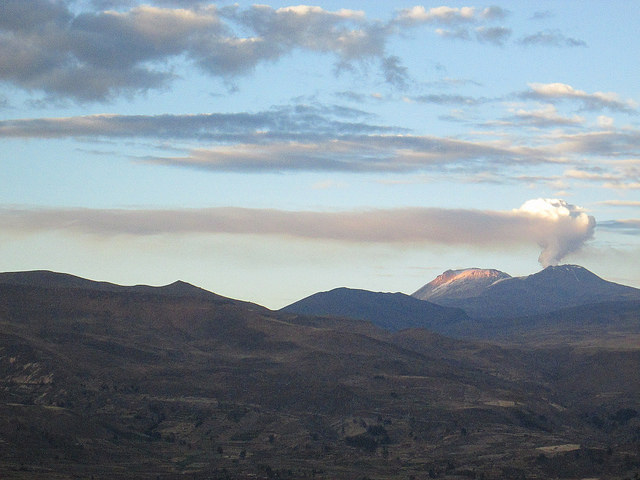
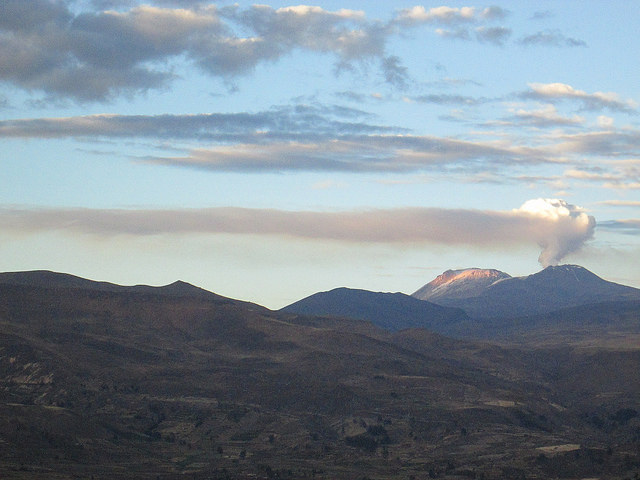
The Volcano Sabancaya in Eruption, seen from Colca Canyon

The Peruvian Volcano Sabancaya in Eruption, seen from Colca Canyon

I can tell you the day and time when it first started. It was at 6:00:41 am PST on February 9, 1971, when the earth started shaking. I held on to my mattress for dear life, even as it was sliding onto the bedroom floor from the massive jolts. The noise was deafening with all those structures shaking, and all the kitchen cabinets being emptied onto the floor. I had just lived through the Sylmar Quake in which 58 people lost their lives.

It was then that I realized we as a species were not exactly in control. Man inhabited a thin crust which was criss-crossed by earthquake faults and floating atop oceans of magma waiting to break out at points along the globe and cover our puny undertakings with layers of lava and ash. And there I was, right on the famed Ring of Fire, in a state with hundreds of faults and not a few volcanoes.

Since then, I have been to Iceland to see Hekla and Eyjafjallajökull, which at various points in history—the latter in 2010—caused havoc worldwide. And now, even as I write, it is Bárðarbunga which continues spewing lava after several weeks.

In September, I saw two volcanoes in Peru’s State of Arequipa spewing ash: Sabancaya and Ubinas. Both are highly active and may continue erupting for some time.

Our lives on this earth are incredibly fragile. I am most impressed by earthquakes and volcanoes, but there are other terrestrial and atmospheric events that can cut our short lives even shorter. That’s not even to mention microscopic bacteria and viruses, slips and falls, tree branches crashing down on our heads, automobile accidents, or any number of causes. Life is magnificent even when it is at its most destructive. Enjoy it while you can!


Policia

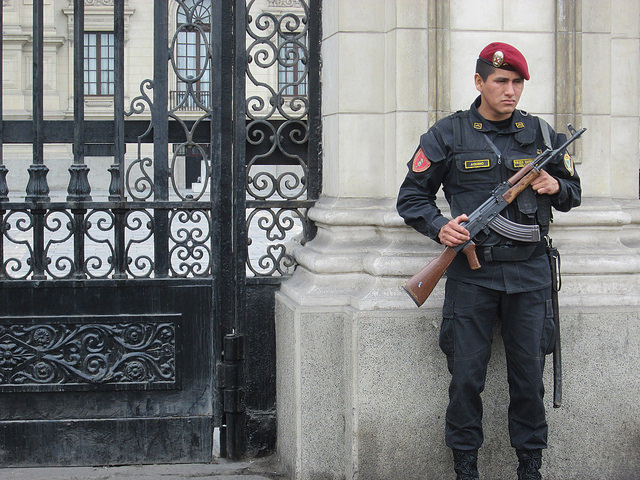
Assault Police Guarding the Palacio de Gobierno

Assault Police Guarding the Palacio de Gobierno

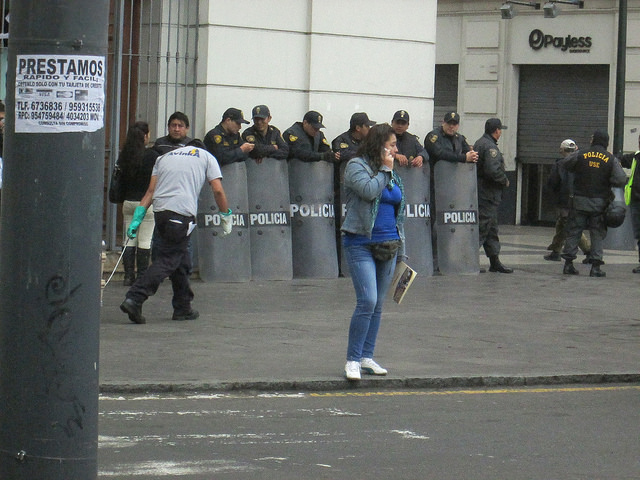
You may recall the news flap that occurred a couple months ago when someone scaled the White House fence and penetrated all the way to the East Room before he was snared. This would not be quite so likely in Lima, where asalto (assault) police with automatic weapons guard the Palacio de Gobierno along with badged security personnel in suits.

The first time I was in Lima, there was a demonstration expected. Just to make sure that it wouldn’t spill over into any sensitive areas, large groups of riot police with shields were stationed all around the Plaza de Armas.

Riot Police with Shields Stationed by the Main Plaza

Riot Police with Shields Stationed by the Main Plaza

South America has had a history of violence against government forces, culminating in the hanging of President Gualberto Villaroel, who in July 1946 was dragged from the presidential palace in La Paz, Bolivia, and hanged from a lamppost on the main square—which is still there and which is grimly shown to tourists.

Did I feel safe in Lima? Yes, as long as I followed the orders of the police about standing too close to the main gate.


Peru in the Rear View Mirror

Schoolchildren with Teacher in Lima’s Plaza de Armas

Schoolchildren with Teacher in Lima’s Plaza de Armas

It is now almost two months since I’ve returned from Peru, and it’s beginning to seem as if it all happened years ago. When you replace one present with another, it becomes part of an ever-diminishing past. Well, I have no intention of jettisoning some beautiful memories, such as:

  1. Seeing Peruvian schoolchildren, such as the ones above in front on Lima’s Palacio de Gobierno. (You can see the security personnel in the background.) Kids always make me feel good about the future, even if I don’t have any of my own.
  2. Being awestruck by the Volcano Sabancaya in eruption from Colca Canyon.
  3. Reliving my past by visiting the most ornate and gorgeous Catholic Churches I have ever seen.
  4. Experiencing heartfelt gratitude in Puno when I bought a handmade alpaca scarf from an old Aymara woman.
  5. Eating delicious wor won ton soup at a Peruvian Chinese restaurant, or chifa, on a cold day.
  6. Interacting with the Peruvian people in my broken Spanish, and finding it no bar to communicating with them.
  7. Feeling that the Inca moment in history is still going on, especially in the Sacred Valley.

Because today is Thanksgiving, I will give thanks for Peru and for all the other wonderful places I have seen, all the kind people I have met, and that I still have it in me to want more.


The Liberator and the Ombú

I Had to Come All the Way to Peru to See This Argentinian Tree

I Had to Come All the Way to Peru to See This Argentinian Tree

It is a tree from the pampas of Argentina, which, although I have been to that country twice, I have not yet seen at ground level. My first acquaintance with the tree is from W. H. Hudson’s little known (but excellent) Tales of the Pampas:

In all this district, though you should go twenty leagues to this way and that, you will not find a tree as big as this ombú, standing solitary, where there is no house; therefore it is known to all as “the ombú,” as if but one existed; and the name of all this estate, which is now ownerless and ruined, is El Ombú. From one of the higher branches, if you can climb, you will see the lake of Chascomus, two thirds of a league away, from shore to shore, and the village on its banks. Even smaller things will you see on a clear day; perhaps a red line moving across the water—a flock of flamingos flying in their usual way. A great tree standing alone, with no house near it; only the old brick foundations of a house, so overgrown with grass and weeds that you have to look closely to find them. When I am out with my flock in the summer time, I often come here to sit in the shade. It is near the main road; travellers, droves of cattle, the diligence, and bullock-carts pass in sight. Sometimes, at noon, I find a traveller resting in the shade, and if he is not sleeping we talk and he tells me the news of that great world my eyes have never seen.

Then, in September, while walking in Lima’s Pueblo Libre between the Museo Larco and the National Museum of Anthropology, I saw my first Ombú, which I photographed.

Sign Identifying the Ombú Tree

Sign Identifying the Ombú Tree

What I find interesting about this sign, and this particular tree, is that the seed was purported to have been sowed by José de San Martín, an Argentinian who is considered by the Peruvians as the great liberator of their country. Curiously, Simon Bolivar did more than San Martín to actually free the country from the Spanish yoke, but it was the Argentinian who first declared Peru’s freedom. In the end, it was Bolivar who finally sealed the deal by his military victories.

They would have done it together, if it were not for the fact that they didn’t get along well together. Bolivar felt that San Martín was horning in on his action, and that he was quite capable of actually liberating Peru by himself. The discouraged San Martín returned to Argentina.

In 2011, Martine and I visited his tomb in the Metropolitan Cathedral of Buenos Aires, where a military honor guard protects his remains.

So it was not only my first Ombú, but it was a historically important one at that.


Catholic Peru

Statue of Saint in Lima’s Cathedral

Statue of Saint in Lima’s Cathedral

Peru was without a doubt the most Catholic country I have ever visited. Whenever I wanted to rest, especially when I was at high altitude, I frequently stopped at a church, looked around, and took a pew. Never before had I seen so much ornateness and wealth lavished on any religion. Although I have not been a practicing Catholic for almost fifty years, I did not feel out of place in this whole pre-Vatican II religious environment: The altars may have been turned around to face the congregation, but otherwise I was in the 16th and 17th centuries, where the Churrigueresque ruled. And I spent the first seventeen years of my life in a Catholic environment.

When I was in Puno fighting for my breath at an altitude of 12,500 feet, I sometimes attended Mass twice in one day, once at the Cathedral and once at the parish church of San Juan Bautista at Parque Pino. I could not follow the service as my Spanish is highly rudimentary.

The Main Staircase of the Archbishop’s Palace in Lima

The Main Staircase of the Archbishop’s Palace in Lima

I had no inkling that this would happen to me, but I probably spent more time visiting churches and related religious museums in Peru than I did Inca-related archaeological sites. The Inca locations were what I had been led to expect, but the power and majesty of the Catholic Church in Peru came as a surprise to me.

It was from the Audiencia of Peru that the Spanish ruled South America. The gold and silver from the mines of Peru and Bolivia were transshipped from Lima to Panama, where they were carried overland to the Caribbean ports of  Nombre de Dios and Porto Bello and put on treasure galleons to Spain. Even though some 20% of all treasure was for the Spanish Crown, I suspect twice as much or more eventually found its way into the hands of the Church.

In future postings, I hope to show you some of the churches I saw.


Two Little Girls, One Lamb

Of Course, I Would Tip These Girls for a Photo!

Of Course, I Would Tip These Girls for a Photo!

It started in Arequipa. From there to Puno and Cusco, I would run into pairs of girls in indigenous costume cradling either a baby lamb (most often) or a llama. In Cusco, there was an elderly grandmother with a llama. Each time, I was grateful to tip them 10 or 20 soles for a picture—knowing full well that I was being used. So what! It was an easy way for indigenous women and their daughters to make some easy money, and I didn’t mind. (The only people who minded were the women who were trying to sell their handicrafts to the tourists—but I bought from them, too!)

This bWoman in Chivay Had a Lamb and a Llama

This Woman in Chivay Had a Lamb and a Llama

Finally, here’s the old woman with the llama in Cusco. She was so sweet that she felt uncomfortable talking about money at all. I gave her 20 soles anyhow. She looked like she could use it:

Okay, Sio I’m a Big Chump

Okay, So I’m a Big Chump

I look at it this way: The Spanish Conquistadores ripped off the poor campesinos of Peru, stealing their labor, their lives, and what little they had for themselves. Do I feel ripped off? Not a bit!