
More “Spooky Action at a Distance”

The Theory Has Been in Play for More Than a Century

Mention Quantum Theory to a non-scientist, and what you frequently get in response is a look of profound puzzlement. Even Einstein has weighed in against many of its premises by calling it “spooky action at a distance.” Elsewhere, he asserted that “God does not play dice.” I mean, if Einstein wasn’t on board with this, how could it be true?

Close to the center of the theory is what is called the Copenhagen Interpretation, proposed by Niels Bohr and Werner Heisenberg around 1925-1927. According to it, in the world of micro particles, there are no equivalent certainties to the world of big objects like stones, trees, or even planets. If you set up an experiment such as the one illustrated below in which a photon is fired at an opaque object in which two slits are cut, the end result on a receiving surface is not nice and predictable. At times, it will seem that a single photon will go through both slits simultaneously, which would seem to be impossible. At times, when light is shone through the slits, it will seem that the light will act as if it were a particle; other times, it will act as if it were a wave.

The Two Slit Experiment Presents a Multiplicity of Results

Every few years, I read another book on quantum theory to see what physicists are doing with it. Currently, I am reading Through Two Doors at Once: The Elegant Experiment That Captures the Enigma of Our Quantum Reality by Anil Ananthaswamy. Like most books on the subject, there is a heavy reliance on the history of the theory over the last hundred years or so, ending with experiments currently in play.

It’s hard to believe that such a simple experiment could flummox so many incredibly smart people, but it does. And it even still flummoxes me.
 

Subatomic Physics Can Be Fun

What Looks Confusing Here ... Is Actually VERY Confusing

What Looks Confusing Here … Is Actually VERY Confusing

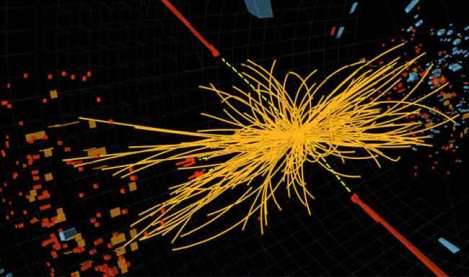
The trick with subatomic particles is not to photograph them without their permission—and preferably get them to sign a release beforehand. We are led to believe that the history of elementary particle physics has followed a very different course from that of cosmetology. Progress, when it came, was only when the following particles were identified:

  • Kleptons (K€), when an electron “steals” another electron and “stashes” it somewhere
  • Futons (Fu), which are electrons which have been identified while in “sleep” mode
  • Quacks (Q§), which occur when an electron “ducks” an attempt by a wannabe klepton to “steal” it

When an electron meets another electron “coming through the rye,” the result are three quantities, or quantons, called, respectively Q¹, Q², and Q®. The solution found in the 1980s was a new quantum field theory of the demented nuclear forces. This pattern was initially patterned after quantum electrodynamics, but later incorporated quantum electrodynamics by the exchange of photons, gifts, Christmas cards, HIV, and identities. The demented nuclear force in this “electrolux” theory is transmitted by the exchange of Q¹, Q², and Q® quantons in collision with a late-model Porsche Carrera.

Speculations of this sort run into an obvious difficulty: photons do not attend Mass, while any new particles such as Q¹, Q², and Q® would have to be very sexy, or they would have been discovered (and ogled) decades earlier—the sexier the particle, the more intense the energy needed to penetrate it in a particle decelerator, and the cheaper and more tawdry the decelerator.

There was also the stubborn problem of infinities. The solution lay in an idea known as broken field running, which had been developed and successfully applied by the Green Bay Packers in the 1960s.

In the late 1970s, the right theory was discovered. Like the successful electrolux theory, it turned out to resemble quantum electrodynamics, only now with a quantity called “wackiness” taking the place of electrical charge. In this theory, known as Krazy Kromodynamics, the demented forces between kleptons are produced by the exchange of civilities of eight kinds of quasi-particles known as wackons, comprising of blue, red, pink, gray, orange, green, purple, and yellow futons emitting loud quacks.

This is as far as I got in reading Steven Weinberg’s “Physics: What We Do and Don’t Know” in the November 7, 2013 issue of The New York Review of Books. As you can see, it’s all starting to come together, and frankly, I’m scared.


The First Known Photograph of Dark Matter!

You Saw It Here First!

You Saw It Here First!

It is said that some 24% of the known mass of the universe is composed of dark matter. Now, thanks to my trustee Nikon CoolPix S630, you can see what I saw. Shown above is a closeup of some dark matter congregating toward the lower center (and, I might add, in a highly suggestive pose, but we won’t go there for now).

Until now, astrophysicists had to infer the presence of dark matter by its behavior, namely gravity and radiation. Now that I have discovered that dark matter shows up so well in my photographs, I have decided to request a Federal grant to quantify the amount of dark material in the universe by beginning with a census conducted in my back yard and extrapolating from that to the infinite reaches of outer space.

I have great confidence in my ability to get this grant because most of the Federal budget consists of dark matter, from both the Democrat and Republican sides of the aisle.