
An Enduring Masterpiece

Sam Weller and His Father Tony

Although I first read Charles Dickens’s The Pickwick Papers in the late 1960s, a number of its characters have remained fresh in my memory. Aside from Mr Pickwick himself, there was Sam Weller and his father Tony, Job Trotter, Sergeant Buzfuz, and Angelo Cyrus Bantam. I have always regarded this book as one of Dickens’s best, though I had the feeling in the back of my mind that I would not think so upon re-reading it.

Fortunately, I was wrong. I loved the book—again. It is one of those long picaresque shaggy-dog stories that sags in some places, but rises to incredible heights during such set pieces as the parliamentary election at Eatanswill, the trial of Mr Pickwick for breach of promise, the time spent in the Fleet debtors’ prison, and the Christmas festivities at Dingley Dell.

The book starts slowly with Pickwick and his three associates (Nathaniel Winkle, Augustus Snodgrass, and Tracy Tupman) as the main characters. Before long, however, we find that the real character of interest is Sam Weller, Pickwick’s manservant. Despite coming from the lower classes, his native wit is considerable, and before long he leaves everyone else in the shade. And he is 100% pure English: He almost defines Englishness.

As the book grinds to a halt, Dickens gives us a delirious ending:

Let us leave our old friend in one of those moments of unmixed happiness, of which, if we seek them, there are ever some, to cheer our transitory existence here. There are dark shadows on the earth, but its lights are stronger in the contrast. Some men, like bats or owls, have better eyes for the darkness than for the light. We, who have no such optical powers, are better pleased to take our last parting look at the visionary companions of many solitary hours, when the brief sunshine of the world is blazing full upon them.

In the end, we have been mightily entertained. There has been much humor and—a rarity in Dickens—very little extreme pathos.

Yes, indeed, this is still one of the great books!
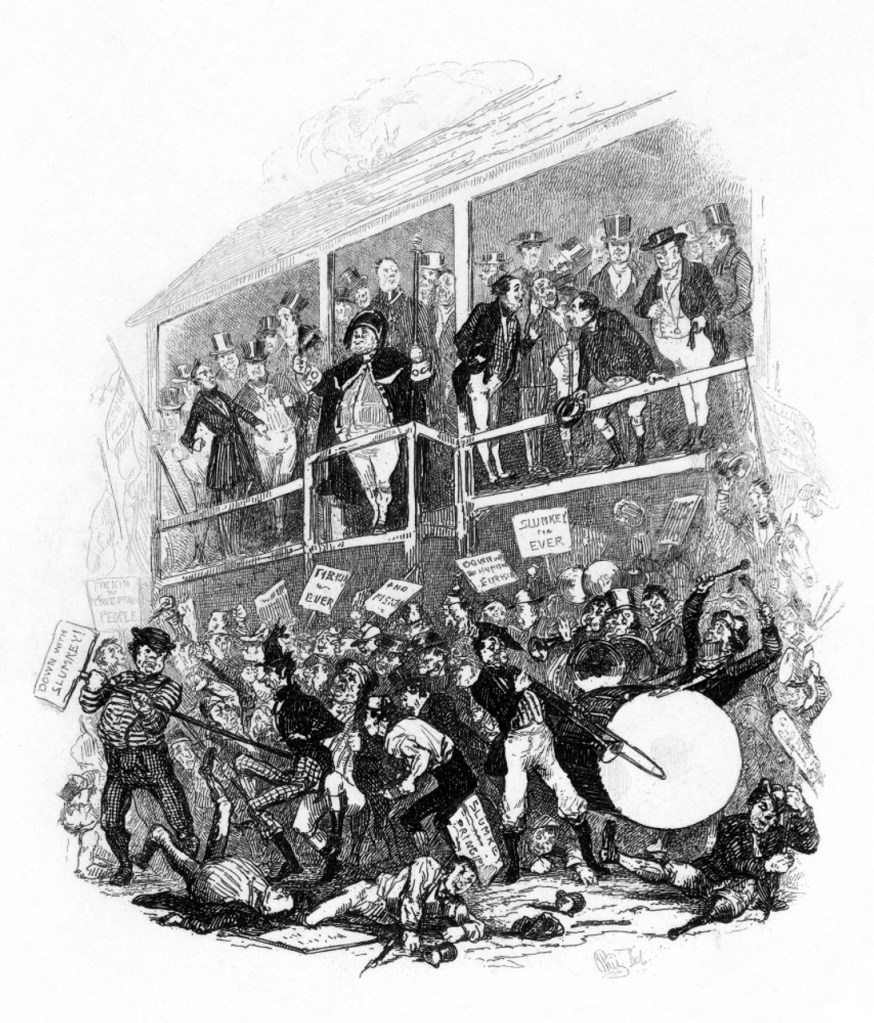
The Parliamentary Election at Eatanswill

Illustration by “Phiz” for The Pickwick Papers by Charles Dickens

If you think the political division between the Democrats and Republicans is a new think, you should read Charles Dickens’s The Posthumous Papers of the Pickwick Club (1837), particularly in the scenes describing the parliamentary election at Eatanswill (“Eat and Swill”), one of the most savage satires by the British writer. Here is his masterful description of the state of things at Eatanswill:

It appears, then, that the Eatanswill people, like the people of many other small towns, considered themselves of the utmost and most mighty importance, and that every man in Eatanswill, conscious of the weight that attached to his example, felt himself bound to unite, heart and soul, with one of the two great parties that divided the town—the Blues and the Buffs. Now the Blues lost no opportunity of opposing the Buffs, and the Buffs lost no opportunity of opposing the Blues; and the consequence was, that whenever the Buffs and Blues met together at public meeting, town-hall, fair, or market, disputes and high words arose between them. With these dissensions it is almost superfluous to say that everything in Eatanswill was made a party question. If the Buffs proposed to new skylight the market-place, the Blues got up public meetings, and denounced the proceeding; if the Blues proposed the erection of an additional pump in the High Street, the Buffs rose as one man and stood aghast at the enormity. There were Blue shops and Buff shops, Blue inns and Buff inns—there was a Blue aisle and a Buff aisle in the very church itself.

Of course it was essentially and indispensably necessary that each of these powerful parties should have its chosen organ and representative: and, accordingly, there were two newspapers in the town—the Eatanswill Gazette and the Eatanswill Independent; the former advocating Blue principles, and the latter conducted on grounds decidedly Buff. Fine newspapers they were. Such leading articles, and such spirited attacks!—‘Our worthless contemporary, the Gazette’—‘That disgraceful and dastardly journal, the Independent’—‘That false and scurrilous print, the Independent’—‘That vile and slanderous calumniator, the Gazette;’ these, and other spirit-stirring denunciations, were strewn plentifully over the columns of each, in every number, and excited feelings of the most intense delight and indignation in the bosoms of the townspeople.